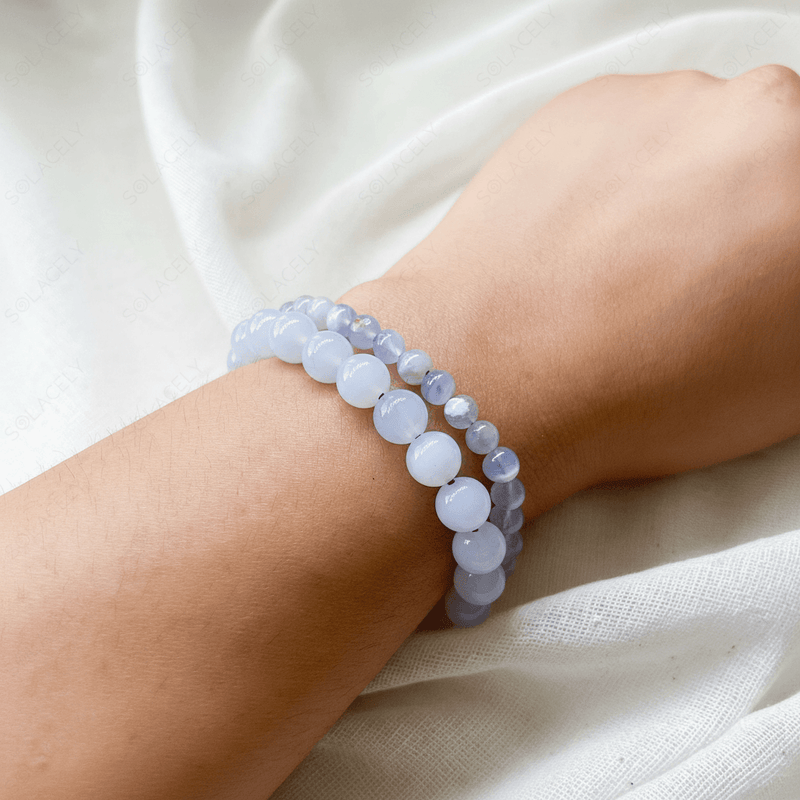
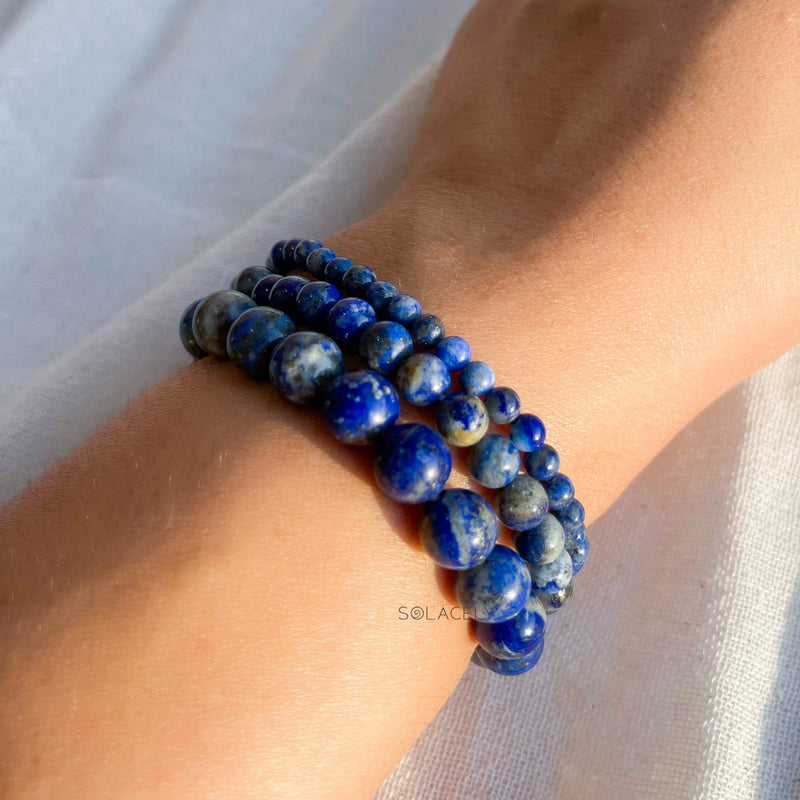
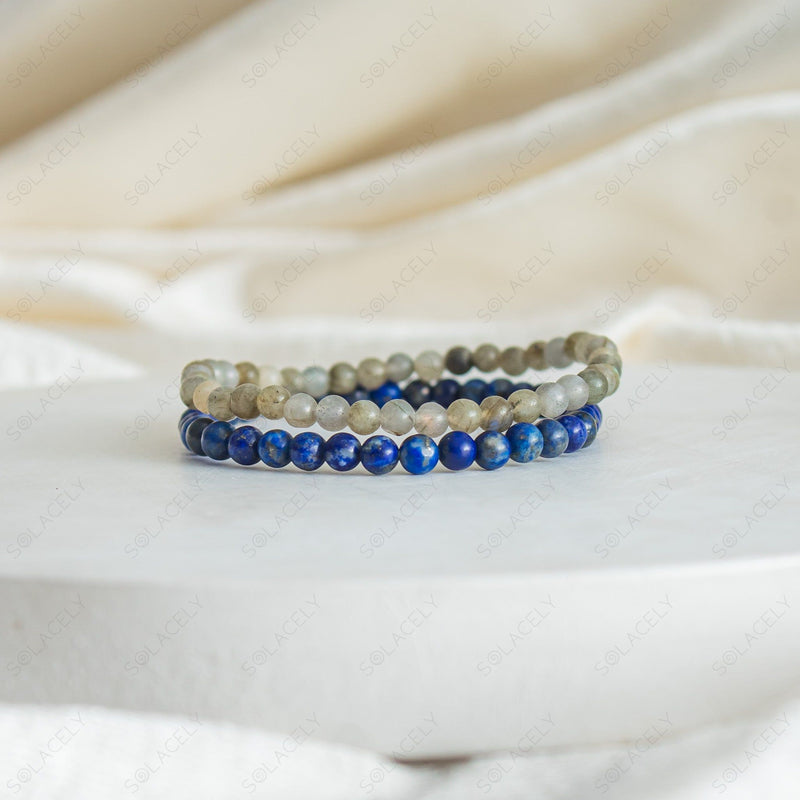
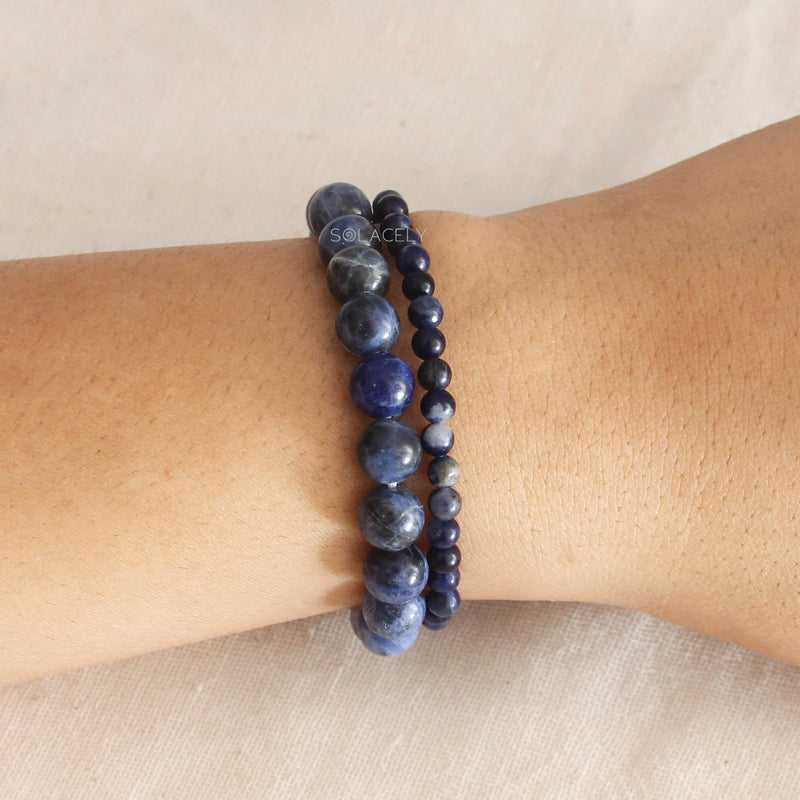
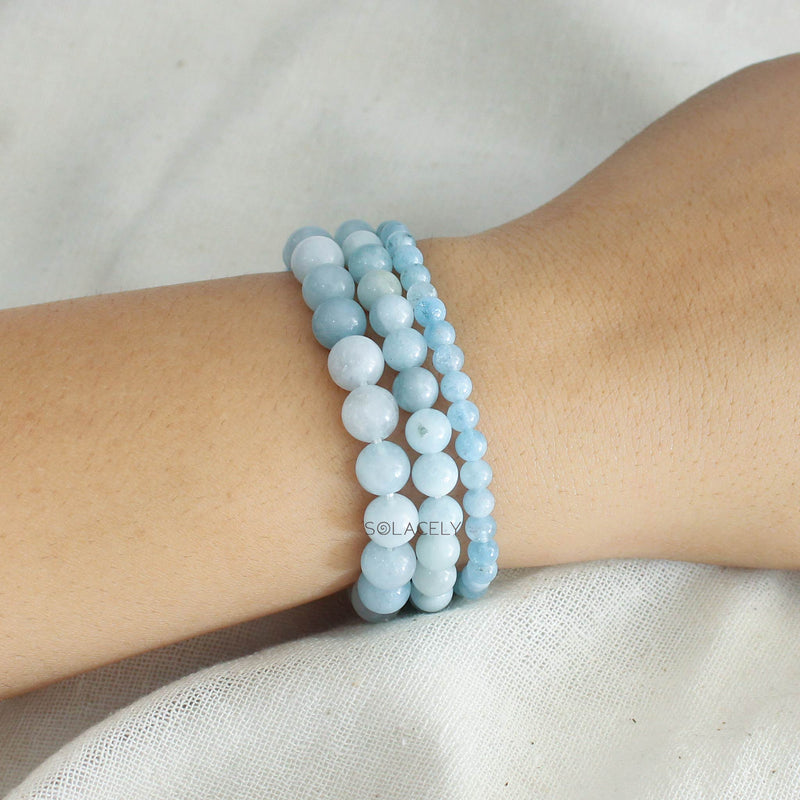
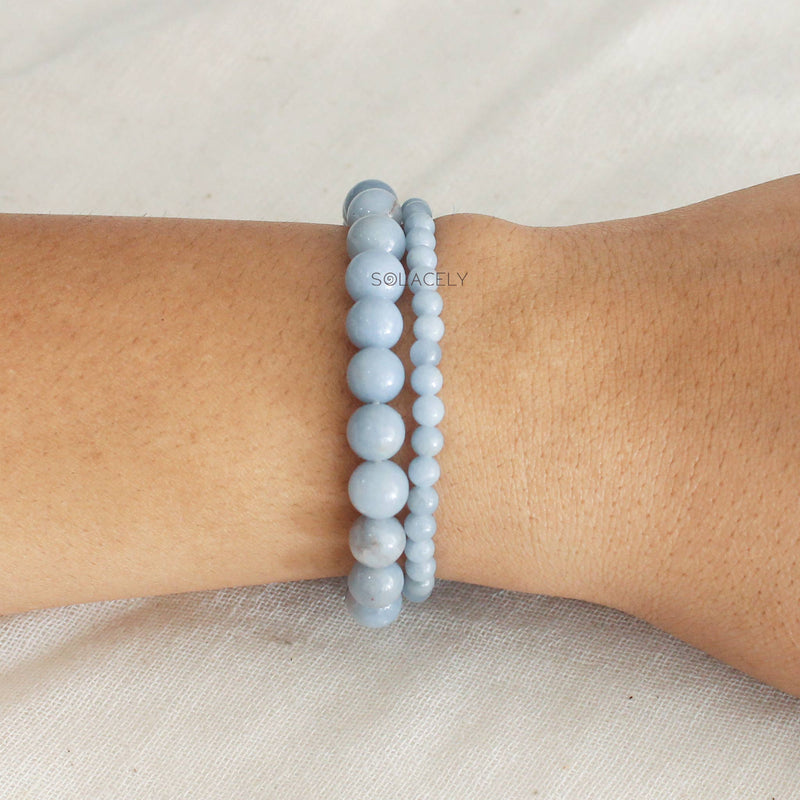
Blue lace agate, lapis lazuli, sodalite, turquoise, aquamarine and angelite are the traditional throat chakra stones. All of them are blue, following the colour assigned to the fifth centre, and each has its own character: blue lace agate for calm speech, lapis for saying the true thing, sodalite for thinking clearly while you talk.
Key takeaways
- The throat, vishuddha, is the fifth centre and is assigned the colour blue.
- Its traditional difficulty is not being unable to speak but being unwilling to.
- Core stones: blue lace agate, lapis lazuli, sodalite, turquoise, aquamarine, angelite.
- A short pendant at the collarbone is the classic wearing format.
- Put it on as part of preparing rather than wearing it constantly, so it stays tied to the moment.
What the throat centre is for
Vishuddha sits at the base of the throat, the fifth of the seven main centres. Yogic tradition describes it as governing honest expression: saying what is actually meant, being heard, and letting what is inside reach the outside without distortion.
The traditional framing is worth pausing on, because it is more precise than people expect. The difficulty attributed to this centre is rarely an inability to talk. It is the swallowed sentence, the softened request, the thing you decided not to mention. That is why throat work is associated with courage as much as with communication.
It is also why every stone here is blue. Colour drives chakra correspondences throughout the system, and once you know that, the whole thing becomes easier to use rather than harder. Our beginner's chakra stone guide covers all seven centres.
The stones and how they differ
| Stone | Traditionally kept for | Reach for it when |
|---|---|---|
| Blue lace agate | Calm, unhurried speech | You talk too fast when nervous |
| Lapis lazuli | Truthful expression | You know what to say and keep not saying it |
| Sodalite | Clear thinking while speaking | You lose the thread under pressure |
| Turquoise | Speaking with protection | Speaking up carries some risk |
| Aquamarine | Courage to be heard | Auditions, interviews, first times |
| Angelite | Gentleness with yourself | After a conversation that went badly |
Blue lace agate is the usual starting point: inexpensive, hard enough for daily wear, and its association with calm rather than volume matches what most people actually need. Lapis lazuli has the longest documented history of the group, mined in Afghanistan for thousands of years and ground into ultramarine for Renaissance painters, which is part of why it carries such a strong association with scholarship and truth.
Our turquoise guide covers that stone's dual role as traveller's stone and throat stone.
How to wear and place them
The format that matters most is a short pendant. A stone resting at the collarbone sits at the right height without any effort, which is why chokers and short chains dominate throat chakra jewellery. Long pendants drop to the solar plexus and are doing a different job entirely.
For a session, lie down and rest a piece at the base of the throat for ten to fifteen minutes. Breathe gently rather than deeply here, since forcing the breath at the throat tends to create tension rather than release it. Some practitioners add humming or a quiet sustained note, on the reasoning that the centre responds to being used.
Through the day, the practice most people find useful is situational rather than constant. Put the piece on while preparing for the thing you are dreading, and let it belong to that. A stone worn every day for months stops registering; a stone you put on deliberately keeps its meaning.
Working with it before a difficult conversation
- Put the piece on while you prepare, not an hour before and not on the way in.
- Write the one sentence you are most avoiding saying. On paper, in plain words.
- Say it out loud once, to the room. The awkwardness is the point.
- Touch the stone as you go in. A physical marker for the decision.
- Afterwards, swap it. Many people move to angelite or rose quartz once it is done.
For nerve in front of people specifically, our crystals for confidence selection covers the wider set, and crystals for the singing voice covers performance preparation.
Where the throat sits in the system
The throat is the bridge between the heart below it and the third eye above. Practitioners often find that what presents as a throat difficulty is really coming from underneath: something unsaid because of what it would cost, which is heart territory, or because of a sense of not being entitled to say it, which is solar plexus territory.
That is why the conventional advice is to work upward rather than jumping to whichever centre seems obviously blocked. Our sacral chakra guide covers the lower centres, and the full chakra system guide shows how they connect.
Caring for blue stones
This group needs more care than the quartz family, and the differences matter.
Blue lace agate is the toughest, around 6.5 to 7, and takes warm water and a soft cloth easily.
Lapis lazuli is softer, around 5 to 5.5, and is a rock rather than a single mineral. Keep it away from acids, harsh cleaners and long soaks, and wipe rather than wash it.
Turquoise is porous and softer still. Keep it dry, and put jewellery on after perfume and lotion rather than before.
Angelite is a form of anhydrite and genuinely water sensitive: it can convert and degrade with prolonged wetting, so keep it dry entirely.
For energetic cleansing, sound suits this group especially well and avoids the water question altogether. Smoke and moonlight work equally.
Chakra work and crystals are offered here for reflection and wellbeing as part of a long standing spiritual tradition. They are not a medical model and are not a treatment for any condition. Persistent hoarseness, throat pain or voice changes should be assessed by a doctor.
Sources
Written by Chetena Sharma. Reviewed by the Solacely editorial team.
Frequently asked questions
About the author


Written by Chetna Sharma, crystal healing practitioner and co-founder of Solacely. Chetna has worked with healing crystals for over a decade and curates Solacely's protective stone collection.