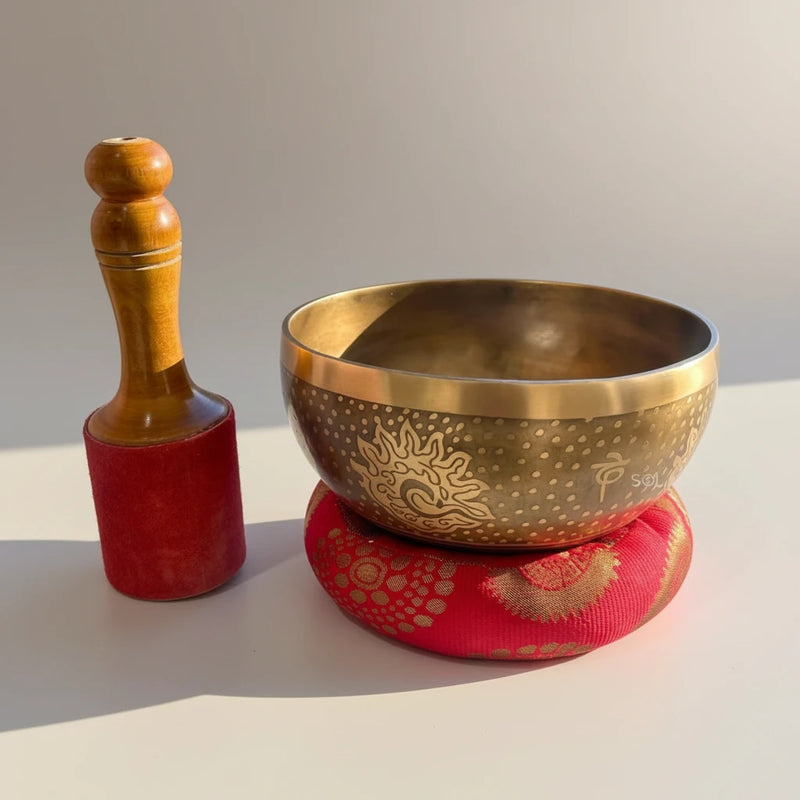
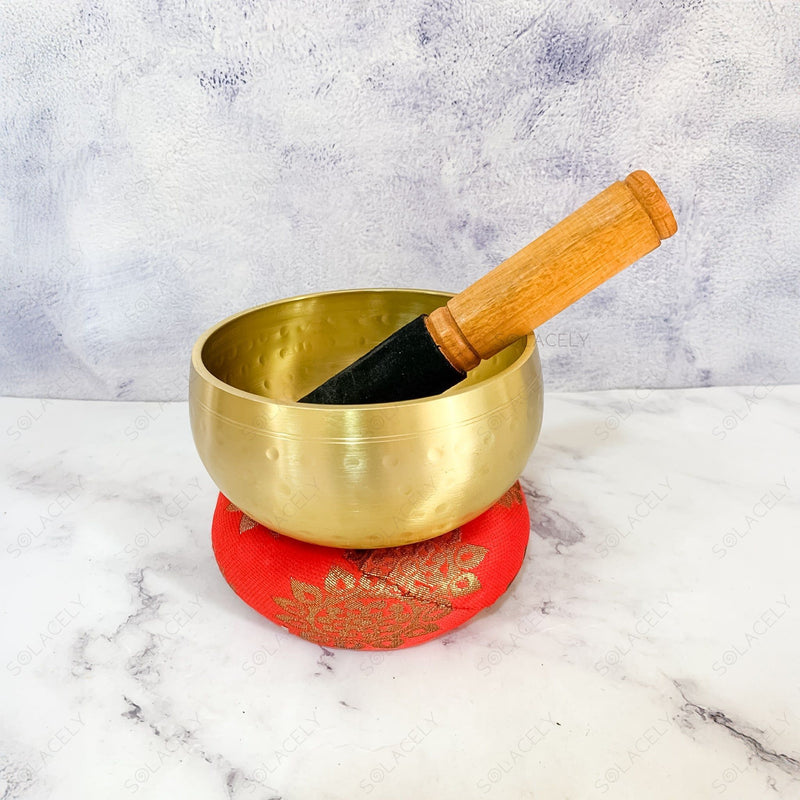
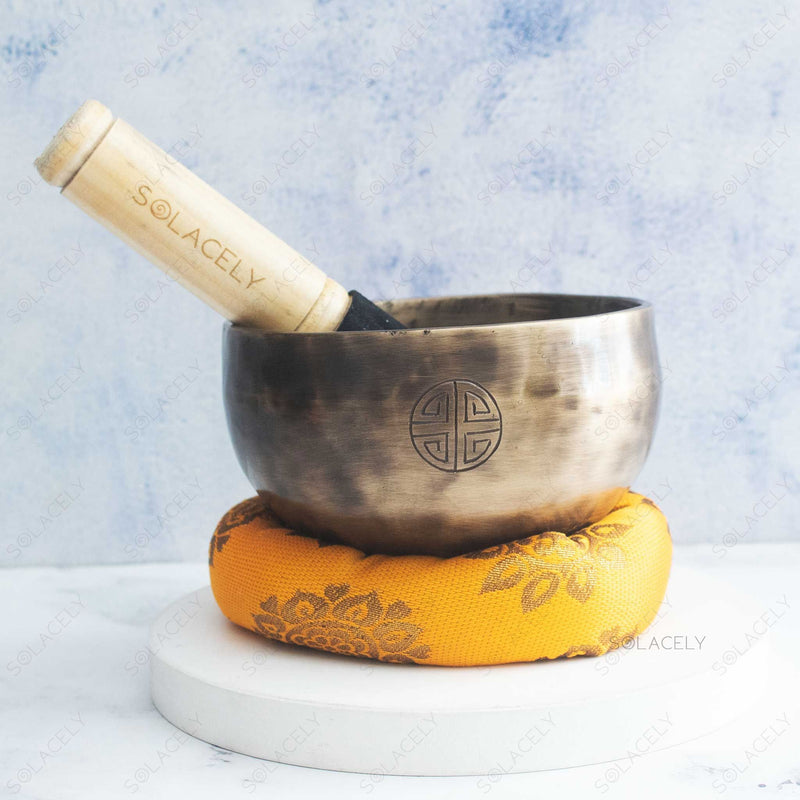
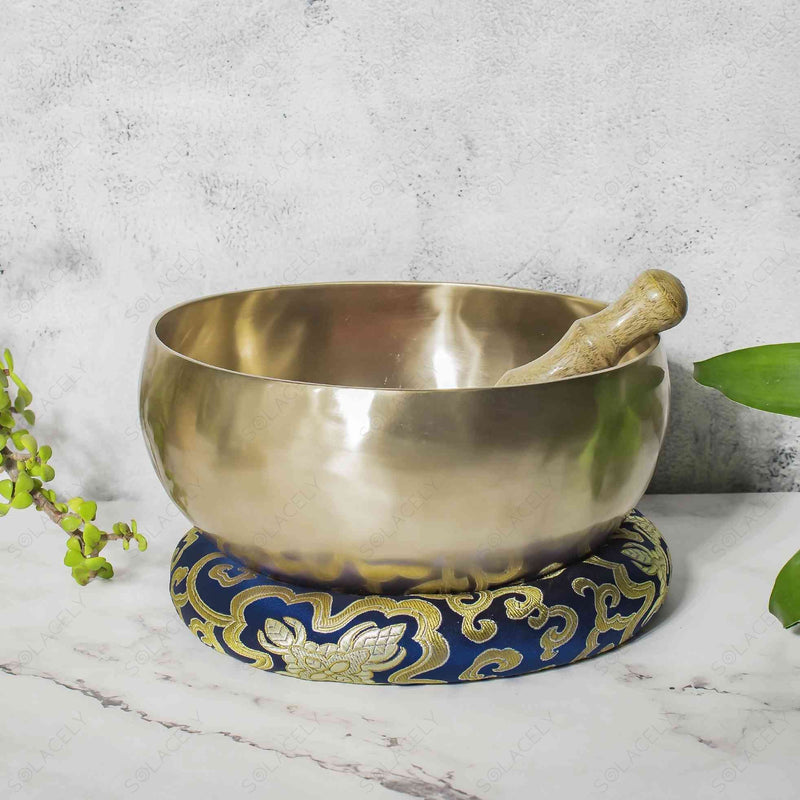
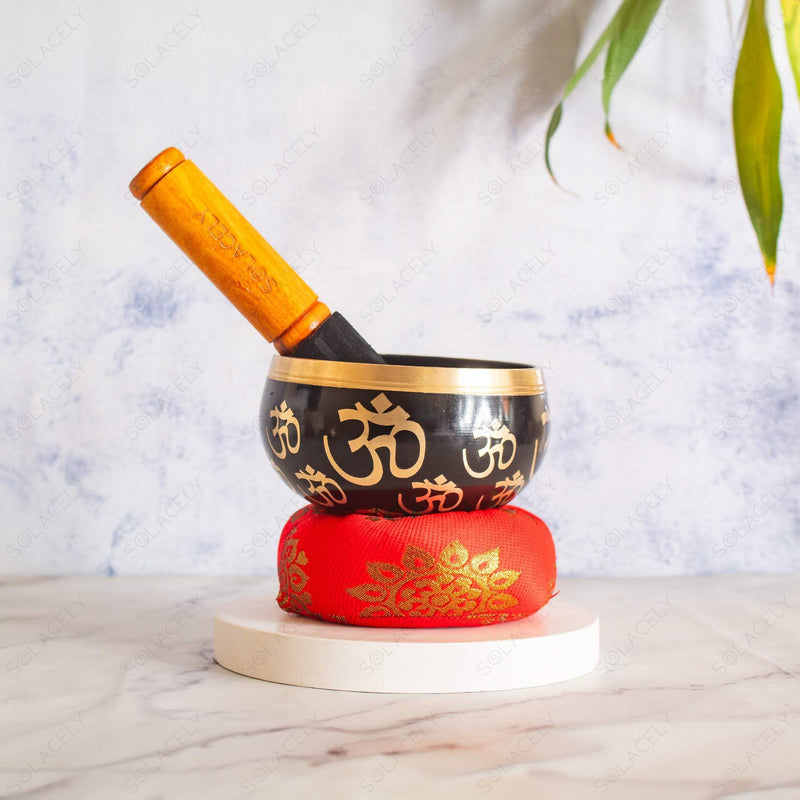
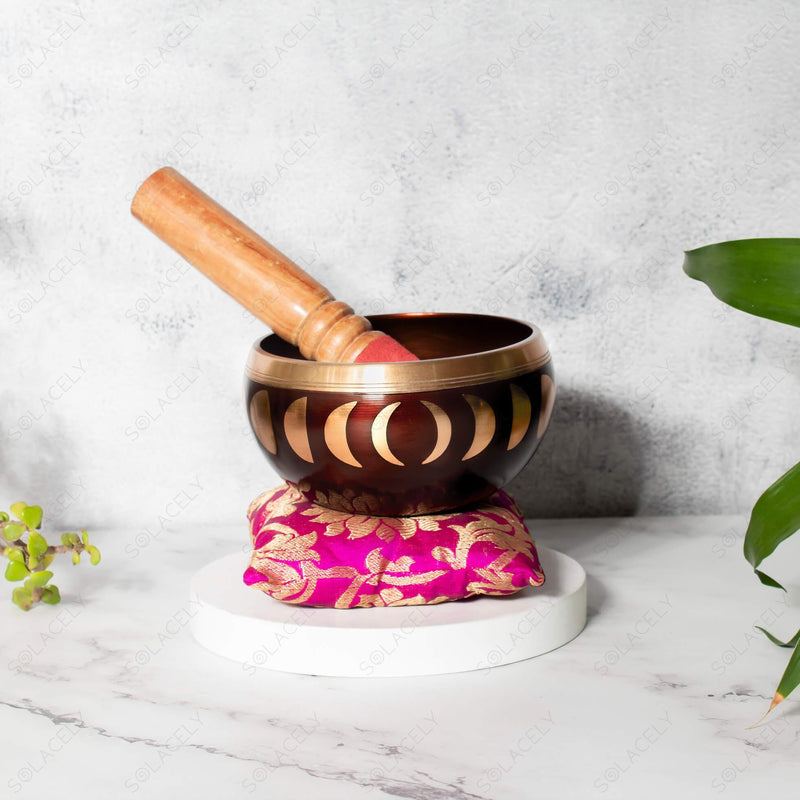
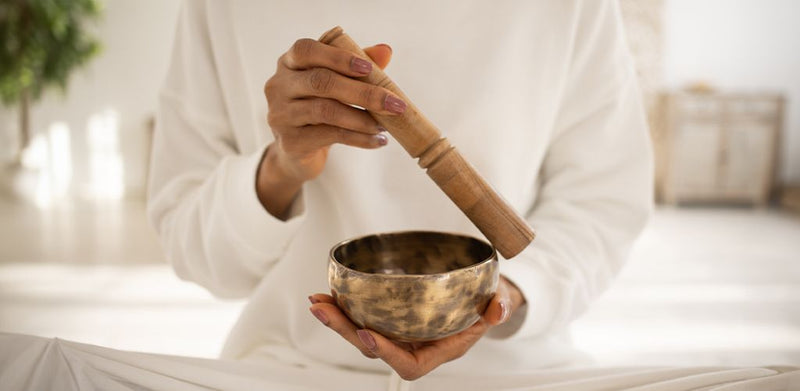
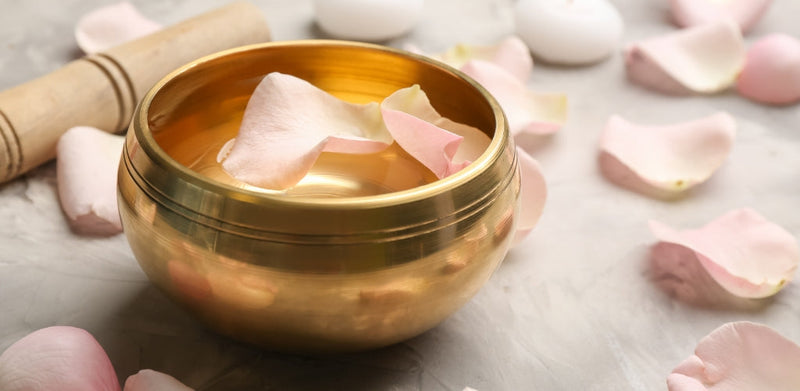
A singing bowl's frequency is simply the pitch of the note it rings, measured in hertz (Hz), which counts how many times the bowl's rim vibrates back and forth each second. A higher number means a higher note. So when someone says a bowl 'is tuned to 432 Hz,' they just mean its main tone vibrates 432 times a second. That's it. No magic required to understand it. If you want the actual note-by-note lookup table, we keep that on a separate page; this guide explains what the numbers mean so the table makes sense. Start with the basics of the singing bowl itself, then follow the frequency logic below.
Key Takeaways
- Frequency (in Hz) is just pitch: the number of times a bowl's rim vibrates per second. Higher Hz means a higher note, lower Hz means a deeper note. Nothing mystical about the measurement itself.
- A bowl's pitch is set by physics, mainly its size, wall thickness, and metal. Big, thick bowls ring low; small, thin bowls ring high. You can change the note slightly by adding water or striking a different spot.
- Every metal bowl also produces several overtones at once, so a single strike is really a small chord, which is why bowls sound richer than a plain tuning fork.
- The popular 'Solfeggio healing frequencies' (like 528 Hz) and the '432 Hz vs 440 Hz' debate are cultural beliefs, not proven medicine. No solid clinical evidence shows a specific Hz number cures a specific condition.
- For the actual chart matching notes to chakras and bowl sizes, see our singing bowl frequencies chart. This page is the 'why,' that page is the 'which.'
What 'frequency' actually means for a singing bowl
Frequency is the scientific word for pitch, and it's measured in hertz (Hz), the number of vibrations per second. When you strike a singing bowl, its rim flexes in and out very fast, pushing the air around it into waves. Count those pushes in one second and you have the frequency. A bowl at 220 Hz vibrates 220 times a second; one at 440 Hz vibrates twice as fast and sounds an octave higher.
According to Encyclopaedia Britannica, pitch is the perceived 'highness' or 'lowness' of a sound, and it corresponds directly to the frequency of the vibration producing it. That's the whole relationship in one sentence: fast vibration equals high note, slow vibration equals low note. A deep temple gong might live near 60 to 100 Hz, a mid-size Tibetan bowl often sits somewhere between 150 and 400 Hz, and a small crystal bowl can ring up past 500 or 600 Hz. None of those numbers is 'better.' They're just different notes on the same ladder.
It helps to separate three words people mix up. Frequency is the physical measurement in Hz. Pitch is how your ear labels that frequency (a note like C or G). Tone or timbre is the overall character or 'colour' of the sound, which is why two bowls playing the same note can still sound clearly different. When a seller lists a bowl as 'F note, 349 Hz,' they're giving you the pitch label and the frequency for the same thing.
How a bowl's size and thickness set its pitch
A singing bowl's pitch comes almost entirely from its physical build: bigger and thicker bowls ring lower, smaller and thinner bowls ring higher. This is the same physics behind every instrument. A long, heavy string on a cello vibrates slowly and sounds deep; a short, tight string on a violin vibrates fast and sounds bright. A bowl is just a bell turned upward, and the same rules apply to its vibrating rim.
Size is the biggest lever. A large bowl has a longer rim to flex, so each vibration takes more time, which means fewer vibrations per second and a lower Hz. Shrink the bowl and the rim snaps back and forth faster, pushing the frequency up. This is why a palm-sized bowl chimes high and bright while a bowl the width of a dinner plate hums low in your chest.
Wall thickness and mass do the rest. A thick, heavy wall resists bending, which changes how the bowl flexes and generally shifts and stabilises its tone, while very thin walls vibrate more freely and often sing higher and longer. The metal alloy matters too. Most traditional Tibetan bowls are a bronze-family blend of copper and tin, sometimes with traces of other metals, and the exact recipe and the way a bowl is hammered or cast affect both its main note and its overtones. Handmade bowls vary bowl to bowl, which is part of their charm. If you're comparing metal against glass, our crystal singing bowl guide explains why quartz bowls tend to give purer, single-note tones than hammered metal.
Here's the quick mental model most buyers find useful:
| Bowl trait | Effect on frequency | What you hear |
|---|---|---|
| Larger diameter | Lower Hz | Deep, grounding hum |
| Smaller diameter | Higher Hz | Bright, ringing chime |
| Thicker, heavier wall | Lower and more stable tone | Solid, focused note |
| Thinner wall | Higher, longer-sustaining tone | Airy, singing ring |
| Denser metal / more mass | Generally lower fundamental | Fuller, weightier sound |
Why one strike sounds like a small chord: overtones
Strike a metal singing bowl once and you don't hear a single clean frequency; you hear a main note plus several fainter notes ringing at the same time. The main note is the fundamental, the one you'd name as 'the pitch.' The quieter notes stacked above it are overtones or harmonics, and they're what give a bowl its shimmering, layered voice.
Every physical object that vibrates does this. A plucked guitar string, a struck bell, a singing bowl: each one vibrates in several patterns at once, one big slow motion plus smaller, faster ripples on top. Britannica notes that almost all real musical tones are made of a fundamental frequency combined with these higher overtones, and the particular mix is what makes a violin sound different from a flute playing the very same note. For bowls, hammered metal produces a complex, slightly clashing set of overtones, which is why a Tibetan bowl can sound wobbly, alive, and a bit otherworldly compared with a smooth crystal bowl.
This matters for two practical reasons. First, it's why 'what frequency is this bowl?' is a slight simplification, because the bowl is really producing a small cluster of frequencies, and the listed Hz is just the strongest one. Second, it's why bowls feel so good to play. That gentle beating between close overtones creates the slow, pulsing 'wah-wah' you notice as a bowl fades, and many people find that pulsing sound especially calming. It's physics, not mysticism, and it's genuinely lovely.
The Solfeggio 'healing frequencies': what's true and what's marketing
You'll see bowls sold as tuned to 'Solfeggio frequencies,' a set of numbers like 396, 417, 528, 639, 741, and 852 Hz, each promised to do something specific: 528 Hz to 'repair DNA,' 396 Hz to 'release fear,' and so on. Here's the honest version. These are modern wellness claims wrapped around old-sounding names. There is no solid scientific evidence that any of these frequencies produces the specific healing effects attributed to them.
The backstory is worth knowing so you can spot the myth. The Solfeggio names (Ut, Re, Mi, Fa, Sol, La) come from a medieval system of naming musical notes, used to teach singers roughly a thousand years ago. The idea that these syllables map onto a magic set of Hz numbers with medical powers is a much more recent invention, popularised in the late 20th century, not handed down from ancient temples. The '528 Hz repairs DNA' claim in particular traces to a single author's writing, not to any peer-reviewed biology. Your DNA is not waiting on a specific audio frequency to fix itself.
That doesn't mean these bowls are bad or that the sound isn't pleasant. A bowl tuned near 528 Hz makes a perfectly nice note, and if the ritual of playing it relaxes you, that benefit is real. The problem is only the overclaim: that a particular number cures a particular condition. Treat 'healing frequency' language the way you'd treat any bold health promise on a label, with friendly skepticism. Our sound healing guide digs into what the actual research does and doesn't show, and it's careful about exactly this gap between a relaxing practice and a proven treatment.
A quick honest split so you can shop without getting spun:
| Reasonable to believe | Overclaimed, treat with caution |
|---|---|
| Different notes genuinely feel different to listen to | '528 Hz repairs your DNA' |
| A tone you find soothing can help you relax | '396 Hz removes fear and guilt' |
| Low bowls are felt in the body more than high ones | 'This exact Hz cures a named disease' |
| Bowls are tuned to notes for musical, harmonious reasons | 'Ancient Solfeggio frequencies were lost sacred medicine' |
What about 432 Hz vs 440 Hz?
The other frequency debate you'll meet is '432 Hz vs 440 Hz.' Modern instruments are usually tuned so the note A above middle C sits at 440 Hz, an international standard. Some people prefer tuning A to 432 Hz instead, claiming it's more 'natural,' more calming, or in tune with the universe. Bowls get sold on this basis too, marketed as '432 Hz tuned.'
The plain truth: 432 Hz is a slightly lower, and therefore slightly mellower, tuning reference, and that's a legitimate aesthetic choice. Some listeners honestly prefer how it sounds, and that's fine. What isn't supported is the bigger claim that 432 Hz has special healing or cosmic properties that 440 Hz lacks. There's no reliable evidence for that. Blind listening tests don't show people reliably able to tell the two apart or consistently preferring one. So if a 432 Hz bowl sounds nicer to you, buy it for that reason. Just don't pay a premium expecting medicine. Pitch standards are conventions humans agreed on, not laws of nature.
The note-to-chakra idea, explained honestly
One of the most common frameworks pairs the seven musical notes with the seven chakras: C for the root, D for the sacral, E for the solar plexus, F for the heart, G for the throat, A for the third eye, and B for the crown. In this system, a bowl playing a particular note is said to 'resonate with' the matching energy centre, so people pick bowls by the chakra they want to work on.
It's a genuinely useful organising idea, and it's a lovely way to build a practice, as long as you hold it as tradition and belief rather than physics. There's no scientific mechanism by which a musical F specifically 'opens' the heart chakra; the pairing is a symbolic system, much like matching colours or crystals to chakras. What's real is that choosing a note gives your session structure and intention, and intention is a big part of why any ritual feels meaningful. If the framework helps you focus, it's doing its job.
Because this idea trips up so many first-time buyers, we've given it its own guides. For how notes map to energy centres and how to actually run a session, see singing bowl chakra, and for a step-by-step balancing routine, our singing bowl chakra balancing walkthrough keeps the same honest footing. And remember the note is just a frequency label, so a 'heart chakra F bowl' is simply a bowl whose fundamental lands on F, around 349 Hz.
Where to find the actual frequency chart
This page is the 'why.' When you want the 'which,' meaning the actual table matching notes to Hz values, chakras, and typical bowl sizes, that lives on our dedicated singing bowl frequencies chart. Think of it as the lookup companion to everything explained here: once you understand that Hz is pitch and that size sets the note, the chart tells you which note tends to land where.
Use the two together. Read this page so the numbers aren't a mystery, then open the chart to pick a note or size. If you're brand new and unsure which bowl to buy, the chart's size-to-note guidance is the fastest shortcut, and you'll now understand exactly why a bigger bowl shows a lower Hz. For putting a chosen bowl to work in a calm daily practice, our Tibetan singing bowl meditation guide gives you a simple routine.
Does the exact frequency change how a bowl feels?
Up to a point, yes, and it's the honest, physics-based part of the story. Low frequencies carry more physical vibration you can feel in the body, which is why a deep bowl or gong seems to hum in your chest while a high bowl feels bright and 'in the head.' That felt difference is real. What's not established is the leap from 'this feels different' to 'this exact number treats this exact ailment.'
So choose by feel, not by folklore. Sit with a bowl if you can, or listen to clips online, and notice which range you actually enjoy resting inside. Lots of people gravitate to lower, warmer bowls for grounding and sleep, and to brighter bowls for a lighter, more alert mood. There's no wrong answer, and there's no note you 'need.' The best frequency is the one you'll happily play again tomorrow.
A good beginner Tibetan bowl is an entry-level to mid-range buy, and the note or 'frequency' it's sold with shouldn't push the price up much on its own. Be wary of bowls marked up sharply purely for a 'special healing frequency' label. A larger, well-made low bowl or a crystal bowl will cost more because of size, material, and craft, not because of a magic number. Spend on sound quality and build, which you can hear, rather than on frequency claims, which you can't verify.
How to choose a bowl by frequency, practically
Pick a frequency range by the mood you want, then let size and budget narrow it down. For grounding, sleep, and a heavy, meditative feel, lean toward larger, lower bowls in the deeper Hz range. For clarity, brightness, and a lighter session, choose smaller, higher bowls. For a 'chakra note,' decide the note first, then buy the bowl whose fundamental matches it, checking the chart for the size that tends to produce it.
A simple decision path:
- Name the feeling. Grounding and calm points low; bright and uplifting points high.
- Translate to size. Lower feeling means a bigger, heavier bowl; higher feeling means a smaller one.
- Optionally pick a note. If you follow the chakra framework, choose your note and match the bowl's fundamental.
- Listen before you commit. Trust your ears over any Hz on the label. If it soothes you, it's right.
- Check the chart. Confirm your note-and-size choice against the frequencies chart so expectations match reality.
Whatever you pick, remember what a frequency is and isn't. It's the pitch of a beautiful, resonant object, chosen for how it sounds and feels. It's a wonderful anchor for a few quiet minutes a day. It is not a dose of medicine measured in hertz.
Sources
- Encyclopaedia Britannica — Pitch (music): the perception of the highness or lowness of a sound as determined by frequency of vibration
- Encyclopaedia Britannica — Sound: fundamental frequency and overtones (harmonics) and how they shape timbre
- National Center for Complementary and Integrative Health (NIH) — Meditation and Mindfulness: What You Need To Know (on the preliminary nature of relaxation-practice evidence)
Frequently asked questions
About the author


Written by Chetna Sharma, crystal healing practitioner and co-founder of Solacely. Chetna has worked with healing crystals for over a decade and curates Solacely's protective stone collection.