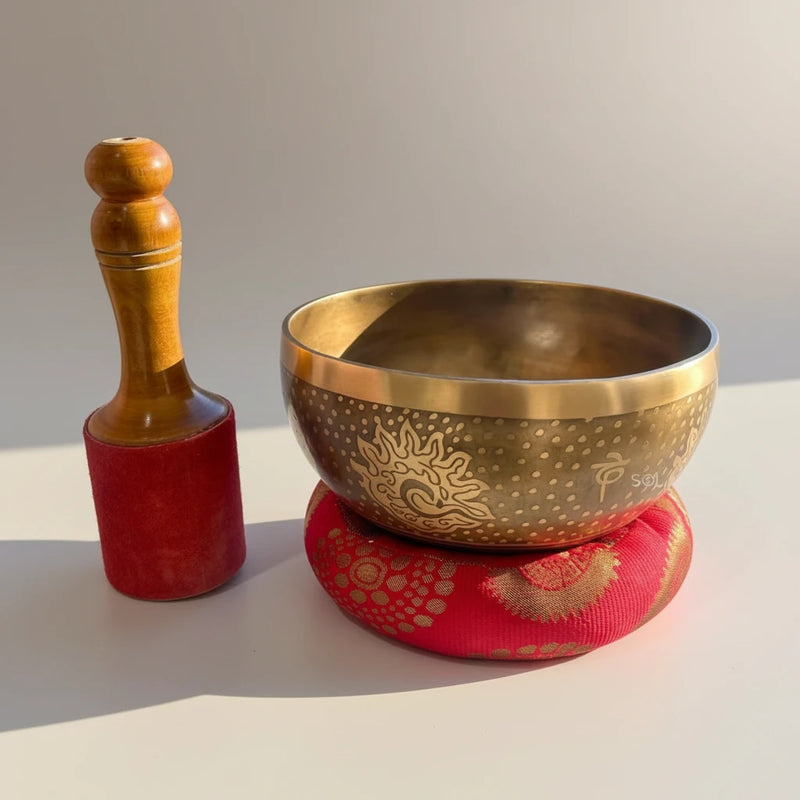
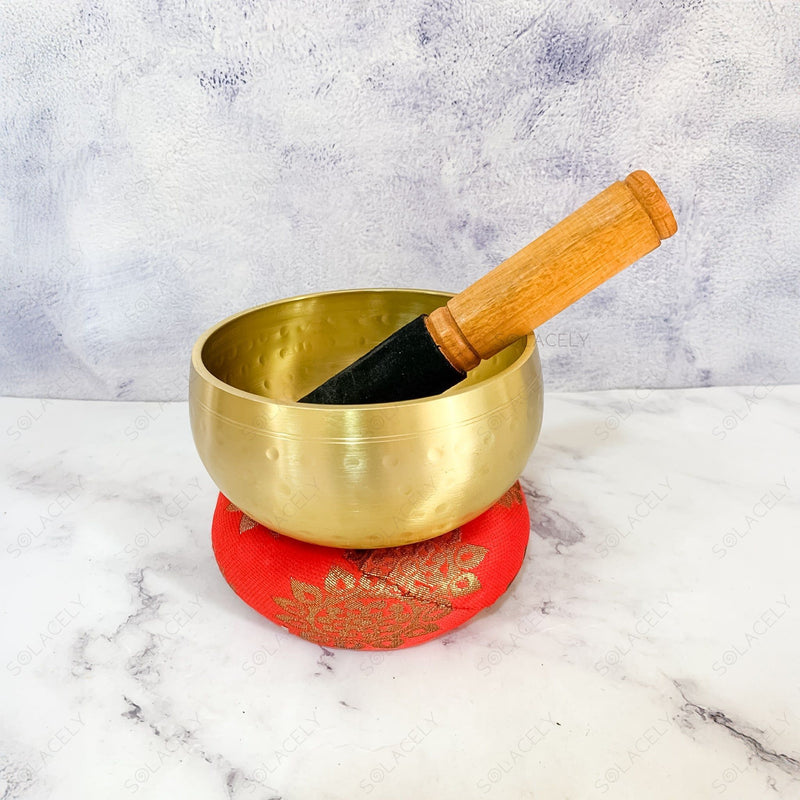
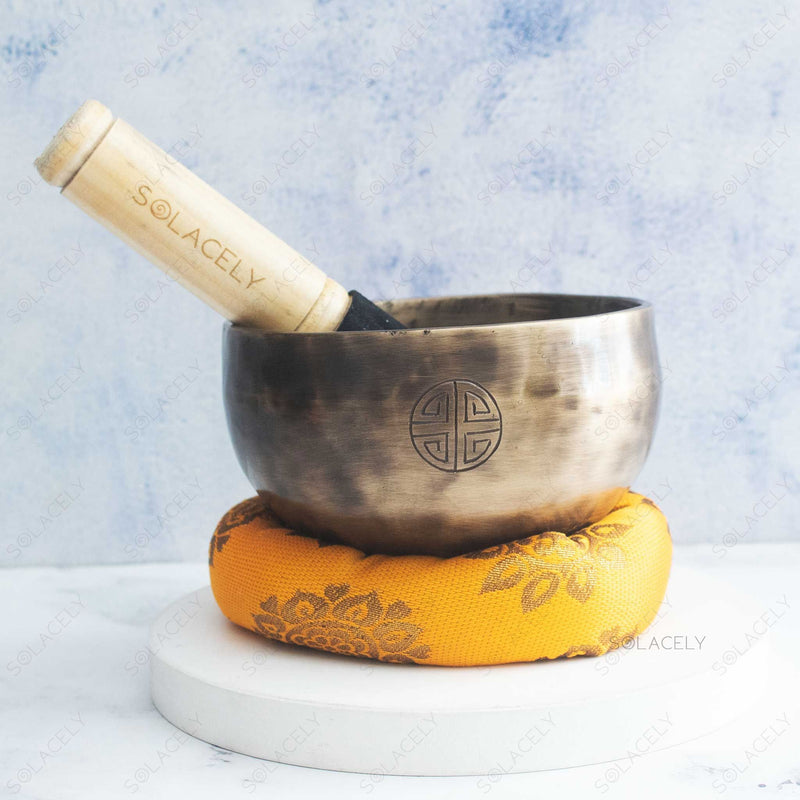
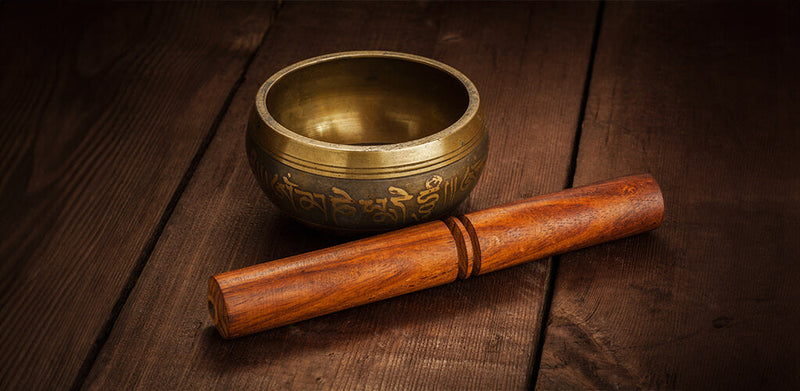
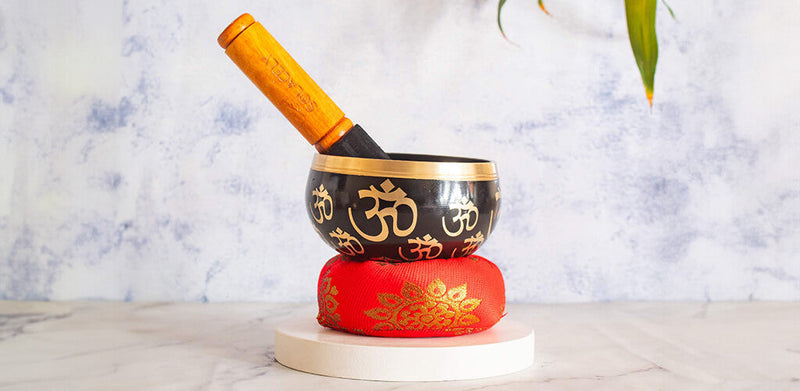
Singing bowl chakra clearing is the practice of sounding a bowl over one energy centre that feels 'stuck,' using the sustained tone and your own intention to release and cleanse it, rather than tuning the whole system at once. In yogic tradition, 'clearing' targets a single chakra you sense is congested or stagnant, sweeping it clear with repeated strikes and long rimming, while 'balancing' evens out all seven together. You strike or rim a singing bowl near the body, breathe out as the note fades, and picture the blockage loosening and leaving. None of this is a medical treatment. It's a focusing ritual, and the small research we have on sound meditation is encouraging but early.
Key Takeaways
- Chakra clearing means using a bowl's sustained tone to cleanse and release one specific centre that feels blocked or stagnant, in contrast to balancing, which evens out all seven chakras in a single flowing session.
- The idea, drawn from yogic and New Age tradition, is that steady vibration and focused intention loosen 'stuck' energy so it can move. It is a belief-based practice, not a proven physical mechanism.
- Signs a chakra 'feels blocked' are described in tradition as difficulty in that centre's theme, restlessness at the root, creative flatness at the sacral, a tight throat when speaking up. These are felt impressions, not diagnoses.
- For clearing, match the bowl's note to the target chakra (roughly C at the root up to B at the crown) and favour long, repeated rimming over a single strike, so the tone keeps working on one centre.
- Evidence for relaxation is real but small-scale, so treat clearing as complementary self-care. A single chakra-tuned bowl sits in the entry-level to premium range.
What 'clearing' a chakra actually means
Clearing a chakra means working on one centre you feel is congested, using sound and intention to release what's stuck there, so energy can move through it again. The word doing the work is 'cleanse.' Where balancing tries to bring the whole system into even flow, clearing zooms in on a single chakra and its single theme.
The mental picture tradition offers is plumbing, not tuning. A balanced system is like seven wheels all turning freely. A blocked chakra is one wheel jammed with grit. Clearing is the act of sounding that one wheel until, in the imagery of the practice, the grit loosens and washes out. That's why clearing sessions are shorter, more repetitive, and aimed at one place on the body rather than travelling up the spine.
It helps to stay honest about what this is. Chakras have never been located by anatomy or measured by instruments. They're a spiritual map of the self, drawn from centuries of yogic and tantric thought, not a physical structure. So 'clearing' is really directed attention: you choose one theme, safety, creativity, voice, and give it your full, unhurried focus while a steady sound holds you there. If the whole idea is new, our overview of singing bowls and the chakras lays out the map before you pick a centre to work on.
How sound is said to 'clear' a chakra
In tradition, a bowl clears a chakra because its sustained vibration is thought to resonate with that centre and shake loose stagnant energy, while your intention directs the release. The physics of the sound is ordinary. The 'clearing' layered on top is belief. Both can sit side by side without pretending one is the other.
The acoustics first, because they're real and rather lovely. When you strike or rim a bowl, its rim flexes in a standing-wave pattern and pushes the surrounding air into sound waves at the bowl's natural frequencies. According to Encyclopaedia Britannica, resonance is the tendency of an object to oscillate with greater amplitude at certain frequencies, and a standing wave forms when a vibration is confined so fixed points of maximum and minimum motion appear. That's exactly what happens around a bowl's rim, and it's why a long rimmed note feels like it fills the whole room and the body with it.
The traditional layer says this vibration does more than fill a room, that it 'moves' energy in a matched chakra and carries a blockage away. There's no measured mechanism for that part, and it's fair to say so plainly. What the steady tone genuinely does is give your nervous system a slow, predictable thing to settle on, and pair naturally with long exhales, which is the part that calms you. A small 2017 observational study by Goldsby and colleagues, published in the Journal of Evidence-Based Complementary and Alternative Medicine, reported that people felt less tension and better mood after a singing-bowl sound meditation, though it had no control group and a small sample. So the calm is plausible and partly documented. The 'energy sweeping out' is imagery that makes the focus vivid and easier to hold. For the wider practice, see our overview of sound healing.
Signs a chakra 'feels blocked' in tradition
Tradition reads a 'blocked' chakra as difficulty in that centre's theme rather than a physical symptom: restlessness or money worry at the root, creative or emotional flatness at the sacral, low confidence at the solar plexus, and so on up the spine. These are felt impressions you notice in yourself, never medical diagnoses, and persistent trouble deserves a doctor, not a bowl.
The point of naming these signs isn't to label yourself. It's to help you choose which single centre to clear today. If you've felt unusually ungrounded and anxious about security, the root is the natural target. If your words keep sticking in your throat when you try to speak up, the throat is where you'd aim the sound. You work on the one theme that feels most alive right now, then leave the rest alone. Here's the traditional map, one row per chakra.
| Chakra | Location | Theme | 'Blocked' signs in tradition |
|---|---|---|---|
| Root (Muladhara) | Base of spine | Safety, stability | Restlessness, insecurity, feeling ungrounded |
| Sacral (Svadhisthana) | Lower belly | Creativity, feeling | Creative flatness, numbness, low pleasure |
| Solar plexus (Manipura) | Upper belly | Confidence, will | Low self-worth, indecision, feeling powerless |
| Heart (Anahata) | Centre of chest | Love, connection | Guardedness, resentment, trouble forgiving |
| Throat (Vishuddha) | Throat | Voice, expression | Difficulty speaking up, feeling unheard |
| Third eye (Ajna) | Brow | Insight, clarity | Foggy thinking, indecision, cut off from intuition |
| Crown (Sahasrara) | Top of head | Awareness, meaning | Cynicism, disconnection, loss of purpose |
Read this as a self-reflection prompt, not a checklist of ailments. Everyone feels most of these at some point, and feeling them doesn't mean anything is wrong with your body. It simply points you toward the theme worth sitting with. For a fuller description of each centre, our chakra hub explains the seven chakras in plain terms.
Which bowl and note to use for clearing
For clearing, match the bowl's note to the chakra you're working on, since the practice is built around resonating with one centre rather than all seven. The common convention runs the musical scale up the spine: C at the root, then D, E, F, G, A, and B at the crown. A bowl tuned near your target note is the tool most clearing traditions reach for.
You don't have to be rigid or scientific about the exact hertz. These note-to-chakra pairings are a tradition, not a law of physics, and a bowl's real pitch drifts a little anyway. What matters more for clearing is sustain and clarity: you want a bowl that rings cleanly for many seconds when rimmed, because clearing leans on a long, continuous tone. Lower chakras suit deeper, heavier bowls; upper chakras suit brighter, higher ones. If you want to go into the detail, our singing bowl frequencies chart maps each note and its claimed associations.
| Chakra | Traditional note | Feel of the bowl | Typical price tier |
|---|---|---|---|
| Root | C | Large, deep, heavy | Premium |
| Sacral | D | Medium-large, warm | Mid range to premium |
| Solar plexus | E | Medium, round | Mid range |
| Heart | F | Medium, resonant | Mid range |
| Throat | G | Medium-small, clear | Entry level to mid range |
| Third eye | A | Small, bright | Entry level |
| Crown | B | Small, high, singing | Entry level |
If you don't own a tuned bowl, don't let that stop you. A single good all-round metal bowl works for clearing any centre, because your intention and focus do most of the traditional 'aiming.' A tuned bowl is a nicety, not a requirement. Deeper bowls that suit root and sacral clearing overlap neatly with the ones people choose for grounding, which we cover in using a singing bowl for grounding.
A step-by-step single-chakra clearing practice
A clearing session sounds one bowl over one chakra, on a loop: sound the bowl, breathe out long as it fades, picture the blockage loosening, repeat. It takes about ten minutes and works on one centre only. This single-pointed focus is exactly what makes clearing different from a full balancing session that travels up all seven.
- Choose one chakra. Using the signs above, pick the single centre whose theme feels most stuck today. Resist the urge to 'do all of them.' Clearing is deliberately narrow.
- Sit and settle. Sit cross-legged on a cushion or upright in a chair, feet flat. Rest your hands in your lap. Take three slow breaths and let your shoulders drop before any sound.
- Place the bowl near the centre. Rest the bowl on a cushion in front of you, or, for the lower chakras, hold it in an open palm at the level of that centre. Don't grip it.
- Set the intention out loud or silently. Name what you're releasing in one plain line, 'I let go of what's tight in my throat,' 'I release this restlessness.' Naming it is the 'clearing' part.
- Rim the bowl into a continuous tone. Press the mallet firmly against the outside of the rim and move it in slow, even circles using your whole arm, until the note builds and sings steadily. A continuous tone, not a single strike, is what clearing relies on.
- Ride each fade with a long exhale. Let the sound wash over the chosen centre. As it swells and settles, breathe out slowly and fully. Picture the tone loosening the 'grit' and carrying it out of the body on your breath.
- Repeat on that one centre. Rebuild the tone and repeat for five to ten cycles, keeping your attention on the same chakra the whole time. With each round, imagine that centre a little clearer and more open.
- Rest in the silence, then close. Let the last note fade completely and sit in the quiet for three natural breaths. Set the mallet down, take five ordinary breaths, and notice how that one theme feels now compared to when you started.
If your mind wanders, that's normal, just come back to the next tone. Keep the rimming technique clean; if it rattles instead of sings, you're going too fast or pressing too lightly. Our walkthrough of Tibetan singing bowl meditation covers the rimming action in detail if yours keeps stalling. Do a clearing session on one centre for a few days running rather than jumping between chakras, tradition treats clearing as patient, repeated work on one place.
Clearing vs balancing vs the chakra overview: which to do
Clearing and balancing are close cousins, and it's worth knowing which you actually want. Clearing focuses on one blocked centre and cleanses it. Balancing works the whole system from root to crown to bring it into even flow. The overview simply explains how bowls and chakras fit together before you commit to either.
Reach for clearing when one theme is loudly stuck, a throat that won't speak, a heart that won't soften, a root that won't settle, and you want to give that single centre patient, repeated attention. It's the 'spot treatment' of the practice. Reach for balancing when nothing in particular is jammed but the whole system feels off, scattered, or you just want a regular full-body reset. That's the difference between cleaning one blocked drain and servicing the whole set of pipes.
Here's the simplest way to hold the three together. Start with our singing bowls and chakras overview if the concept is new and you want the map. Move to singing bowl chakra balancing when you want a full seven-chakra session that travels up the spine in one sitting. Stay on this clearing practice when one centre needs focused, repeated releasing. Many people balance weekly and clear a single centre whenever a particular theme flares up.
Aftercare, cautions, and what a bowl costs
After a clearing session, treat yourself gently: a glass of water, a few quiet minutes, and no rushing straight back to a screen. Emotions can surface when you focus on one theme for a while, which is normal and usually passes. If a session ever leaves you distressed rather than settled, stop, and don't treat sound work as a substitute for real support.
A few honest cautions. Clearing is a wellbeing ritual, not therapy or medicine. If a 'blocked throat' is a persistent physical symptom, or if low mood, anxiety, or a sense of disconnection lingers, that's a matter for a doctor or a mental-health professional, not a bowl. Keep the sound at a comfortable volume, and if you're pregnant or have an ear condition, be modest with loud, close, sustained tones. None of this replaces care when something is genuinely wrong.
On price, here's a realistic picture. You do not need a full seven-bowl set to clear a chakra, one good bowl is plenty, which keeps this an affordable practice.
| Tier | Price tier | What you get |
|---|---|---|
| Entry | Entry level | Small-medium metal bowl, fine for upper-chakra clearing |
| Mid | Mid range | Handmade metal bowl with fuller tone and long sustain |
| Premium | Premium | Large, deep bowl for root and sacral clearing, or a tuned bowl |
| Tuned single | Entry level to premium | One bowl pitched to a specific chakra note |
A singing bowl is one of those rare wellness buys with almost no running cost. Once you own the bowl, the mallet, and a cushion, the practice is free forever. That makes even a single mid-range bowl a thoughtful, long-lived gift for Diwali, a housewarming (griha pravesh), or a friend easing into meditation, and one bowl is enough to start clearing any centre they choose.
Sources
- Encyclopaedia Britannica — Chakra, centres of psychic energy in tantric and yogic tradition, arranged along the spine
- Encyclopaedia Britannica — Resonance (vibration), the tendency of a system to oscillate with greater amplitude at certain frequencies
- Encyclopaedia Britannica — Standing wave (physics), fixed points of maximum and minimum vibration in a confined medium
- U.S. National Center for Complementary and Integrative Health (NIH/NCCIH) — Meditation and mindfulness for stress and well-being
Frequently asked questions
About the author


Written by Chetna Sharma, crystal healing practitioner and co-founder of Solacely. Chetna has worked with healing crystals for over a decade and curates Solacely's protective stone collection.