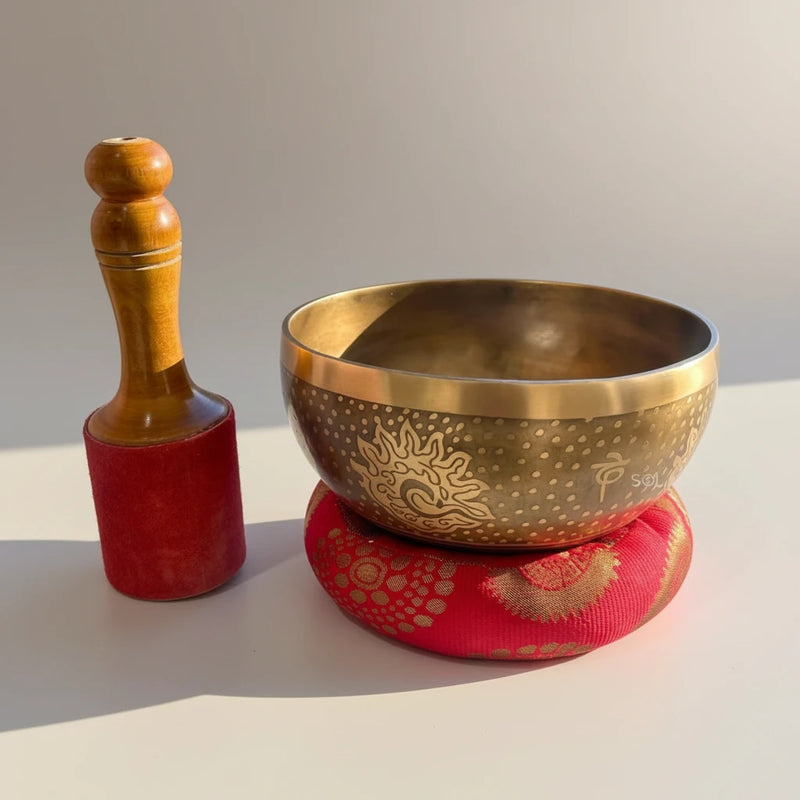
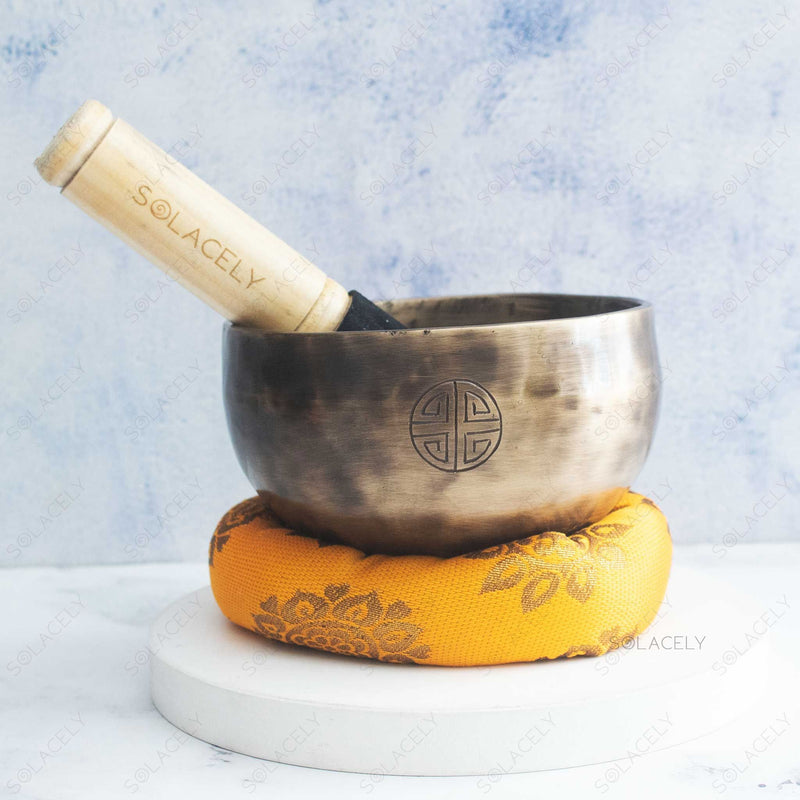
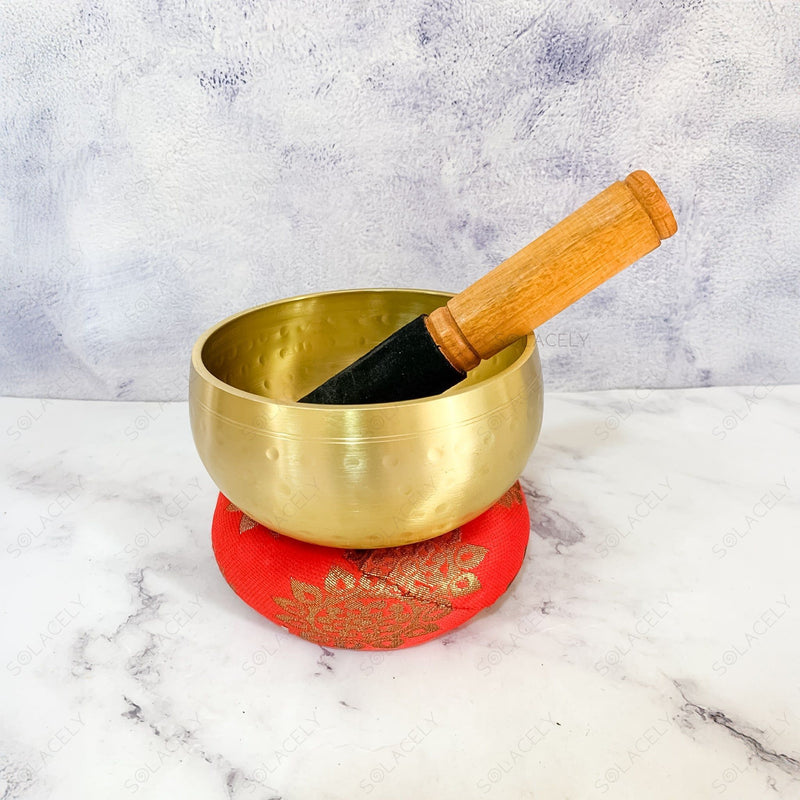
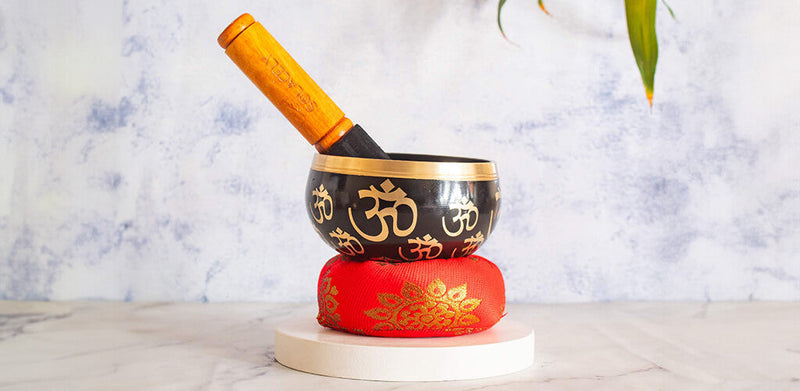
Singing bowl chakra balancing is a step-by-step sound practice: you move a bowl from the root chakra to the crown, playing a matched note over each centre in turn to steady and focus it. Start at the base of the spine with a low C note, rise one chakra at a time to a high B at the crown, and hold each tone for three to five slow breaths. In yogic tradition this evens out the flow of energy through all seven centres. It's a method, not a medicine.
Key Takeaways
- The method runs root to crown: low notes and larger bowls for the lower chakras, higher notes and smaller bowls for the upper ones, always bottom to top.
- The traditional note map is C-D-E-F-G-A-B, one note per chakra from root (C) to crown (B), matching the frequencies used in most sound-healing sets.
- You can run a full session with a single bowl by intention alone, or with a seven-bowl set where each bowl is pre-tuned to one chakra.
- Placement matters: bowls rest beside the body or on a cushion near each centre, never balanced directly on the spine or a pregnant belly.
- A single starter bowl is an entry-level to mid-range buy; a matched seven-chakra set is a premium to collector purchase.
What is singing bowl chakra balancing?
Singing bowl chakra balancing is the practice of playing tuned bowls over each of the seven chakras, from root to crown, to encourage even energy flow. Each chakra is paired with a musical note and a bowl, and you work upward one centre at a time. It's the hands-on 'how,' distinct from the theory of which bowl suits which chakra.
If you want the conceptual map first, which note, which colour, which centre and why, read our companion guide on the singing bowl and the chakras. That piece is the overview. This one is the session: the order, the placement, the timing, and how to actually run it start to finish. Keep both open if you're new, and start any deeper reading from the main singing bowl hub.
Be clear-eyed about what's happening. Chakras have never been found by anatomy, and no study has measured a bowl 'moving energy' through them. What a session reliably gives you is slow breathing, sustained sound, and focused attention on one theme at a time. That's a real, gentle benefit. Treat the chakra framing as tradition, not as physiology, and the practice does exactly what it's meant to.
Why work from root to crown?
Sound-balancing follows the same rule as every other chakra practice: begin at the base and rise. Tradition treats energy as flowing up the spine, so a settled root is said to steady every centre above it. Lower notes anchor first, then the tones climb toward the crown. Working top-down feels ungrounded.
Picture tuning a stringed instrument from the thickest string up, or laying a foundation before the upper floors. A scattered, anxious mind usually needs grounding before it can reach the airier crown work, so the low C at the root does the settling before you climb. Reverse the order and many people feel spacey rather than calm.
There's a practical reason too. The lower bowls are the heavy, low-pitched ones, and the long fundamental tone of a big bowl is what drops the shoulders and slows the breath at the start. Once the body has softened at the root and sacral, the brighter upper bowls land on an already-relaxed nervous system. The physics and the tradition happen to agree on the direction.
The chakra note map: which note and bowl for each centre
Each chakra is traditionally matched to one note of the C-major scale, root to crown, low to high. The standard map runs C, D, E, F, G, A, B, root to crown, and most seven-bowl sets are tuned exactly this way. Lower chakras get bigger, deeper bowls; upper chakras get smaller, brighter ones.
| Chakra | Sanskrit name | Note | Bowl character | Placement in session | Colour |
|---|---|---|---|---|---|
| Root | Muladhara | C | Large, deep, heavy | By the feet or base of spine | Red |
| Sacral | Svadhisthana | D | Large-medium | Beside the lower belly | Orange |
| Solar plexus | Manipura | E | Medium | Beside the upper belly | Yellow |
| Heart | Anahata | F | Medium | Beside the chest | Green |
| Throat | Vishuddha | G | Medium-small | Near the shoulders | Blue |
| Third eye | Ajna | A | Small, bright | Above the head, near the brow line | Indigo |
| Crown | Sahasrara | B | Smallest, highest | Above the crown of the head | Violet |
Two honest caveats. First, handmade metal bowls are rarely tuned to a precise concert pitch, so a 'C bowl' from a Himalayan workshop may sit a little sharp or flat, and that's fine, the note is a guide, not a lab standard. Second, some sets use the 432 Hz or 'solfeggio' tuning families instead of standard concert pitch. For the actual hertz figures behind each note and what those tuning systems mean, see our singing bowl frequencies chart.
How to play a bowl for chakra work
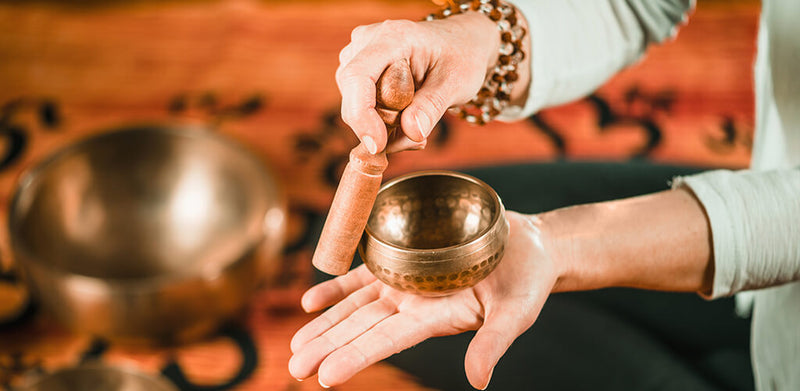
Before the session, know your two strokes. Striking gives a bell-like tone that swells and fades, good for marking each chakra. Rimming, running the mallet steadily around the outside edge, sustains a continuous hum, good for holding a centre open. Chakra sessions use both: a strike to begin a centre, a rim to sustain it.
To strike, hold the bowl flat on your open palm or let it sit on its cushion, and tap the outer rim with the padded side of the mallet, then let it ring. To rim, press the mallet's wooden side against the outer edge and move it slowly and evenly, as if stirring a thick pot. Go slow. Speeding up makes it screech; a patient, even pace builds the tone smoothly.
Keep the bowl on something soft. A metal bowl gripped too tightly or set on a hard surface can't vibrate freely and the tone dies. Rest it on the supplied ring cushion or your flat palm. If you've never held a mallet before, our walkthrough of a full Tibetan singing bowl meditation covers the basic strokes in more detail before you layer chakra work on top.
Placement: where the bowl goes for each chakra
Placement in a chakra session is about proximity, not balancing acts. The bowl sits beside the body near each centre, or moves up the body on a cushion, so the sound reaches that region most directly. It does not need to touch you, and for several centres it plainly shouldn't.
For a person lying down, the usual pattern is: a large bowl near the feet or beside the base of the spine for the root, then a bowl set on the floor beside the lower belly for the sacral, the upper belly for the solar plexus, the chest for the heart, and near the shoulders for the throat. For the third eye and crown, the bowl goes on the floor above the top of the head, since balancing anything on the face is neither safe nor useful.
A word on bowls placed on the body. Some practitioners rest a light bowl on the torso, the belly or chest, and strike it gently so the vibration is felt directly. This is optional and only for metal bowls light enough to be safe. Never place a bowl on the spine, the throat, the head, or on a pregnant belly, and never on someone with a pacemaker or recent surgery. Beside the body works just as well.
Timing: how long on each chakra and the whole session
Hold each chakra for roughly three to five slow breaths, or about one to two minutes, then move up. A full seven-chakra pass takes ten to twenty minutes at a comfortable pace, and you can extend any centre that feels like it needs more. There's no stopwatch rule; the breath is the timer.
Within a single centre, the rhythm is simple. Strike or begin rimming the bowl, let the tone build and fill the space, and breathe slowly while it sustains. When the sound naturally fades, or after a few full breaths, that centre is done and you rise to the next note. If a particular chakra feels tight or busy in the mind, linger there for an extra minute rather than rushing on.
Two timing habits help. Start with a minute of plain slow breathing before the first bowl, so the body is already settling. And end with a minute of silence after the crown bowl fades, letting the whole system rest before you open your eyes. That closing silence, the 'crown' of the session, is where many people feel the deepest calm. For working a single stubborn centre rather than the whole ladder, our guide to singing bowl chakra clearing focuses on one chakra at a time.
The full seven-chakra session, step by step
A full session is one unbroken climb from root to crown, one bowl-note per centre, breath-paced. Here's the sequence most sound practitioners follow, whether you're using one bowl or seven. Read it through once, then run it slowly with your eyes closed.
- Settle (2 minutes): Lie down or sit comfortably, close your eyes, and breathe slowly and evenly. Let the body soften before any sound begins.
- Root, note C (1-2 min): Sound the lowest, deepest bowl near the feet or base of the spine. Picture red, and hold the intention I am safe and grounded. This centre does the anchoring, don't shortchange it.
- Sacral, note D (1-2 min): Move to the next bowl beside the lower belly. Picture orange, intention I flow and create. Let the tone loosen the hips and low back.
- Solar plexus, note E (1-2 min): Sound the mid bowl beside the upper belly. Picture yellow, intention I am confident. A brighter, firmer tone here.
- Heart, note F (1-2 min): The centre of the ladder. Sound the bowl by the chest, picture green, intention I give and receive love. Many people naturally slow their breath most here.
- Throat, note G (1-2 min): Bowl near the shoulders. Picture blue, intention I speak my truth. You can hum softly with the tone if it feels right.
- Third eye, note A (1-2 min): A small, bright bowl above the head near the brow line. Picture indigo, intention I see clearly. The tone lightens noticeably now.
- Crown, note B (1-2 min): The highest, smallest bowl above the crown of the head. Picture violet or white, intention I am open. Let this tone be the airiest of all.
- Rest in silence (2 minutes): Sound nothing. Lie still and let the whole body settle in the quiet. Then take three normal breaths, wiggle your fingers and toes, and open your eyes.
Run the ladder in one direction only, root to crown, and resist the urge to jump around. The even, rising climb is the whole point. If you have time for just a short version, keep all seven but hold each for a single breath rather than several.
Single bowl vs a 7-bowl set: which approach?
You do not need seven bowls to balance seven chakras. A single well-made bowl, played with shifting intention up the body, runs a complete session, and it's how most people start. A matched seven-bowl set gives a distinct note per chakra and suits group sound baths, but it's a bigger commitment of money and space.
With one bowl, you keep the same tone throughout and let your attention do the moving, root breath, then sacral breath, and so on up the body, repositioning the single bowl beside each centre as you climb. The note stays constant; the intention changes. This is portable, affordable, and honestly enough for a home practice. Beginners are better served by one good bowl than seven mediocre ones.
With a seven-bowl set, each bowl is pre-tuned to one chakra's note, so the pitch itself climbs C to B as you rise. It's more immersive, and it's what facilitators use for sound baths where listeners simply lie back. The trade-offs are cost, storage, and the skill of switching bowls smoothly. If you're weighing a matched collection, our guide to the singing bowl set covers what to look for. For the wider 'why sound at all' picture, our sound healing overview gives the honest evidence.
Here's the plain recommendation: begin with one bowl tuned near C or F (a low grounding note or the central heart note), learn the root-to-crown method with it, and only invest in a full set once you know you'll use it. The method matters more than the hardware.
What the evidence actually says
The honest position: research on singing bowls is genuinely promising for relaxation but small and early. A frequently-cited observational study published in the Journal of Evidence-Based Complementary & Alternative Medicine (2017) reported that participants felt less tension, anger, and fatigue after a singing-bowl sound meditation. It's a small study without a control group, so it suggests, rather than proves, a calming effect.
What that means for chakra balancing is simple. The measurable benefit, when there is one, comes from lying still, breathing slowly, and listening to sustained sound, the same reasons meditation and slow breathing help, according to the U.S. National Center for Complementary and Integrative Health. There's no evidence for energy literally shifting between 'centres.' So set your expectations at deep rest and focus, not at a cure.
That framing is freeing, not deflating. It means you can enjoy the practice for what it demonstrably is, a calming ritual, without needing to believe anything unproven, and without mistaking it for medical treatment.
Common mistakes to avoid
- Starting at the crown or jumping around. Always climb root to crown. An out-of-order session leaves most people feeling ungrounded.
- Rushing each centre. Fewer than a couple of slow breaths per chakra and you're just making noise. Let each tone finish.
- Rimming too fast. Speed makes the bowl screech. Slow, even pressure builds a clean tone.
- Placing a bowl on the spine, head, throat, or a pregnant belly. Beside the body is safe and works just as well.
- Buying seven bowls before learning the method. One good bowl and the sequence beats a cheap set you can't play smoothly.
Sources
- Encyclopaedia Britannica, 'Chakra'
- Goldsby TL, et al., 'Effects of Singing Bowl Sound Meditation on Mood, Tension, and Well-being,' Journal of Evidence-Based Complementary & Alternative Medicine (2017), PubMed
- National Center for Complementary and Integrative Health (NIH), 'Meditation and Mindfulness: What You Need To Know'
Frequently asked questions
About the author


Written by Chetna Sharma, crystal healing practitioner and co-founder of Solacely. Chetna has worked with healing crystals for over a decade and curates Solacely's protective stone collection.