An abundance grid puts citrine at the centre with pyrite, green aventurine and jade around it, activated with a clear quartz point. Citrine is the merchant's stone, pyrite the stone of drive, aventurine the stone of opportunity and jade the stone of steady increase. One intention, one grid, one lunar cycle.
Key takeaways
- Citrine at the centre, with pyrite, green aventurine and jade repeating around it.
- Clear quartz is the activator, traced from each outer stone into the middle.
- Abundance in this tradition means increase that builds, not a windfall.
- Place it where money actually moves: a desk, a shop counter, a home office.
- Keep pyrite completely dry and keep citrine out of long hours of hard sun.
What an abundance grid is for
An abundance grid is built for increase that accumulates: a business finding its feet, a run of work coming in, a savings goal, a season where you want money to feel less tight. That is what abundance means in crystal tradition, and it is worth being clear about because it shapes the whole practice.
The grid does not replace the work. What it does, in tradition, is hold one clearly stated intention somewhere you will see it every day, in an arrangement built deliberately rather than assembled by accident. It is a daily reminder of a decision, given a physical shape.
That is why the intention matters more than the stones. "More money" is too vague to hold. "Three new clients by the end of the month" is something a grid can be about, and something you will notice yourself acting on.
Keeping the intention modest also helps. A grid built around a target you half believe in is easier to hold for a month than one built around a figure you named to impress yourself, and the tradition has always treated abundance as something that compounds rather than arrives all at once.
The stones for an abundance grid
Five stones cover it. Each brings a different aspect of the same intention, which is exactly what a grid is meant to gather.
| Stone | Position | Traditionally kept for |
|---|---|---|
| Citrine | Centre | Abundance, optimism, the merchant's stone |
| Pyrite | Surrounding | Drive, resolve, follow-through |
| Green aventurine | Surrounding | Luck and opportunity |
| Green jade | Surrounding | Steady, patient increase |
| Clear quartz | Activator | Amplifying and connecting the whole |
Citrine belongs at the centre because it is the stone the whole intention is built around, kept in tills and cash boxes for generations. Our guide to citrine meaning and properties covers it in full.
Pyrite is the working partner, kept for the follow-through that turns an intention into a habit. Green aventurine is the opportunity stone, and our note on green aventurine meaning and properties sets out the tradition around it.
How to lay the grid
Cleanse every stone first, with sound, incense smoke or moonlight, and wipe the surface. Then write your intention in one sentence. Fold the paper and set it under the centre stone if you like the physicality of that.
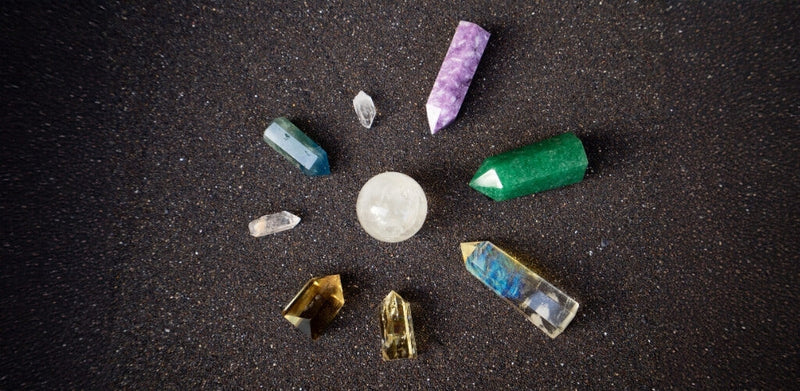
Place the citrine in the middle. Then lay six stones around it in an even ring, alternating pyrite, aventurine and jade so the pattern repeats twice. Work outward, place one stone at a time, and say the intention as you go.
Activate with the clear quartz point. Trace an invisible line from the outermost stone to the citrine, then back out to the next, connecting every stone to the centre in turn until you have gone all the way round. That is the step that makes it a grid.
The six-pointed star is the traditional layout for this intention, being the shape most associated with manifestation. A simple ring of six around one works just as well, and our fuller guide to crystal gridding covers the layouts in detail.
Where to place it
Put it where money actually moves. A desk, a home office, a shop counter, the drawer where invoices live. The traditional logic is that the grid should sit at the point of the activity it is about, not in a bedroom where you never think about work.
In feng shui the southeast corner of a room or a home is the wealth position, and many people place an abundance grid there. Near a front door is the other common choice, on the reasoning that this is where things come in. A small piece kept in a cash box or a wallet is the oldest form of the same idea, and it sits perfectly well alongside a grid on a shelf.
What matters practically is that it is undisturbed and visible. A grid on a busy kitchen table gets dismantled within days. A grid on a shelf you pass every morning stays a live thing for the whole month, which is the point.
Keeping it going
Leave it up for one lunar cycle, from new moon to new moon. Visit it daily, even briefly: stand in front of it, look at it, say the intention again. Thirty seconds is enough, and the consistency matters more than the length.
Pair the grid with one concrete weekly action, because that is where the tradition and the practical actually meet. Send the pitch, raise the rate, chase the invoice. The grid holds the intention and you do the thing, and both are needed.
At the end of the cycle, dismantle it deliberately, cleanse everything, and decide whether to rebuild. Note what actually changed before you take it apart, because a month is long enough to forget what you were hoping for at the start.
Caring for the stones
Pyrite needs the most care of the set. It contains iron sulphide and will tarnish or degrade if it gets wet or meets salt, so never rinse it, never salt-cleanse it, and keep it somewhere dry. Wipe it with a soft dry cloth and nothing more.
Citrine at 7 on the Mohs scale is easy to clean but fades permanently with long hours of hard direct sun, so keep the grid off a south-facing windowsill and charge in moonlight. Green aventurine is also 7 and equally straightforward.
Jade is tough and forgiving but dislikes bleach, strong solvents and sudden heat, and should not go near an ultrasonic cleaner. For cleansing in the spiritual sense, sound, incense smoke and moonlight suit every stone here. Our step-by-step on how to cleanse and charge crystals covers each method.
Crystal grids are built as part of a long-standing spiritual and cultural tradition. They are not a medical device or treatment and they do not diagnose, treat, cure or prevent any condition. Nothing here is financial advice, an investment recommendation or a promise of any financial outcome, and nothing here replaces guidance from a qualified financial or professional adviser. Pyrite must be kept dry and away from food, stones should never be placed in drinking water, and small tumbles are a choking risk for babies and young children.
Sources
Written by Chetena Sharma. Reviewed by the Solacely editorial team.
Frequently asked questions
About the author


Written by Chetna Sharma, crystal healing practitioner and co-founder of Solacely. Chetna has worked with healing crystals for over a decade and curates Solacely's protective stone collection.