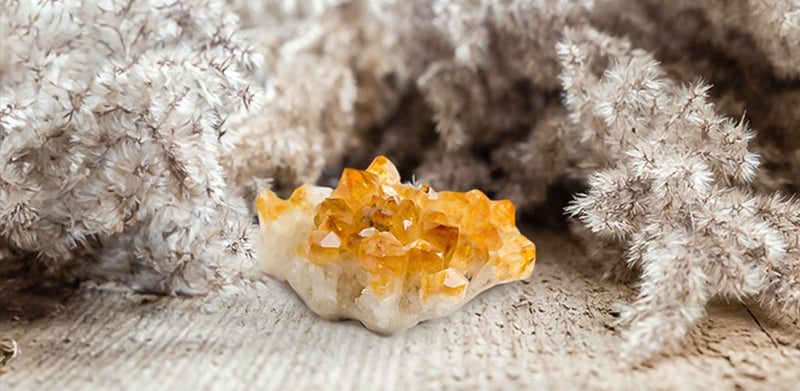
Citrine is the golden variety of quartz, coloured by iron within the crystal structure and sitting at 7 on the Mohs scale. In crystal tradition it is the stone of warmth, confidence and prosperity, long known as the merchant's stone. It is also one of the easiest stones to live with day to day.
Key takeaways
- Citrine is golden quartz, coloured by iron, hardness 7 with no cleavage.
- Its chakra is the solar plexus: will, confidence, self worth.
- Known for centuries as the merchant's stone, kept where money changes hands.
- Shades run pale lemon to deep honey, including the rich reddish grade called Madeira.
- Many practitioners hold citrine never needs cleansing, which is rare among crystals.
- The only real care rule: keep it out of sustained direct sun.
What is citrine?
Citrine is quartz that has taken on a golden colour from iron held within its structure. It belongs to the same mineral family as amethyst, rose quartz and clear quartz, and shares their durability: hardness 7 on the Mohs scale, with no cleavage planes running through it. That combination is what makes citrine so wearable, since it neither scratches easily nor splits when knocked.
The name comes from the French citron, for lemon, which describes the paler end of the range well. The deeper honey and reddish golds sit at the other end, and everything between is citrine too. Our guide to citrine colour covers the full spread and how to judge it.
| Mineral | Quartz, silicon dioxide |
|---|---|
| Colour | Pale lemon to deep reddish gold |
| Colour cause | Iron within the crystal structure |
| Mohs hardness | 7 |
| Cleavage | None |
| Chakra | Solar plexus, sometimes sacral |
| Main sources | Brazil, Bolivia, Madagascar, Zambia, Spain |
| Care | Warm soapy water. Avoid sustained direct sun. |
The history behind citrine
Golden quartz has been set into jewellery since antiquity. Greek and Roman craftsmen cut it for intaglios, and it appears in Scottish weaponry and jewellery from the eighteenth and nineteenth centuries, where it was prized alongside its cousin cairngorm. Art Deco designers took to it enthusiastically in the 1920s and 30s, and some of the most striking citrine pieces ever made date from that period.
For much of that history the trade did not clearly separate golden quartz from topaz, and citrine was often sold under the topaz name. Gemmology eventually drew the line between the two species, which is why an inherited piece described as topaz sometimes turns out to be quartz. That history is also why citrine and topaz still share November between them, covered in our citrine birthstone guide.
Citrine meaning and symbolism
Citrine's symbolism is solar throughout. It is associated with light, warmth, generosity and visible confidence, and across sources the theme stays remarkably consistent: this is a stone of coming forward rather than turning inward.
The best known name for it is the merchant's stone, from the long practice of keeping a piece in a till, a cash box or a ledger drawer. The logic is easy to follow. A golden stone kept where money changes hands works as a standing reminder to charge fairly, value the work, and trade in a way that brings people back.
That gives citrine a distinctly practical character among crystals. Where amethyst turns attention inward and rose quartz turns it toward other people, citrine turns it toward what you are building. Its fuller symbolic history is covered in the symbolic meanings of citrine, and the chakra practice in the spiritual meaning of citrine.
Benefits and healing properties
In crystal tradition citrine is kept for confidence, motivation and abundance. These are the qualities people most often reach for it to support:
- Self worth. The classic use. Traditionally worn by people who undercharge, over apologise, or find it hard to name a figure out loud.
- Prosperity and flow. Associated with money that moves rather than money hoarded, which is why the merchant's stone tradition is about trade rather than saving.
- Motivation. Reached for at the start of something, or when a project has stalled and needs restarting.
- Warmth and optimism. Long associated with lifting a flat mood and with the willingness to be visible.
- Creative output. Where the sacral association is invoked, citrine is kept in studios and at workbenches.
Citrine has no tradition as a calming or sleep stone. Its character is activating, so if what you want is settling, amethyst or lepidolite are the traditional choices instead. Our guide to crystals for calming covers that side.
Citrine and the solar plexus
Chakra tradition places citrine at the solar plexus, sitting just above the navel and associated with will, boundaries and personal authority. It is the seat of what you are prepared to ask for, which is exactly the territory citrine is kept for.
A simple practice: lie down, place the stone on the solar plexus, and take ten slow breaths, in for four and out for six. Or hold it in a closed hand while you say the specific thing you are working toward. Specificity matters here more than duration. A named rate or a named conversation gives the practice something to attach to in a way that a general wish for abundance does not. Step by step placements are in citrine and chakra alignment.
How to use citrine day to day
Placement does most of the work, and the principle is to put it where the relevant activity actually happens rather than where it looks best.
- Desk. In your sightline, for work and projects. The most common placement.
- Wallet, till or cash box. The traditional merchant's placement, for anything to do with pricing and spending.
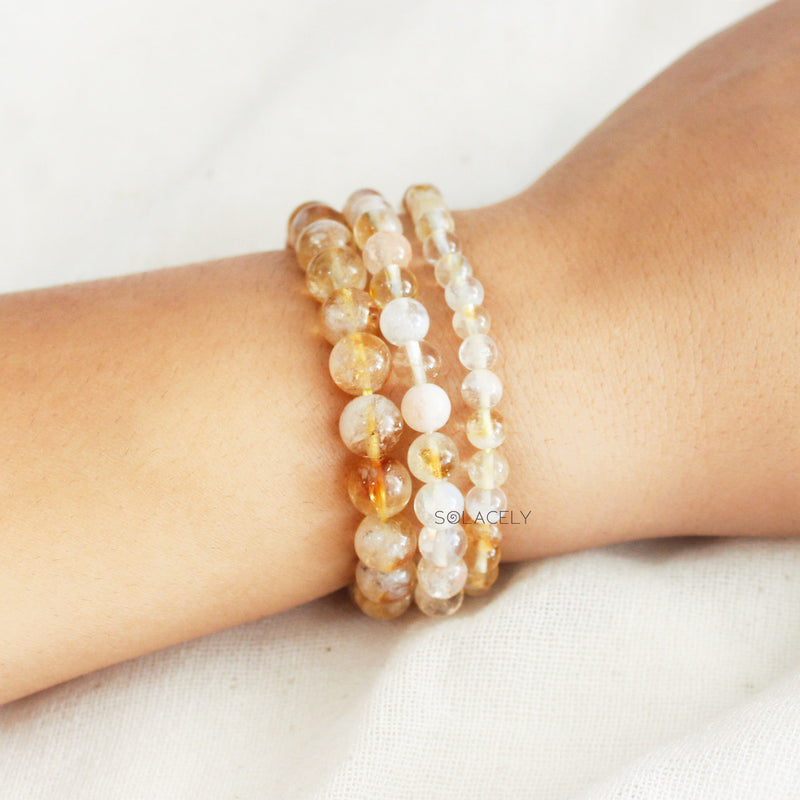
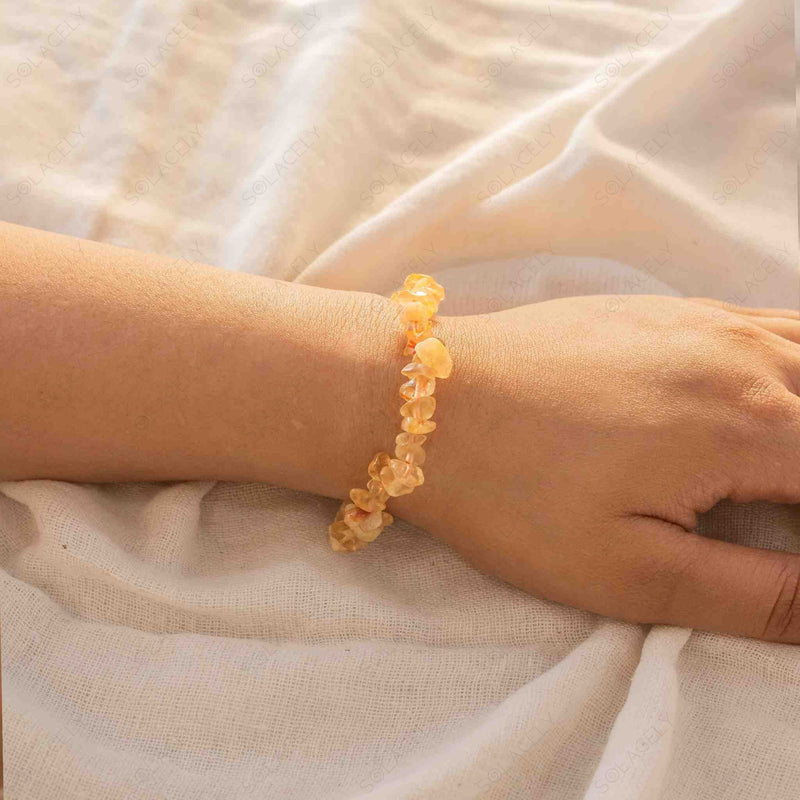
- Worn. A bracelet or ring, when the pattern you are working on is about how you carry yourself rather than one task.
- Studio or workbench. For creative output, invoking the sacral association.
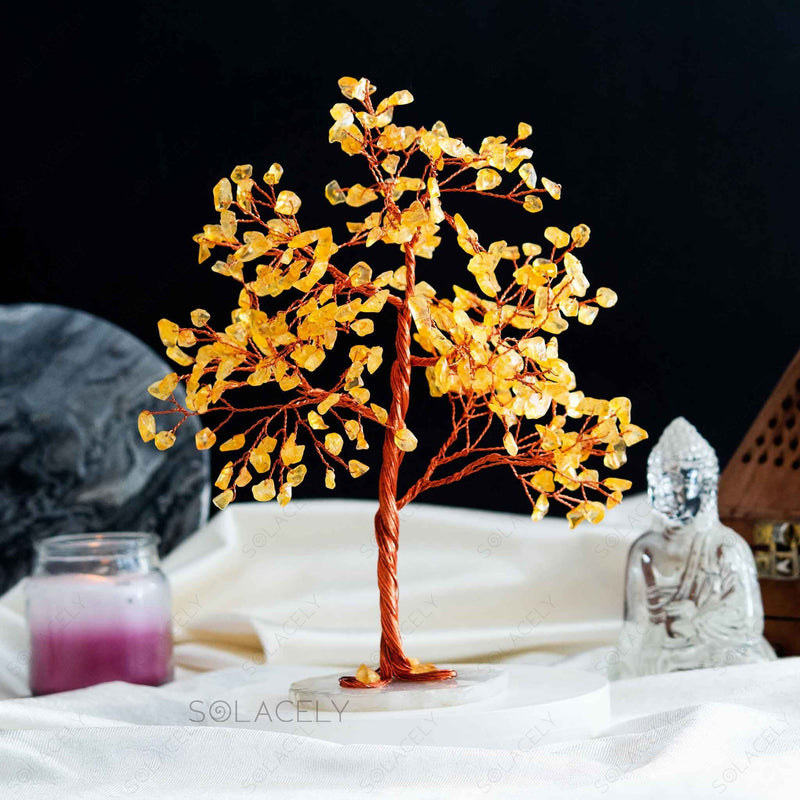
- Home. A citrine tree in a kitchen or workspace, where the household's practical life happens.
One stone kept in one fixed place will do more than several scattered around, because the value comes from the routine rather than the quantity. More formats and routines are in citrine uses.
Choosing citrine well
Three things separate a piece you keep wearing from one that ends up in a drawer, and none of them is depth of colour.
- Evenness. Tilt the stone under a lamp. Colour that sits consistently through the body always reads better than colour concentrated at one end, whichever shade you have chosen.
- Cut and orientation. A well oriented stone shows its best colour face up. Two stones of the same material can look quite different depending on how the cutter placed them.
- Clarity. Faceted citrine should be eye clean. In beads and tumbles, small internal veils are normal and part of the character.
Shade is a matter of taste rather than grade. Pale lemon reads fresh and modern and sits beautifully in silver. Clear gold is the most versatile. Deep honey and Madeira read richer and warmer and are most flattering in yellow gold. None of them carries a different traditional meaning.
Cleansing, charging and care
Citrine is unusual in crystal practice: a common strand holds that it does not accumulate what it encounters and therefore never needs clearing at all. Most stones are said to require it. Citrine is one of the very few given an exemption, which is part of why it is such an easy first crystal.
If you prefer to cleanse it anyway, water, sound and smoke are all safe. Skip long sunlight, which is the one method that can affect this particular stone.
For everyday care: warm water, mild soap, a soft brush. Avoid steam cleaning, and avoid ultrasonic if the stone has any fracture reaching the surface. Keep it off a bright windowsill and out of a parked car, since sustained direct sun and heat can soften the colour over months. Tell any jeweller doing repair work that the stone is quartz before a torch comes near it.
Pairing citrine with other stones
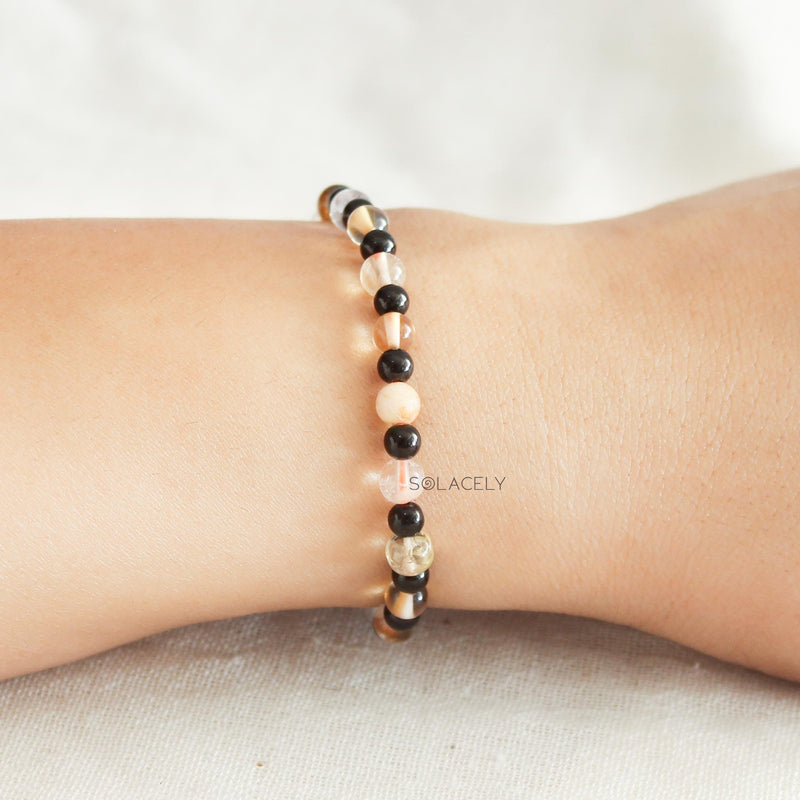
Citrine combines readily, and the pairings split along clear lines. With pyrite and green aventurine it reinforces the prosperity theme. With black tourmaline or smoky quartz it gains grounding, which stops the drive turning into agitation. With amethyst it becomes the sister stone pairing that occurs naturally as ametrine, a single crystal carrying both colours.
Our full guide to citrine crystal combinations works through the twelve most useful pairings, and crystals for money sets citrine against the other stones in that tradition.
Who citrine suits
It suits someone building something, and anyone who finds it hard to say what their work is worth. It is a good first crystal for practical reasons as much as traditional ones: durable enough for daily wear, easy to look after, and available in a shade to suit almost anyone.
It suits less well someone looking for calm or comfort during a hard stretch. Citrine points forward, and there are gentler stones for standing still.
The uses described here reflect traditional and cultural crystal practice. They are not medical claims and are not a substitute for professional healthcare, financial or legal advice.
Sources
Written by Chetena Sharma. Reviewed by the Solacely editorial team.
Frequently asked questions
About the author


Written by Chetna Sharma, crystal healing practitioner and co-founder of Solacely. Chetna has worked with healing crystals for over a decade and curates Solacely's protective stone collection.