Hematite and labradorite pair a heavy iron oxide with a flashing feldspar. Hematite is worn for grounding and steadiness. Labradorite is worn for intuition and a sense of energetic cover. Together they suit people who want to feel settled in the body without switching off their awareness of everything else.
Key takeaways
- Hematite is iron oxide, Fe2O3, the most important ore of iron, and sits at roughly 5 to 6.5 on the Mohs scale.
- Labradorite is a plagioclase feldspar rated about 6 to 6.5 Mohs, known for the blue and gold flash called labradorescence.
- The pairing is used traditionally for grounding plus intuition: hematite settles you down, labradorite keeps you perceptive.
- Care is not the same for both. Labradorite has cleavage planes and chips on impact, while hematite needs drying properly and no salt water.
- Worn together as a daily cue: something steady and weighted on the wrist, something that catches the light every time you move.
What is hematite?
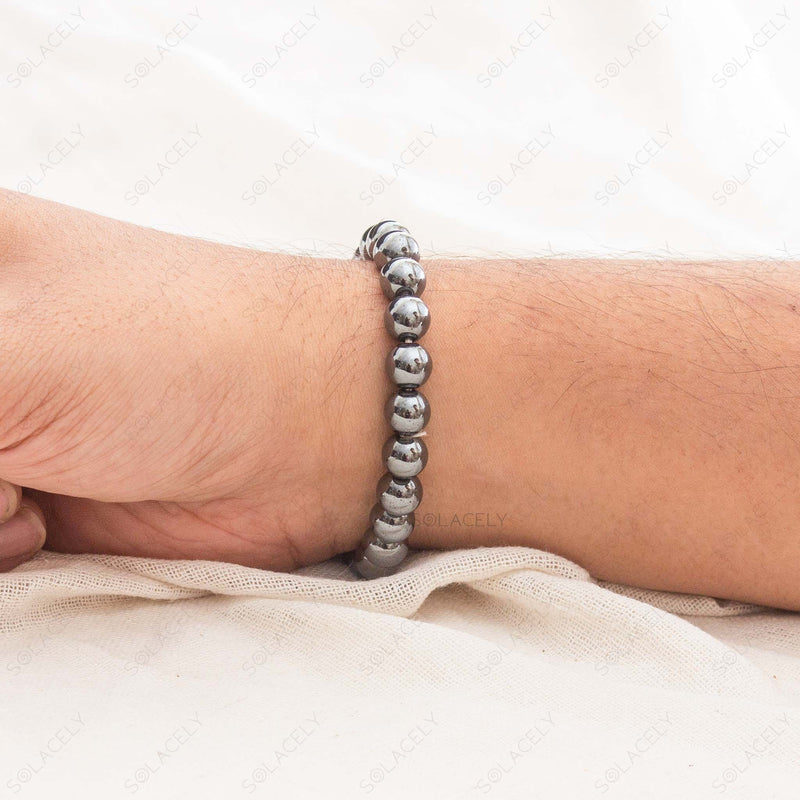
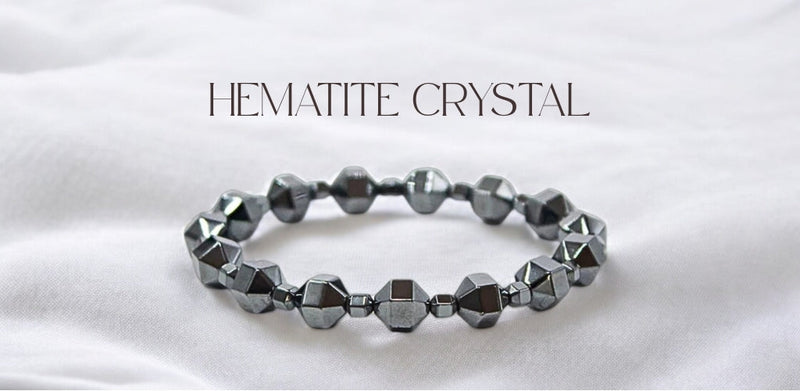
Hematite is an iron oxide mineral with the formula Fe2O3. It is the most important ore of iron, and it always leaves a red to red-brown streak, which is where the name comes from. Polished hematite looks like gunmetal and feels heavy for its size.
That weight is a big part of why people like wearing it. A hematite strand is noticeably denser on the wrist than a quartz strand of the same bead size, and the sensation of something solid sitting on your arm is doing at least half the grounding work. The name traces back to the Greek word for blood, a reference to the red powder the stone produces when it is ground or scratched.
On hardness, hematite lands somewhere around 5 to 6.5 depending on the specimen, so it is harder than glass but softer than quartz. Mirror-polished beads scratch more visibly than matte ones, and a scuff shows up as a dull grey smear.
Finish is worth thinking about before you choose a strand. The high-shine mirror polish is the one most people picture, and it throws a sharp silver highlight that looks striking against a dark labradorite next to it. A matte or frosted finish is quieter, wears its marks far more gracefully, and suits anyone who works with their hands all day. Faceted rounds sit somewhere between the two, catching light in small flashes rather than one broad reflection. Bead size changes the feel as much as the finish does: 6mm reads as a subtle grey line on the wrist, 8mm is the everyday standard, and 10mm upwards makes the weight the whole point of the piece. Our hematite meaning and properties guide covers the wider background.
What is labradorite, and why does it flash?
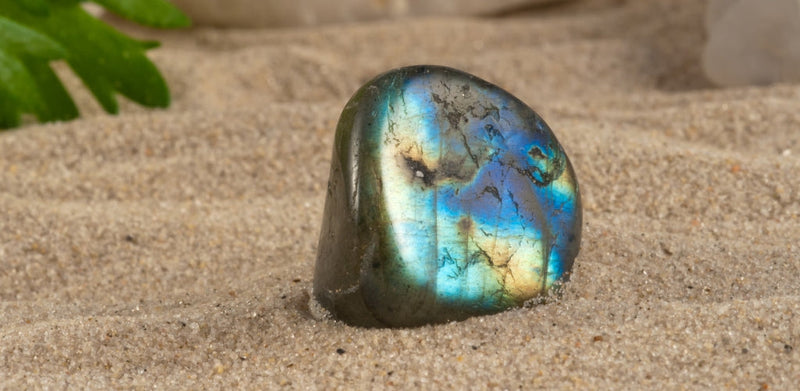
Labradorite is a plagioclase feldspar from the calcium and sodium series, and it is known for labradorescence: the blue, green, and gold sheen that appears as you tilt the stone. Gemmological reference works describe that flash as an optical effect produced inside the stone rather than a surface colour.
The cause is structural. Cooling magma left microscopic layers inside the crystal, and light bouncing between those layers interferes with itself, throwing back certain wavelengths. That is why the colour moves when you move. Hold a piece still under a lamp and it can look like plain grey rock. Tilt it fifteen degrees and it lights up.
The stone takes its name from Labrador in Canada, where it was identified in the eighteenth century, though good material now comes from Madagascar, Finland, and Russia. The intensely coloured Finnish variety is sold as spectrolite. Mineral references put its hardness at roughly 6 to 6.5, which sounds robust until you remember that feldspars have two directions of good cleavage. Hardness resists scratching. Cleavage is about splitting, and that is the real risk with this stone. For the full profile, see the labradorite crystal meaning guide.
Why do hematite and labradorite work together?
The pairing works because the two stones are used for opposite halves of the same task. Hematite is the anchor, linked with the root chakra, physical steadiness, and coming back into your body. Labradorite is the antenna, linked with the third eye, intuition, and a filter against other people's moods.
Used on its own, labradorite has a reputation for being a bit untethered. People who work with it often describe vivid dreams and a busier head, which is welcome if you are after insight and unhelpful if you already struggle to switch off. Hematite is the counterweight. It gives the combination somewhere to land.
Run it the other way and the logic still holds. Hematite alone can feel flat and slightly heavy for some wearers, especially worn all day. Labradorite lifts that without introducing the buzz you would get from citrine or carnelian. In our experience, this is the pairing people settle on after trying grounding stones that felt dull and intuition stones that felt scattered.
Colour supports the same story. Both stones are dark, so they read as one piece rather than two competing ideas, and the flash only shows up in movement. If grounding is your main goal, the broader crystals for grounding guide covers alternatives. If the shielding side matters more, look at crystals for psychic protection.
How should you wear hematite and labradorite?
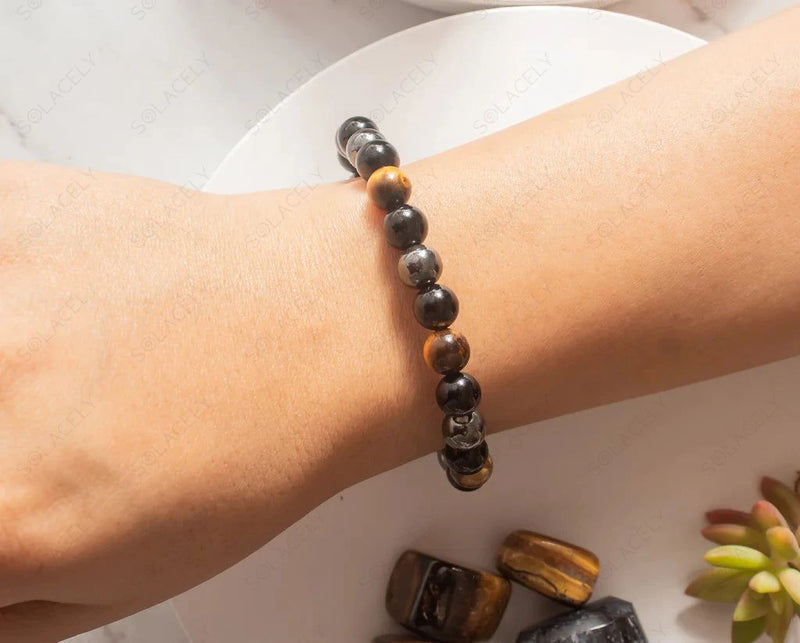
A two-strand stack is the standard approach: one hematite bracelet, one labradorite bracelet, same wrist. Many wearers put hematite lower down the arm, closer to the hand, and labradorite above it, on the reasoning that grounding belongs nearest the earth. There is no rule about this, and comfort matters more than the theory.
- Bracelets. The easiest format. Stack two strands, or pick one alternating design so the flash breaks up the grey.
- Pendants. A labradorite drop with hematite spacer beads keeps the flash at eye level where you actually see it.
- Rings. Fine for hematite, riskier for labradorite. Rings take knocks, and cleavage planes do not forgive knocks.
- Pocket stones. A tumbled hematite in a pocket is the most discreet option going, and it doubles as a fidget.
- At a desk. Hematite near the keyboard, labradorite where light hits it, so the flash catches your eye during the day.
How long should you wear it? Start with a few hours rather than a full day. Hematite is dense, and a wide strand can feel like a lot at first. If you want the pairing purely for shielding in crowded places, hematite and black tourmaline is the more conventional protective build.
How do you care for hematite and labradorite?
These two want different handling, and treating them as one material is the mistake most people make. Hematite is chemically iron oxide and dislikes staying wet. Labradorite is physically fragile along its cleavage and dislikes impact. Neither enjoys salt water, and neither needs it.
| Hematite | Labradorite | |
|---|---|---|
| Type | Iron oxide mineral | Plagioclase feldspar |
| Hardness | About 5 to 6.5 Mohs | About 6 to 6.5 Mohs |
| Main risk | Scratches and surface rust | Chipping along cleavage |
| Water | Quick rinse, dry at once | Mild soapy water, soft cloth |
| Salt | Avoid | Avoid |
| Storage | Away from softer stones | Padded, on its own |
Keep perfume, hairspray, and hand cream off both. Residue dulls hematite's mirror finish faster than anything else, and it settles into the surface of labradorite in a way that mutes the flash. Put jewellery on last, once cosmetics have dried.
For cleansing, moonlight, sound, or a rest on selenite suit the pair. Skip long sun sessions, since prolonged heat is not good for either, and skip ultrasonic cleaners entirely because vibration and cleavage are a poor match. If you are ever unsure what a new stone can handle, the Mohs hardness scale is the quickest reference to check first.
Who does this combination suit?
This pairing suits people who feel scattered rather than people who feel flat. It is a common choice for anyone who absorbs the mood of a room, works in a busy open-plan office, or lies awake with a head that will not settle. Hematite handles the settling. Labradorite handles the discernment.
It also suits practitioners, therapists, teachers, and carers, roles where you spend the day taking on other people's states and need something that helps you draw a line. That is a long-standing traditional association, and it is why the combination shows up so often in pieces made for that group.
It is a weaker fit if what you actually want is energy or motivation. Neither stone is warm. For drive you would be better off with carnelian or garnet, and for outright heavy-duty shielding, black tourmaline is the more traditional pick. Choose this pair when the problem is noise, not fatigue.
The properties described here reflect traditional and cultural belief around crystals. They are not medical claims and are not a substitute for professional healthcare. If you are managing a health concern, speak to a qualified practitioner.
Sources
Written by Chetena Sharma. Reviewed by the Solacely editorial team.
Frequently asked questions
About the author


Written by Chetna Sharma, crystal healing practitioner and co-founder of Solacely. Chetna has worked with healing crystals for over a decade and curates Solacely's protective stone collection.