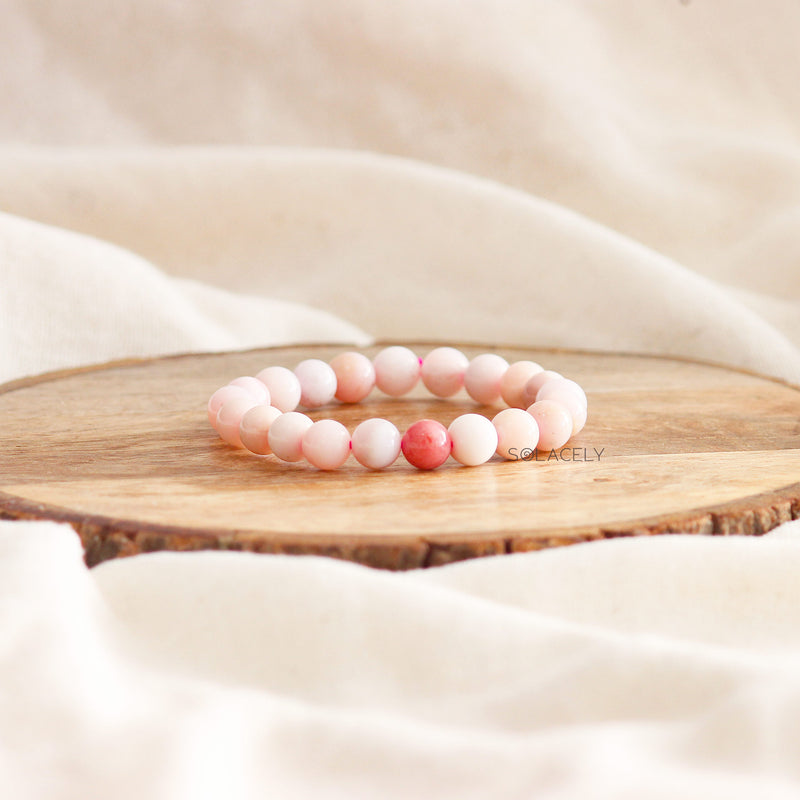
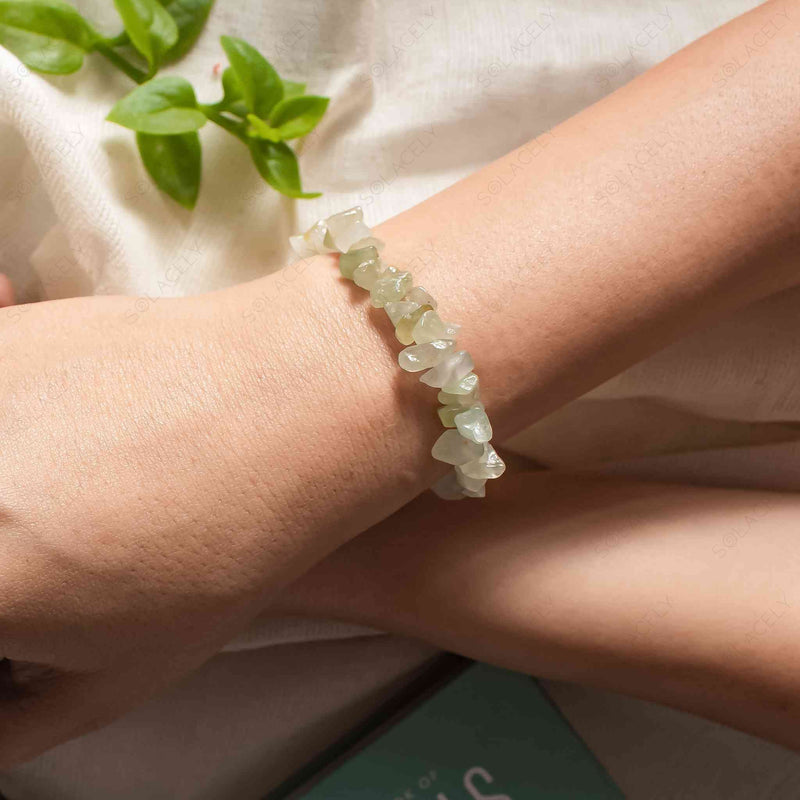
Pink opalite and green calcite are a soft pairing: a milky, opalescent pink glass set beside a pale green calcium carbonate mineral. In crystal tradition, pink opalite is kept for gentle emotional soothing around the heart, while green calcite is kept for renewal, growth and clearing out whatever has started to feel stale.
Key takeaways
- Pink opalite is a manufactured opalescent glass, made and sold openly as opalite across the crystal trade, prized for its milky pink and blue glow.
- Green calcite is calcium carbonate, the same mineral that builds limestone and marble, and it sits at about 3 on the Mohs hardness scale.
- Glass sits higher, at roughly 5 to 6 on that same scale, so opalite handles daily wear more easily than calcite does.
- Calcite reacts with acids: no vinegar, no lemon juice, no long soaks. Wipe it and dry it instead.
- Store the two apart. Harder beads will scuff soft calcite if they rub together in a bowl or a pouch.
- Traditional pairing logic: opalite for comfort and softness, calcite for growth and forward motion.
What are pink opalite and green calcite?
Pink opalite is an opalescent glass, made to carry a cloudy glow that drifts between pink, cream and soft blue as the light moves. Green calcite is a natural calcium carbonate mineral, usually mint to apple green, and soft enough to mark with a copper coin.
Pink opalite
Opalite has been part of the crystal trade for decades, sold under its own name rather than passed off as anything else. Its shimmer comes from fine particles suspended inside the glass, which scatter light and produce that milky, lit-from-within look. Hold a bead near a window and it warms towards rose. Move it into shade and it cools towards blue.
That behaviour is exactly why people buy it. The colour is even, the polish is bright, and the surface takes daily wear without fussing. Glass also carries no cleavage planes, so a well made bead is far less likely to split along a weak line than many natural stones are. It feels cool in the hand and warms quickly against skin.
Green calcite
Calcite is one of the most common rock forming minerals on the planet. Geological references describe it as the primary component of limestone and marble, crystallising in the trigonal system with a very distinctive rhombohedral cleavage: break a clear piece and the fragments repeat the same slanted box shape. Green colouring comes from trace elements and fine mineral inclusions.
Two properties matter to anyone who owns a piece. First, hardness. At around 3 on the Mohs scale, calcite is softer than window glass, softer than a steel blade, and easily scratched by quartz. Second, chemistry. Calcium carbonate reacts with acids, which is why a drop of dilute acid will fizz on a fresh surface. Both facts shape how you should store and clean it.
Why do people pair pink opalite with green calcite?
The two cover different halves of the same job. Pink opalite is traditionally kept for gentle emotional soothing, the sort you want after a difficult week. Green calcite is traditionally kept for renewal and growth. Softness and forward motion, sitting side by side, is the whole logic of the pairing.
Think of it as a sequence rather than a blend. Pink opalite is the stone people reach for when feelings are still raw and the only sensible next step is to be kinder to yourself. It is often described as a quiet companion for grief, for homesickness, for the tender days after a relationship shifts. Many people keep it near for the same reasons they keep crystals associated with emotional healing on a bedside table.
Green calcite comes in afterwards. Green is the traditional heart colour in chakra work, and calcite has long been associated with clearing out stale habits, stale rooms and stale thinking. It suits the moment when comfort has done its work and you are ready to move again. That makes it a natural companion to stones kept for new beginnings.
Why does that order matter? Because pushing straight to growth rarely sticks. In our experience, people who keep both stones tend to use the opalite far more in the first fortnight, then find themselves picking up the calcite without planning to. The pairing gives your intention two speeds rather than one.
How do pink opalite and green calcite compare?
The headline difference is durability. Pink opalite is glass, at roughly 5 to 6 on the Mohs hardness scale, while green calcite sits near 3. That gap of two to three points is large, and it decides almost everything about how you wear, clean and store each one.
| Feature | Pink opalite | Green calcite |
|---|---|---|
| Material | Manufactured opalescent glass | Calcium carbonate mineral |
| Colour | Milky pink with blue and cream lights | Mint to apple green, often banded |
| Mohs hardness | About 5 to 6, typical of glass | About 3, softer than a steel blade |
| Reaction to acids | Stable; simply avoid harsh cleaners | Reacts and etches; keep vinegar and lemon away |
| Water | A quick rinse is fine, then dry it | Keep it dry, and never soak it |
| Common forms | Beads, tumbles, points, pendants | Rough chunks, tumbles, carved shapes |
| Traditionally kept for | Gentle soothing, comfort, the heart | Renewal, growth, releasing the stale |
One practical consequence follows from that table. Opalite is the one to wear; calcite is the one to keep. A calcite tumble in a coat pocket alongside keys will lose its polish quickly, which is a shame when the colour is the point.
How do you use pink opalite and green calcite together?
Most people run a simple split: opalite on the body, calcite in the room. An opalite bracelet or pendant travels with you as a daily cue, and a piece of green calcite sits somewhere you pass often, on a desk, a windowsill or a bedside shelf. That covers both moods without asking calcite to survive a handbag.
A few arrangements that people come back to:
- Morning and evening. Hold the opalite while you set your intention for the day, and hold the calcite in the evening while you name one thing you are ready to let go of.
- Desk corner. Green calcite near the spot where work piles up, kept as a reminder that stale tasks are allowed to be cleared rather than carried.
- Bedside pair. Both stones on a small dish, opalite closest to you. Just keep them from resting against one another.
- Simple grid. Green calcite in the centre for growth, four opalite tumbles around it for softness, refreshed at the new moon.
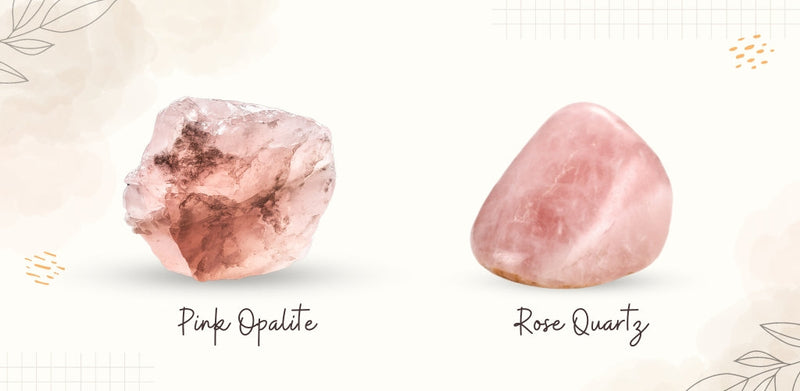
If you want a gentler heart-focused combination for wearing, opalite also pairs comfortably with rose quartz. Our guide to pink opalite and rose quartz covers that route, and both stones there are hard enough to share a strand.
How should you care for pink opalite and green calcite?
Green calcite needs the careful handling; opalite is straightforward. Because calcite is calcium carbonate at about 3 on the Mohs scale, it is both soft and acid sensitive. That rules out vinegar rinses, lemon juice, salt water baths and long soaks of any kind. A soft dry cloth does the job.
Green calcite
Wipe it with a barely damp cloth, then dry it straight away. Keep it out of prolonged direct sun, which can pale some green material over time. Store it on its own, wrapped in a soft cloth or in a lined box, well away from quartz, agate and metal clasps. Anything harder will leave marks. Handle rough pieces gently, since calcite parts along its cleavage if you knock it hard against a table edge. The same softness applies to calcite paired with other stones, as we note in our piece on green jade and calcite.
Pink opalite
Lukewarm water, a drop of mild soap and a soft cloth keep opalite bright. Rinse it, dry it and put it back on. Skip ultrasonic cleaners and steam, and take a bracelet off before swimming, since chlorine is unkind to elastic and to any metal findings. Sudden temperature changes are worth avoiding too, as with any glass.
Cleansing the pairing
Dry methods suit both. Sound from a bell or a singing bowl, a night on a windowsill under the moon, incense smoke, or a few hours resting on a selenite plate all work without wetting anything. Keep salt away from the calcite entirely, since salt grains are hard enough to scratch it and salt water dulls the surface.
Which chakras are linked with this pairing?
Both stones are usually placed at the heart. Green is the traditional heart chakra colour, so green calcite is a familiar choice there, and pink opalite is often laid at the heart or just above it, at what many practitioners call the higher heart. The pairing therefore reads as a single heart centred set rather than two competing focuses.
Some people also link opalite with the third eye and crown, drawn by its shifting inner light and the way it seems to change colour with the surroundings. That is a matter of preference rather than rule. If you are choosing by colour rather than by mineral, our overview of pink crystals and what they are traditionally kept for is a useful starting point.
A simple layout: lie down, place the green calcite at the centre of the chest and the pink opalite just above it near the collarbone. Ten quiet minutes is plenty. Many people find the pairing easier to sit with than a single stone, because there is something soft to fall back on when the growth theme feels demanding.
This article shares crystal tradition and general information only. Crystals are not medicine and cannot treat, cure or prevent any physical or mental health condition. Please speak with a qualified healthcare professional about any health concern and continue any treatment they have advised. Keep small stones, beads and tumbles away from young children and pets, since they present a choking hazard, and never place stones in drinking water.
Sources
Written by Chetena Sharma. Reviewed by the Solacely editorial team.
Frequently asked questions
About the author


Written by Chetna Sharma, crystal healing practitioner and co-founder of Solacely. Chetna has worked with healing crystals for over a decade and curates Solacely's protective stone collection.