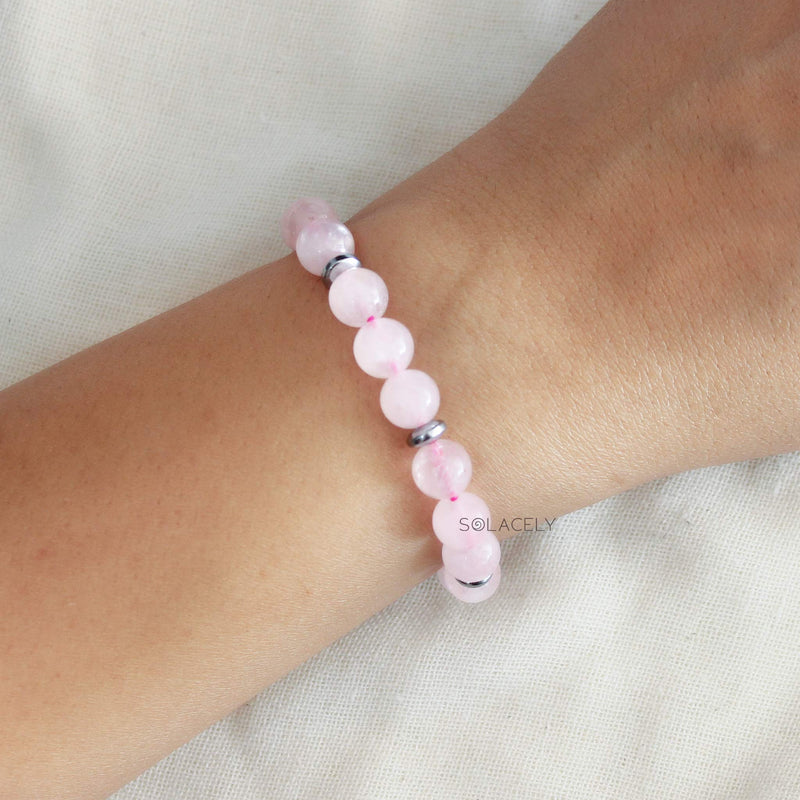
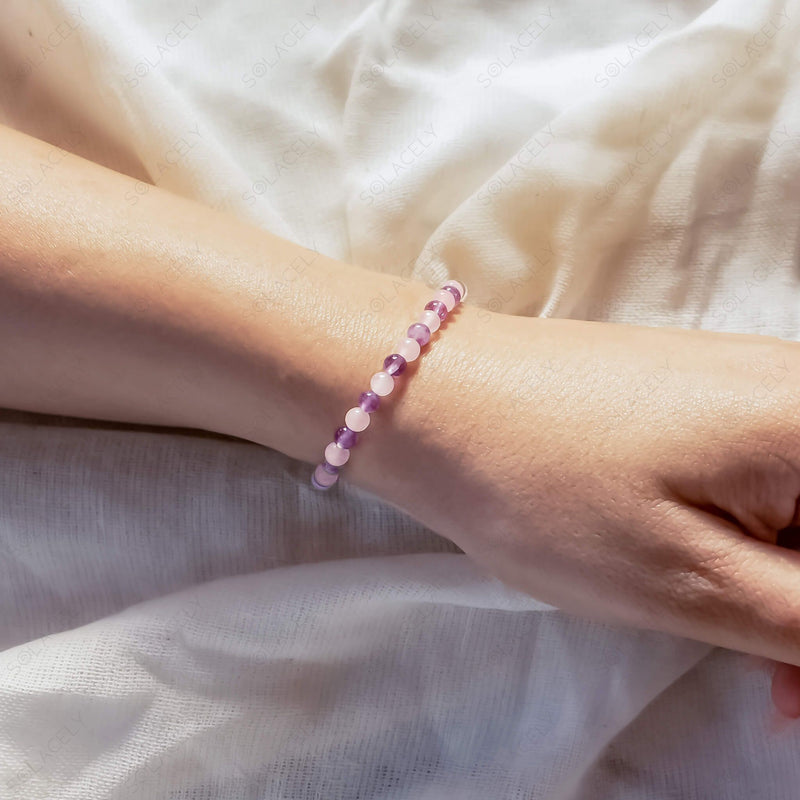
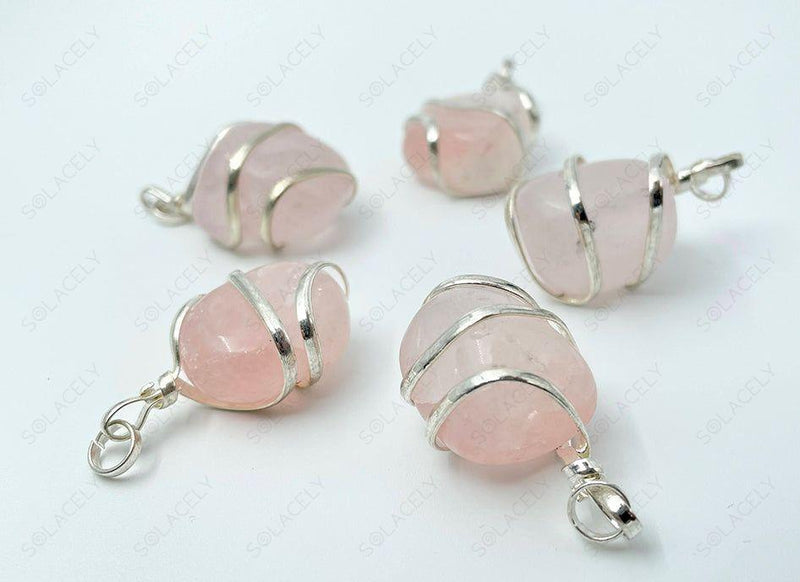
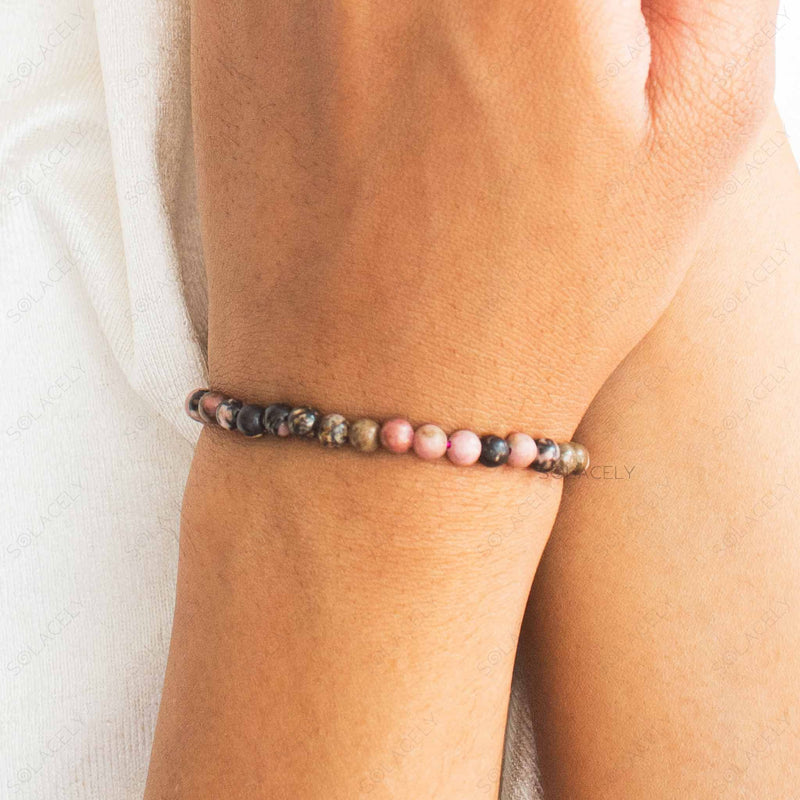
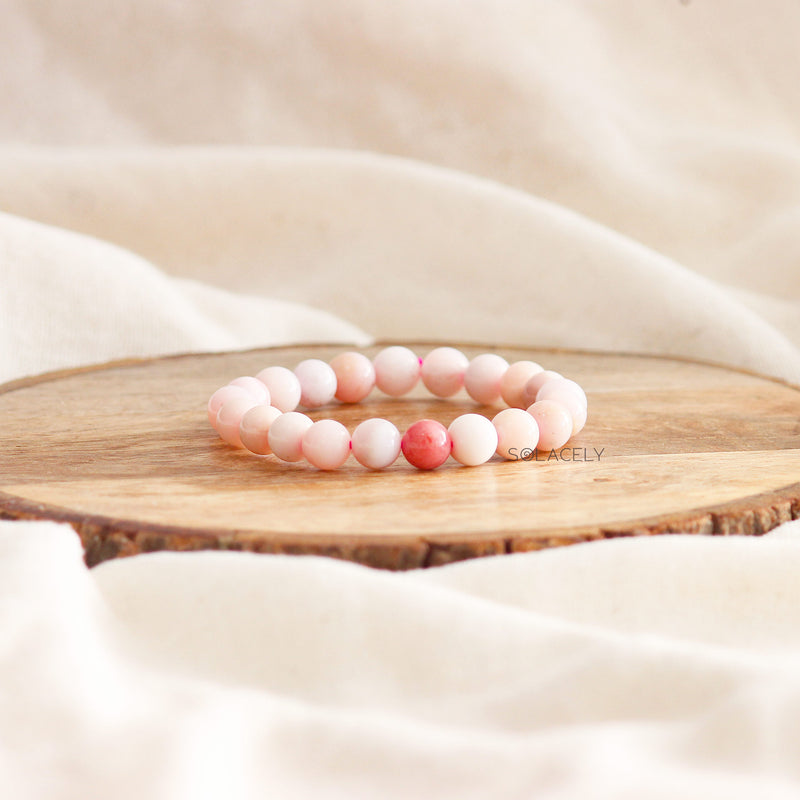
Pink crystals are stones whose colour runs from the palest blush to deep raspberry, most of them coloured by traces of manganese. Rose quartz, rhodonite, rhodochrosite, pink opal, morganite, kunzite, pink tourmaline, thulite and pink calcite are the main ones. In crystal practice, pink is the colour of the heart chakra.
Key takeaways
- Manganese is the shared reason so many pink minerals are pink. It colours rhodonite, rhodochrosite, morganite, kunzite, thulite and pink calcite.
- Hardness across the group swings widely, from pink calcite at Mohs 3 to morganite at 7.5 to 8.
- Rose quartz is silicon dioxide at Mohs 7, the most worn pink stone and the easiest to look after.
- Rhodochrosite is manganese carbonate at Mohs 3.5 to 4 and reacts to acids, so it wants a dry cloth rather than a soak.
- Kunzite and rose quartz can pale after long spells in direct sun, so keep them off a hot windowsill.
- In crystal tradition pink is the heart chakra colour, kept for love, gentleness and self-kindness.
Which stones count as pink crystals?
Nine stones cover almost every pink crystal you will meet: rose quartz, rhodonite, rhodochrosite, pink opal, morganite, kunzite, pink tourmaline, thulite and pink calcite. They come from four different mineral families, which is why their hardness, colour depth and care needs vary so much.
Quartz and silica
Rose quartz is silicon dioxide, the same material as clear quartz, tinted by microscopic mineral inclusions rather than by one colouring element. It sits at 7 on the Mohs scale and is usually cut as tumbles, beads, spheres and carvings. Read the full rose quartz meaning and properties guide for its history in more depth. Pink opal is hydrated silica, a soft pastel stone associated with Peru and Australia, generally 5.5 to 6.5 on the Mohs scale and opaque rather than flashy.
Beryl, spodumene and tourmaline
Morganite is pink beryl, the same mineral family as emerald and aquamarine, coloured by manganese and hard enough at 7.5 to 8 for a ring worn every day. Kunzite is pink spodumene, known for long prismatic crystals that show a deeper pink down the length of the crystal than across it. Its perfect cleavage means it wants a careful setting, and kunzite's meaning and properties are worth reading before you commit to a piece. Pink tourmaline, whose deeper reddish material is called rubellite, runs 7 to 7.5 and takes a bright polish.
Manganese silicates and carbonates
Rhodonite is a manganese silicate, usually a deep rosy pink veined with black manganese oxide, at 5.5 to 6.5. Thulite is a manganese bearing zoisite in a similar warm pink, around 6 to 6.5, and often carved rather than faceted. Rhodochrosite is manganese carbonate, banded in raspberry and white, soft at 3.5 to 4. Pink calcite, usually sold as mangano calcite, is calcium carbonate at only 3. It is the softest and palest stone on this list.
What does the colour pink mean in crystal practice?
Pink is the heart chakra colour. Green shares that chakra, and pink is its softer half: where green reads as balance and growth, pink reads as warmth, gentleness and affection. Practitioners keep pink stones for love in every form, for friendship, for family and for the way you speak to yourself.
Colour is the first thing most people sort crystals by, and it holds up well as a system. Red stones are traditionally kept for drive and courage, blue for calm and clear speech, black for grounding. Our guide to crystal colour meanings sets pink alongside the rest of the spectrum if you want the wider map before choosing.
Depth of colour carries its own reading in practice. Pale blush stones such as pink opal and pink calcite are treated as quiet, everyday company, the sort of thing that lives on a bedside table. A deep rubellite or a raspberry banded rhodochrosite is usually kept for bigger moments: an apology, a wedding, a fresh start after something hard.
Why do people reach for pink crystals for self-kindness?
Because the heart chakra covers self-regard as much as romance. People reach for pink stones for self-compassion at least as often as for attracting a partner: getting through a hard month, forgiving themselves, softening after a breakup. The stone is worn as a daily cue to be gentler with yourself.
That is worth saying plainly, because pink crystals get marketed almost entirely as love charms. In practice, the rose quartz tumble in someone's coat pocket is far more often there for a difficult week at work than for a crush. Same stone, quieter job.
Rose quartz carries the softest of these associations and is the usual starting point. Rhodonite, with its black veining, is long associated with steadiness while feelings settle, which is why people keep it through arguments and reconciliations. Rhodochrosite is traditionally held for the younger version of yourself, the one you are still being hard on. Pink opal and pink calcite are kept for rest and slow recovery.
None of this needs elaborate ritual. Many people simply hold the stone for a minute in the morning and name one thing they will not criticise themselves for that day.
How hard are pink crystals, and which suit daily wear?
Pink crystals span most of the Mohs scale, from pink calcite at 3 to morganite at 7.5 to 8. Anything at 7 or above takes daily wear happily as a ring or bracelet. Below about 5, keep the stone as a pocket piece or a shelf specimen instead.
| Stone | Mineral | Mohs hardness | Best kept as |
|---|---|---|---|
| Morganite | Beryl | 7.5 to 8 | Rings, everyday jewellery |
| Pink tourmaline | Tourmaline | 7 to 7.5 | Rings, pendants, beads |
| Rose quartz | Quartz | 7 | Bracelets, tumbles, carvings |
| Kunzite | Spodumene | 6.5 to 7 | Pendants and earrings, protected settings |
| Thulite | Zoisite | 6 to 6.5 | Cabochons and carvings |
| Rhodonite | Manganese silicate | 5.5 to 6.5 | Tumbles, beads, cabochons |
| Pink opal | Hydrated silica | 5.5 to 6.5 | Pendants, occasional wear |
| Rhodochrosite | Manganese carbonate | 3.5 to 4 | Display pieces, pendants |
| Pink calcite | Calcium carbonate | 3 | Shelf and altar pieces only |
The Mohs scale measures scratch resistance, not toughness. A stone can be hard and still chip if it has cleavage, which is exactly kunzite's situation. Ordinary household dust contains quartz particles at around 7, so anything softer than that will slowly go dull if you keep wiping it with a dry, gritty cloth.
How do you use pink crystals day to day?
Most people wear one, keep one at home, or both. A bracelet or pendant keeps the stone in view during the day. A tumble or sphere near the bed, the sofa or the front door marks the space where you want the softer mood. Both approaches do the same job: they keep the intention somewhere you will notice it.
For jewellery, choose by hardness first and colour second. Morganite, pink tourmaline and rose quartz are the workhorses. Pink opal and rhodonite suit pendants that come off at night. Rhodochrosite and pink calcite are happier as display pieces where nothing knocks them.
At home, the bedroom is the traditional spot. A pair of rose quartz pieces on a bedside table, one on each side, is a long standing arrangement for couples. A single stone works just as well for one person. Some people keep a pink stone on a desk instead, on the reasoning that the place you are hardest on yourself is usually where you work.
Pairings are common too. Pink with green amplifies the heart chakra theme. Pink with clear quartz is the classic combination for keeping an intention sharp. Pink with a grounding black stone suits anyone who finds soft stones alone a bit floaty.
How do you care for pink crystals?
Three rules cover the whole group: keep them out of prolonged direct sun, keep the soft carbonates away from water and acids, and store them so harder stones cannot scratch softer ones. Get those right and a pink crystal collection lasts decades without any fuss.
Sunlight is the first concern. Kunzite and rose quartz can both pale after long spells in direct sun, so a shelf across the room beats a hot windowsill. Pink tourmaline, morganite and rhodonite hold their colour far better if you want something for a bright spot.
Water is the second. Rose quartz, morganite and pink tourmaline take a quick rinse in cool water without complaint. Rhodochrosite and pink calcite are carbonates, soft and reactive to acids, so they get a soft dry cloth and nothing else. Pink opal contains water in its structure and can craze if it is baked dry or shocked by a sudden temperature change, so keep it away from radiators.
Storage is the third and the most often skipped. Keep the soft pieces wrapped separately rather than loose in a bowl with your quartz. Skip ultrasonic cleaners and steam entirely. And keep small tumbles away from young children, since they are a choking risk, and never put stones in drinking water.
Crystals are kept as part of a personal practice and enjoyed as beautiful objects. Nothing here is medical advice, and no stone treats, cures or prevents any condition. Please speak to a qualified healthcare professional about any health concern. Keep small stones away from young children, who may choke on them, and never place stones in drinking water.
Sources
Written by Chetena Sharma. Reviewed by the Solacely editorial team.
Frequently asked questions
About the author


Written by Chetna Sharma, crystal healing practitioner and co-founder of Solacely. Chetna has worked with healing crystals for over a decade and curates Solacely's protective stone collection.