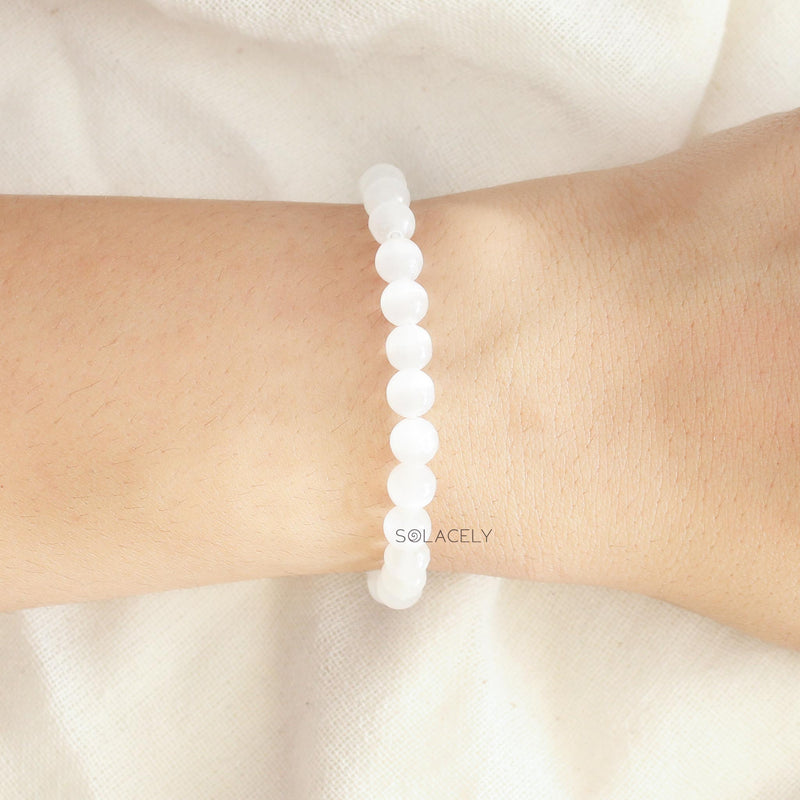
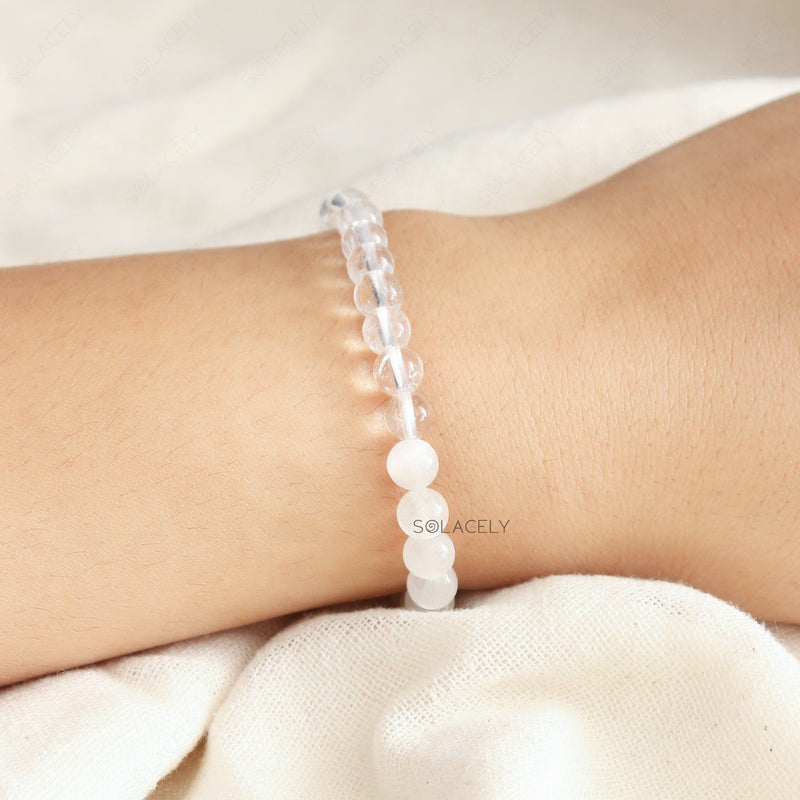
Wear a selenite bracelet on your left wrist. In crystal tradition the left is the receiving side, and selenite is kept for calm and a clearer head, both of them things you invite in rather than send out. The right wrist is the thoughtful alternative when the intention is to clear and release a busy day. Neither hand is wrong.
Key takeaways
- Which hand to wear a selenite bracelet: the left, the receiving side, is the traditional choice.
- Selenite is a crown chakra stone in tradition, kept for clarity and quiet, which is receiving work.
- The right wrist suits a season of clearing and letting go. Both placements are practised.
- Left handed? Tradition reads the two sides of the body, not the writing hand. Comfort is a fair tiebreaker, and intention matters more than the rule.
- Selenite sits at 2 on the Mohs scale, so give it its own wrist, keep it off the watch wrist, and keep it dry.
A quiet question with a simple answer
The left wrist. You open the box, the beads are cool and pale, and the only thing left to decide is which side they belong on. Tradition answers gently: the left, the hand that receives, for a stone that is all about taking in light and letting the noise settle.
That agrees with our general guide to which hand to wear your crystal bracelet, which places selenite among the receiving stones. Clearing and quiet are things you receive, and the wrist follows from that.
Why the left hand, traditionally
In crystal practice the left side of the body is the side that receives and the right is the side that acts. Selenite is kept to bring something in: a clearer head, a softer mood, the feeling of a room that has just been aired. A stone with that job sits naturally on the receiving side.
There is a second reason specific to selenite. Tradition places it at the crown chakra, the centre associated with awareness, clarity and the quiet above a busy mind. Crown stones are worn to open and receive rather than to project. The name helps the picture too: selenite is named for Selene, the moon, and moonlight is something that falls on you rather than something you send out. Our complete selenite guide covers the stone's meaning in full.
When the right hand makes sense instead
The right wrist is the giving and releasing side, and selenite has a releasing tradition of its own. It is the stone people reach for when they want to stop carrying something, which is outward work. If you bought it to clear the residue of a long day rather than to invite calm in, the right wrist matches that intention.
A simple way to decide: left when you want more quiet to arrive, right when you want less noise to stay. Some people move the bracelet across for a difficult week and back again afterwards. There is no wrong hand. The same two placement logic runs through our guides to which hand to wear a black tourmaline bracelet and which hand to wear a citrine bracelet, where the second placement is also chosen by intention.
Wearing it with intention
Before you slip the bracelet on, pause for one breath and name what you are inviting in. A clearer morning, a kinder pace, an evening that ends quietly. Then put it on the wrist you have chosen. That small ritual is what gives the placement its meaning.
Our selenite bracelet is described on its product page as soft white light for the wrist, and that is the mood to wear it in: on for meditation, a quiet afternoon or a day you want the clarity close, and off before water. Every piece is cleansed and charged by singing bowl before it is packed, so the first wear needs only that one breath.
Stacking, watches and left handed wearers
Selenite is gypsum and sits at 2 on the Mohs scale, soft enough to mark with a fingernail, so handedness is partly a question of care. Give it its own wrist where you can. If you stack, choose a smooth, polished neighbour rather than a faceted strand or a charm bracelet, and leave room for each to move.
Keep it off the watch wrist. A steel case and clasp will rub against the beads all day and take the satin finish off them.
Does being left handed change the answer?
Usually not. Tradition reads the two sides of the body, not the hand you write with, so the left stays the receiving side for a left handed wearer. Comfort is a fair tiebreaker, though. A left handed wearer's left wrist meets more keyboards and door frames, and a soft stone shows that sooner, so if the right wrist is the quieter one for you, wear it there with the releasing intention in mind.
Whichever wrist you choose, take it off before showers, swimming and sweaty workouts, since selenite clouds and softens in water. Our guide to how to cleanse and charge a selenite bracelet without water covers the dry methods that suit it.
A small light on the quieter side
Left for receiving, right for releasing, and a breath before either. The wrist is a small detail next to the reason you chose selenite at all, probably a wish for a little more quiet in the day. Worn with attention and kept dry, a selenite bracelet does that gentle work wherever it sits. From our space to yours.
The uses described here reflect traditional and cultural crystal practice. They are not medical claims and are not a substitute for professional healthcare or advice. Selenite is a soft, water soluble form of gypsum, so keep it dry and never place it in drinking water. Keep small beads away from young children, as loose beads are a choking risk.
Sources
Written by Chetena Sharma. Reviewed by the Solacely editorial team.
Frequently asked questions
About the author


Written by Chetna Sharma, crystal healing practitioner and co-founder of Solacely. Chetna has worked with healing crystals for over a decade and curates Solacely's protective stone collection.