Labradorite is a plagioclase feldspar best known for labradorescence, the flash of blue, green and gold that rises out of the stone when light hits it at the right angle. It sits at roughly 6 to 6.5 on the Mohs scale. People keep it as a stone of intuition, transformation and quiet protection.
Key takeaways
- Labradorite belongs to the plagioclase feldspar series, the calcium and sodium aluminium silicates that make up much of the Earth's crust.
- Labradorescence is a real optical effect. Light interferes inside microscopically thin internal layers, which is why the colour moves as you tilt the stone.
- The base body colour is usually grey to near black, so the flash reads brightest against a dark, quiet background.
- It is traditionally kept for intuition, change and a sense of being shielded during a transition.
- Hardness is about 6 to 6.5 with cleavage in two directions, so knocks matter more than water does.
- Choose by the flash colour you actually want to see, because blue, green, gold and purple all occur and every piece fires at its own angle.
What is labradorite?
Labradorite is a mineral in the plagioclase feldspar series, a family of calcium and sodium aluminium silicates that forms a large share of the Earth's crust. It crystallises in igneous and metamorphic rocks and reaches the crystal trade as tumbles, beads, cabochons, palm stones and polished slabs. It takes its name from the Labrador coast in Canada.
The plagioclase series runs between two end members, a sodium rich one and a calcium rich one, with every composition in between. Labradorite occupies the calcium leaning middle of that range. In practice you do not need the chemistry to shop for it, but it explains why labradorite sits so close to stones like moonstone and sunstone: they are all feldspars, separated by composition and by internal structure rather than by anything you would notice on a shelf.
Material comes from several countries. Canada and Finland are the classic sources, and the very dark Finnish stone that shows a full spread of colour is sold under the trade name spectrolite. Madagascar supplies a great deal of the tumbled and beaded labradorite you see today, with further deposits in Norway, Russia and elsewhere. Larvikite, the grey Norwegian stone with a silvery sheen, is a close feldspar relative rather than the same material.
Physically the stone is easy to recognise once you have handled a few pieces. The body colour is usually smoky grey, steel grey or almost black, sometimes with faint striping across the surface. It breaks along two directions of cleavage that meet at close to a right angle, and a well cut cabochon uses those flat internal planes to place the flash where your eye will find it.
What causes labradorescence?
Labradorescence is an interference effect, not a coating and not a pigment. As the stone cooled, it separated into alternating layers of slightly different feldspar compositions, each far thinner than a hair. Light entering the stone reflects off those layers, the reflected waves overlap, and certain wavelengths reinforce each other into the colour you see.
That single mechanism explains almost everything a buyer notices. The colour moves as you tilt the stone because interference depends on the angle at which light enters and leaves the layers. It vanishes at some angles because the reflected waves cancel instead of reinforcing. Thicker internal layers push the reinforced wavelength towards gold and orange, thinner ones towards blue and violet, which is why one piece flashes deep blue and its neighbour from the same block flashes green.
It also explains why the grey body is an asset rather than a compromise. The flash is light returning from inside the stone, so a dark, calm background lets it read cleanly, in the same way a torch beam shows better against a dark wall. Cutters orient a cabochon so that its dome sits parallel to those internal layers, which is why a good cut lights up across the whole face instead of firing in one narrow stripe.
Several feldspars and one famous non feldspar do related things by different routes, and it is worth knowing which effect you are actually looking at.
| Stone | Effect | What you see | Where it comes from |
|---|---|---|---|
| Labradorite | Labradorescence | Broad sheets of blue, green or gold that switch on and off as you tilt it | Interference of light in fine internal layers |
| Moonstone | Adularescence | A soft blue or white glow that seems to float below the surface | Light scattering between intergrown feldspar layers |
| Sunstone | Aventurescence | Warm copper or orange glitter scattered through the stone | Reflections from tiny included mineral platelets |
| Opal | Play of colour | Shifting patches of spectral colour | Diffraction from an orderly array of silica spheres |
If you like the drifting glow of moonstone you may find labradorite bolder than expected, because labradorescence arrives in sheets and edges rather than a haze. Many people end up keeping both for exactly that reason.
Labradorite meaning
Labradorite is long associated with transformation, intuition and a quiet kind of protection. It is the stone people reach for during a change they did not entirely choose: a move, a new role, the end of something, the slow rebuild afterwards. Its meaning sits in the gap between one chapter and the next.
An old story from the Labrador coast holds that the northern lights were once locked inside the rocks along the shore until a passing figure struck them with a spear and set most of them free, leaving the rest still glowing in the stone. Whatever you make of the telling, it fits the material perfectly: something bright kept inside something plain, visible only when the angle is right.
That image carries into how the stone is used. Labradorite is treated as a companion for the part of a transition that nobody else sees, the private recalibration rather than the announcement. It is also treated as a boundary stone, worn as a reminder that you can be open and still keep your own centre, which is why it turns up so often on people who work closely with others all day.
Labradorite benefits and properties
Labradorite is traditionally kept for intuition, creative momentum and steadiness through change. It is worn as beads and pendants, carried as a tumble and set on a desk or altar as a palm stone. The benefits people describe centre on perspective: noticing what you already sense, and holding your footing while things move.
The qualities most often named are these:
- Intuition. Held during quiet time, it is used as a cue to trust the read you already have rather than talking yourself out of it.
- Transformation. Kept through a move, a career change or the end of a chapter, as a marker that the unsettled stretch is part of the process.
- Quiet protection. Worn as a reminder to stay open without absorbing everyone else's mood.
- Imagination. Popular on desks and studio benches, where the shifting colour is an easy prompt to look at a problem from another angle.
- Clear speech. The blue flashing pieces are often chosen for throat work and steady, unhurried expression.
- Balance in busy work. Carried by teachers, nurses, therapists and anyone whose day is mostly other people.
On the physical side, the properties that matter to a buyer are hardness and cleavage. At roughly 6 to 6.5 on the Mohs scale labradorite is hard enough for everyday jewellery but softer than quartz, so it will pick up scuffs from harder beads over time. The two cleavage directions mean a sharp knock against a hard surface is a bigger risk than a rinse under the tap.
Labradorite and the chakras
Labradorite is placed with the third eye chakra first, following its long association with intuition and inner sight. The throat chakra comes second, especially for the strongly blue pieces, and some practitioners extend it to the crown. In a layout it usually rests at the brow while you breathe slowly and let the mind settle.
A simple practice is to lie down, set a tumbled piece at the brow, and spend a few minutes noticing what surfaces without steering it. People who journal often keep the stone beside the notebook afterwards. If you want the fuller picture of how it sits alongside amethyst, lapis lazuli and fluorite in that work, the guide to third eye crystals covers the group together.
Because labradorite is a stone of movement rather than weight, many people balance it with something heavier underfoot. A grounding stone at the feet or in the other hand keeps a third eye session from feeling untethered, and the guide to grounding crystals sets out the usual choices.
How to use labradorite
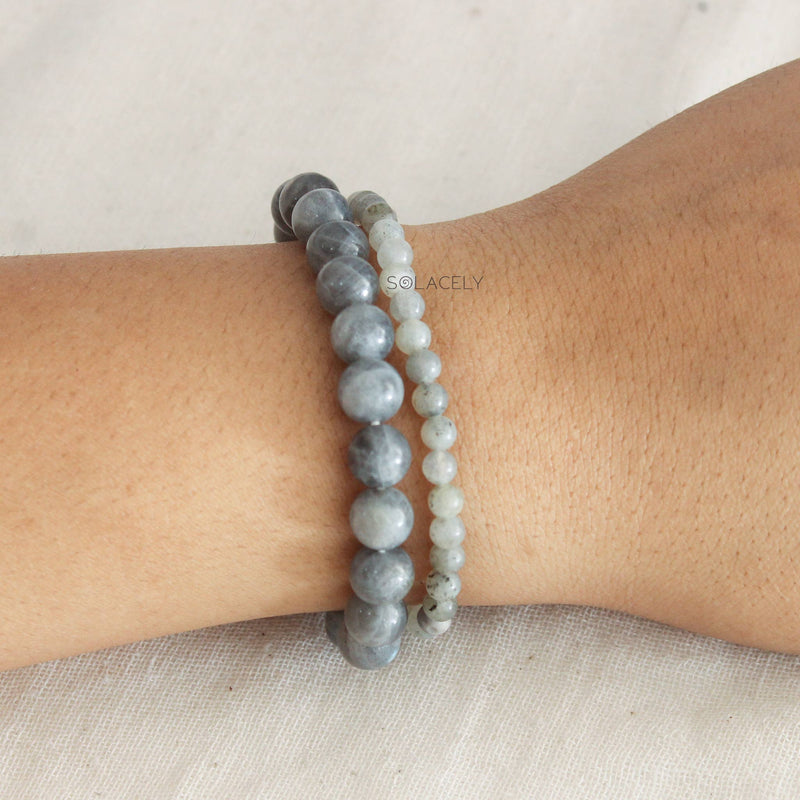
Use labradorite where the light will reach it and where a transition is happening. The three placements that get the most use are the wrist, the desk and the bedside. Worn as beads it stays in your eyeline all day, which is most of the point, since the flash only appears when you move.
A few practical ways people work with it:
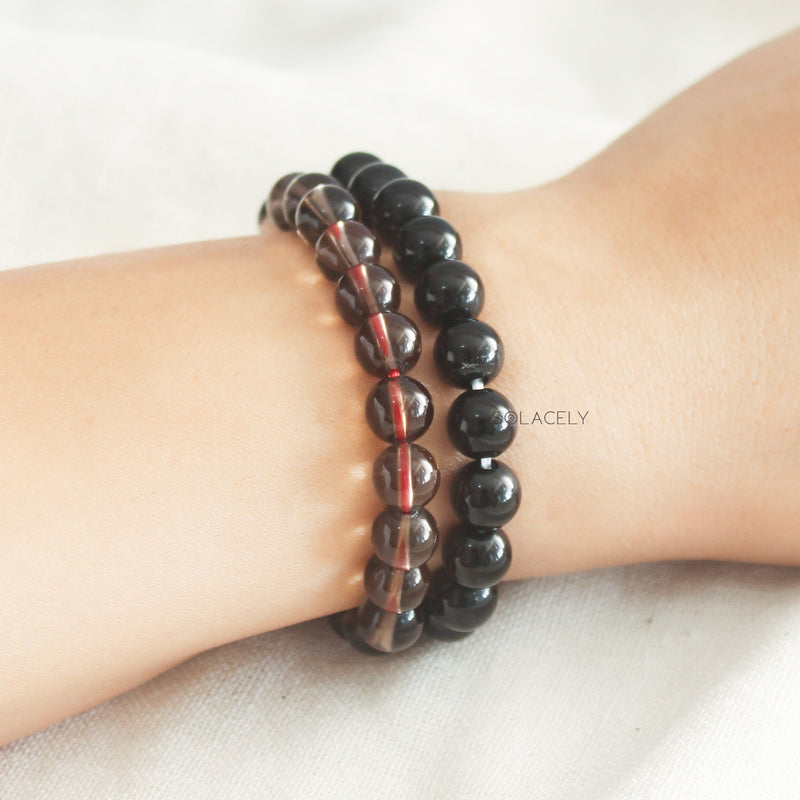
- As daily beads. On the wrist through a period of change, where the colour catches every time you turn your hand.
- On the desk. A palm stone within reach, picked up between tasks as a short reset.
- In meditation. At the brow or in the palm during a quiet sit, often at dusk rather than first thing.
- In a pocket. Carried to interviews, first days and difficult meetings as a private anchor.
- By the bed. Set beside a dream journal, since the stone is closely tied to noticing what surfaces overnight.
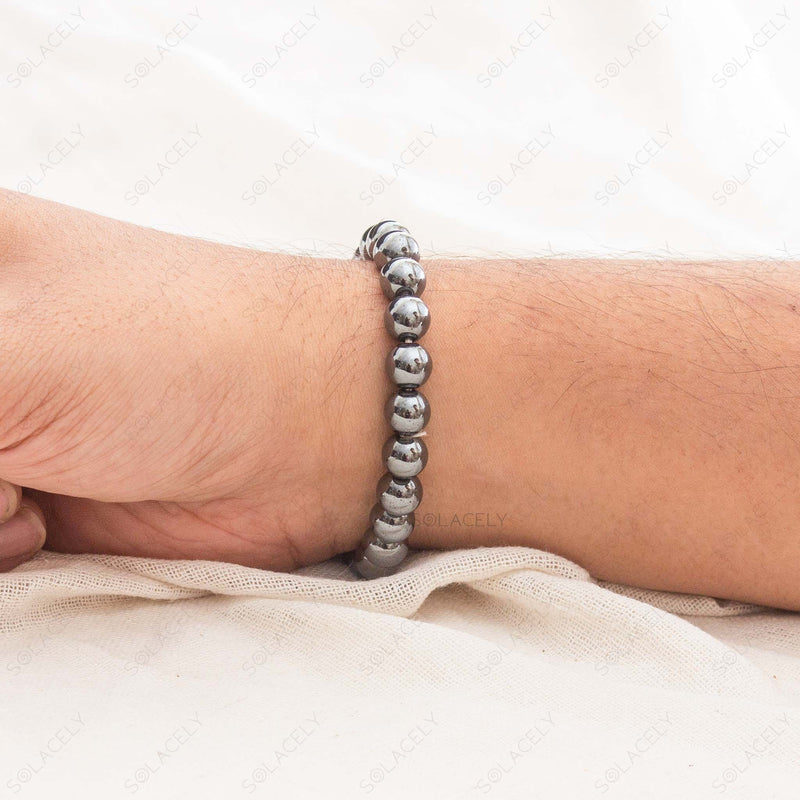
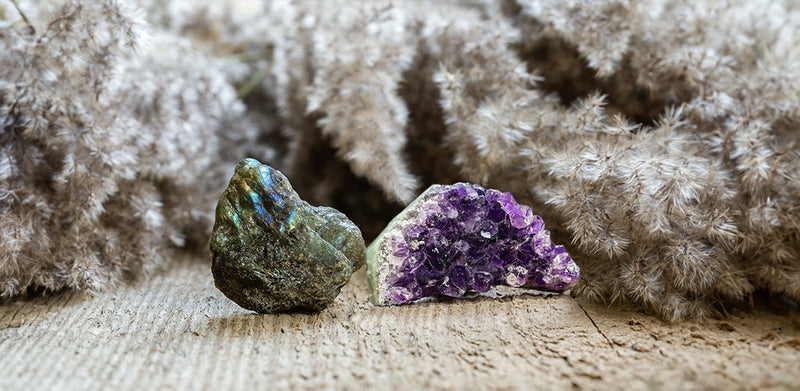
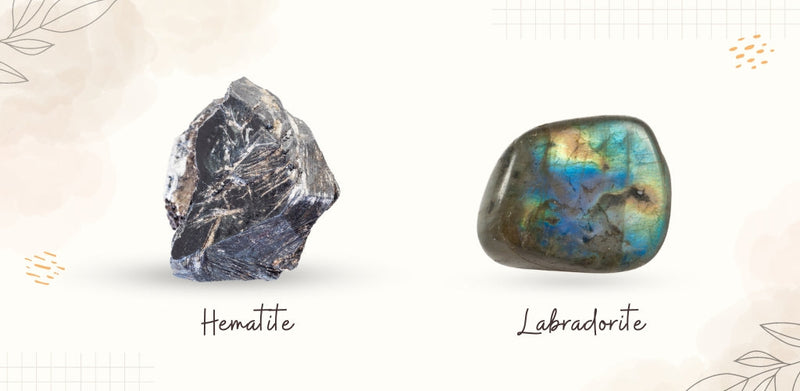
It pairs well. Amethyst is the classic partner for evening practice and intuitive work, a combination covered in the guide to amethyst and labradorite. Hematite offers the opposite pull, weight and focus against labradorite's movement, which is the subject of the guide to hematite and labradorite. Clear quartz is added when someone wants to sharpen an intention, and moonstone joins it for cycle work and softer evening ritual.
Caring for and choosing labradorite
Labradorite takes ordinary care. At about 6 to 6.5 on the Mohs scale it handles a brief rinse in cool water and a dry with a soft cloth without trouble. Its cleavage is the thing to respect: keep it off hard floors and out of ultrasonic and steam cleaners, and store it where it will not knock against other pieces.
Take bracelets off for the gym, for washing up and before swimming, since pool and spa chemicals are harsh on polished surfaces and on the elastic that holds beads together. Perfume, hairspray and hand cream dull the polish over time, so dress first and put the stone on last. Long spells in strong sun are best avoided for any coloured stone kept on a windowsill.
Cleansing is straightforward. Smoke from sage or palo santo, the sound of a bowl or chime, an hour on a selenite plate, or a night under the moon all suit it, and moonlight is the traditional favourite for a stone this closely tied to the dark. Set your intention while you hold it, then put it back where you actually use it.
When you are choosing a piece, start with the flash rather than the paperwork. Blue is the most familiar, green and gold are warmer on the skin, and pieces that show purple or a full sweep of colour are prized. Tilt the stone under the light you live with, whether that is a bright kitchen or a lamp lit evening room, because a cabochon that dazzles under shop spotlights can read very differently at home. Then look at the body tone, from pale storm grey to near black, and pick the one you want to keep looking at.
Crystals are kept for comfort, focus and ritual. They are not a treatment for any physical or mental health condition, and nothing here replaces advice from a qualified professional or any care that has already been arranged for you. Keep labradorite out of ultrasonic and steam cleaners, and never place stones in drinking water. Small beads and chips are a choking and strangulation risk, so keep them away from babies and young children.
Sources
Written by Chetena Sharma. Reviewed by the Solacely editorial team.
Frequently asked questions
About the author


Written by Chetna Sharma, crystal healing practitioner and co-founder of Solacely. Chetna has worked with healing crystals for over a decade and curates Solacely's protective stone collection.