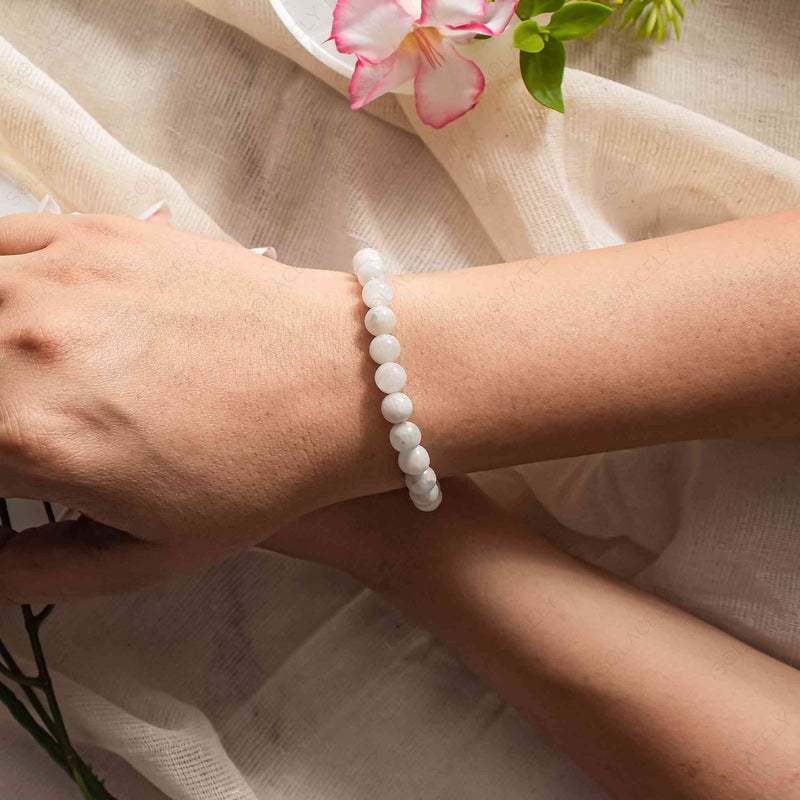
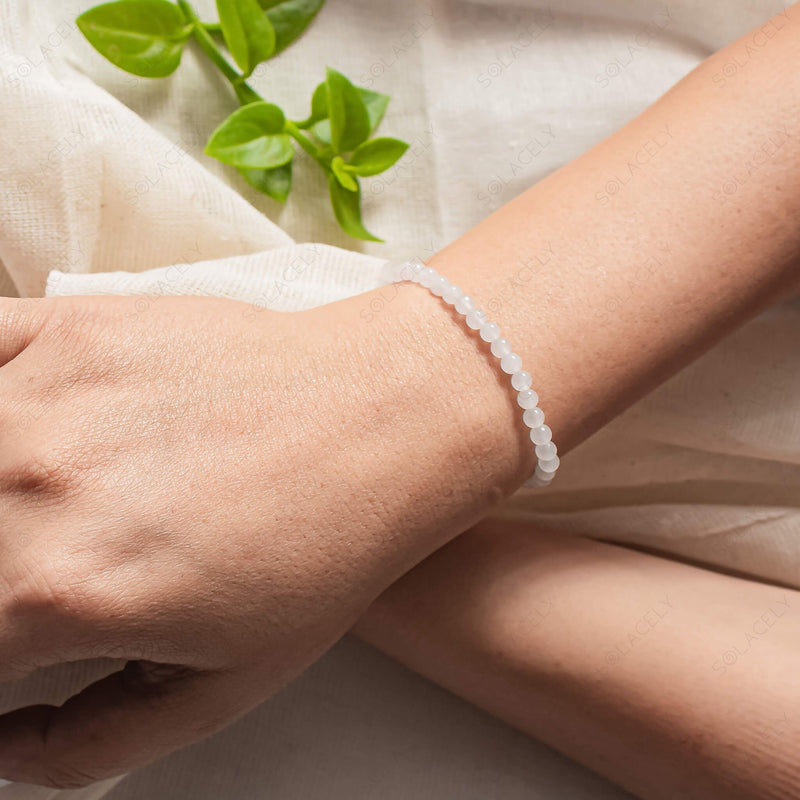
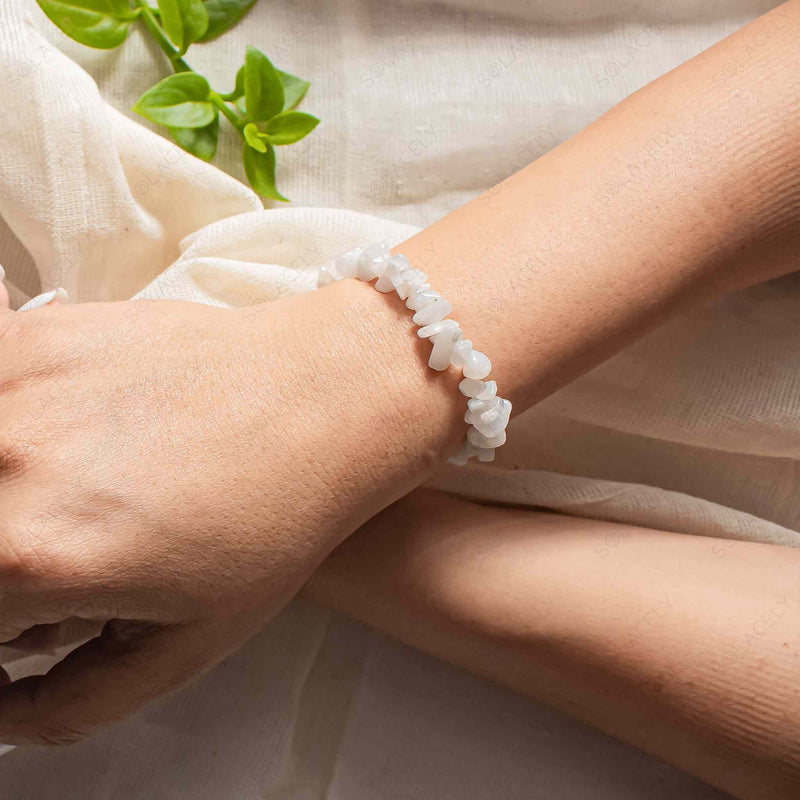
Moonstone is a feldspar whose floating blue sheen appears to sit just beneath the surface and moves as the stone turns. Traditionally kept for cycles, intuition and new beginnings, it is the stone most often given to mark a turning point rather than to push an outcome.
Key takeaways
- Moonstone is a potassium feldspar, and its appeal is optical rather than chemical.
- The floating sheen is called adularescence, caused by light scattering between microscopic internal layers.
- It sits at 6 to 6.5 on the Mohs scale with cleavage planes, so pendants outlast rings.
- Traditionally kept for cycles and beginnings, which is why it is the classic milestone gift.
- Rainbow moonstone is technically a labradorite, sold legitimately under the same name.
What moonstone actually is
Moonstone belongs to the feldspar group, and what makes it moonstone is not its chemistry but the way light behaves inside it. The Gemological Institute of America attributes the floating sheen to light scattering between microscopic layers within the stone, an effect named adularescence.
Floating is the right word for it. Unlike a surface shine, the glow appears to sit below the surface and drift across the stone as it turns, which is why moonstone looks alive in the hand and disappointingly flat in a photograph.
That has a direct practical consequence. Moonstone needs movement and daylight to do anything at all, so a bracelet or a pendant earns far more from the material than a piece kept in a drawer for special occasions.
What moonstone is kept for
The traditional association is with cycles, intuition and beginnings, and it is one of the more coherent associations in crystal practice because all three point the same way: toward something turning rather than something being achieved.
That is why moonstone is the classic milestone stone. It is given for a first period, a sixteenth birthday, a move to a new city, a return to work, or the start of a chapter somebody has been putting off. The occasion carries the meaning as much as the stone does.
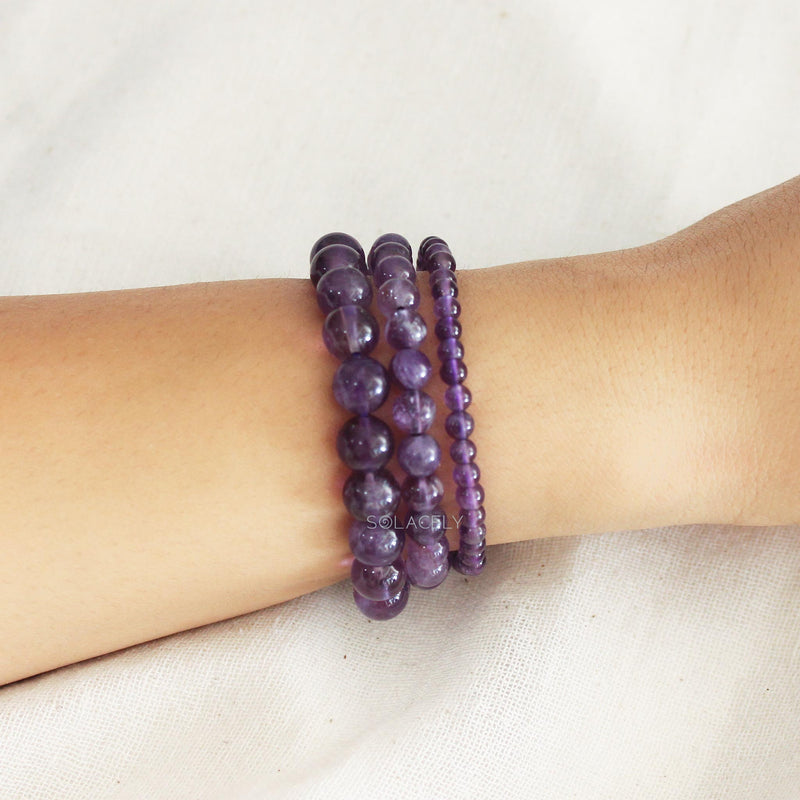
It also explains why moonstone suits evening practice better than daytime wear. For the pairing most often built around that, see amethyst and moonstone, which covers how the two work together at the end of a day.
Varieties worth knowing
Three names come up constantly and they are not quite interchangeable, which is worth understanding before spending money.
- Classic moonstone. Adularia feldspar with a single floating blue or white sheen. This is what the traditional associations describe.
- Rainbow moonstone. Technically a labradorite, showing flashes of several colours. Widely and legitimately sold as moonstone, and lovely in its own right.
- Peach moonstone. A warmer body colour with a softer sheen, generally less expensive and often more wearable day to day.
None of these is a substitute pretending to be something else. They are all genuine material, and the naming is trade convention rather than anything misleading. Choose on how the piece looks to you.
Choosing a good piece
| What to check | A good piece | A weak piece |
|---|---|---|
| Sheen travel | Glow moves across most of the stone | Narrow band at one angle only |
| Body | Translucent, with depth | Flat milky white, no movement |
| Colour of the flash | Strong blue, or clean multicolour | Faint grey with little contrast |
| Surface | Even polish, no chips at drill holes | Scuffs from transit, soft edges |
| Format | Pendant, earrings, bracelet | A ring intended for daily wear |
Tilt any piece slowly under a single light source before deciding. Shop lighting is designed to flatter, and a stone that only performs under a spotlight will look ordinary in daylight.
How moonstone is used
The practices are quiet and mostly happen at home, which suits the stone.
The most common is simply keeping it on a nightstand, where it marks the end of the day rather than the start. Beside that, people keep moonstone where a journal or calendar lives, which is the traditional cycle-aware use and the one the stone was historically given for.
Worn, it belongs on a wrist or at the throat where it will catch daylight and move. If intuition rather than cycles is the reason you are drawn to it, crystals for the third eye covers the wider group kept for perception.
Care and cleansing
Moonstone asks for a little more care than the quartz family, and the reason is structural rather than chemical. Like all feldspars it has cleavage planes, so a sharp knock can split a piece that has survived years of gentle wear without a mark.
Clean it with warm water, mild soap, a soft cloth and a full dry. Never use an ultrasonic or steam cleaner on a feldspar, since the cleavage makes it vulnerable to vibration, and take moonstone jewellery off before anything likely to knock it.
Store it away from quartz and harder beads, which will scratch it at 7 against moonstone's 6 to 6.5. For energetic cleansing, moonlight is both the traditional match and the gentlest option physically. If the stone is going to a child as a milestone gift, crystals for kids covers age-appropriate formats.
Who this stone suits
It suits people marking something rather than fixing something. That distinction is the most useful thing to know about moonstone, because it explains why it disappoints anyone who arrives wanting a stone to change how a difficult week feels.
What it does well is sit alongside a transition and make it feel deliberate. A stone given at a beginning, worn through the uncertain part, and still there afterwards carries a genuine weight of association by the end of it.
It also happens to be one of the most beautiful inexpensive stones available, which is a fair reason on its own. Good material is not expensive, and a well chosen moonstone pendant looks considerably better than its price suggests.
Where moonstone comes from
Sri Lanka has historically produced the finest classic moonstone, the near-colourless material with a strong blue sheen that commands the highest prices. India supplies most of the rainbow and peach material that fills the affordable end of the market, and both are entirely legitimate sources.
Origin matters less here than it does with sapphire or emerald, since moonstone is judged almost entirely on how well the sheen performs rather than on where it was mined. A well chosen Indian piece can easily outperform a mediocre Sri Lankan one, and it will cost considerably less.
If you are choosing moonstone to mark a beginning, crystals for new beginnings covers what else is traditionally given at the same moments.
The properties described here reflect traditional and cultural belief around crystals. They are offered for reflection and wellbeing and are not medical advice, a diagnosis, or a treatment for any condition, including anything relating to menstrual, hormonal or reproductive health. If you are managing a health concern, please speak with a qualified healthcare professional. Keep small stones away from young children, and never place crystals in drinking water.
Sources
Written by Chetena Sharma. Reviewed by the Solacely editorial team.
Frequently asked questions
About the author


Written by Chetna Sharma, crystal healing practitioner and co-founder of Solacely. Chetna has worked with healing crystals for over a decade and curates Solacely's protective stone collection.