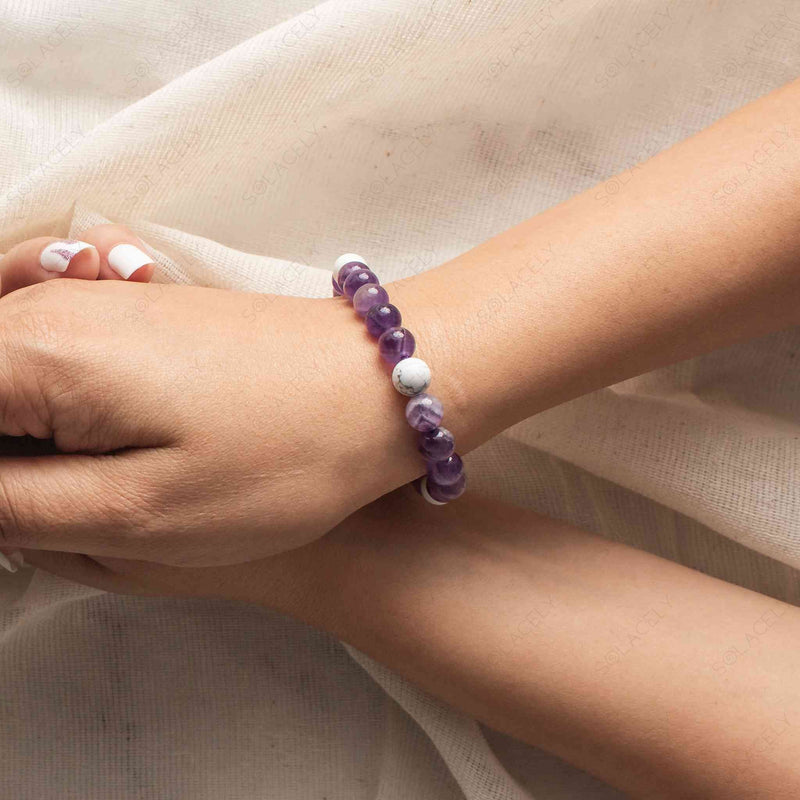
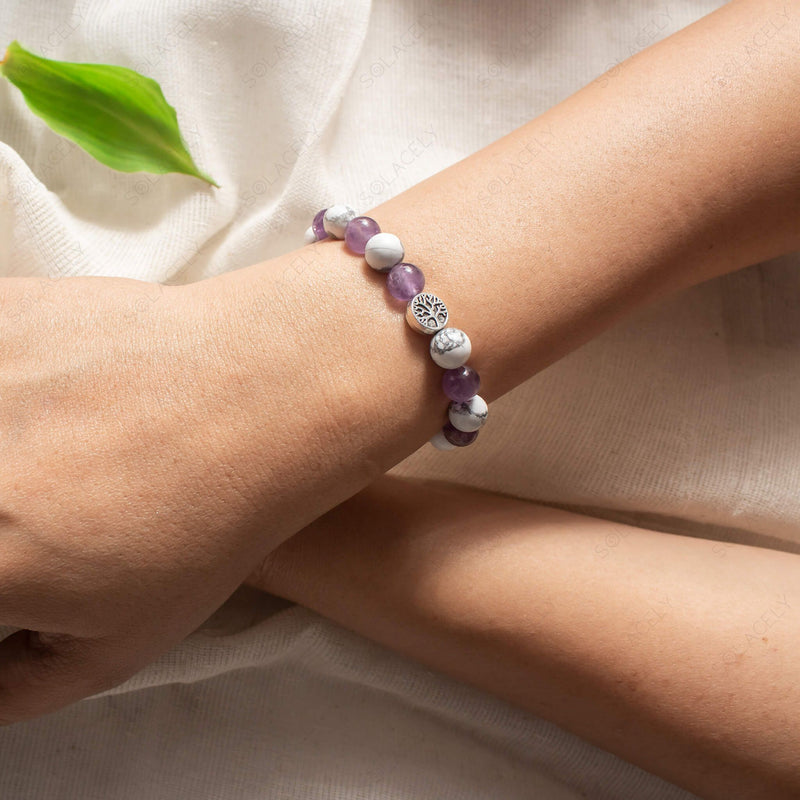
Precious stone bracelets are usually not made from precious stones. In gemmology, precious means only diamond, ruby, sapphire and emerald. Everything else, including amethyst, tiger's eye and lapis lazuli, is classed as semi-precious, a split the trade now treats as historical shorthand rather than a ranking of quality.
Key takeaways
- Only four gems carry the traditional precious label: diamond, ruby, sapphire and emerald. Every other stone is called semi-precious.
- The division is historical trade language, not a quality grade. Rarity, colour, clarity, cut and treatment decide what a stone is worth.
- For everyday wear, favour beads at Mohs 7 or above: quartz, agate, carnelian, tiger's eye, garnet and aquamarine.
- Soft or porous beads such as selenite, howlite, malachite and fluorite are better kept for occasional wear.
- Stretch cord relaxes with heavy use and needs restringing; store the strand flat and keep it clear of perfume and lotion.
What counts as a precious stone?
Four stones carry the traditional precious label: diamond, ruby, sapphire and emerald. Everything else is semi-precious. The division comes from nineteenth century European trade rather than from mineralogy, and modern gemmological reference work catalogues dozens of gem species without treating that two-tier split as a measure of worth.
Hardness helps explain why those four were singled out. The Mohs scale places diamond at 10 and corundum, the mineral species behind both ruby and sapphire, at 9. Those are the two hardest gem materials in common use, so they hold a polish for decades.
Emerald breaks the pattern. It is a beryl, sitting around 7.5 to 8 on the same scale, yet it is one of the more delicate gems in the jewellery box. Gemmological reference work notes that emeralds characteristically carry inclusions and fine surface-reaching fissures. Settling those with oil or resin is long established, entirely routine practice across the coloured stone trade, and it is part of what gives a good emerald its even, glowing green.
That is the quiet contradiction in the word precious. An emerald bead will chip on a doorframe long before a plain quartz bead does. Prestige and practicality are not the same thing, and a bracelet lives a rougher life than a ring in a box.
Are semi-precious bracelet stones lower quality?
The label describes trade tradition, not quality. Gemmological reference works catalogue a wide range of minerals and organic materials used as gems, from everyday quartz through to species rarer than diamond. Fine jadeite and top-colour tanzanite regularly outprice commercial ruby, yet both sit on the semi-precious side of the old line.
What actually sets value is a shorter list: rarity, colour saturation, clarity, quality of cutting, size and whether the stone has been treated. None of those tracks the precious label reliably. A muddy, heavily filled ruby is a poorer stone than a crisp, evenly banded piece of agate, whatever the two are called.
Bracelets shift the maths again. Almost all beads are commercial grade material bought by the strand, so the things worth paying for are colour evenness, polish and a clean drill hole. If you enjoy the rarity angle, the round-up of the most expensive crystals shows how far the price range stretches at the top end.
What should you look for when buying a stone bracelet?
Judge four things before you judge the stone: bead consistency, polish and colour evenness, how the piece is strung, and whether the material can survive your wrist. Those four decide whether a bracelet still looks good in a year. Species name and marketing language decide almost nothing.
Bead consistency and drilling
Line the beads up and look along the strand. Good beads sit close to the same diameter and read as properly round rather than slightly barrelled, so the strand curves smoothly around your wrist instead of kinking. Flat spots and stray tool marks are easy to see once you know to look for them.
Then check the holes. Drill holes should be centred and clean, without chipping at the rim. Off-centre drilling makes a bracelet sit crookedly and puts uneven strain on the cord, which is a common reason strands snap early.
Polish and colour evenness
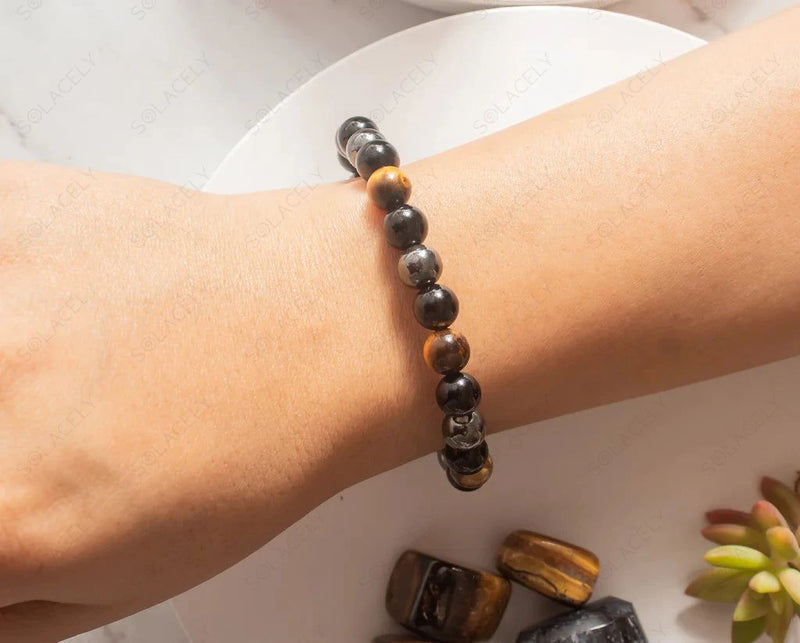
Polish is the easiest quality signal to read, and it is the one you will notice every day. Tilt the strand under a lamp and watch the highlight travel across the beads. A well finished bead throws a bright, continuous reflection. On banded and chatoyant stones such as agate and tiger's eye, a good polish is what makes the bands and the moving silk stripe come forward.
Colour evenness is a matter of taste as much as grade. Beads cut from a single block match closely and read as calm and deliberate on the wrist, which suits a strand you want to wear with everything. Beads drawn from several blocks give you tonal variation, and on stones like sodalite, labradorite and jasper that variation is half the appeal.
So decide which look you are after before you buy, then check the whole strand delivers it rather than just the few beads facing the camera. Turn the bracelet all the way round in your hand. The beads at the back should belong to the same piece as the ones at the front.
Stretch cord or beading wire?
Stretch cord is the default for beaded bracelets because it slips on without a clasp and absorbs knocks. It also relaxes over time. With daily wear, expect to restring roughly once a year, and sooner if the cord looks slack, fuzzy or shiny where it passes through the beads.
Beading wire with a clasp holds its sizing far better and carries heavier or higher value beads more safely. The trade-off is convenience: a clasp is fiddly one-handed. Our wider notes on choosing bead material sit in the guide to choosing crystals for bracelets.
Which bracelet stones survive daily wear?
Anything at Mohs 7 or above copes with daily wear comfortably. Household dust contains quartz particles at hardness 7, so softer beads pick up a dull, scratched surface simply from being worn and wiped. That single fact, drawn from the Mohs scale, explains most of the wear you see on older bracelets.
| Stone | Mohs hardness | Suitability for daily wear |
|---|---|---|
| Aquamarine | 7.5 to 8 | Good, avoid hard knocks |
| Amethyst, rose quartz, clear quartz | 7 | Good |
| Tiger's eye | 7 | Good |
| Garnet | 6.5 to 7.5 | Good |
| Carnelian and agate | 6.5 to 7 | Good |
| Amazonite | 6 to 6.5 | Fair, cleaves if struck |
| Moonstone | 6 to 6.5 | Fair, cleaves if struck |
| Sodalite | 5.5 to 6 | Fair, scratches over time |
| Lapis lazuli | 5 to 6 | Fair, porous, keep it dry |
| Obsidian | 5 to 5.5 | Fair, chips at the edges |
| Fluorite | 4 | Occasional wear only |
| Malachite | 3.5 to 4 | Occasional wear only |
| Howlite | 3.5 | Occasional wear only |
| Selenite | 2 | Not suited to wrists, water sensitive |
None of this means you should refuse a soft stone. It means you should place it thoughtfully: selenite on a shelf, malachite in a pendant, fluorite on a bracelet you wear on quiet days rather than at the gym.
How should a stone bracelet fit, and how do you stack them?
Measure first. Wrap a soft tape or a strip of paper around the narrowest part of your wrist, mark it, then add roughly one to one and a half centimetres. That allowance lets the strand rotate freely without sliding over your hand, which is the fit most people find comfortable for all-day wear.
Bead diameter changes the sum. A 10 mm bead sits further from your skin than a 6 mm bead, so a chunky strand needs more slack than a delicate one to feel identical. Buying two bracelets at the same stated length in different bead sizes is the usual reason one of them feels tight.
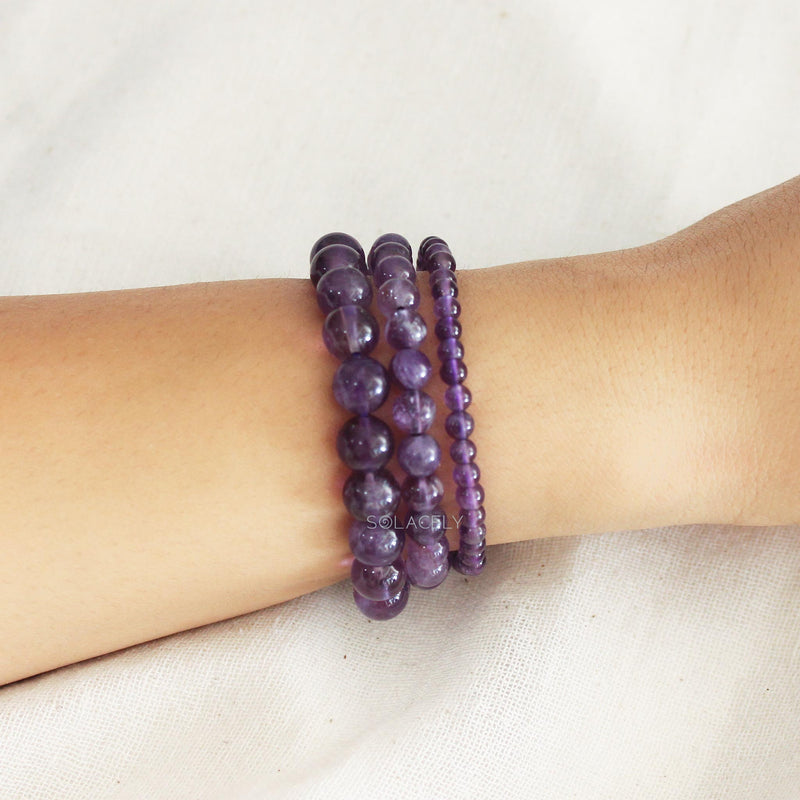
For stacking, keep hardness in mind. A quartz strand rubbing against selenite will slowly sand it down, so group beads of similar hardness together or separate them with a metal or wood strand. Two or three bracelets per wrist is the practical ceiling before typing and sleeves become annoying.
Which wrist you choose is mostly personal preference, though several traditions have firm opinions about it. The reasoning behind those customs is set out in our guide to which hand to wear a crystal bracelet on. If you are assembling a first set, the walkthrough for crystal bracelets for beginners covers pairing and sequencing.
How do you care for a stone bracelet?
Put it on last and take it off first. Perfume, hairspray, sunscreen and hand lotion leave a film that dulls polish and works away at the cord. Removing a bracelet before the gym, swimming, cleaning and sleeping prevents most of the damage that shortens a strand's life.
Clean gently. A soft cloth, barely damp, wiped along the strand is enough for the great majority of beads. Do not soak stretch bracelets: water weakens elastic and porous stones such as lapis lazuli, turquoise and howlite absorb liquid and can lose colour. Dry the piece fully before storing it flat rather than hanging it, since hanging stretches the cord.
Light matters too. Amethyst's colour can fade with prolonged exposure to strong light, which is worth remembering before leaving a purple strand on a sunny windowsill to charge. Moonlight, sound or a rest on a selenite plate does the same job for cleansing without the risk.
Finally, inspect the stringing every few months. Slack cord, fraying at the knot, or beads that have started to rotate loosely are all signals to restring before the strand fails in a supermarket car park. Restringing costs very little and saves the beads.
The properties described here reflect traditional and cultural belief around crystals. They are not medical claims and are not a substitute for professional healthcare. If you are managing a health concern, speak to a qualified practitioner.
Sources
Written by Chetena Sharma. Reviewed by the Solacely editorial team.
Frequently asked questions
About the author


Written by Chetna Sharma, crystal healing practitioner and co-founder of Solacely. Chetna has worked with healing crystals for over a decade and curates Solacely's protective stone collection.