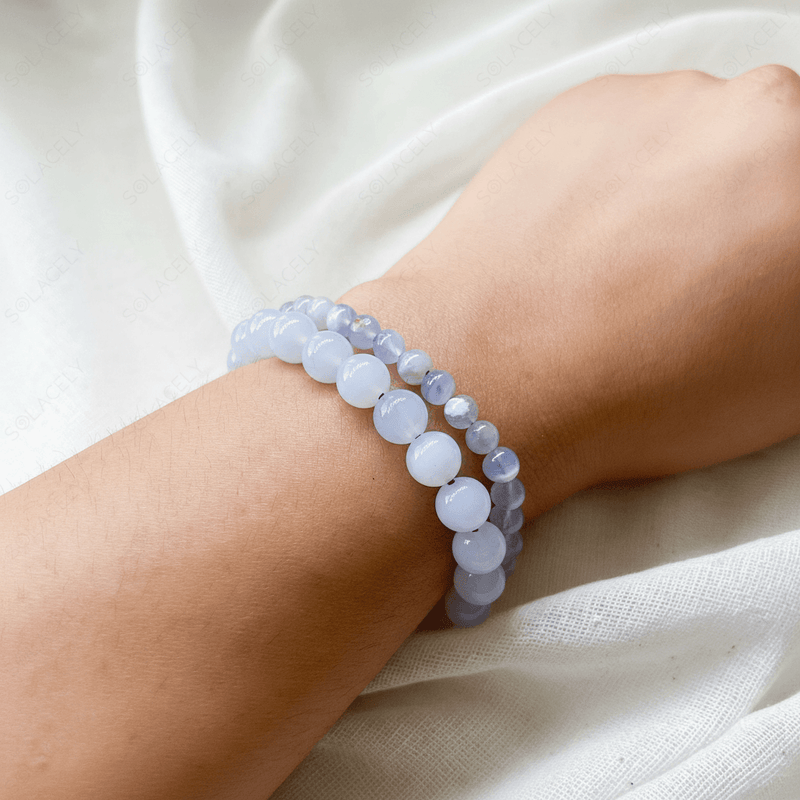
Blue apatite and lapis lazuli pair two blue stones kept for the mind. Apatite is traditionally associated with clarity and focus, lapis with wisdom, truth and self-knowledge. Together they are chosen by people studying, writing, or working something out properly.
Key takeaways
- Blue apatite is kept for clarity, focus and motivation; lapis lazuli for wisdom, truth and insight.
- Lapis is a rock rather than a single mineral, mainly lazurite with golden pyrite and white calcite.
- Both are soft: apatite around 5 on the Mohs scale, lapis around 5 to 5.5.
- The pyrite flecks in lapis mean it should never be soaked or salt cleansed.
- The pairing suits study, writing and long thinking rather than quick decisions.
What lapis lazuli is
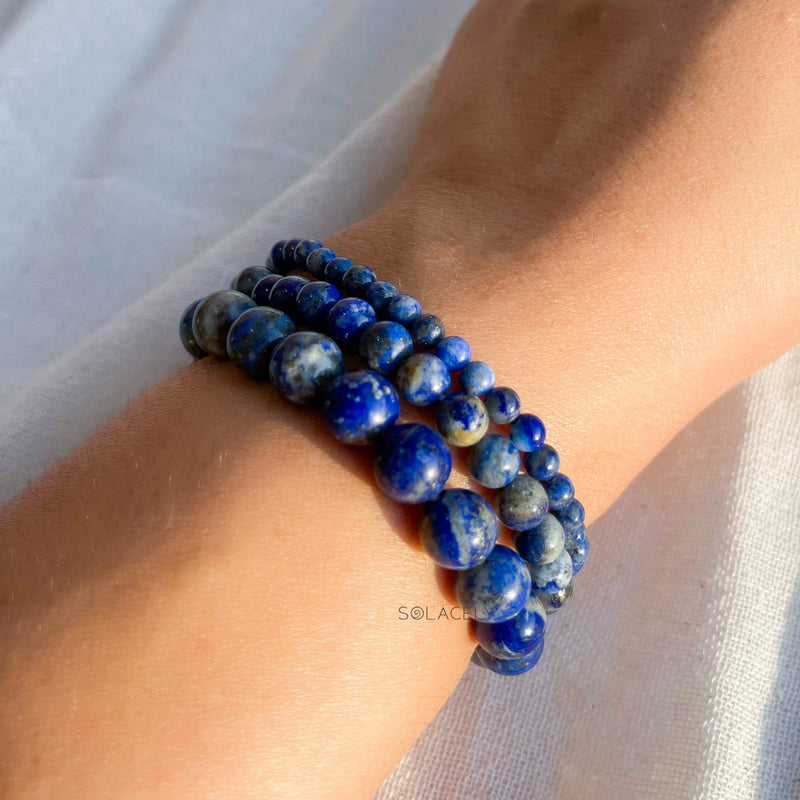
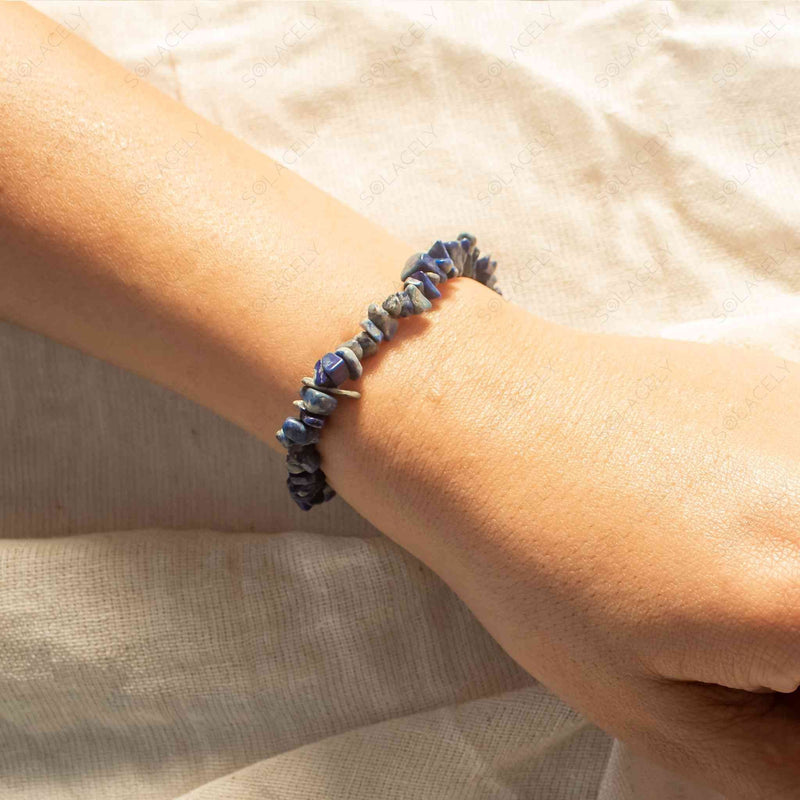
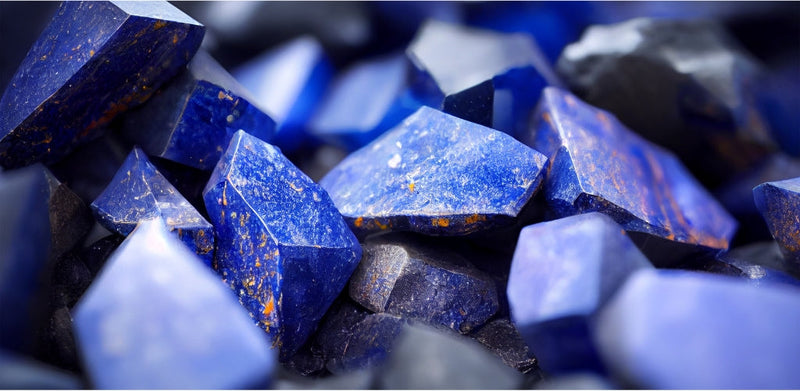
Lapis lazuli is a rock rather than a single mineral, made mainly of lazurite with flecks of golden pyrite and veins of white calcite running through it. That combination is what gives it the deep midnight blue scattered with gold that has been prized for thousands of years.
Its history is remarkable. It was mined in the mountains of Afghanistan for over six thousand years, traded across the ancient world, set into Egyptian jewellery and burial masks, and ground into ultramarine, the most expensive pigment in Renaissance painting.
In crystal tradition it is the stone of wisdom and truth, kept for self-knowledge and for saying what is actually so. That association is old and consistent, and it is why lapis turns up so often in the hands of writers and students. The lapis lazuli guide covers it fully.
What blue apatite adds
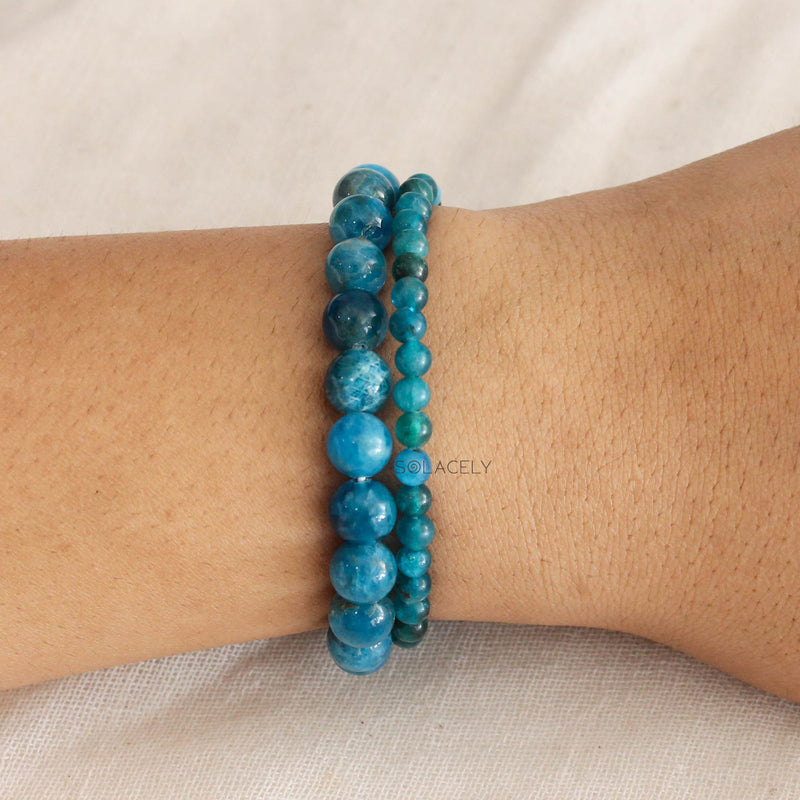
Blue apatite is a calcium phosphate, brighter and more transparent than lapis, running from soft sea blue to a vivid teal. Where lapis is deep and still, apatite is lively, and that difference is the whole point of putting them together.
Traditionally it is kept for clarity and focus, and unusually among blue stones it is also associated with motivation. People reach for it when they know what they need to do and cannot quite get the thinking to start moving.
So the two split the work neatly. Lapis handles depth and honesty, the long look at something. Apatite handles the getting on with it. For a study set, that combination covers both the wanting to understand and the actually sitting down.
Why the pairing works
Both stones sit with the throat and third eye centres in chakra practice, so they are a natural traditional pairing, and in practice they suit sustained mental work rather than quick decisions.
The recurring picture is somebody in the middle of something long. A course, a dissertation, a book, a career change that requires learning a new field. In each case the difficulty is not a single decision but keeping going through a stretch of not yet understanding.
Lapis is the stone people describe as helping them sit with not knowing yet, which is exactly what long study requires. Apatite keeps that from becoming rumination. Together they make one of the more coherent sets for anyone whose work is mostly thinking.
Comparing blue apatite and lapis lazuli
| Blue apatite | Lapis lazuli | |
|---|---|---|
| Material | Calcium phosphate mineral | Rock: lazurite, pyrite and calcite |
| Look | Bright sea blue to teal, often translucent | Deep midnight blue with gold flecks |
| Hardness | Around 5 Mohs | Around 5 to 5.5 Mohs |
| Traditionally kept for | Clarity, focus, motivation | Wisdom, truth, self-knowledge |
| Water | Brief wipe only | Never soak. Pyrite content dislikes water |
| Best format | Pendant, tumbled stone | Pendant, beads, carved piece |
Both are soft by collection standards, so keep them away from quartz family stones in storage. Lapis in particular shows scratches readily because its polish is what carries the depth of colour.
How to use the pair
This is a working set, so it belongs where the work happens rather than at a bedside.
- On a desk. Both within sight, apatite nearer the notebook and lapis nearer where you read.
- Worn while studying. A lapis pendant is the traditional scholar's choice and still a lovely one.
- Held at the start of a session. Apatite for a few slow breaths before beginning.
- As a gift for a student. The pair reads as thoughtful and lasts well beyond the course.
If the goal is learning specifically, crystals for knowledge and wisdom covers the wider set, and crystals for the third eye covers the centre both stones sit with.
Caring for both
Lapis has one firm rule that comes from its composition. Because it contains pyrite, it should never be soaked or salt cleansed, and it is happiest kept dry. A soft, barely damp cloth wiped over and dried at once is the whole method.
Blue apatite wants much the same treatment. Both are porous enough that household chemicals, perfume and hairspray will dull them over time, so put jewellery on after cosmetics have dried and take it off before cleaning.
Neither should go near an ultrasonic or steam cleaner. For energetic cleansing, moonlight, sound or a rest on selenite all suit the pair. If you would like a green partner for apatite instead, blue apatite and green aventurine covers a different combination entirely.
Choosing a lapis piece
Colour is what you are choosing between. The most prized lapis is a deep, even royal blue with a scattering of fine gold pyrite and little visible white calcite, though plenty of people prefer more gold or more marbling for the character it gives.
Look at the polish, since lapis relies on it. A good piece has a smooth, slightly waxy sheen without dull or chalky patches, and the gold flecks should catch light rather than looking flat. Check the edges for chips, as with any softer stone.
Beyond that, buy what you like. Because the proportions of lazurite, pyrite and calcite vary from piece to piece, every lapis stone looks slightly different, which makes this genuinely a stone to choose by eye rather than to a specification.
Lapis in history
Few materials have travelled as far or mattered as much. Lapis was mined in the Sar-e-Sang valley in Afghanistan for over six thousand years, and from there it moved along trade routes into Mesopotamia, Egypt and eventually Europe, which for most of that period made it one of the most valuable substances a person could own.
It was set into the funerary mask of Tutankhamun, carved into Sumerian cylinder seals, and inlaid across the ancient Near East wherever a deep, unfading blue was wanted. Nothing else available at the time came close to that colour.
Its second life was as pigment. Ground and purified into ultramarine, lapis became the most expensive colour on a Renaissance painter's palette, reserved by contract for the most important passages in an altarpiece. That history is a large part of why the stone still reads as serious.
Building a study set
Two stones is usually enough, and the third only earns its place if there is a specific gap.
- Add fluorite if the difficulty is structuring rather than understanding, kept on a dish beside the plan.
- Add clear quartz as a neutral anchor if the desk feels like it needs a centre.
- Add amethyst if the studying is happening at the expense of sleep, kept in the bedroom instead.
- Keep it to three. A crowded desk stops signalling anything in particular.
The properties described here reflect traditional and cultural belief around crystals. They are offered for reflection and wellbeing and are not medical advice, a diagnosis, or a treatment for any condition. If you are managing a health concern, please speak with a qualified healthcare professional. Keep small stones away from young children, and never place crystals in drinking water.
Sources
Written by Chetena Sharma. Reviewed by the Solacely editorial team.
Frequently asked questions
About the author


Written by Chetna Sharma, crystal healing practitioner and co-founder of Solacely. Chetna has worked with healing crystals for over a decade and curates Solacely's protective stone collection.