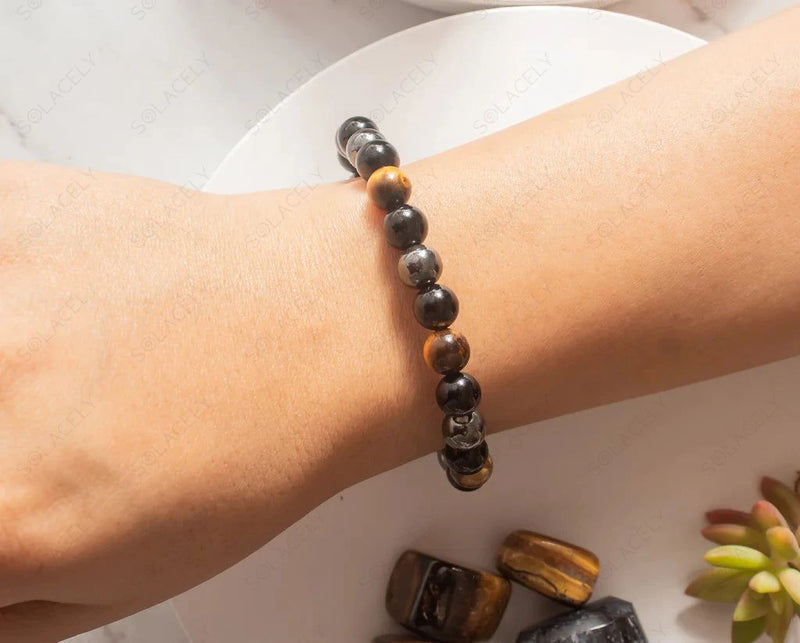
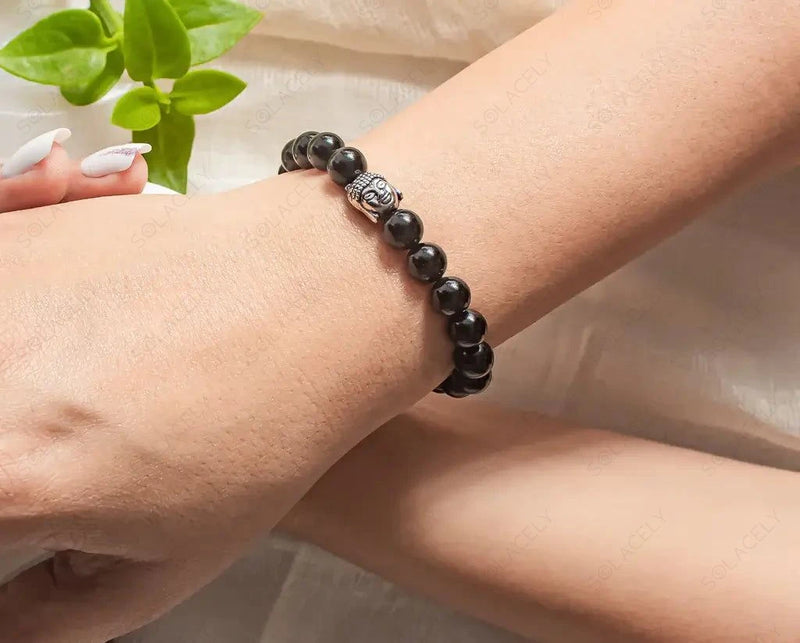
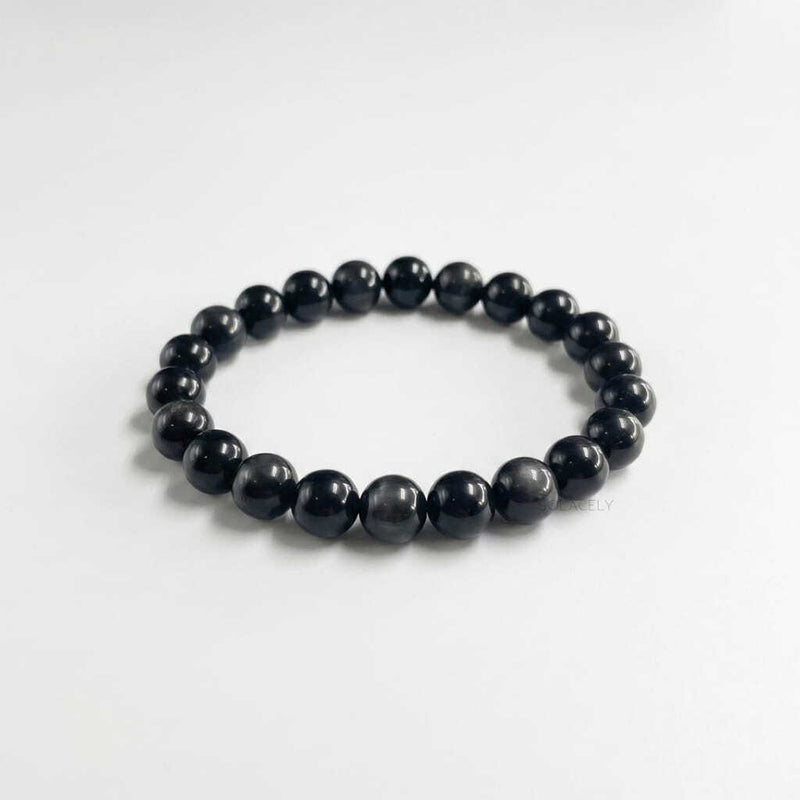
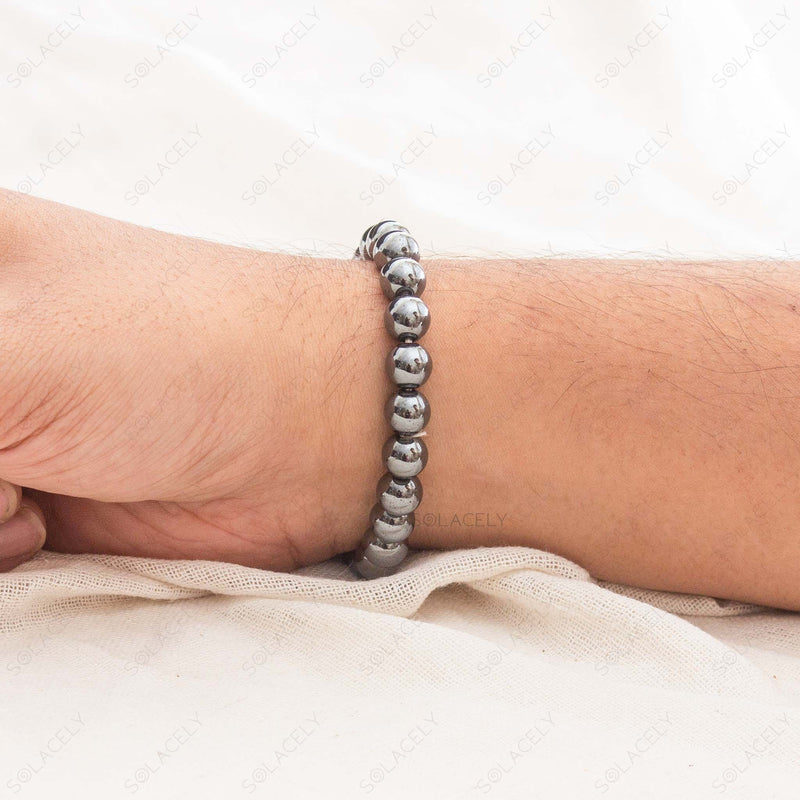
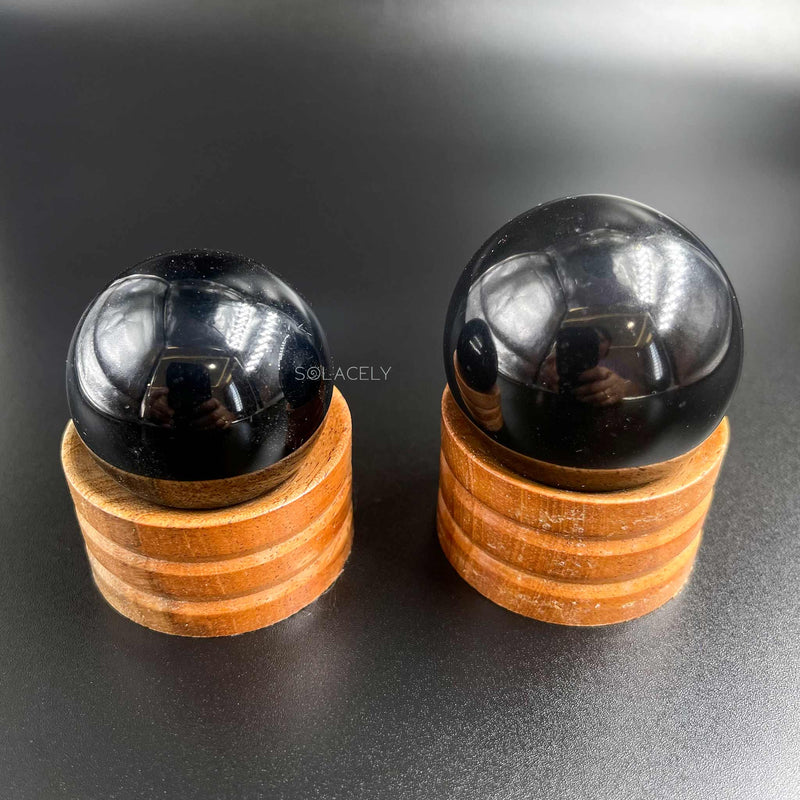
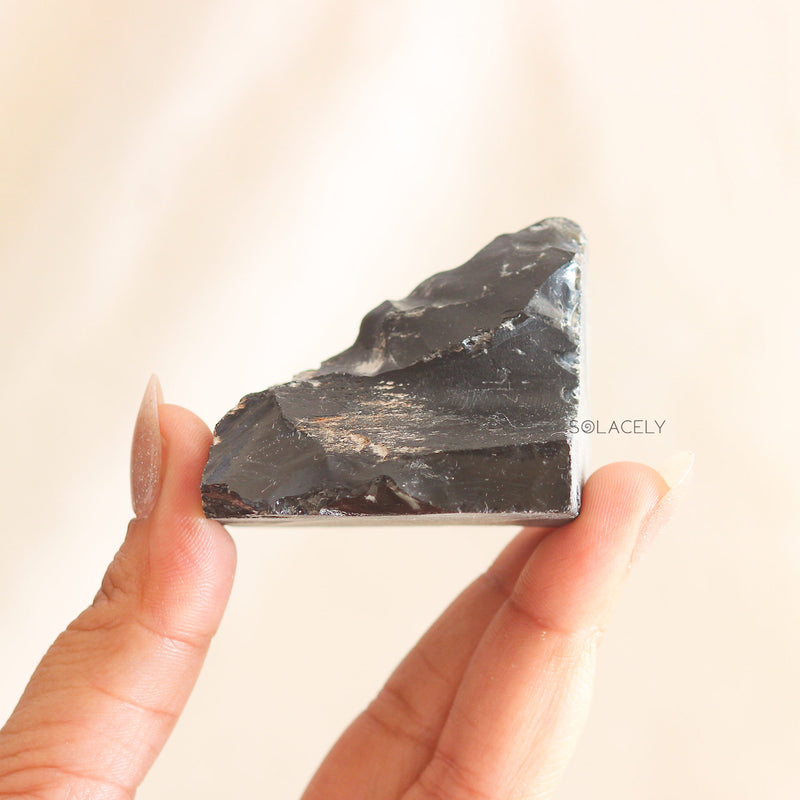
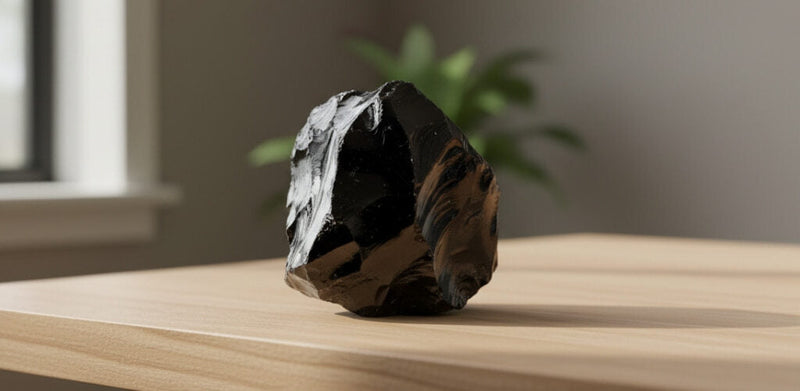
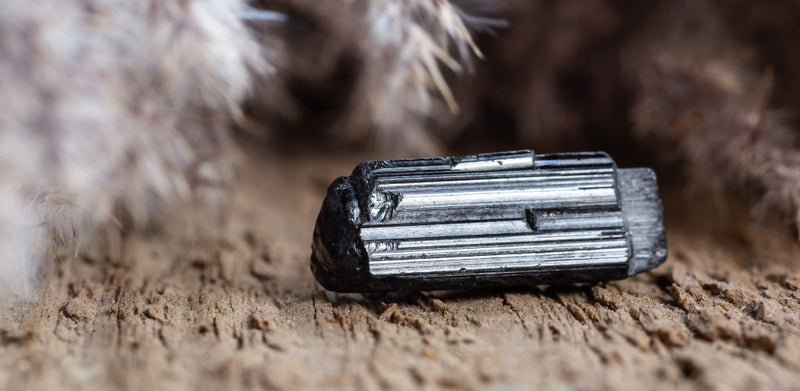
Black obsidian is volcanic glass, formed when lava cools too fast to crystallise. Black tourmaline, or schorl, is a true crystal, a boron silicate that grows in long striated columns. Obsidian is traditionally the mirror stone that shows you what you are carrying. Tourmaline is the anchor that keeps you steady.
Key takeaways
- Obsidian is natural glass with no crystal structure. Black tourmaline is a crystalline boron silicate called schorl.
- Tourmaline is harder, at 7 to 7.5 on the Mohs scale, against obsidian at 5 to 5.5.
- Obsidian fractures to a glassy edge that can be genuinely sharp. Tourmaline breaks along its length instead.
- In tradition obsidian is the truth-telling mirror and tourmaline is the grounding anchor.
- They work well together, and many people keep tourmaline for daily wear and obsidian for deliberate inner work.
What is black obsidian?
Black obsidian is volcanic glass. When silica-rich lava cools so quickly that atoms have no time to arrange themselves into a lattice, the result is glass rather than crystal, and that glassy nature is the source of everything distinctive about obsidian: the deep gloss, the conchoidal fracture and the famously keen edge.
It has been worked by human hands for tens of thousands of years, flaked into blades, arrowheads and scrapers long before metal, and polished into mirrors in Mesoamerica. That history of being both a cutting tool and a looking glass sits underneath its modern reputation as the stone that shows you things plainly.
At 5 to 5.5 on the Mohs scale it is softer than quartz, so it scratches more readily and chips at the edges if knocked. Polished spheres, palm stones and beads are the usual forms, and a smooth obsidian palm stone is a genuinely satisfying thing to hold.
What is black tourmaline?
Black tourmaline is schorl, the iron-rich member of the tourmaline family. Unlike obsidian it is properly crystalline, growing in elongated three-sided columns with deep lengthwise striations that are unmistakable once you have seen them. Those grooved black rods are what raw tourmaline looks like.
Tourmaline is pyroelectric and piezoelectric, meaning it develops a small electrical charge when its temperature changes or when it is put under pressure. That is a genuine and well documented physical property of the mineral, and it is a large part of why the stone acquired its long-standing protective reputation.
At 7 to 7.5 on the Mohs scale it is harder than quartz and considerably tougher in wear than obsidian, which is why black tourmaline bracelets hold up so well to daily use. Our fuller guide to black tourmaline meaning and properties covers the stone on its own terms.
Black obsidian compared with black tourmaline
Both are black, both are kept for protection, and there the similarity ends. One is glass and one is crystal, and that difference runs all the way through how they look, how they wear and what people traditionally use them for.
| Black obsidian | Black tourmaline | |
|---|---|---|
| What it is | Volcanic glass, no crystal structure | Schorl, a crystalline boron silicate |
| Appearance | Deep glossy black, glassy sheen | Matte to satiny black, lengthwise striations |
| Hardness | 5 to 5.5 | 7 to 7.5 |
| How it breaks | Curved glassy fracture, sharp edges | Along the length of the column |
| Notable physics | Amorphous, holds a keen edge | Pyroelectric and piezoelectric |
| Traditionally kept for | Seeing clearly, releasing what is held | Grounding, steadiness, shielding |
| Best for | Deliberate inner work, meditation, home placement | Everyday wear, desks, doorways |
When to choose which
Choose black tourmaline when you want steadiness through ordinary days. It is the wearable one, hard enough for a bracelet you never take off, and it is what people keep beside a desk, near a router or at a front door. If the feeling you want is grounded, tourmaline is the stone.
Choose black obsidian when you are ready to look at something. It is the mirror stone, traditionally used for the kind of honest self-reflection that surfaces what has been avoided, which is why practitioners tend to reach for it deliberately rather than wear it constantly. Its energy is often described as direct.
People frequently describe the two quite differently in practice. Tourmaline feels like weight in the pocket, a settling and a slowing. Obsidian feels sharper and more revealing, and many people find it best used in sessions with a clear purpose rather than as constant company. Neither reaction is a rule, and yours may differ.
There is also a straightforward practical answer. If the piece will be knocked about, worn to work, taken to the gym, handled by everyone in the house, tourmaline survives that better. Obsidian belongs somewhere calmer, and our note on black obsidian and feng shui covers where it is traditionally placed at home.
Can you use them together?
Yes, and the pairing is a classic one. In crystal tradition the two do different jobs that complement each other neatly: obsidian brings something into view and tourmaline gives you the ground to stand on while you look at it. Used together the sharpness of the first is tempered by the steadiness of the second.
The common arrangement is tourmaline worn or carried through the day and obsidian kept for a specific sitting: a palm stone held during meditation, or a sphere placed on the table for journalling. Some people keep both at a doorway, tourmaline for the threshold and obsidian on the shelf beside it.
If you would rather build outward from tourmaline, it pairs generously with other stones. Selenite is the usual partner for lightening its weight, hematite for reinforcing the grounding, and citrine for warmth. Our guide to black tourmaline crystal combinations sets out the pairings.
Caring for both stones
Tourmaline is the low-maintenance one. Warm soapy water and a soft cloth suit it, it tolerates handling, and a bracelet worn daily will still look right in a year. Store it away from anything harder, and dry it properly if it does get wet.
Obsidian needs more care because it is glass. Handle polished pieces gently, keep them off hard floors and away from other stones that could scratch the gloss, and check raw or knapped pieces for genuinely sharp edges before you hand one to anyone. Wipe with a soft dry cloth rather than scrubbing.
Both are traditionally cleansed often, since they are protective stones and the tradition holds that they take on what they deflect. Sound, incense smoke and moonlight suit both and risk neither. A brief rinse is fine for tourmaline. Our step-by-step on how to cleanse and charge crystals covers the methods in order.
The properties described here reflect traditional and cultural belief around crystals. They are not medical claims, they are not claims about physical shielding, and they are not a substitute for professional healthcare. If you are managing a health concern, speak to a qualified practitioner. Obsidian is a natural glass and broken or knapped pieces can have genuinely sharp edges, so handle them carefully and keep them away from babies and young children.
Sources
- Geology.com, Obsidian: volcanic glass, formation and properties
- Geology.com, Tourmaline: schorl, structure and pyroelectricity
Written by Chetena Sharma. Reviewed by the Solacely editorial team.
Frequently asked questions
About the author


Written by Chetna Sharma, crystal healing practitioner and co-founder of Solacely. Chetna has worked with healing crystals for over a decade and curates Solacely's protective stone collection.