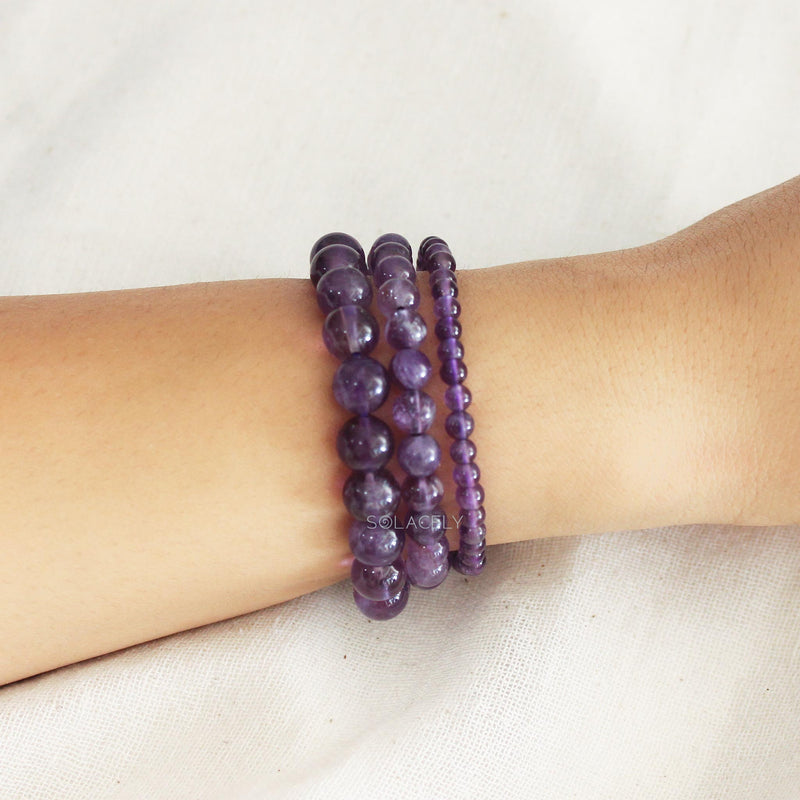
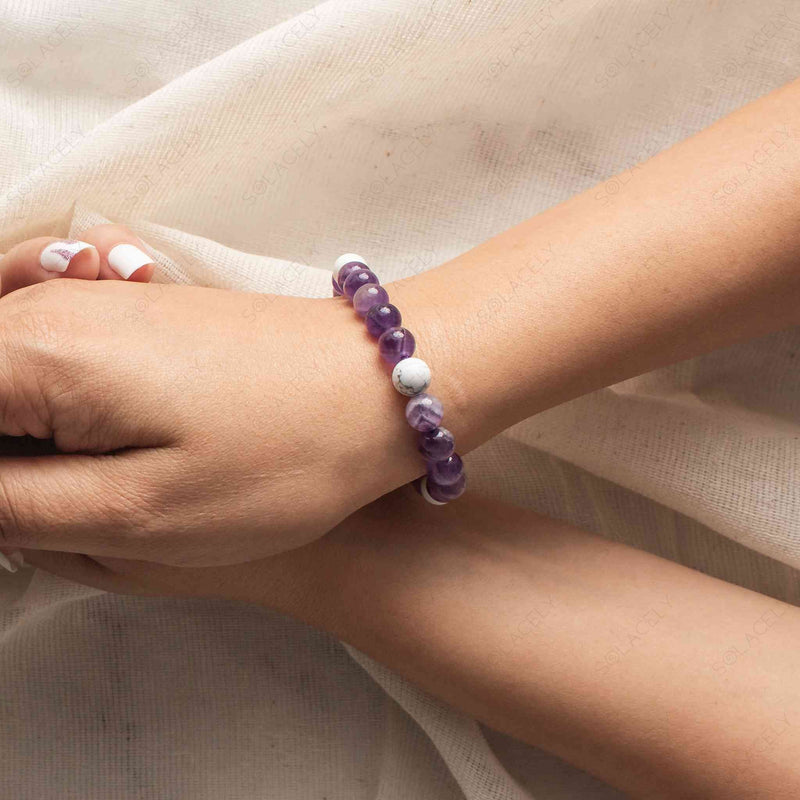
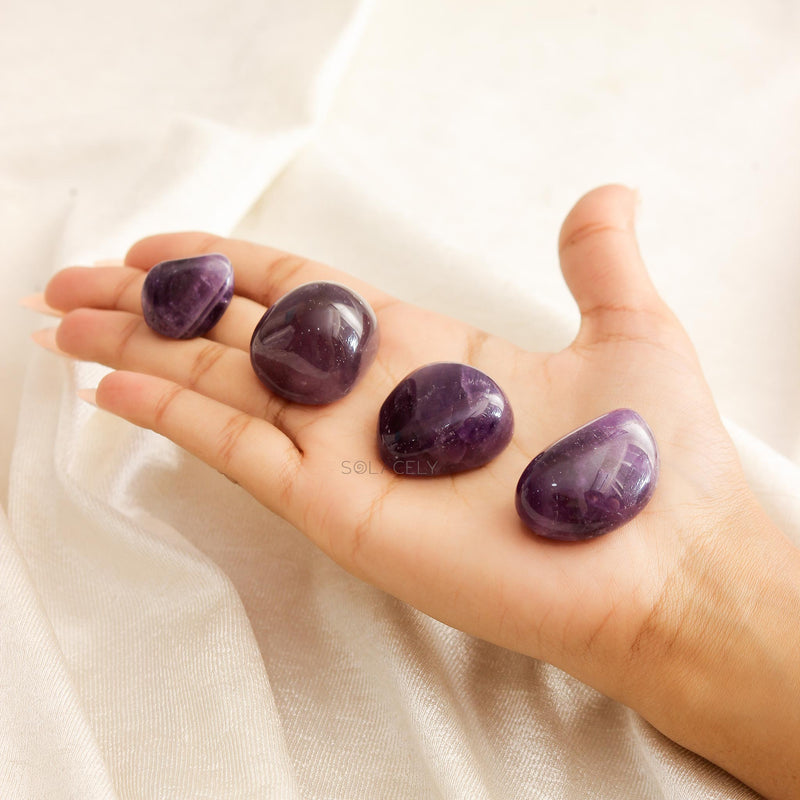
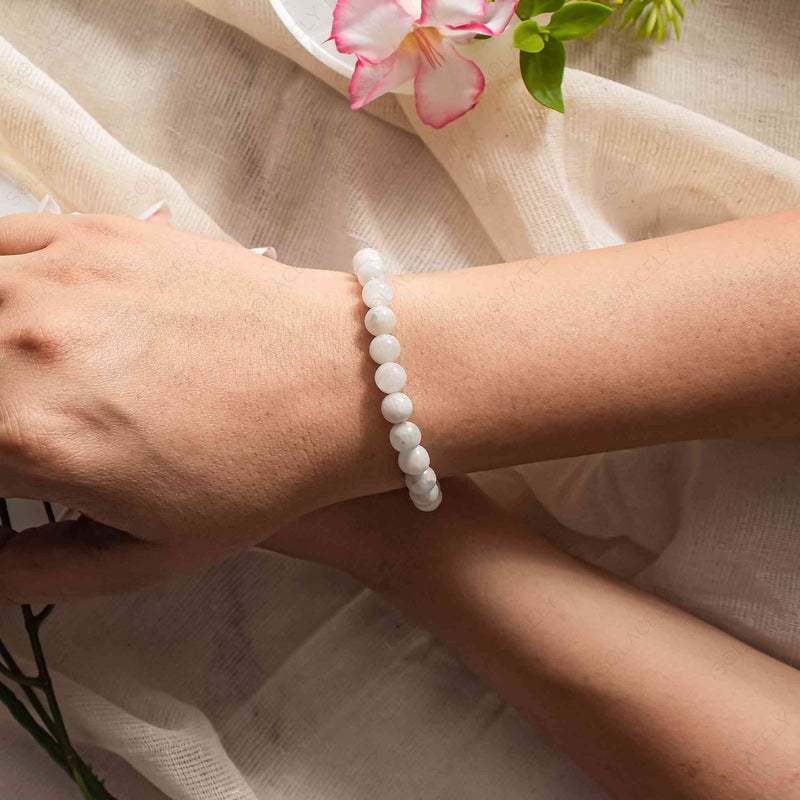
Moonstone, amethyst, lepidolite, and rose quartz are the stones most often kept close through menopause. In crystal tradition moonstone belongs to cycles and change, amethyst to rest, lepidolite to softening, and rose quartz to self-kindness on the days you feel unlike yourself. They are company through a transition, not treatment for it, and they sit best alongside the care your doctor provides. Here is how people use them.
Key Takeaways
- Moonstone is the traditional stone of cycles and change, which is why it is the one most often chosen for this season.
- Amethyst is kept for rest, lepidolite for softening tension, rose quartz for self-kindness.
- Menopause is confirmed after twelve months without a period; the years before it are perimenopause.
- An evening ritual works best when it is short enough to do on a bad night.
- Symptoms affecting your daily life are worth a GP appointment. Stones are company alongside that, never instead of it.
Why moonstone belongs to this season
Of all the stones people reach for during menopause, moonstone is the one that comes up first, and the reason is in its long association with cycles. It has been linked for centuries to change, to phases, to the idea that things move and then move again. That is a fitting companion for a stretch of life defined by exactly that.
Moonstone is a feldspar, and its soft blue-white shimmer, called adularescence, comes from light scattering between microscopic layers inside the stone. Encyclopaedia Britannica describes the effect, and it is worth knowing, because the glow is what gives moonstone its quiet, lit-from-within quality in the hand.
Practically, moonstone sits around 6 to 6.5 on the Mohs scale, a little softer than quartz, with cleavage planes that can split on a hard knock. It suits a pendant or a bedside stone rather than something rattling in a bag with keys.
The four stones, and what each is kept for
You do not need all of them. Choose the one whose meaning matches the thing that is actually hardest at the moment, and let that be the one you keep close.
| Stone | Traditionally kept for | Where it lives |
|---|---|---|
| Moonstone | Cycles, change, moving through a phase | Pendant or bedside |
| Amethyst | Rest, quiet, settling at the end of a day | Bedside table |
| Lepidolite | Softening, letting the shoulders drop | Shelf, it is soft and flakes |
| Rose quartz | Self-kindness, patience with yourself | Worn, it is durable at 7 |
Lepidolite is worth a note: it is a mica at roughly 2.5 to 3 on the Mohs scale, so it scratches and flakes easily and should never be soaked. Keep it somewhere it will not be knocked about. Our guide to lepidolite and rose quartz covers that pairing in full.
Understanding what is happening
It helps to have the shape of it clear, because so much of what makes this stretch difficult is not knowing what is normal. Menopause is a single point, confirmed once twelve consecutive months have passed without a period. The years leading up to it, when things fluctuate and symptoms often begin, are perimenopause, and that can last several years.
The US National Institute on Aging sets out the common experiences: hot flushes, night sweats, disrupted sleep, mood changes, joint aches, brain fog, and vaginal dryness. The NHS covers the same ground with UK treatment routes.
Reading that list and recognising yourself in it is often a relief in itself. These are common, they are well understood, and they are treatable. Which brings us to the part that matters most.
Where the real help comes from
Crystals are company. Treatment comes from your doctor, and it is genuinely good, which is why this section sits in the middle of the article rather than buried at the end.
Hormone therapy helps a great many people. There are effective non-hormonal options for those who cannot take it. Vaginal oestrogen treats symptoms that often go unmentioned for years out of embarrassment, and it works. None of this is something to endure quietly while waiting for it to pass.
So book the appointment, and take a fortnight of notes on sleep, flushes, and mood with you, because a symptom diary makes a ten-minute consultation far more useful. Then keep the stone on the bedside table, because the appointment and the ritual are not in competition. One treats the symptoms; the other keeps you company between appointments.
Building an evening ritual
Sleep is where this transition wears people down hardest, and it is also where a small, repeatable ritual earns its place. The trick is to keep it short enough that you will still do it on the night you cannot be bothered.
A version that works: same time each evening, screens down, hold the stone, three slow breaths, and one sentence naming how the day actually went. That is it. Ninety seconds. The stone's job is to make the ritual concrete, something your hands can find, so the habit sticks.
The pause is worth having for its own sake. The U.S. National Center for Complementary and Integrative Health notes that mindfulness practices can help many people manage stress. Our guide to crystals for sleep covers the wind-down further, and crystals for anxiety and stress covers the daytime version.
Caring for these stones
Each of the four wants something different, and a little care keeps them looking like something you want to pick up.
Rose quartz is the sturdy one at 7 on the Mohs scale, as Encyclopaedia Britannica notes, so warm soapy water and a soft brush is all it needs. Its only weakness is strong sunlight, which fades the pink, so keep it in bright indirect light rather than on a sunny sill. Amethyst fades the same way.
Moonstone takes a gentle wipe and a soft pouch, away from harder stones. Lepidolite should stay dry entirely, since water works between the mica layers and it will shed. If you also cleanse stones in the spiritual sense, our step-by-step on how to cleanse and charge crystals covers which methods suit which material.
Sources
- US National Institute on Aging - What is menopause?
- NHS - Menopause, symptoms and treatment
- Encyclopaedia Britannica - Moonstone, feldspar and adularescence
- National Center for Complementary and Integrative Health - Meditation and Mindfulness
Frequently asked questions
About the author


Written by Chetna Sharma, crystal healing practitioner and co-founder of Solacely. Chetna has worked with healing crystals for over a decade and curates Solacely's protective stone collection.