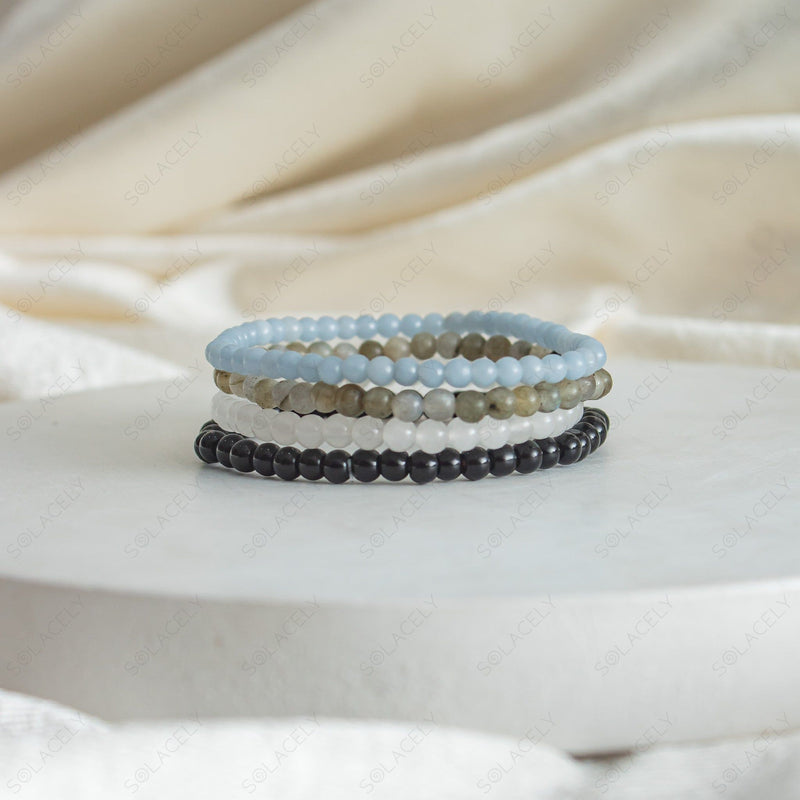
Grey crystals run from silvery hematite through smoky quartz to the dark, flashing base of labradorite. They are traditionally kept for grounding, steadiness and clear thinking, which is why they suit a work desk or a daily bracelet. Grey also happens to be the easiest crystal colour to wear with anything.
Key takeaways
- Grey is a neutral rather than a mineral family, so the group runs from metallic hematite to translucent smoky quartz and dark feldspars such as labradorite.
- Hematite and smoky quartz are the two most widely worn grey stones, and both are hard enough for everyday bracelets.
- Smoky quartz gets its colour from natural irradiation deep underground, which is a genuine geological process and gives a stable, permanent smoke tone.
- Labradorite, larvikite and grey moonstone are the flash stones, where a plain grey body throws blue, silver or gold light as you move.
- Grey stones are long associated with the root chakra, with grounding and with keeping a level head under pressure.
- Softer greys such as howlite and apache tears need separate storage, and pyrite should be kept away from water and salt.
What counts as a grey crystal?
Grey is a neutral, low saturation colour, so a grey crystal is one whose body colour sits between white and black without a strong hue behind it. That covers metallic stones such as hematite, smoky stones such as quartz, and the dark feldspars including labradorite and larvikite.
Because grey is defined by tone rather than chemistry, the group is unusually varied. A polished hematite bead has a mirror-bright metallic surface. A smoky quartz tumble is translucent and lets light straight through. A grey agate is banded and waxy. They all read as grey on a shelf, yet they behave completely differently in the hand.
That neutrality is the practical appeal. Grey sits beside silver and steel jewellery without competing with it, and it does not clash with the rest of your wardrobe the way a strong green or purple can. If you want something darker still, the same logic applies to black crystals, which overlap with this group at the deeper end of the range.
Ten grey crystals at a glance
The ten stones below cover almost everything you will meet on a grey shelf. The hardness column is the one that decides where a piece lives: anything at 6 or above copes with daily wear, while the softer stones are happier in a pouch, a bowl or a display piece. Traditional associations are given as they have been handed down.
| Stone | Colour range | Mohs hardness | Traditionally kept for |
|---|---|---|---|
| Hematite | Steel grey to silvery black, metallic | 5 to 6.5 | Grounding and protection |
| Smoky quartz | Pale smoke to deep grey brown | 7 | Letting go, staying steady |
| Labradorite | Grey base with blue, gold or green flash | 6 to 6.5 | Intuition and change |
| Larvikite | Dark grey with a silver blue shimmer | 6 to 6.5 | Level headed decisions |
| Grey agate | Banded pale grey to charcoal | 6.5 to 7 | Stability and self confidence |
| Grey moonstone | Smoky grey with a soft sheen | 6 to 6.5 | New starts and intuition |
| Tourmalinated quartz | Clear quartz threaded with black needles | 7 | Clearing and protection |
| Apache tears | Translucent smoky grey to black | 5 to 5.5 | Comfort through grief |
| Pyrite | Brassy silver grey, metallic | 6 to 6.5 | Confidence and drive |
| Howlite | Chalky white with grey veining | 3.5 | Quiet and rest |
Hematite: the metallic grey most people start with
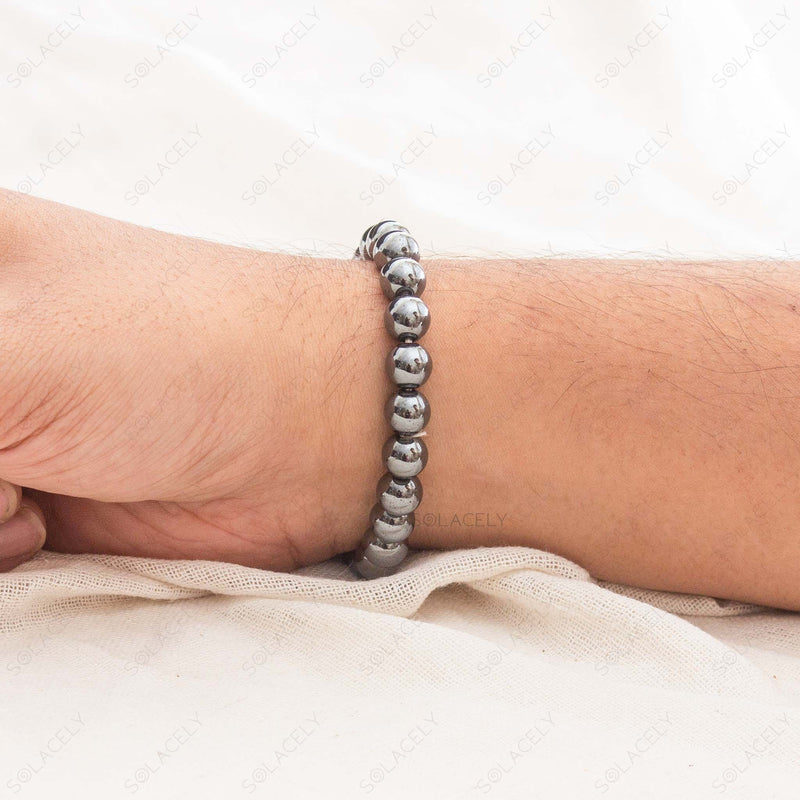
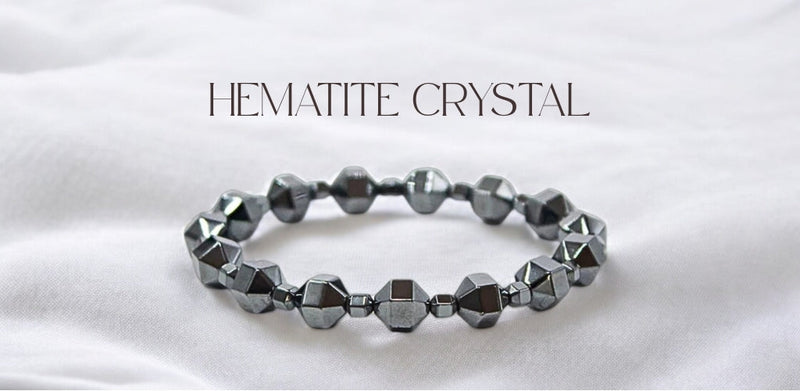
Hematite is an iron oxide, and it is the grey stone people meet first. Polished beads take a mirror finish that reads almost like gunmetal, it is noticeably heavy for its size, and it sits around 5 to 6.5 on the Mohs scale, which is comfortably hard enough for a bracelet worn every day.
The weight is the giveaway in the hand. Iron oxide is dense, so a hematite bracelet has a reassuring heft that lighter quartz beads do not, and that physical presence is part of why people describe it as grounding. Rub an unpolished piece on unglazed porcelain and it leaves a red brown streak, which is where the name comes from: haima, the Greek word for blood.
Traditionally hematite is worn for steadiness, for holding your ground in a difficult room, and as a quiet piece of daily armour. It is the anchor stone in most root chakra layouts, and our full hematite meaning and properties guide covers formats, pairings and which wrist people tend to choose.
Smoky quartz and where its grey comes from
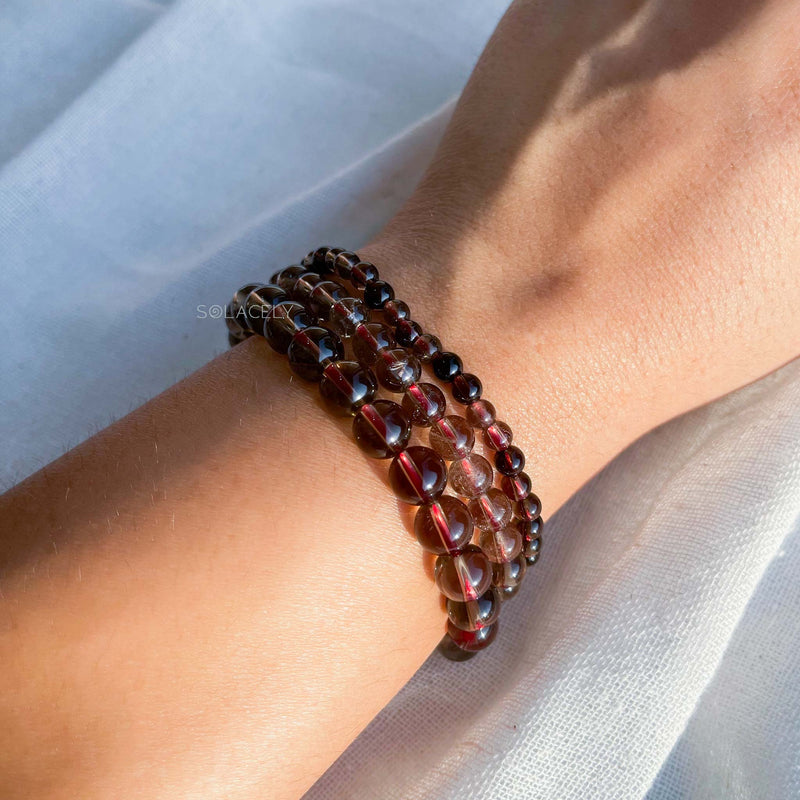
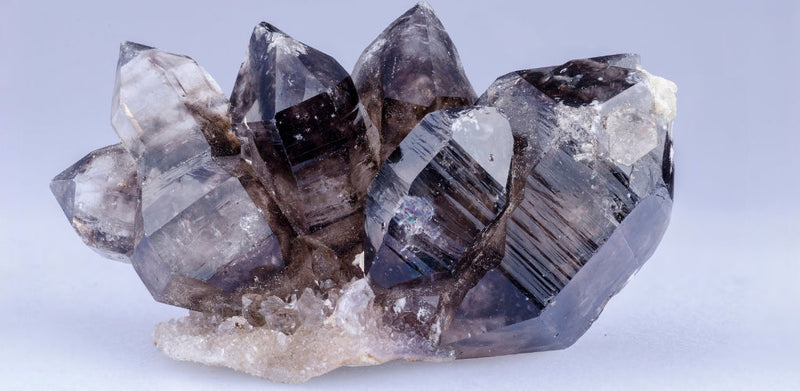
Smoky quartz is quartz that nature has coloured, and the process is genuinely interesting. Quartz that grew with a trace of aluminium sitting in place of silicon in its structure will slowly darken when it sits near naturally radioactive granite. That gentle, natural irradiation over geological time is what produces the smoke.
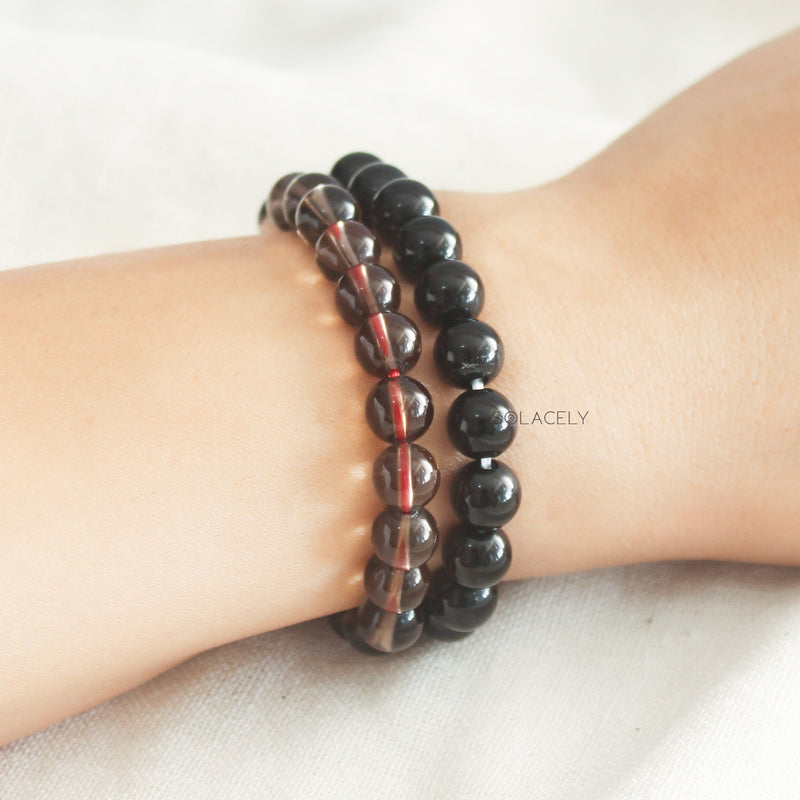
The result is a colour that runs from the faintest grey haze through to a deep, almost black brown, and it is stable and permanent once formed. Two tumbles from the same locality can sit at opposite ends of that range, so the sensible way to buy smoky quartz is to pick the depth of tone you actually want to look at rather than assuming darker is better.
At 7 on the Mohs scale, smoky quartz is one of the toughest greys here, and it takes a high polish without scratching in ordinary wear. It is long associated with putting down what you have been carrying and with staying level when things get loud. Our smoky quartz guide goes further into how people use it at home and at work.
The flash stones: labradorite, larvikite and grey moonstone
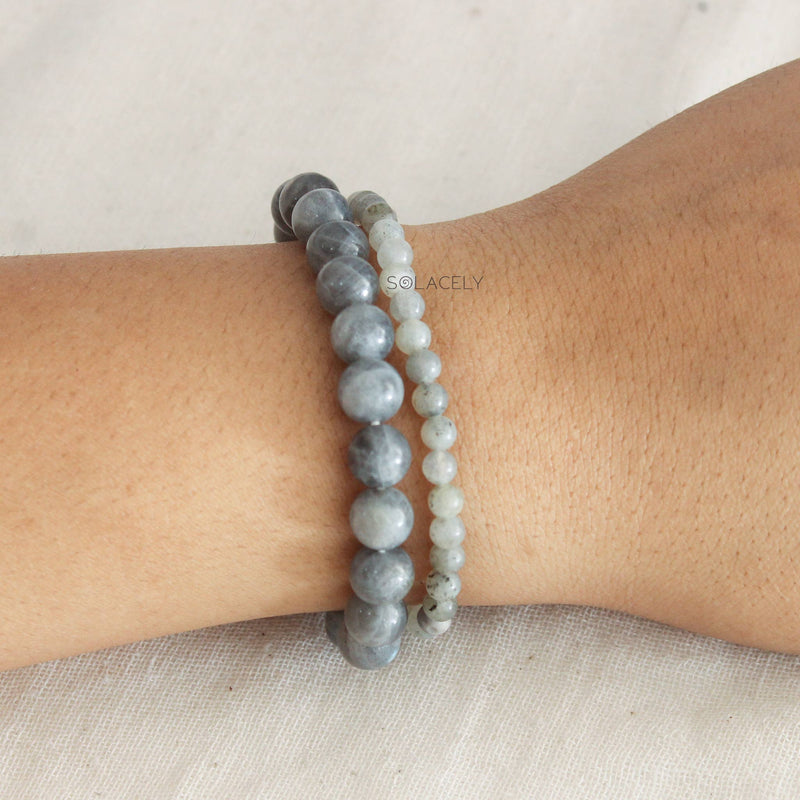
These three share a trick. Each has a plain grey body that suddenly throws colour as you tilt it, because light is bouncing off microscopic layers inside the stone rather than off the surface. Labradorite flashes blue, gold and green, larvikite shows a silver blue shimmer, and grey moonstone gives a soft floating sheen.
Labradorite is a plagioclase feldspar, and the effect named after it, labradorescence, comes from thin alternating layers within the crystal that split and scatter light. It is why the same piece can look flat grey from one angle and electric blue from the next. Choose one by moving it under the light you will keep it in, since the flash is the whole point. Our labradorite guide covers the family in detail.
Larvikite comes from the Larvik area of southern Norway and is technically a rock rather than a single mineral, which is why you see it as slabs, spheres and chunky beads. Grey moonstone sits in the same feldspar family as labradorite and carries a gentler, milkier glow. All three are around 6 to 6.5 on the Mohs scale, so they wear well, though feldspars can chip if you knock them hard against a door frame.
How to use grey crystals day to day
Most people use grey crystals in three ways: worn, carried or placed. A hematite or smoky quartz bracelet works as a visible daily cue. A tumble in a coat pocket gives you something solid to hold in a tense moment. A sphere or a raw piece on a desk sets the tone of a workspace without asking anything of you.
Grey suits working hours particularly well. A common arrangement is one grounding stone within reach of the keyboard and one in the pocket, so that reaching for it becomes the pause rather than the fix. People often pair a metallic grey with a translucent one, hematite with smoky quartz for example, so the set covers both weight and light. Our notes on crystals for grounding set out a few simple routines.
If you meditate, grey stones are traditionally held in the palms or placed at the base of the spine rather than at the crown, since the whole family leans downward and inward. There is no single correct method. Pick one stone, stay with it for a few weeks, and you will learn far more about whether it suits you than by rotating through the whole shelf.
Caring for grey crystals
Grey stones need three things: gentle cleaning, separate storage and a bit of care around water. Most of this group takes a soft dry cloth perfectly well. The metallic stones and the very soft ones are the two ends to watch, and a few minutes of thought when you put a piece away saves the finish over the years.
Hematite and pyrite are both iron minerals, so keep them dry. Wipe them with a dry cloth, take bracelets off before showering or swimming, and never cleanse either one in salt water, which dulls the polish and works into the surface. Smoky quartz, agate and tourmalinated quartz are far more forgiving and tolerate a brief rinse in cool water followed by a thorough dry.
Howlite at 3.5 and apache tears at around 5 are the softest here and scratch easily, so store them in their own pouches rather than loose in a box with quartz or hematite. Keep smoky quartz out of long spells of direct sun so the tone stays as deep as the day you bought it, and skip ultrasonic cleaners across the whole group. Keep small beads, chips and tumbles well away from young children.
Crystals are kept for comfort, focus and ritual. They are not a medical treatment and nothing here is medical, psychological or safety advice. If you have a health concern, please speak to a qualified professional and carry on with any care that has already been arranged for you. Keep small stones, beads and chips away from babies, young children and pets, as they present a choking and strangulation risk.
Sources
- Geology.com, Hematite: A Primary Ore of Iron and a Pigment Mineral
- Geology.com, Quartz: Mineral Information and Varieties
Written by Chetena Sharma. Reviewed by the Solacely editorial team.
Frequently asked questions
About the author


Written by Chetna Sharma, crystal healing practitioner and co-founder of Solacely. Chetna has worked with healing crystals for over a decade and curates Solacely's protective stone collection.