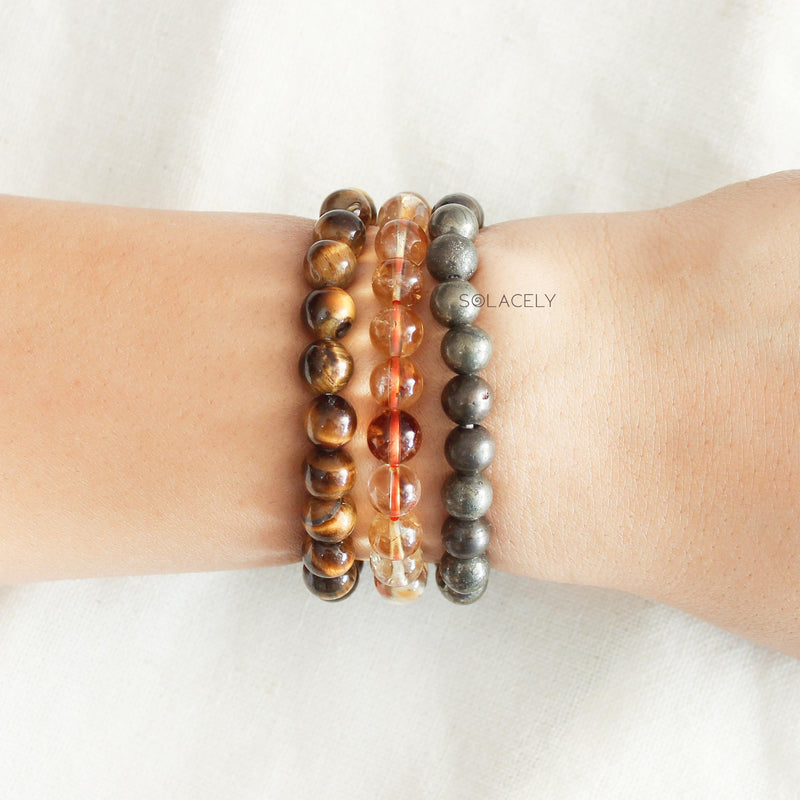
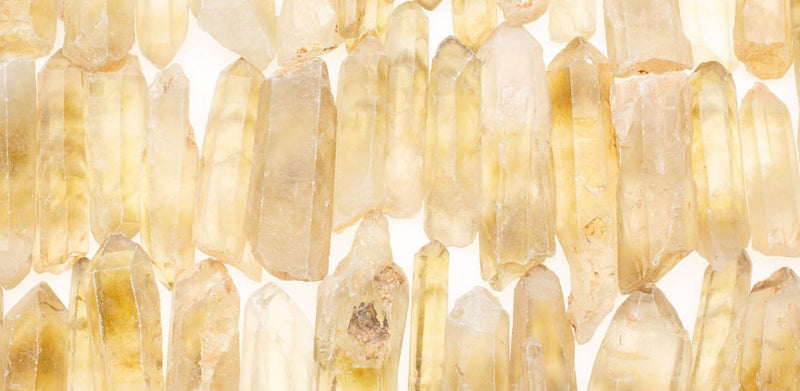
Citrine symbolises sunlight, prosperity and personal will. Every meaning attached to it traces back to its yellow-to-orange colour: warmth, harvest, gold, and the confidence to act. It has been the merchant's stone for centuries, and unlike stones tied to love or protection, its symbolism is almost entirely about self-direction and circulation.
Key takeaways
- Citrine is the yellow to orange variety of quartz, hardness 7 on the Mohs scale.
- Its core symbolism is sun, abundance and willpower.
- The merchant's stone tradition comes from keeping a piece in a till or cash box to encourage trade.
- A November birthstone, sitting at the harvest end of the year.
- Keep it off a bright windowsill so the colour stays deep.
Where citrine's symbolism comes from
Colour drives the meaning. Yellow and gold have signified sun, harvest and wealth across nearly every culture that had access to both, and citrine is one of the few common gemstones that reliably delivers that colour. The name itself comes from the French citron, for lemon.
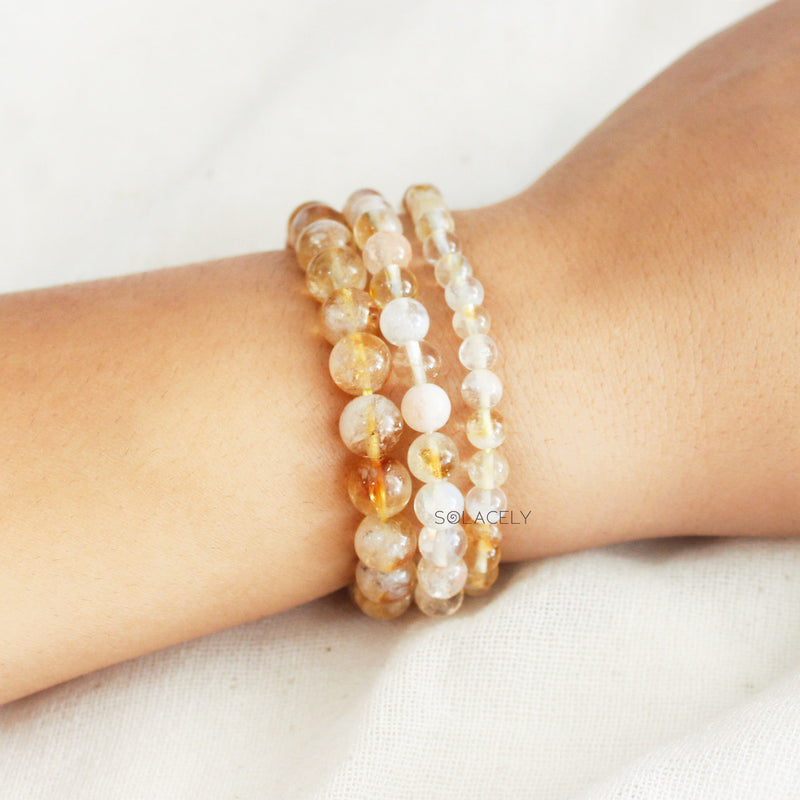
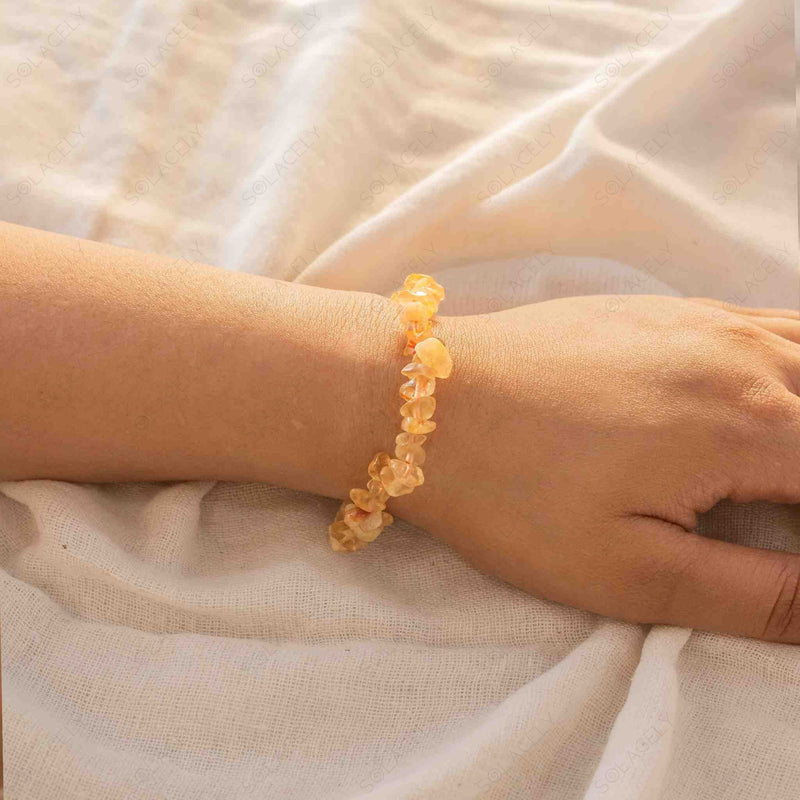
Its place as a November birthstone reinforces the association, sitting at the harvest end of the year in the northern hemisphere. The shades run from a pale lemon through honey to a deep amber sometimes called Madeira, and gemmological grading favours a warm, evenly spread, well saturated colour.
Which shade you choose is worth thinking about, because it is what you will look at every day. Paler stones read light and fresh; deeper amber reads rich and warm. Both carry the same tradition. Our guide to citrine colour covers the full range.
The merchant's stone
Citrine's best-known name comes from a specific and long-lived practice: keeping a piece in a cash register, safe, or wallet. Shopkeepers did it for generations, and the habit carried into modern crystal practice almost unchanged.
What is interesting is the shape of the tradition. Citrine was never a hoarding stone. The framing is circulation, money moving through a business, trade staying brisk. That is why the conventional placement is the till rather than the vault, and why the modern equivalent is a piece near a card reader or on the desk where the work happens.
It is also why citrine is the customary gift at the start of something: a new business, a first market stall, a change of career. If prosperity is your reason for reading, our citrine properties guide sets out the full traditional list.
Citrine, the solar plexus, and personal will
In chakra practice, citrine is assigned to the solar plexus, the centre associated in yogic tradition with personal power, boundaries, and the capacity to digest experience. The mapping is colour-driven, as most chakra-stone assignments are: yellow stone, yellow chakra.
The symbolic content here is worth separating from the wealth association. Solar plexus work is about deciding, about the willingness to take up space and say what you want. In the traditional logic, prosperity follows from that rather than arriving independently. Someone who cannot ask for a raise does not get one, whatever is in their pocket.
Our citrine and chakra alignment guide covers the placement practice, and the crystals for confidence selection covers the same territory from the self-assurance side.
What citrine is
| Property | Citrine |
|---|---|
| Mineral family | Quartz (silicon dioxide) |
| Hardness | 7 Mohs |
| Colour cause | Iron within the quartz structure |
| Colour range | Pale lemon through honey to deep amber |
| Birthstone month | November |
| Chakra association | Solar plexus |
Citrine sits in the quartz family alongside amethyst, rose quartz and smoky quartz, all the same underlying mineral wearing different colours. Warming quartz to draw out its golden tones is a well established practice used across the coloured stone trade, and the colour it produces is permanent and entirely stable. It is part of why citrine is available in such a consistent, dependable range of warm shades.
Symbolic uses in practice
Traditional and modern uses cluster into a few clear categories:
- Trade and business. A piece at the point of sale, or in a wallet. The oldest documented use.
- Starting something. Citrine is customarily given at the launch of a business, a new role, or a move, for its association with momentum.
- Speaking up. Carried before a negotiation, interview, or difficult conversation, on the solar plexus logic.
- Lifting a flat mood. Kept in a workspace or a darker room, borrowing from the sun symbolism.
- Gifting. A common November birthday choice and a natural congratulations gift.
The distinctly spiritual readings, the sun deity associations and solar symbolism across traditions, are covered in our citrine spiritual meaning article.
Caring for citrine
At 7 on the Mohs scale, citrine handles daily wear without much fuss. Warm soapy water and a soft brush are sufficient. Store it away from harder stones such as topaz or sapphire.
The one thing to watch is light. Prolonged direct sunlight can pale citrine over months, so charge it in indirect daylight, moonlight, or with sound instead, and avoid steam and ultrasonic cleaners. It is a pleasing irony that the sun stone prefers to be kept out of the sun.
Who citrine suits
People starting something. Freelancers, new business owners, anyone in a role where they have to ask for money. It also suits people whose difficulty is not lack of desire but reluctance to act on it, which is precisely the solar plexus territory the tradition points at.
It suits less well anyone looking for calm. Citrine is an activating stone in traditional practice, and for anxious stretches amethyst, blue lace agate or lepidolite are the conventional answers, with citrine kept for the working day.
The meanings described here are traditional, cultural and symbolic. They are not medical or financial claims, and crystals are not a substitute for professional advice of any kind.
Sources
Written by Chetena Sharma. Reviewed by the Solacely editorial team.
Frequently asked questions
About the author


Written by Chetna Sharma, crystal healing practitioner and co-founder of Solacely. Chetna has worked with healing crystals for over a decade and curates Solacely's protective stone collection.