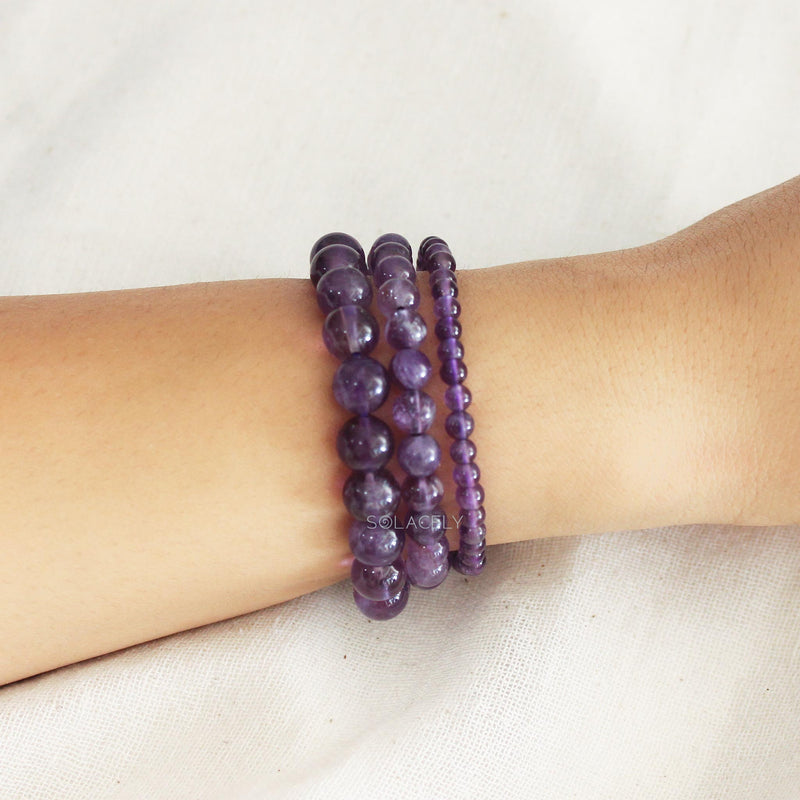
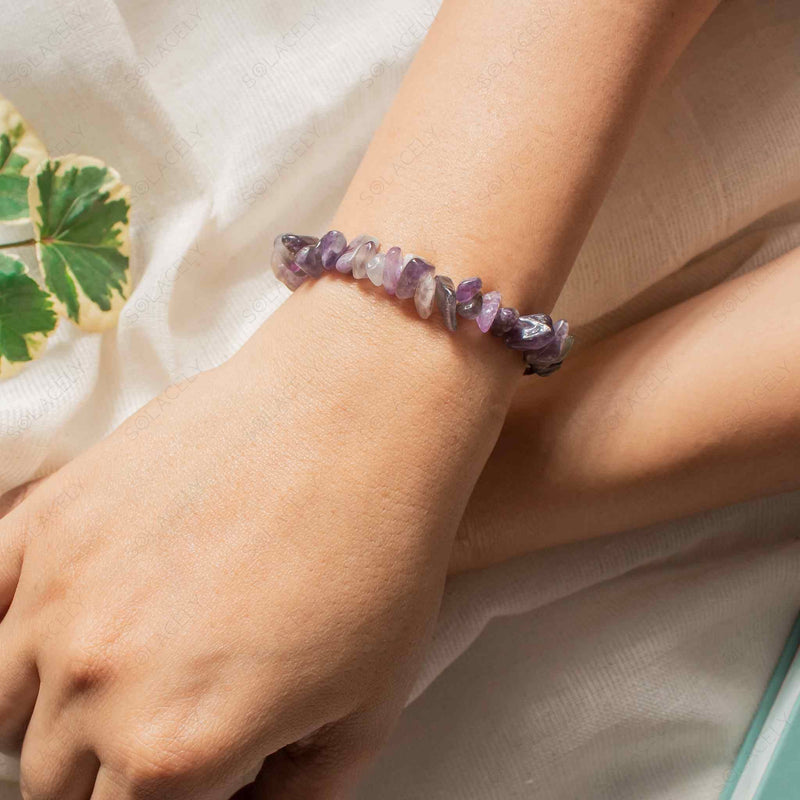
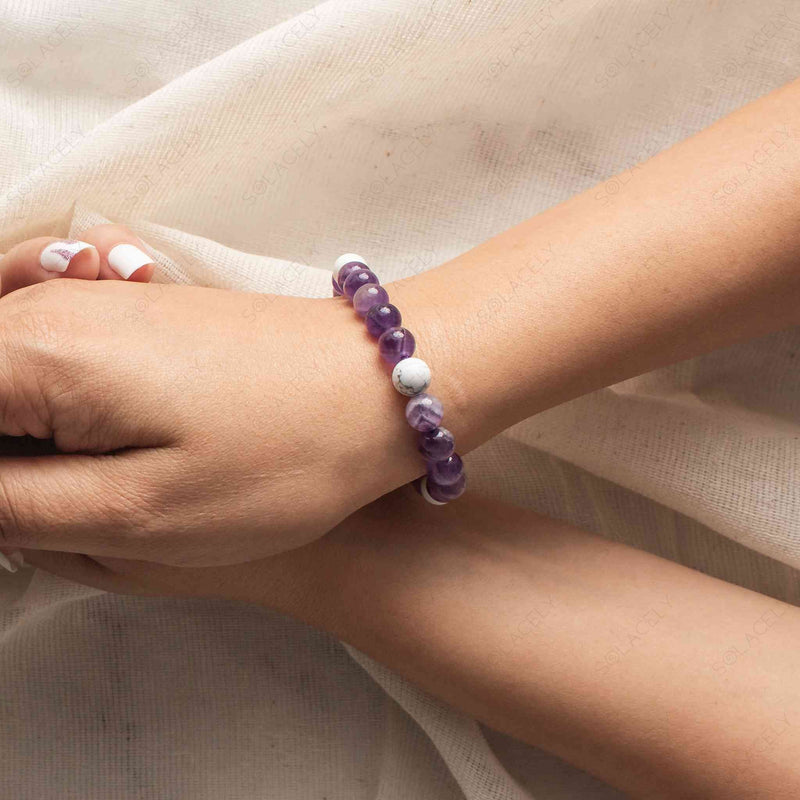
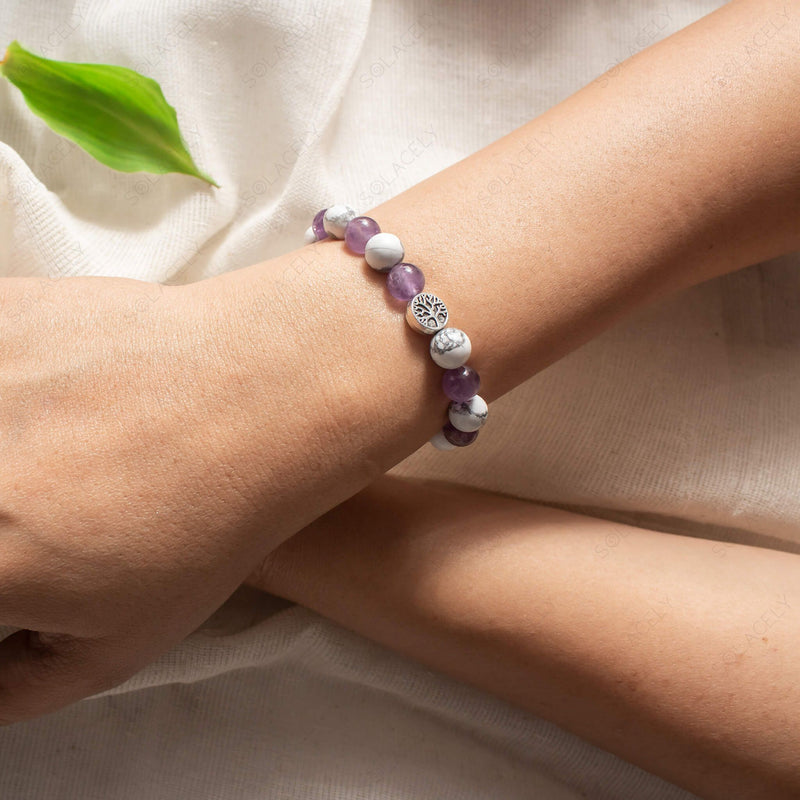
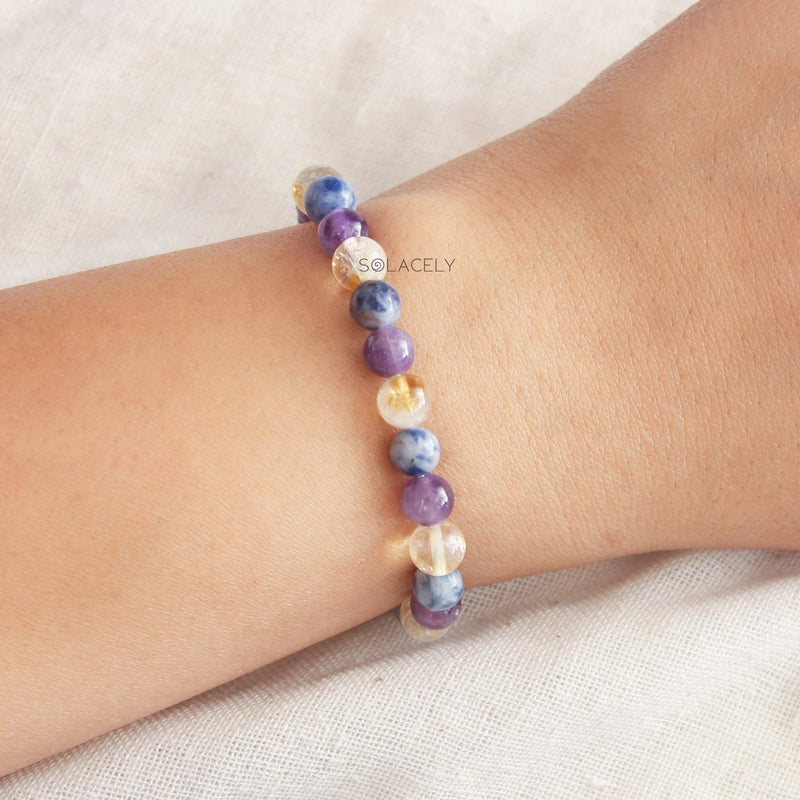
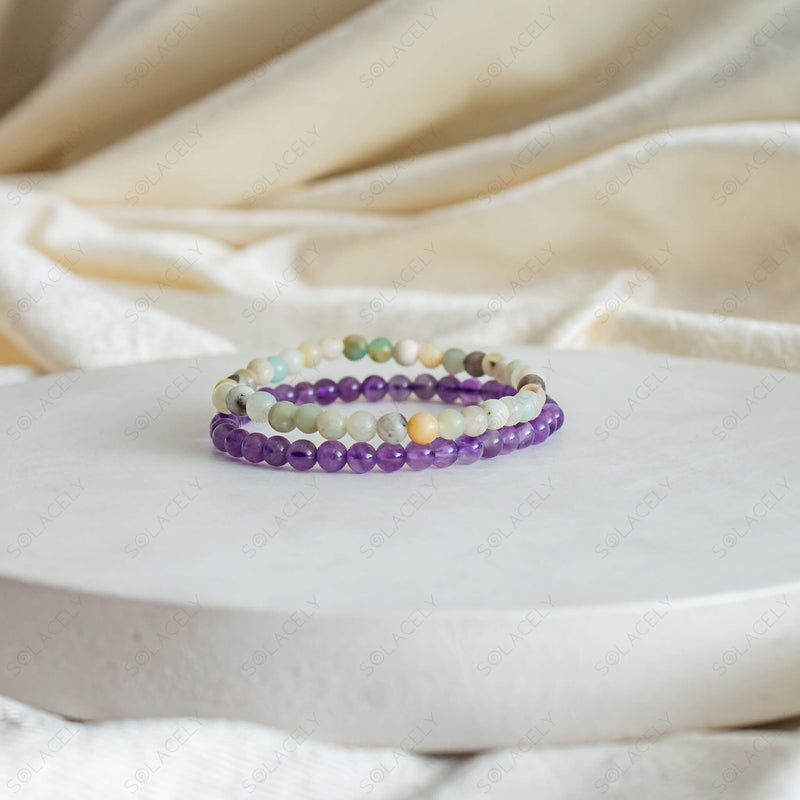
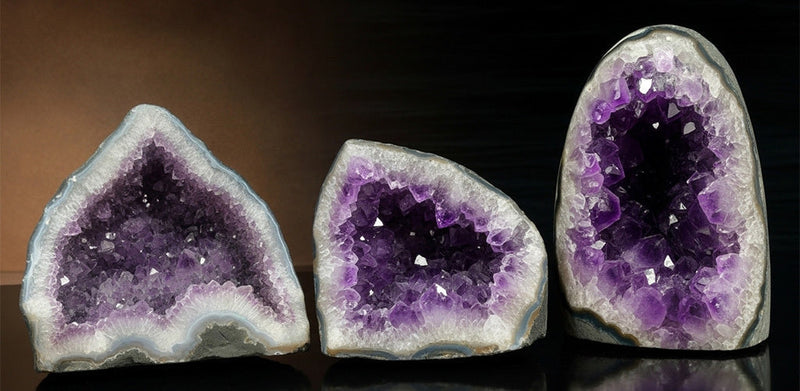
Wear an amethyst bracelet on your left wrist. Amethyst is kept for settling a busy mind, and calm is something you take in rather than send out, so it belongs on the receiving side. The right is the less common choice, made when you want to bring a calmer manner to other people.
Key takeaways
- Left wrist for settling your own mind. This is the standard placement.
- Right wrist when you set the tone for other people at work or at home.
- Pairs well with howlite, clear quartz and rose quartz.
- A bedside tumble beats a bracelet for sleep, and lasts longer.
- Keep it out of sustained sun, which pales the purple permanently.
Why the left wrist
Crystal practice reads the left as the receiving side and the right as the projecting side. Amethyst's tradition is unambiguously about receiving: quieting an overactive mind, easing into sleep, taking the edge off a week that has been running too fast.
None of that points outward, which is why the left placement is what nearly every practitioner recommends for this stone. It is one of the least debated placements in the whole tradition.
When to wear it on the right
The right placement exists and it is a deliberate choice rather than a mistake.
If your role involves setting the tone in a room, the right wrist reads as bringing calm to other people rather than to yourself. Teachers, carers, therapists and anyone who manages a team sometimes choose it for exactly that reason. The stone does not change; the direction of the intention does.
Most people who buy amethyst are buying it for themselves, which is why the left remains the default answer.
Once you know which wrist feels right for wearing Amethyst, you can also choose a bracelet that reflects your personal preferences and intentions. Custom crystal bracelets offer a more personal way to select the stones and design details that feel right for you.
What to wear with it on the same wrist
| Partner stone | Mohs | What it adds |
|---|---|---|
| Clear quartz | 7 | A neutral partner, matches hardness exactly |
| Rose quartz | 7 | For restlessness tied to a relationship |
| Howlite | 3.5 | Pre event tension, but it is soft and wears fast |
| Lepidolite | 2.5 to 4 | Emotional volatility, better off the wrist |
Clear quartz and rose quartz are the structurally safe partners, both sitting at 7 alongside amethyst. Howlite and lepidolite suit the same intention but are considerably softer, so they will scuff and flake long before the amethyst shows anything. Both are better as pocket tumbles.
Should you wear it to bed?
Plenty of people do, and the stone itself takes it fine at hardness 7. What suffers is the elastic, which stretches faster when it is slept in every night.
The more traditional placement for sleep is a tumble on the bedside table rather than a bracelet on the wrist, and it has the practical advantage of lasting indefinitely. If sleep is the specific reason you bought amethyst, the nightstand is the better home for it.
Looking after it
Warm soapy water and a soft cloth, and off before showering and the gym so the cord lasts. Amethyst is quartz at 7 with no cleavage, so it is hard wearing in every other respect.
The one real rule is sunlight. Amethyst's purple comes from a light sensitive colour centre, and long spells on a bright windowsill will pale it permanently. That change does not reverse, so keep the bracelet in a drawer or pouch when it is not on your wrist.
Where to go next
For the rule applied across every stone, see our pillar guide to which hand to wear your crystal bracelet. For what amethyst is and what it is traditionally kept for, see amethyst meaning, properties and benefits.
The uses described here reflect traditional and cultural crystal practice. They are not medical claims and are not a substitute for professional healthcare or advice.
Sources
Written by Chetena Sharma. Reviewed by the Solacely editorial team.
Frequently asked questions
About the author


Written by Chetna Sharma, crystal healing practitioner and co-founder of Solacely. Chetna has worked with healing crystals for over a decade and curates Solacely's protective stone collection.