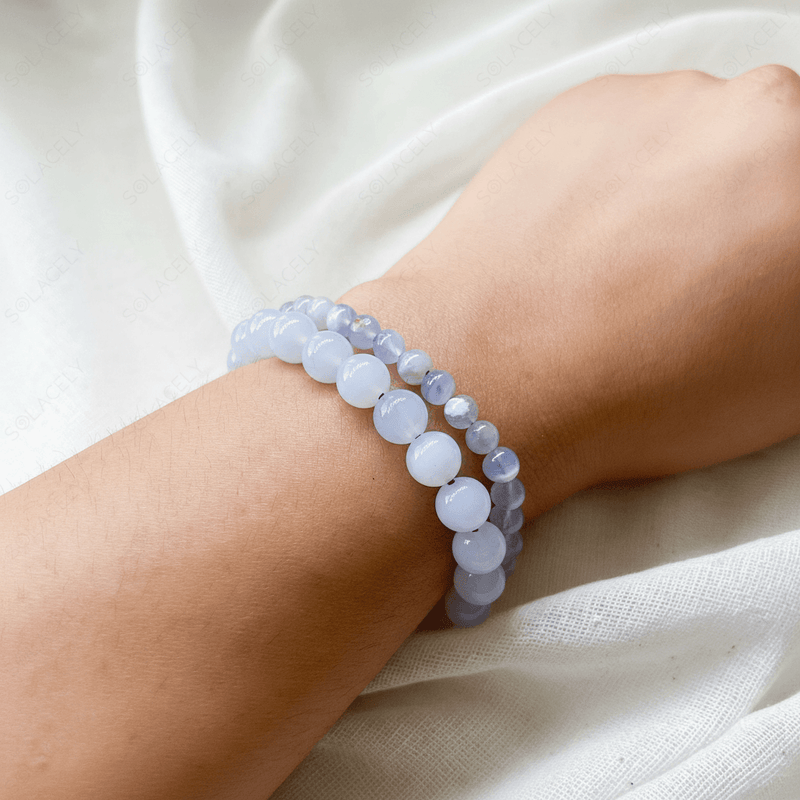
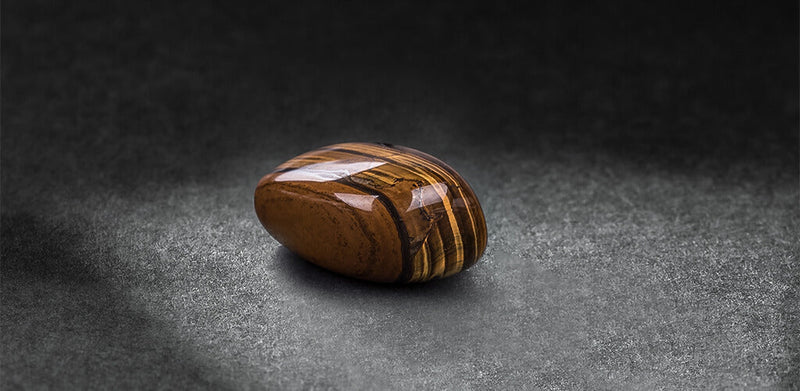
Blue tiger's eye, properly called hawk's eye, is the blue grey form of tiger's eye. It is quartz threaded with parallel fibrous inclusions that throw a single moving band of light. In crystal practice it is read as the calmer sibling of the golden stone: perspective and measured speech rather than drive.
Key takeaways
- Blue tiger's eye is also called hawk's eye. Same material, different stage.
- The blue comes before the iron oxidises. Oxidation is what turns other material golden brown.
- The moving band is chatoyancy, from parallel fibrous structures inside the quartz.
- Traditional use: perspective, measured speech, keeping your head. Throat and third eye rather than solar plexus.
- Mohs 7, no cleavage. One of the most durable stones in the crystal cabinet.
- Natural hawk's eye is a soft, muted steel blue rather than a vivid electric one.
What blue tiger's eye actually is
Tiger's eye is quartz containing dense parallel fibrous structures. Light reflects off those fibres in a single band that slides across the surface as the stone tilts, an effect called chatoyancy, from the French for cat's eye.
The colour difference between blue and golden tiger's eye comes down to iron. In hawk's eye the iron is still in its unoxidised state, giving the blue grey to steel blue colour. Where it has oxidised to limonite, the stone turns the familiar golden brown. Material caught partway through, showing both, is sold as pietersite or as blue and gold tiger's eye depending on the deposit.
The formation mechanism itself was long explained as quartz replacing crocidolite fibre by fibre. More recent work supports a crack seal process instead, with quartz and the fibrous mineral growing together as a fracture repeatedly opened and healed. Both explanations produce the same visible result.
| Also called | Hawk's eye |
|---|---|
| Mineral | Quartz with fibrous inclusions |
| Colour | Grey blue to steel blue, sometimes near indigo |
| Optical effect | Chatoyancy, a single moving light band |
| Mohs hardness | 7 |
| Cleavage | None |
| Main source | South Africa, plus Western Australia and India |
Meaning and traditional benefits
Golden tiger's eye has a long tradition as a courage stone: drive, action, pushing forward. Blue tiger's eye is consistently read as the temperature lowered version of the same character. Where the golden stone is used for doing, the blue is used for seeing clearly first.
Three uses come up repeatedly:
- Perspective under pressure. The commonest recommendation. Used when a situation feels larger than it is and you need to size it properly before reacting.
- Measured speech. Its throat chakra association makes it a stone for saying difficult things without heat, which is why it appears alongside sodalite and blue lace agate.
- Cooling anger. Traditional practice pairs it with situations where the golden stone would be exactly wrong, meaning frustration that needs slowing rather than energising.
Our guide to tiger's eye meaning, properties and benefits covers the golden stone, and crystals for the throat chakra sets blue tiger's eye against the other blues.
What natural hawk's eye looks like
Knowing the natural look helps you buy with confidence.
Hawk's eye is a muted stone. It reads as grey blue or steel blue with a soft, silky sheen, and the colour varies gently along the fibre bands because the bands themselves vary. That subtlety is the point: the chatoyant band is what carries the drama, not the base colour.
Deeper, more vivid blues do exist in the market, achieved through colour enhancement, which is a long established practice across the coloured stone trade. Both look good and both wear the same. If the natural muted look is what you want, choose a piece where the colour shifts slightly along the fibres rather than sitting perfectly uniform, and buy from a seller who will tell you which you are getting.
Durability and care
This is where blue tiger's eye is genuinely excellent. At Mohs 7 with no cleavage, it is as tough as any stone in common crystal jewellery. It takes daily wear in bracelets and rings without complaint, it does not chip along planes the way feldspars do, and it holds a polish for years.
Warm water, mild soap and a soft cloth are enough. Avoid prolonged direct sunlight, which can dull the colour over long periods, and skip ultrasonic cleaners as a general precaution with fibrous material. Beyond that it asks for nothing.
Who blue tiger's eye suits
It suits someone who reacts fast and later wishes they had waited. It also suits anyone who wants tiger's eye's character without the golden stone's rather assertive look, since the blue reads as considerably more restrained in jewellery.
It suits less well someone who needs activation rather than moderation. If the problem is not starting rather than not pausing, the golden stone is the better choice, and our guides to crystals for confidence and crystals for focus point at different sets entirely.
The uses described here reflect traditional and cultural crystal practice. They are not medical claims and are not a substitute for professional healthcare or advice.
Sources
Written by Chetena Sharma. Reviewed by the Solacely editorial team.
Frequently asked questions
About the author


Written by Chetna Sharma, crystal healing practitioner and co-founder of Solacely. Chetna has worked with healing crystals for over a decade and curates Solacely's protective stone collection.