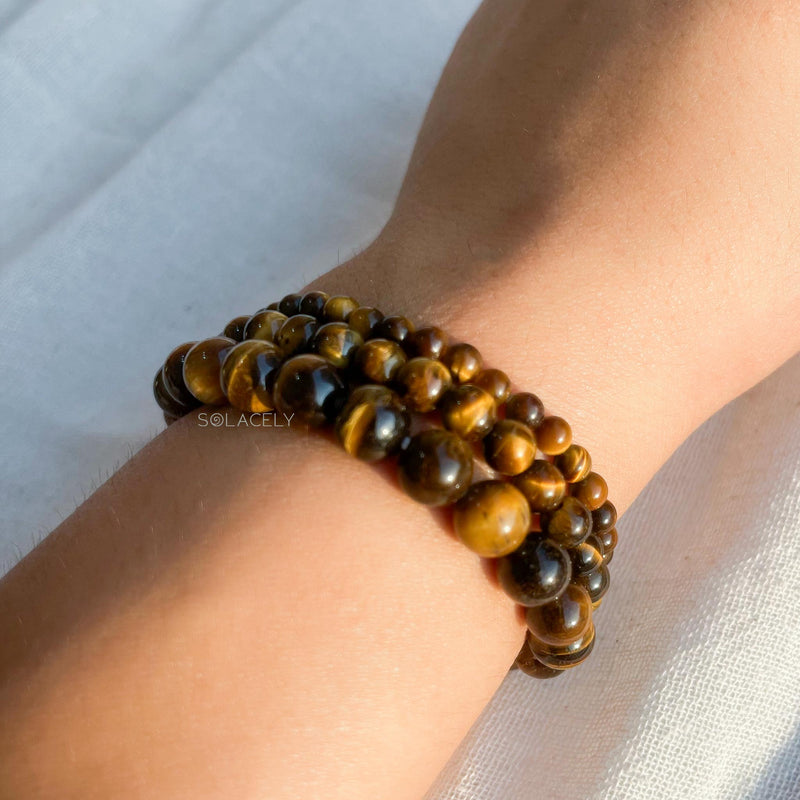
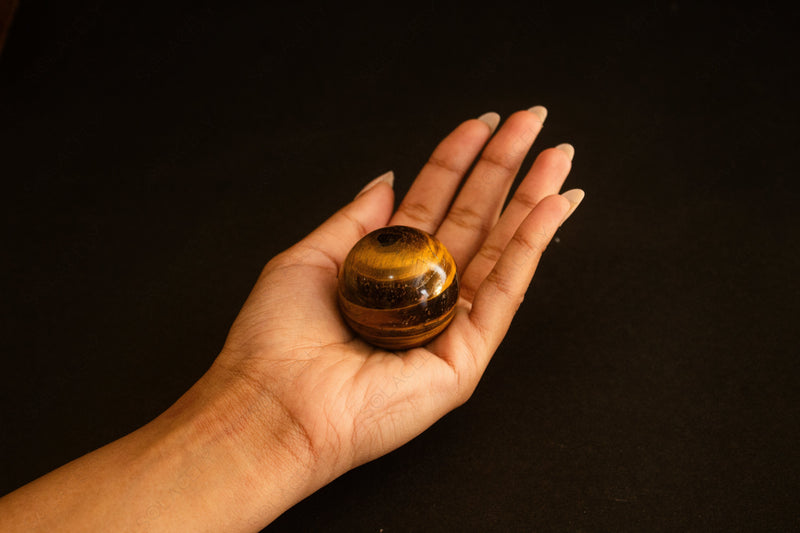
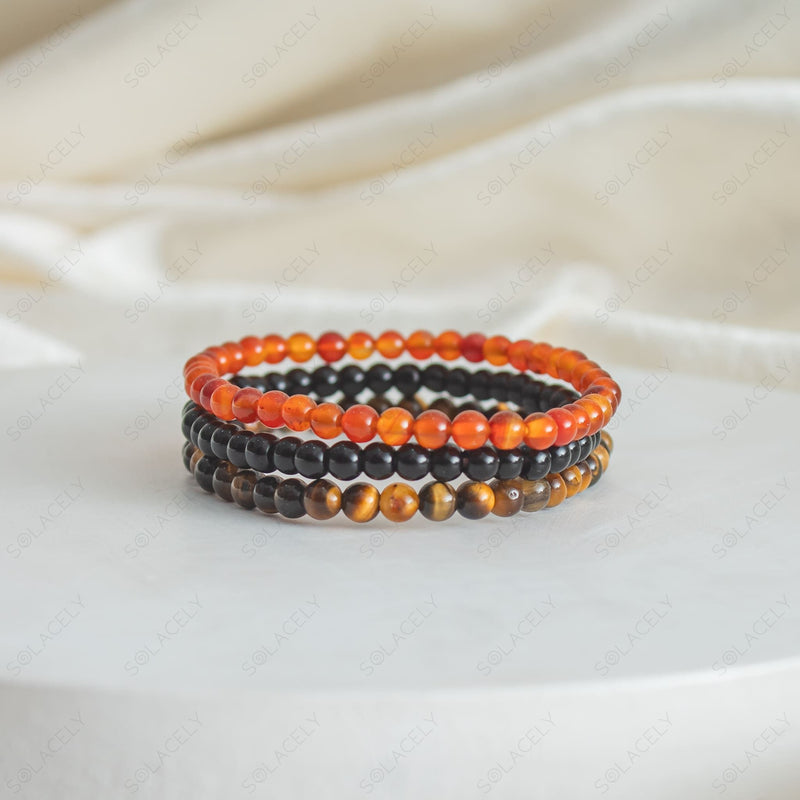
Tiger's eye is a quartz whose fibrous internal structure reflects light in a moving golden band. Traditionally kept for willpower and follow-through, it is the stone for staying with something past the interesting part rather than for confidence in general.
Key takeaways
- Tiger's eye is a quartz with a fibrous structure that produces a shifting band of light.
- That effect is called chatoyancy, from the French for cat's eye.
- Durable at 7 on the Mohs scale, so it takes any format including daily rings.
- Kept for follow-through, which is a narrower brief than confidence.
- It belongs on a wrist or in a pocket, since it needs to travel with you.
What tiger's eye actually is
Tiger's eye is a quartz, which puts it in the same family as amethyst, citrine and rose quartz, but its internal structure is quite different. Parallel fibrous formations run through the stone, and light reflecting off them produces a band that moves as the piece turns.
That effect is chatoyancy, named from the French for cat's eye, and it is what people are actually buying. A good piece shows a bright, sharply defined band that travels smoothly; a poor one shows a vague sheen with no clear movement.
Geology.com describes quartz as one of the most abundant minerals on Earth, which is why tiger's eye is affordable despite the striking optical effect. At 7 on the Mohs scale it is also genuinely hard wearing, unlike most stones with dramatic optics.
What tiger's eye is kept for
The traditional association is willpower and decisiveness, and the useful version of that is more specific than it sounds. Tiger's eye is the stone for the middle of a project, not the beginning.
The distinction matters when choosing. If the difficulty is starting, pyrite or carnelian is the traditional answer. If the difficulty is that something has stopped being interesting and still needs finishing, tiger's eye is the one people reach for.
That is why it turns up so often in study and work sets. For the concentration-focused version, crystals for focus covers how it sits alongside fluorite and clear quartz.
Colour varieties
Three appear regularly, and they are all the same basic material with different iron chemistry.
- Golden tiger's eye. The classic warm brown and gold banding, and the one the traditional associations describe.
- Red tiger's eye. Usually heat treated, which is stable and long established. Kept for a more energetic version of the same intention.
- Blue tiger's eye, or hawk's eye. The unaltered blue-grey form, generally kept for calm rather than drive.
None of these is a substitute for another, and heat treatment on the red material is standard practice rather than anything to be wary of. Choose the colour you would genuinely wear, since a stone kept in a drawer does nothing at all.
How tiger's eye is used
| The difficulty | How it is kept | Why that placement |
|---|---|---|
| Project has gone dull | Bracelet, worn daily through it | Marks a defined stretch of effort |
| Avoiding a decision | Held for a few slow breaths | A physical pause before committing |
| Losing the thread mid-task | On the desk, in view | Visible at the point attention drifts |
| Long study period | Pocket stone, carried | Travels to the library and back |
| Interview or negotiation | Worn on the wrist you gesture with | Present at the moment it is needed |
The common thread is that tiger's eye wants to travel. It is not a shelf stone, and its durability is precisely what makes daily carrying practical where a softer stone would be marked within weeks.
Choosing a good piece
The band is what you are judging. Tilt a piece slowly under a single light source and watch how the line of light moves across the surface.
A strong piece shows a bright, narrow, clearly defined band that glides smoothly as the stone turns. A weaker one shows a broad diffuse sheen that never resolves into a line. Both are genuine tiger's eye, so this is a quality judgement, and the price difference between them is usually small.
On beaded bracelets, check that the bands run consistently across the beads rather than at random angles, since a well matched strand looks considerably better on the wrist. Look at the drill holes too, where chipping shows first.
Care and cleansing
Tiger's eye is among the easiest stones in a collection to look after. Warm water, mild soap, a soft brush and a full dry, and at 7 on the Mohs scale it shares storage with almost anything without picking up scratches.
The one habit worth keeping is about light. Prolonged strong sunlight can soften the golden banding over a long period, as it can with most coloured quartz, so a bright windowsill is not the ideal permanent home.
For energetic cleansing, moonlight, sound or a rest on selenite all suit it, and salt water is unnecessary. For the wider set it belongs to, crystals for confidence covers what else people keep alongside it.
Pairing tiger's eye
Tiger's eye works best with one partner rather than in a crowd, and the choice depends on where the effort is failing.
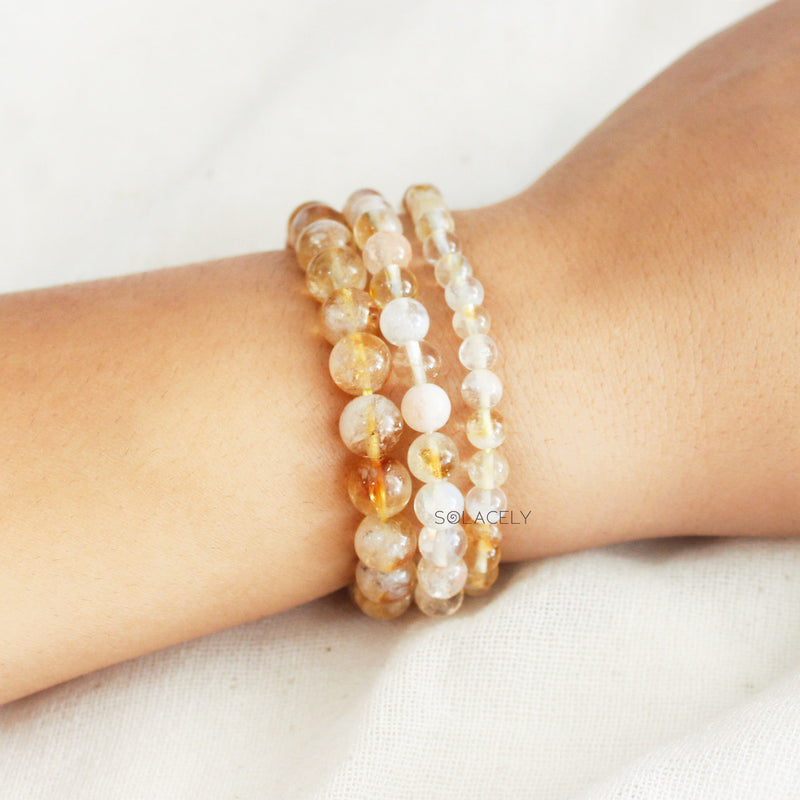
- With citrine. The most common work pairing: citrine for stepping forward, tiger's eye for staying with it.
- With fluorite. For projects with too many moving parts, where structure matters as much as persistence.
- With hematite. When the difficulty is feeling scattered rather than bored.
- On its own. Perfectly reasonable. Tiger's eye needs no companion to make sense.
Two stones with distinct jobs beat five with overlapping ones, and this is a stone that holds a job clearly. For the workplace version of the same set, the best crystals for work success covers what belongs on a desk alongside it.
What this stone can honestly offer
A repeatable cue at the point where effort usually lapses. Most unfinished work is not defeated by lack of ability but by the stretch in the middle where nothing feels like progress, and having a physical object attached to continuing through that is a genuine help.
Beyond that, it is simply a handsome stone that survives being carried, which is a fair reason to own one on its own terms.
Where tiger's eye comes from
South Africa has long been the dominant source, with Australia, India and Brazil also producing material. Unlike sapphire or emerald, origin has very little bearing on price here, since the quality of the chatoyant band matters far more than the mine it came from.
That is good news for anyone buying. It means judging a piece in front of you is entirely reliable, and there is no premium attached to a place name that a seller can lean on. Look at the band, check the polish, and buy the piece that performs.
The properties described here reflect traditional and cultural belief around crystals. They are offered for reflection and wellbeing and are not medical advice, a diagnosis, or a treatment for any condition. If persistent difficulty with motivation or concentration is affecting your daily life, please speak with a GP or a qualified practitioner. Keep small stones away from young children, and never place crystals in drinking water.
Sources
Written by Chetena Sharma. Reviewed by the Solacely editorial team.
Frequently asked questions
About the author


Written by Chetna Sharma, crystal healing practitioner and co-founder of Solacely. Chetna has worked with healing crystals for over a decade and curates Solacely's protective stone collection.