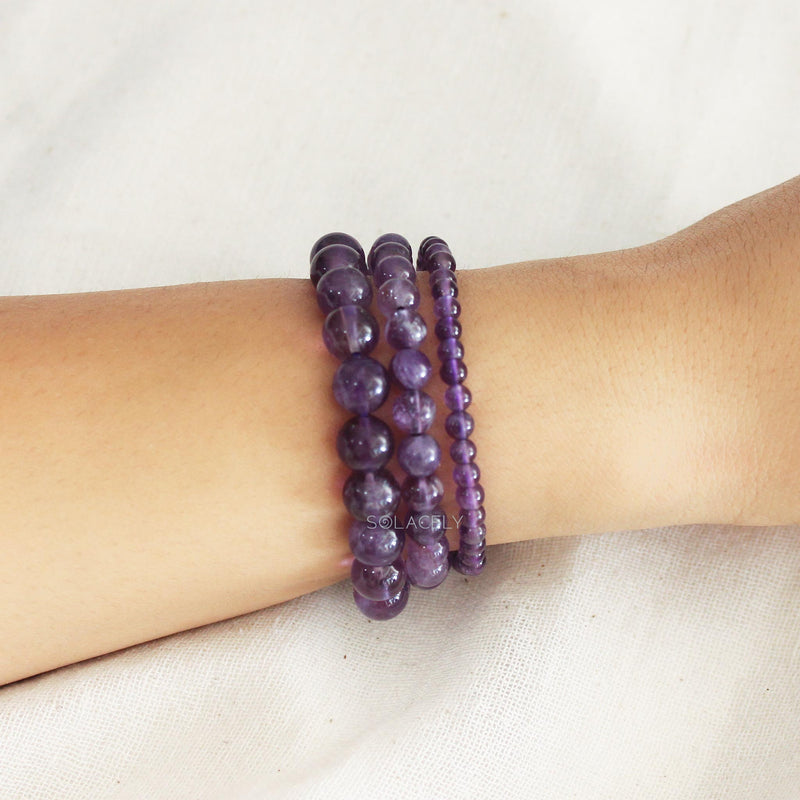
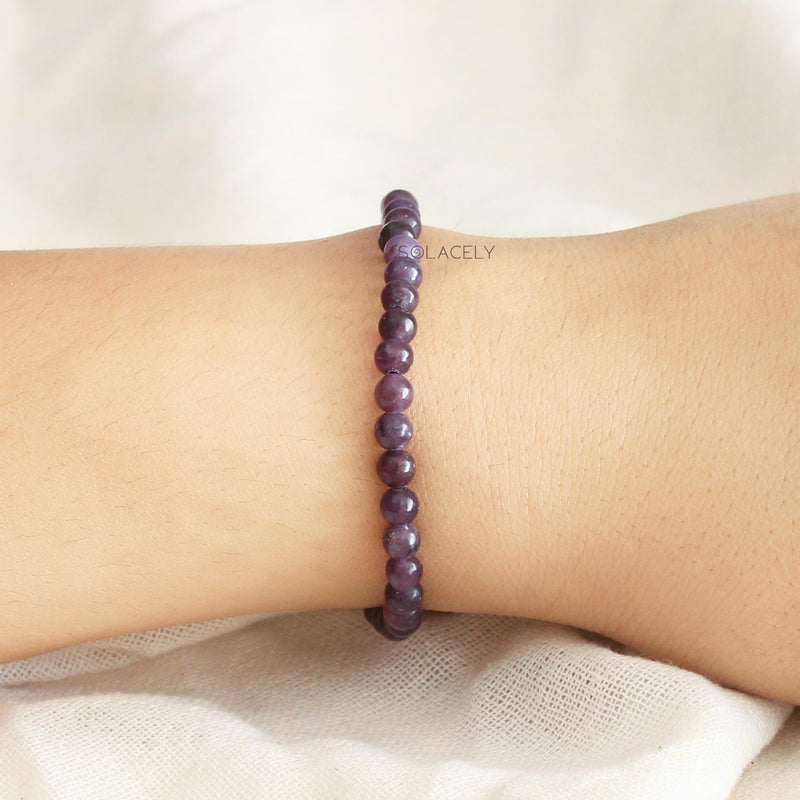
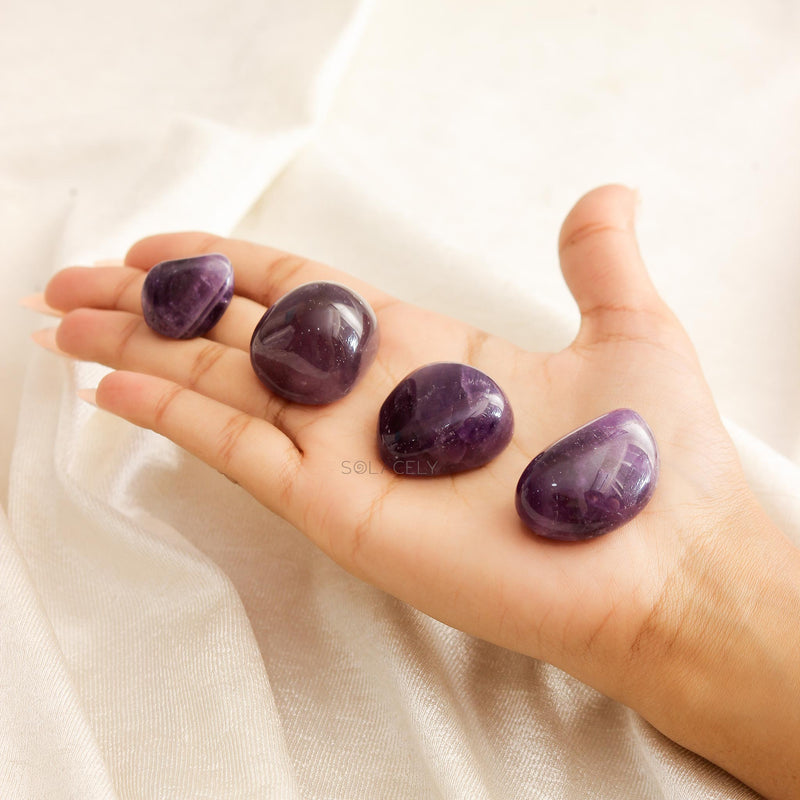
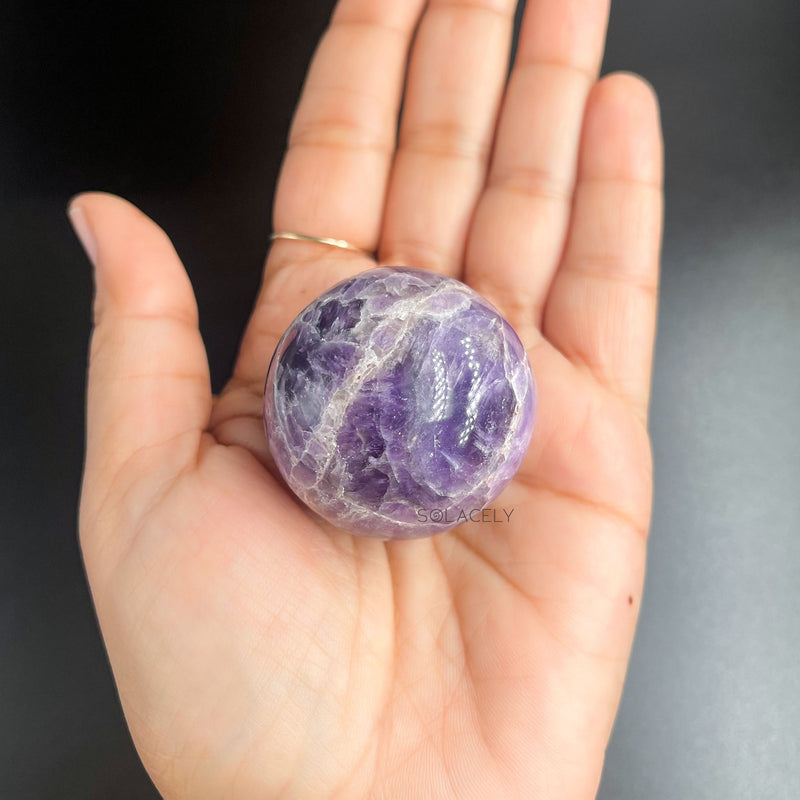
Violet crystals are the stones that sit between blue and red on the colour wheel, running from pale lavender through to deep grape. Amethyst leads the group, alongside lepidolite, charoite, sugilite, purple fluorite and iolite. They are traditionally kept for calm, intuition and quiet focus, which is why they suit evening routines so well.
Key takeaways
- Violet covers everything from soft lavender to saturated purple, so the group is defined by colour rather than by one mineral family.
- Amethyst is the violet variety of quartz and is the easiest place to start, being hard enough for daily wear at 7 on the Mohs scale.
- Lepidolite, charoite and sugilite are softer stones that are better suited to a pocket, a shelf or a meditation cushion than to a knock-about bracelet.
- Purple fluorite, iolite and tanzanite bring a clearer, more transparent violet, and each shows the colour in a different way.
- Violet stones are long associated with the crown and third eye chakras, and people reach for them when they want to slow the mind down.
- Keep amethyst and fluorite out of long, direct sunlight so the colour stays as deep as the day you bought it.
What makes a crystal violet?
Violet in crystals comes from trace elements and from the way a mineral's structure bends light. In amethyst, small amounts of iron sitting inside a quartz framework, combined with natural irradiation underground, produce the purple. In fluorite and charoite the colour comes from different chemistry again, which is why no two violets look quite alike.
That variety is worth knowing before you shop. A lavender quartz and a deep sugilite are both correctly called violet, yet they read completely differently in the hand and in a photograph. Quartz-family violets tend to be glassy and cool. The mica and silicate violets, such as lepidolite and charoite, are softer looking, with a satin or pearly sheen and visible swirls.
Colour saturation also shifts with the light source. Many violet stones look bluer under daylight and warmer under lamplight, so it is worth checking a piece under the lighting you will actually live with. If you want the wider colour story, our guide to purple crystals covers the same family from a slightly different angle.
Ten violet crystals at a glance
The ten stones below cover most of what you will meet on a violet shelf. The hardness column is the practical one: anything at 6 or above copes with being worn daily, while the softer stones are happier in a bowl, a pouch or a display piece. Traditional associations are given as they have been handed down.
| Stone | Colour range | Mohs hardness | Traditionally kept for |
|---|---|---|---|
| Amethyst | Lilac to deep grape | 7 | Calm, clear thinking, sleep routines |
| Lepidolite | Soft lavender to pinkish purple | 2.5 to 3.5 | Settling a busy head |
| Charoite | Swirled violet and white | 5 to 6 | Moving through change |
| Sugilite | Deep purple to magenta purple | 5.5 to 6.5 | Self acceptance, forgiveness |
| Purple fluorite | Pale to inky violet, often banded | 4 | Focus and study |
| Iolite | Violet blue to grey violet | 7 to 7.5 | Inner direction, intuition |
| Purple jade | Dusty lavender | 6 to 7 | Steadiness and wisdom |
| Tanzanite | Blue violet to purple | 6 to 7 | Perspective and insight |
| Lavender quartz | Pale, milky lavender | 7 | Rest and softening |
| Purple aventurine | Purple with a glittery shimmer | 7 | Creative confidence |
Amethyst: the violet crystal most people start with
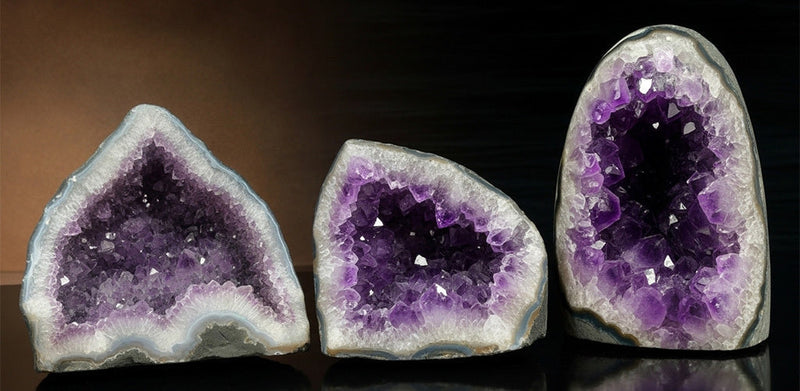
Amethyst is the purple variety of quartz, and it is the violet stone people meet first for good reason. It is widely available in every format from tumbles to spheres, it sits at 7 on the Mohs scale so it holds up to daily wear, and its colour range is broad enough that almost everyone finds a shade they like.
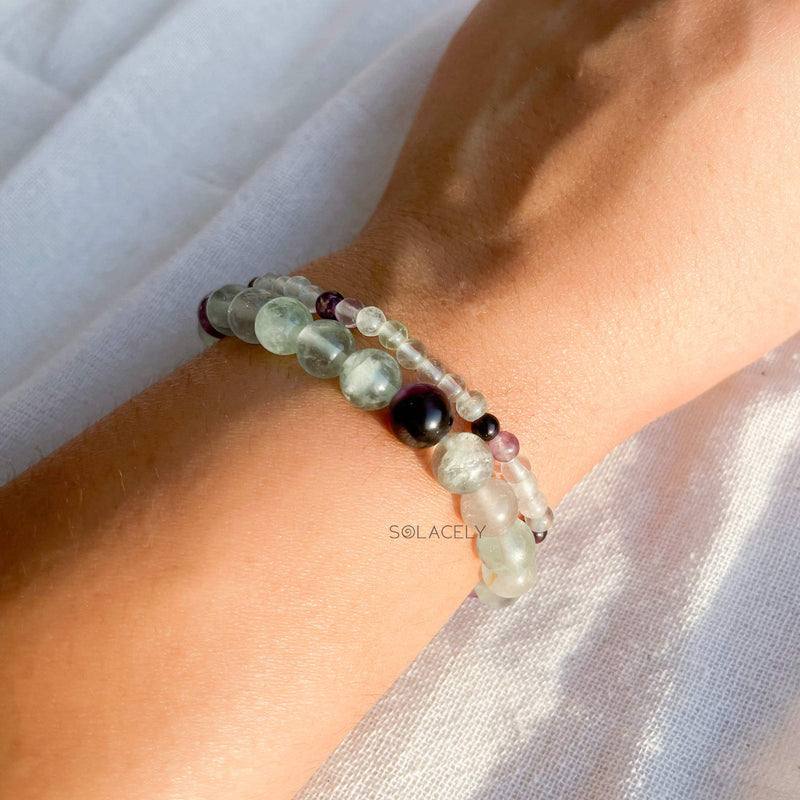
Gemmological grading pays close attention to how evenly the purple runs through a piece. Amethyst often grows with colour zoning, meaning bands of stronger and paler violet within the same crystal, and cutters work with that zoning to bring the richest colour face up. On a beaded bracelet you will often see a mix of tones across the strand, which many people prefer to a flat, uniform look.
Traditionally amethyst is kept for a calmer head. People reach for it during meditation, place it on a bedside table, or wear it as a daily reminder to slow down before reacting. Our full amethyst meaning and properties guide goes deeper on formats and pairings, and amethyst is also the anchor stone in most crown chakra layouts.
The softer violets: lepidolite, charoite and sugilite
These three are the mood stones of the violet family, and all three need a gentler hand than amethyst. Lepidolite is a lavender mica that splits into flakes. Charoite is a swirled violet silicate from a single area of Siberia. Sugilite runs from grape to magenta purple, with the best known gem material coming from South Africa.
Lepidolite is the softest of the three at roughly 2.5 to 3.5 on the Mohs scale, so it scratches easily and should not be tumbled or strung tight against harder beads such as quartz or hematite. Keep a lepidolite bracelet on its own wrist, or store it separately in a pouch. People traditionally reach for it when the head will not stop running, and it pairs naturally with amethyst, as covered in our amethyst and lepidolite guide.
Charoite is prized for its pattern rather than its transparency. The violet swirls, chatoyant fibres and white or black flecks make every cabochon different, so choose by the pattern you actually want to look at. Sugilite is a little harder and takes a strong polish, which is why it turns up in pendants and rings. It is long associated with self acceptance and with forgiving yourself for something.
The clearer violets: purple fluorite, iolite and tanzanite
Where the mica and silicate violets are opaque, these three let light through. Purple fluorite is often banded with green or clear zones. Iolite shifts colour depending on the angle you view it from. Tanzanite carries a blue violet that changes character between daylight and lamplight, which is part of its appeal.
Fluorite is the softest of the three at 4 on the Mohs scale, so it belongs on a desk or an altar rather than on a wrist you knock against door frames. Its banding is a genuine growth feature, formed as the chemistry of the fluid changed while the crystal grew. Study and focus are the traditional associations, which is why fluorite so often ends up next to a laptop.
Iolite is the gem quality form of cordierite, and it is strongly pleochroic: turn the same stone and you can see violet blue from one direction and a pale straw grey from another. Cutters orient the rough to bring the violet face up. Tanzanite, a blue violet zoisite from the Merelani Hills in Tanzania, shows a similar play between blue and purple and is usually set rather than worn loose.
How to use violet crystals day to day
Most people use violet crystals in three ways: worn, held or placed. A bracelet keeps the stone in your line of sight as a daily cue. A tumble in the pocket gives you something to reach for in a tense moment. A sphere or cluster on a shelf sets the tone of a room without asking anything of you.
For an evening routine, a simple sequence works well. Put the stone somewhere you will see it as you wind down, take a few slow breaths while holding it, and set a plain intention such as leaving the day's mental noise behind. Amethyst and lepidolite are the usual choices here, and our list of the best crystals for sleep covers how people arrange them around a bed.
If you meditate, violet stones are traditionally placed at the crown or brow, or simply held in the palms. There is no single correct method. Pick one stone rather than five, stay with it for a few weeks, and you will get a much clearer sense of whether it suits you than by rotating through the whole shelf.
Caring for violet crystals so the colour stays deep
Violet stones need three things: shade, gentle cleaning and separate storage. Amethyst, fluorite and lavender quartz can lighten under long spells of direct sunlight, so a sunny windowsill is the one place not to keep them. Soft stones want a dry cloth rather than a scrub, and they should never share a box with harder beads.
For cleaning, a soft dry or barely damp cloth handles almost everything. Quartz family violets such as amethyst, lavender quartz and purple aventurine tolerate a brief rinse in cool water and a thorough dry. Lepidolite and charoite are better kept away from soaking altogether, since water works into the flakes and fibres. Skip ultrasonic cleaners and hot water across the whole group.
Store bracelets flat in individual pouches so the softer stones are not rubbing against the harder ones. If you like to cleanse your pieces, moonlight, sound and dry salt on a plate beside the stone are all gentle options that avoid soaking. Keep small beads, chips and tumbles well away from young children, as they are a choking and strangulation risk.
Crystals are kept for comfort, focus and ritual. They are not a medical treatment and nothing here is medical, psychological or safety advice. If you have a health concern, please speak to a qualified professional and carry on with any care that has already been arranged for you. Keep small stones, beads and chips away from babies, young children and pets, as they present a choking and strangulation risk.
Sources
- GIA, Amethyst Quality Factors and Description
- Geology.com, Quartz: Mineral Information and Varieties
Written by Chetena Sharma. Reviewed by the Solacely editorial team.
Frequently asked questions
About the author


Written by Chetna Sharma, crystal healing practitioner and co-founder of Solacely. Chetna has worked with healing crystals for over a decade and curates Solacely's protective stone collection.