Citrine and carnelian are worn together because they cover two halves of the same push: citrine for abundance and confidence, carnelian for courage and creative drive. Both are quartz family stones of similar hardness, so they sit happily on one wrist and wear at the same rate. This guide covers what each is kept for and how to wear them.
Key takeaways
- Citrine is the abundance and confidence half of the pair, long associated with the solar plexus and with backing yourself in public.
- Carnelian is the courage and creative drive half, traditionally linked to the sacral chakra and to getting started rather than getting organised.
- Both are quartz family stones, silica coloured by iron, which is why they polish alike and wear evenly on a single bracelet.
- Gentle heating is a long established, permanent finish across the coloured stone trade, so pick the golden or orange shade you actually want on your wrist.
- Keep both out of prolonged direct sun, since citrine's golden colour softens over months of strong light.
- Small beads, chips and tumbles are a choking and strangulation risk, so keep them away from babies and young children.
Why citrine and carnelian are worn together
The pairing works because the two stones sit next to each other in the body's traditional map and cover a sequence rather than a contrast. Carnelian is placed at the sacral chakra, where the impulse to make something starts. Citrine is placed at the solar plexus directly above it, where that impulse turns into confidence and follow through.
That is the whole logic of the combination. Carnelian is reached for at the point where you have an idea and have not moved on it. Citrine is reached for at the point where you have to say the idea out loud, ask for the fee, send the pitch or walk into the room. Worn together they are traditionally kept as a start-and-finish pair.
There is a practical reason as well. Both stones belong to the quartz family, both are silica coloured by iron, and both sit around 7 on the Mohs scale. A bracelet that alternates them wears at one rate instead of one stone slowly grinding down the other, which is what happens when a soft stone is strung against a much harder one.
Citrine, the abundance and confidence half
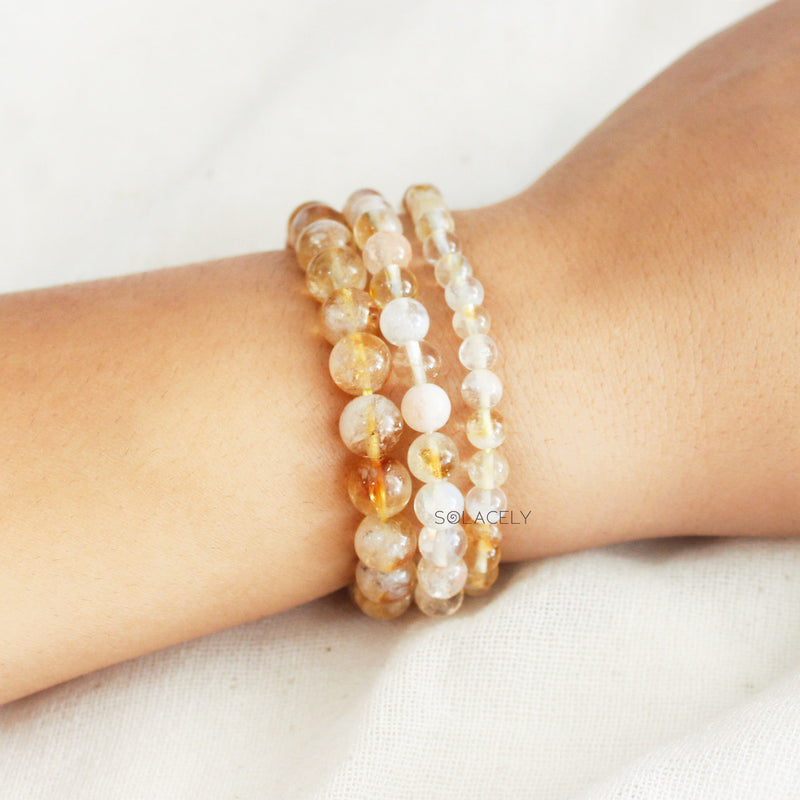
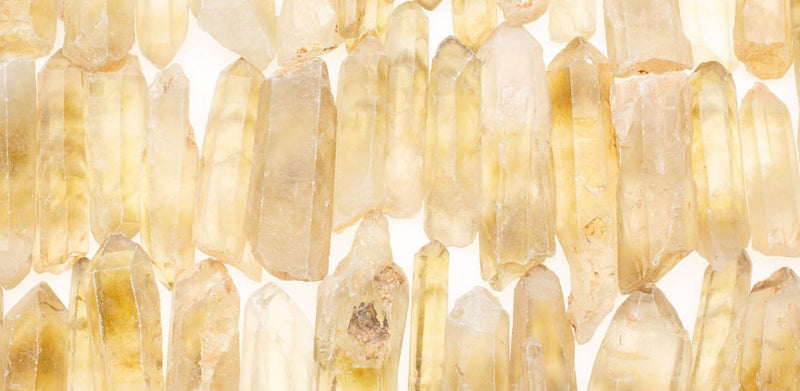
Citrine is the golden variety of quartz, running from a pale champagne through honey to a deep amber brown. It has been carried for centuries as a stone of trade and self assurance, and it is the one people reach for before an interview, a pitch, a price conversation or anything where the hard part is speaking up for yourself.
Its traditional home is the solar plexus, the soft spot below the ribs where nerves are felt first. The old association is with personal power in the plainest sense: knowing what you are worth and being willing to name it. That is why citrine turns up so often in money and career rituals, and why it is the most common stone in an abundance bracelet stack.
As a mineral it is a straightforward macrocrystalline quartz, transparent to translucent, hard enough for daily wear, with no cleavage planes to split under a knock. Our fuller guide to citrine meaning and properties goes further into its history, and if the confidence side is what draws you, the wider list of crystals for confidence is the natural next read.
Carnelian, the courage and creative drive half
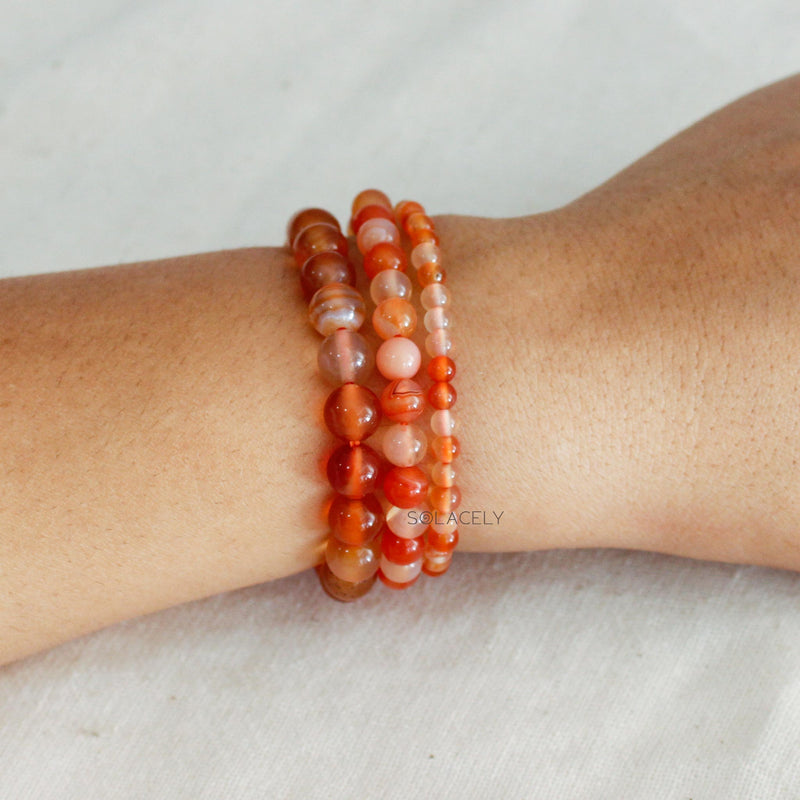
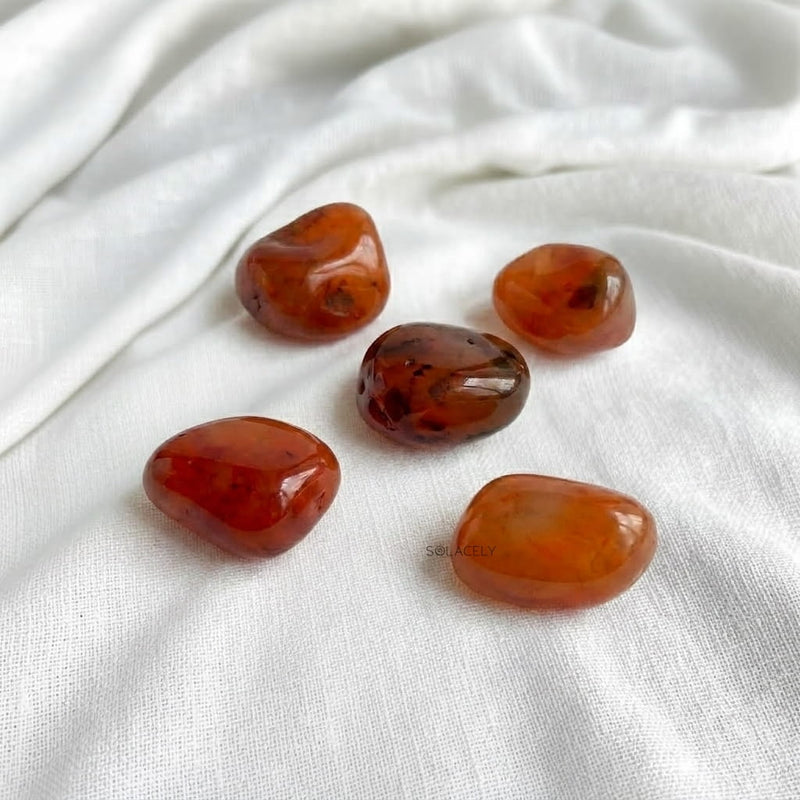
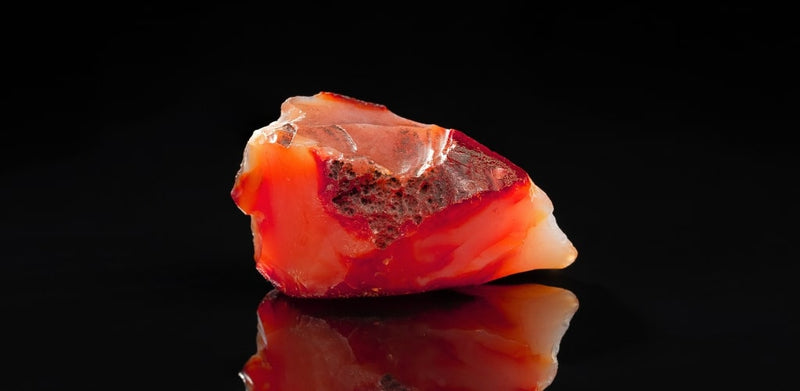
Carnelian is a warm red to orange chalcedony, a microcrystalline form of quartz whose crystals are too fine to see. Its colour comes from iron oxide dispersed through the stone, and it is translucent rather than clear, which gives it that lit-from-within glow when you hold a bead up to a window.
It has one of the longest documented histories of any stone worn today. Carnelian beads were cut and traded across the ancient world, and the stone appears in Egyptian funerary jewellery and in Roman signet rings, where its hardness and even texture made it ideal for carving a seal. That long association with action, craft and making a mark is exactly the reputation it still carries.
In practice carnelian is kept for the beginning of things. People reach for it when the work is stalled, when a blank page needs a first line, or when the courage required is the ordinary kind: making the call, starting the class, showing the work to someone. The carnelian guide covers it in more depth, and the broader crystals for courage list places it alongside its usual companions.
Choosing the shade you actually want
Colour is the decision that matters most with this pair, because it is what you will look at every day. Citrine runs from pale champagne to deep amber. Carnelian runs from a light apricot through bright orange to a deep brick red. The two families overlap in the middle, so the contrast you get depends entirely on where you pick.
Gentle heating is a long established, permanent and stable finish used right across the coloured stone trade, and it is how a great deal of the warm golden citrine and deep orange carnelian on any counter reaches its final colour. Because the result does not shift or wash out, the only question worth asking is which shade you want on your wrist.
A useful way to choose: a pale champagne citrine beside a soft apricot carnelian reads quiet and works under a shirt cuff, while a deep amber beside a brick red reads bold and carries at a distance. If you want maximum contrast, take a light citrine against a dark carnelian. If you want the pair to blend into one warm band, keep both mid-toned. Our notes on citrine colour walk through the golden range in more detail.
| Property | Citrine | Carnelian |
|---|---|---|
| Family | Macrocrystalline quartz | Chalcedony, microcrystalline quartz |
| Look | Transparent to translucent | Translucent, waxy glow |
| Colour range | Champagne, honey, amber, brown | Apricot, orange, brick red |
| Mohs hardness | Around 7 | Around 6.5 to 7 |
| Traditional chakra | Solar plexus | Sacral |
| Traditionally kept for | Abundance, confidence, follow through | Courage, creative drive, starting |
| Best formats | Beads, points, tumbles, rings | Beads, cabochons, tumbles, carvings |
How to wear the pairing
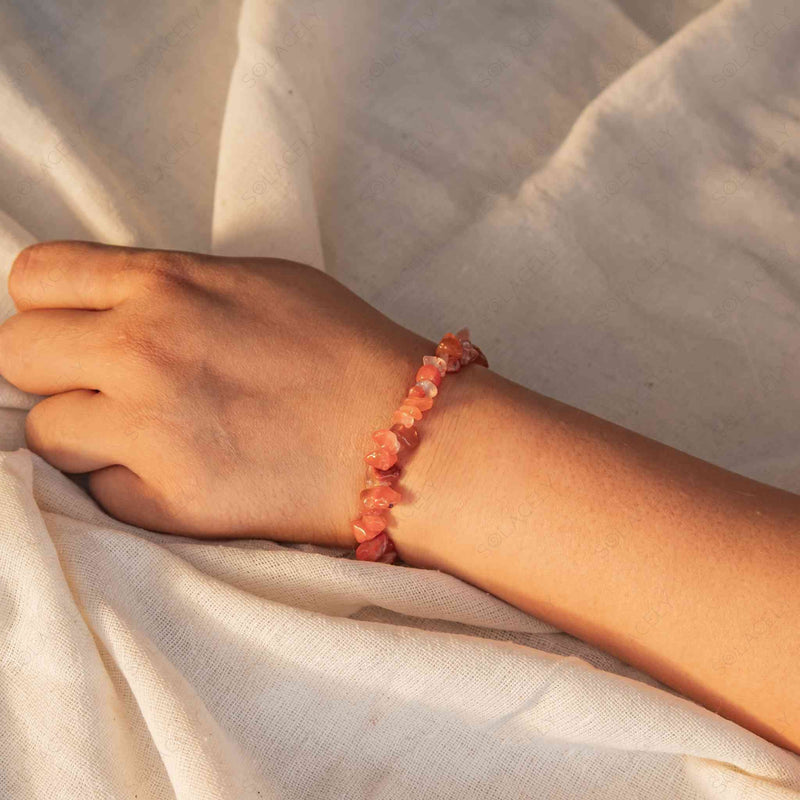
Most people meet this combination as a beaded bracelet, and that is still the easiest way in. Beyond that, the pair works as two pendants, as a pocket set, or as a small desk arrangement. What matters is that you see them often enough for the association to hold, since the stone is the cue that starts the habit.
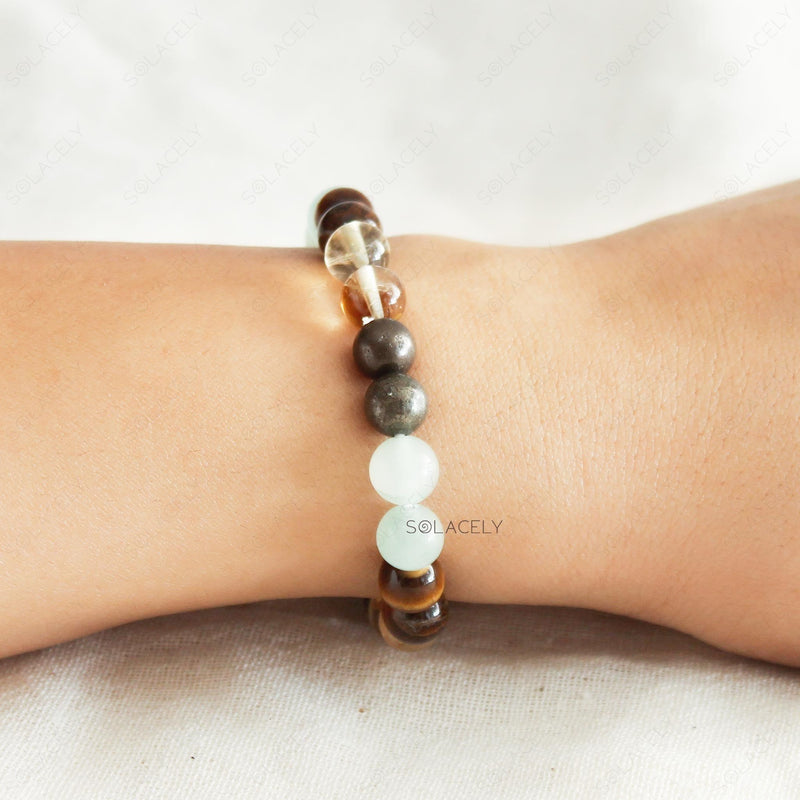
- Alternating bracelet. Six or eight millimetre beads in a half-and-half split gives the clearest gold against orange. Eight millimetre suits most adult wrists and reads well on its own.
- Stacked bracelets. One citrine strand and one carnelian strand worn together, so you can drop to a single stone on days when only one of the two is the job at hand.
- Pendant pair. A citrine point and a carnelian cabochon on one chain, or on two chains of different lengths. Both take silver, gold and brass settings without trouble.
- Pocket stones. A small tumble of each. Carnelian in the hand before you start something, citrine in the hand before you have to speak about it.
- Desk pair. Two tumbles at the top corner of a desk, in sight while you work. Many people find this the version that actually sticks.
Which wrist is a matter of tradition rather than rule. The common practice places a stone you want to draw in on the left, the receiving side, and a stone you want to project outward on the right. Plenty of people simply wear the bracelet where it is comfortable and where they will notice it, which is a perfectly good approach.
Give it a fortnight before judging. A one line intention when you put the bracelet on in the morning, and the same bracelet on the same wrist each day, is the whole practice. Consistency does far more than the length of any single ritual.
How to care for citrine and carnelian
Both stones are hard enough for daily wear and need very little. Warm soapy water and a soft cloth is the safe baseline for each, followed by a proper dry before you put the piece away. Skip ultrasonic and steam cleaners, which can find internal fractures in any stone and open them up.
The one point worth remembering is light. Citrine's golden colour softens with prolonged direct sunlight, so a sunny windowsill is the wrong home for it. Charge it in moonlight overnight instead, or with sound from a singing bowl, or by passing it through incense smoke. Carnelian is more forgiving of light, but the same shaded storage suits both.
A few habits that keep a pair looking new:
- Store the bracelet in a soft pouch rather than loose in a bowl with harder or softer stones.
- Take it off before swimming, showering or applying hand cream and perfume, which dull the polish and the cord over time.
- Avoid long salt water soaks. They dull the surface on both stones and shorten the life of an elastic cord.
- Never put stones in drinking water or a water bottle.
- Keep small beads, chips and tumbles well away from babies and young children, for whom they are a choking and strangulation risk.
Crystals are kept as part of a personal ritual and are not a treatment for any medical condition. If something about your health or wellbeing is worrying you, please speak to your doctor or another qualified health professional, and carry on with any care that has already been arranged for you. Keep stones out of drinking water, and keep small beads, chips and tumbles away from babies and young children, for whom they are a choking and strangulation risk.
Sources
Written by Chetena Sharma. Reviewed by the Solacely editorial team.
Frequently asked questions
About the author


Written by Chetna Sharma, crystal healing practitioner and co-founder of Solacely. Chetna has worked with healing crystals for over a decade and curates Solacely's protective stone collection.