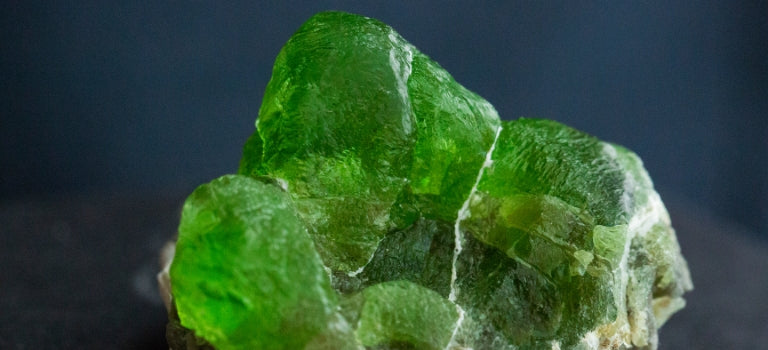
Green jade and peridot pair two green stones with different jobs. Jade is worn for patient prosperity and steadiness; peridot for renewal and clearing out what has gone stale. The combination suits people building something new after ending something else, and the two need quite different care.
Key takeaways
- Jade is a trade name for two minerals, jadeite and nephrite, distinguished only in the nineteenth century.
- Peridot is gem quality olivine, the August birthstone, and one of very few gems found in a single colour.
- Peridot is acid sensitive. Perfume, cosmetics and sweat left on it will dull the polish over time.
- Jade is exceptionally tough; peridot is brittle. Store them separately and choose formats accordingly.
- Metaphysical uses described here are traditional belief, not medical fact.
What each stone is
Green jade covers two chemically distinct minerals. Jadeite is a pyroxene and nephrite is an amphibole, and the Gemological Institute of America notes that jadeite is the rarer and generally more valuable of the two, with the finest imperial green reaching prices that rival fine coloured diamond.
Peridot is the gem variety of olivine, a magnesium iron silicate. The GIA describes it as forming deep in the Earth's mantle and reaching the surface through volcanic activity, with some material even arriving inside meteorites. Every peridot is green; the shade varies with iron content but the colour never does.
Geology.com describes olivine as a rock forming mineral abundant in basalt and peridotite, which is a useful corrective. Peridot is not rare as a substance, only as clean gem quality material. The peridot guide covers it further.
Why the pairing works
The two stones sit at different points on the same arc. Jade is the long game: accumulation, harmony, and the kind of luck that comes from consistency rather than chance. Peridot is the clearing out: letting go of a stale chapter and starting without dragging the last one along.
That combination is chosen most often by people at the beginning of something they intend to keep. Starting a business after leaving a job, moving into a home of their own, or rebuilding after a long difficult stretch. Peridot handles the departure; jade handles what gets built next.
Visually the pairing is subtler than most. Two greens of different character, jade's even waxy tone against peridot's brighter transparency, reads as considered rather than showy, which suits the intention behind it.
Comparing green jade and peridot
| Green jade | Peridot | |
|---|---|---|
| Mineral | Jadeite (pyroxene) or nephrite (amphibole) | Olivine, magnesium iron silicate |
| Hardness | Jadeite 6.5 to 7, nephrite 6 to 6.5 | 6.5 to 7 Mohs |
| Toughness | Exceptional, resists breaking | Brittle, chips more easily than the number suggests |
| Main vulnerability | Harsh chemicals, ultrasonic on treated material | Acids and sudden temperature change |
| Traditional use | Prosperity, harmony, longevity | Renewal, lightness, letting go |
| Best format | Bangle, pendant, carved piece | Pendant or protected setting |
The hardness numbers are almost identical, which is misleading. Jade's interlocking fibrous structure makes it far tougher in practice, while peridot's brittleness means it chips where jade simply does not. Consult the Mohs hardness scale for storage, but judge formats on toughness rather than hardness alone.
How to wear the pair
Give jade the exposed position and keep peridot protected. That single rule handles most of the durability difference.
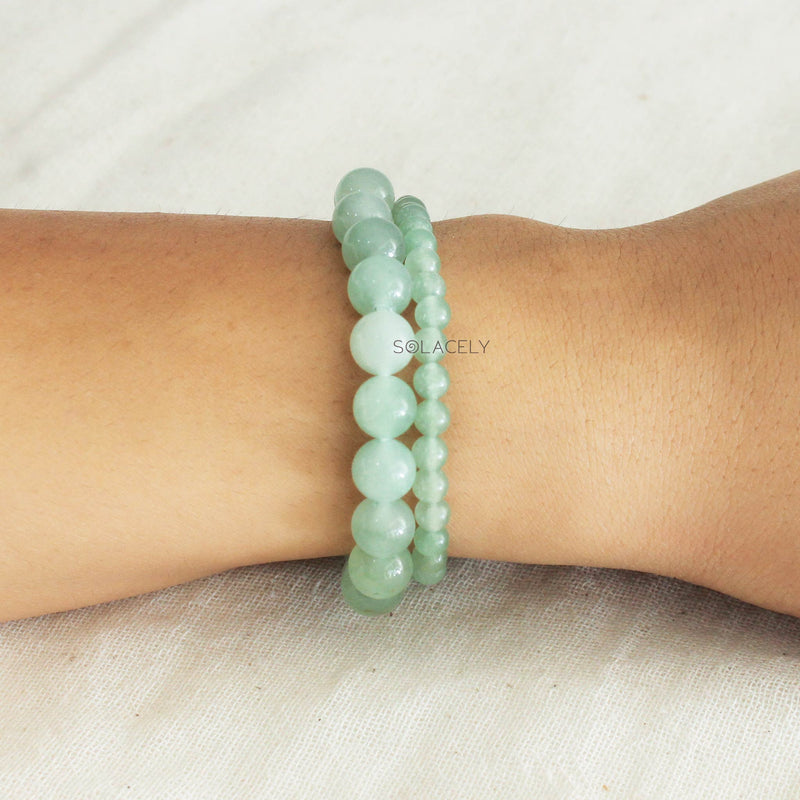
- Bangles and bracelets. Jade is the classic choice here and survives knocks that would chip peridot.
- Pendants. Peridot as the drop, hanging clear of surfaces, with jade beads on the chain.
- Rings. Jade handles this well. Peridot needs a bezel setting that shields the edges.
- At home. Both suit a desk or a shelf, though keep peridot out of a window that gets strong afternoon sun.
If August is your birth month the pairing doubles as a birthstone set, and the August birthstone guide covers what else is recognised alongside peridot.
Buying both without overpaying
Jade is one of the most misrepresented stones in the trade, and the terminology matters. Type A means untreated jadeite. Type B has been bleached and polymer impregnated. Type C has been dyed. Type B and C can look excellent on day one and yellow noticeably within a few years as the polymer degrades.
Jade covers two minerals, jadeite and nephrite, and both are properly jade. Serpentine and aventurine quartz are handsome green stones in their own right and sometimes appear alongside under broader trade names, so it is worth simply asking which mineral a piece is. Any good seller will say plainly and put it in writing on anything expensive.
Peridot is where the price varies most by grade. Colour drives it, with a clean slightly yellowish grass green commanding far more than a muddy olive. Visible inclusions are normal and not a defect. Peridot also has a distinctive optical signature, a doubling of the back edges visible under magnification, which is one of the quiet pleasures of the stone.
Care and cleansing
Jade is forgiving. Warm water, mild soap, a soft brush, dried fully. Avoid ultrasonic cleaners and steam on any dyed or polymer treated piece, which covers most of the low end of the market.
Peridot needs more thought. It is sensitive to acids, so perfume, hairspray and cosmetics should go on well before the jewellery does, and sweat left on it overnight will dull the polish over time. It also dislikes sudden temperature change, which rules out steam cleaning and hot to cold rinses. Warm soapy water and a soft cloth is the whole method.
For energetic cleansing both suit moonlight or sound. Skip salt water, which is unkind to peridot's polish, and skip prolonged sun. For related pairings on the same jade base, see green jade and malachite for a sharper version and the green jade guide for the stone on its own.
Who this combination suits
It suits people in the specific gap between ending and building. That is a narrower brief than most crystal pairings claim, and it is the reason the combination holds together: peridot addresses the reluctance to let go, jade addresses the patience required for whatever comes next.
It suits badly anyone looking for protection or grounding, since neither stone is traditionally used for either. If boundaries are the actual need, a black stone belongs in the set instead. And if the goal is prosperity alone rather than prosperity after a change, jade on its own does the job without the extra care requirements. See crystals for prosperity for that shortlist.
Peridot's long history
Peridot has been mined for well over three thousand years, and the earliest known source was the island of Zabargad in the Red Sea, which supplied Egyptian workshops. Much of what ancient writers described as topaz appears to have been peridot from that source, a confusion that persisted in the historical record for centuries.
That documented history is unusual in crystal writing, where a great deal of the lore is modern invention presented as ancient. Material formed in the mantle, carried up by volcanic activity, occasionally arriving inside meteorites, and mined continuously for millennia is a genuinely good story that needs no embellishment.
Jade's history runs at least as deep and arguably deeper, with nephrite worked in China for thousands of years and jadeite carved across Mesoamerica entirely independently. Two cultures on opposite sides of the world arrived at the same conclusion about the same material, which is part of why the stone carries the weight it does.
The properties described here reflect traditional and cultural belief around crystals. They are not medical claims, financial guidance, or a substitute for professional advice. If you are managing a health concern, speak to a qualified practitioner rather than relying on a crystal practice.
Sources
- Gemological Institute of America, Jade Description
- Gemological Institute of America, Peridot Description
Written by Chetena Sharma. Reviewed by the Solacely editorial team.
Frequently asked questions
About the author


Written by Chetna Sharma, crystal healing practitioner and co-founder of Solacely. Chetna has worked with healing crystals for over a decade and curates Solacely's protective stone collection.