Larimar is a blue variety of pectolite, a sodium calcium silicate, and it is mined in commercial quantity in only one place on earth: a mountainous stretch of the Dominican Republic. Its blue comes from copper sitting in the structure. In crystal tradition it is kept for calm, clear speech and emotional cooling.
Key takeaways
- Larimar is a blue variety of pectolite, a sodium calcium silicate, coloured by copper substituting into its structure.
- It is mined in commercial quantity in only one place on earth, the Bahoruco mountains of the Dominican Republic.
- Hardness is roughly 4.5 to 5 on the Mohs scale, softer than quartz at 7, so it suits pendants and earrings more than daily rings.
- The name dates to the 1970s, when Miguel Mendez joined his daughter Larissa's name to mar, the Spanish word for sea.
- In crystal tradition it is a throat chakra stone kept for calm, clear speech and emotional cooling.
- Keep it out of prolonged direct sunlight and heat, and away from ultrasonic cleaners and household chemicals.
What is larimar, and where does it come from?
Larimar is the trade name for a blue variety of pectolite, a sodium calcium silicate that normally forms white, grey or colourless. Copper substituting for some of the calcium is what turns it blue. Gemmological reference works place it at roughly 4.5 to 5 on the Mohs scale, which is soft for a stone worn every day.
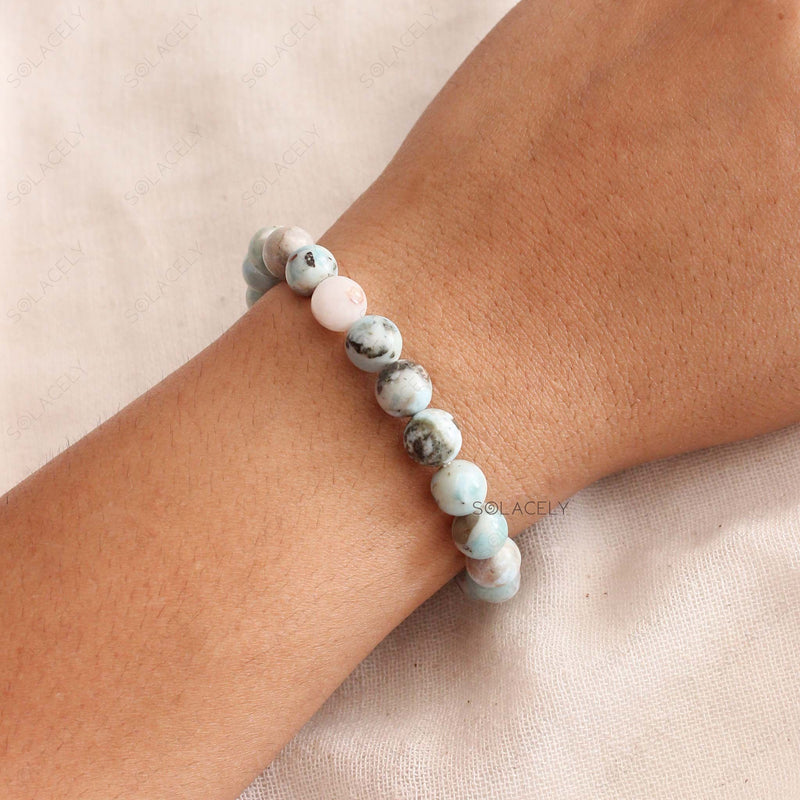
Pectolite itself grows as needle like sprays inside cavities in volcanic rock. The Dominican material formed in exactly that setting, in gas pockets and veins within basalt, and the same setting gives larimar its marbling. Paler pectolite and traces of host rock thread through the blue, so a single cabochon can carry deep blue, sky blue and clean white at once.
The deposit sits in the Bahoruco mountain range in Barahona province, in the south west of the Dominican Republic. For generations, water carried loose pieces down the Bahoruco river towards the coast, which is why the first larimar people picked up was sea worn pebbles on the beach. Today the hillside seams are worked directly. If you enjoy this family of stones, our guide to blue crystals sets larimar alongside its cousins.
How did larimar get its name?
Larimar was named in the 1970s by Miguel Mendez, a Dominican who joined the first letters of his daughter Larissa's name to mar, the Spanish word for sea. The name suited the material exactly. Blue and white in the same stone looks a great deal like shallow water seen from above.
Before that, the stone travelled under plainer descriptions: blue pectolite among mineral people, and a handful of sea coloured nicknames locally. Mendez's version is the one that stuck, and it is now what the whole trade uses. You will still hear the phrase stone of the sea alongside it, used less as a trade term and more as a description of what the pattern does to the eye.
What makes one piece of larimar more sought after than another?
Colour depth and pattern do most of the work. The deepest material, usually called volcanic blue, carries a saturated sea blue with crisp white veining and strong contrast. Paler green blue and white dominant pieces are gentler and easier on the budget. Even colour and a clean, readable pattern matter as much as depth does.
- Volcanic blue: the deepest, most saturated blue, with sharp white veining.
- Blue: a clear mid blue, and the grade you meet most often in jewellery.
- Green blue: a turquoise leaning shade where more of the pale pectolite shows through.
- White dominant: mostly white with soft blue clouding, quiet and very wearable.
Collectors read the pattern the way you read a sky. Some pieces look like sunlight moving on shallow water. Others look like cloud breaking up over open sea. A good cutter orients the cabochon to keep that movement, so two stones from the same seam can sit at very different prices on pattern alone. Choose the shade you actually want to look at every day.
What is larimar traditionally kept for?
Larimar is traditionally kept for calm, and for clear, unhurried speech. It is a throat chakra stone in most modern crystal systems, and people reach for it when they want to say a difficult thing kindly. Its second association is emotional cooling, which is where the nickname stone of the sea comes from.
Throat work is what it is best known for. Long associated with honest, measured speech, larimar is worn as a reminder to breathe before answering, and it turns up often in sets built for presentations, hard conversations and singing. Our guide to crystals for the throat chakra covers the usual companions if you want to build a full set.
The second thread is steadiness. Water imagery runs through nearly everything written about this stone: tides, breath, the temperature dropping. Many people keep a piece near them through demanding weeks as a daily cue to soften, which is why it sits comfortably among calming crystals. Held in the hand it feels cool, smooth and faintly soapy, and that touch is part of the appeal.
How do you wear larimar?
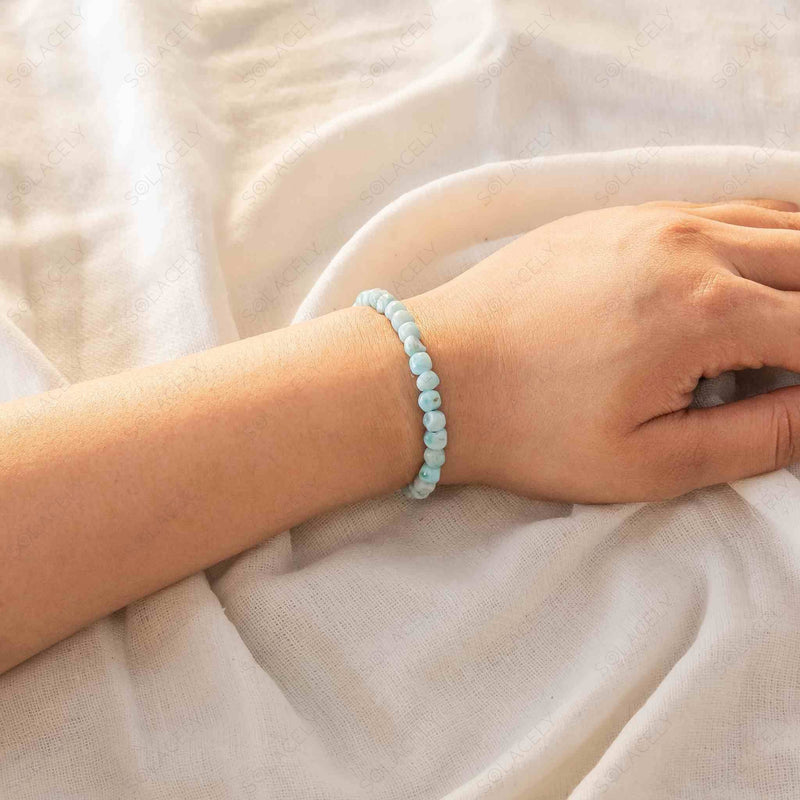
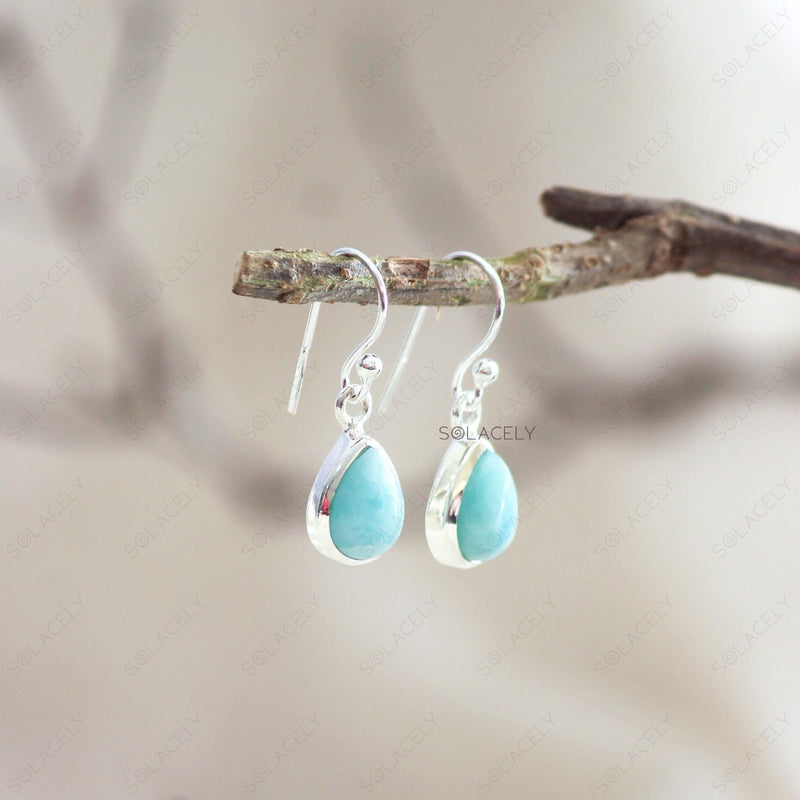
Wear larimar where it will not be knocked. At roughly 4.5 to 5 on the Mohs scale it is softer than quartz, so pendants, earrings and brooches are the settings that treat it best. Bracelets are fine with a little care. A ring worn every day puts it in the line of fire.
Cabochons suit it better than facets, because the pattern reads across a smooth dome rather than being broken up. Silver is the traditional setting and flatters the blue, and a bezel is worth asking for, since a rim of metal around the edge takes the knocks that would otherwise chip the stone. Beads and tumbles are popular too, and a tumble in a pocket is the easiest way to keep it with you.
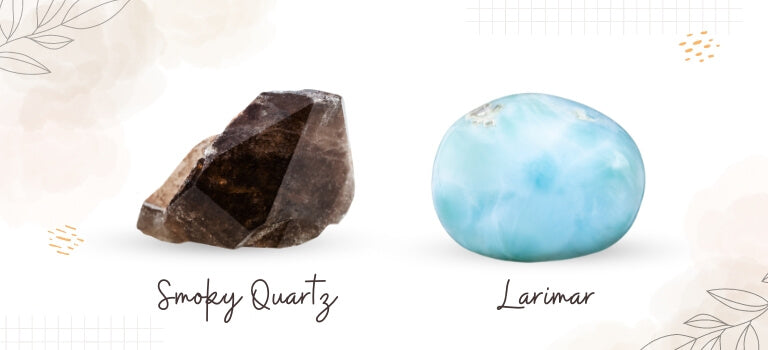
Pairing is straightforward. Grounding stones balance its airiness, and the combination of smoky quartz and larimar is a well travelled one. For another blue with sea associations, aquamarine sits beside it happily and is a good deal harder, so it can take the rougher wear in a mixed stack.
How do you care for larimar?
Warm water, mild soap and a soft cloth. That is the whole routine. At 4.5 to 5 on the Mohs scale larimar scratches easily, so store it apart from harder stones, keep it out of prolonged direct sunlight and heat, and keep it away from ultrasonic cleaners, steamers and household chemicals.
| Stone | Mohs hardness | Care note |
|---|---|---|
| Larimar | 4.5 to 5 | Scratches easily. No ultrasonics. Keep out of prolonged sun and heat. |
| Turquoise | 5 to 6 | Porous. Keep away from oils, perfume and chemicals. |
| Lapis lazuli | 5 to 5.5 | Soft. Mild soap only, and no ultrasonics. |
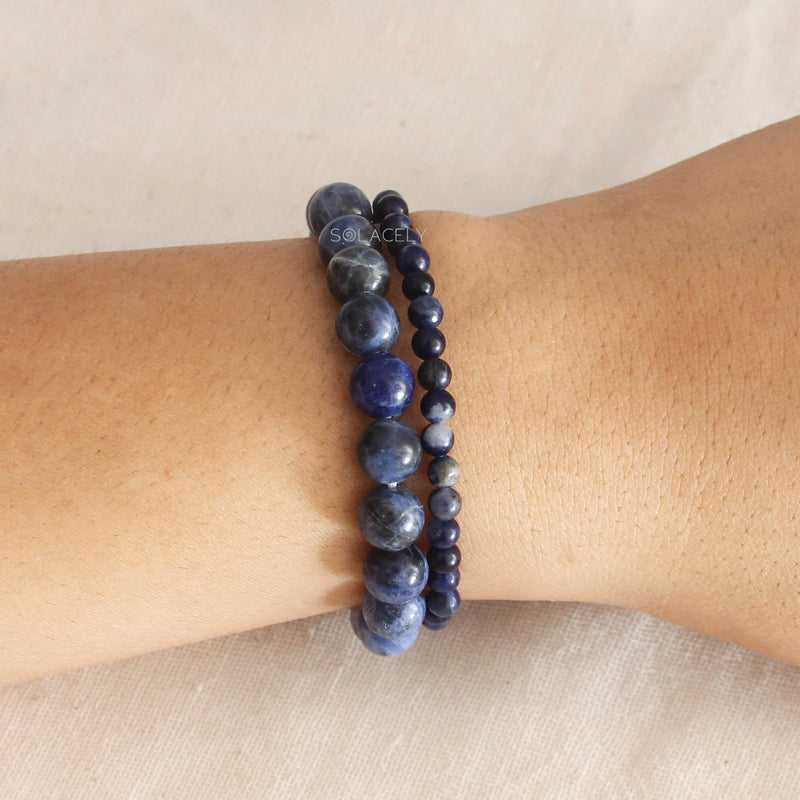
| Sodalite | 5.5 to 6 | Mild soap. Avoid acids and long soaking. |
| Aquamarine | 7.5 to 8 | Hard wearing. Still protect facet edges from knocks. |
Sunlight is the detail people forget. A larimar pendant left on a bright windowsill for months can lose some of its blue, and the same goes for heat from a radiator, a car dashboard or a hot bath. Take the piece off before swimming, showering and sleeping, and put it on after perfume, sunscreen and hairspray rather than before. Last on, first off is the simplest rule to remember.
For storage, use a soft pouch or a lined box with separate compartments. Sharing a drawer with quartz, topaz or a steel watch back is the most common way a smooth blue cabochon picks up its first scratch. Wipe it with a barely damp cloth after wear, dry it properly, and it will keep its polish for years.
This article is for general information and reflects long standing crystal tradition rather than medical guidance. Crystals are not a treatment for any physical or mental health condition, and nothing here should replace or delay advice from a qualified doctor or therapist. Keep small stones and beads away from young children and pets, since they are a choking hazard, and never place crystals in drinking water.
Sources
Written by Chetena Sharma. Reviewed by the Solacely editorial team.
Frequently asked questions
About the author


Written by Chetna Sharma, crystal healing practitioner and co-founder of Solacely. Chetna has worked with healing crystals for over a decade and curates Solacely's protective stone collection.