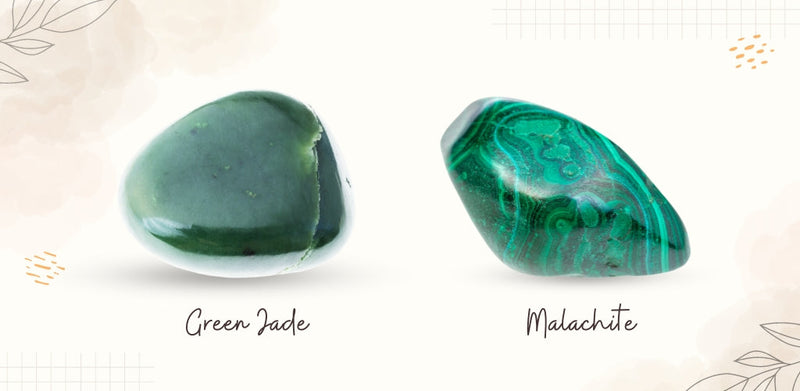
Malachite is a banded green copper carbonate, long known as the stone of transformation. In crystal tradition it is kept for change, for protection through that change, and for the clarity to stop repeating a pattern. Its concentric banding makes every piece unmistakably its own.
Key takeaways
- Malachite is a copper carbonate, and the copper is what gives it that deep, unmistakable green.
- Traditionally kept for transformation, protection during change, and breaking a repeating pattern.
- It is soft, around 3.5 to 4 on the Mohs scale, so pendants and display pieces outlast rings.
- Handling care matters. Keep polished pieces dry, never make crystal water with it, and do not sand or grind raw material.
- Every piece is individual. The concentric banding never repeats exactly from one stone to the next.
What malachite is
Malachite is a copper carbonate hydroxide mineral, formed where copper deposits weather near the surface. That origin is the reason for both its colour and its pattern: the stone builds up in rounded, layered growths, and when those are cut across you get the swirling light and dark green bands it is known for.
People have valued it for a very long time. It was mined in Egypt for ornament and pigment, carved through the Greek and Roman world, and used on a grand scale in nineteenth century Russia, where the malachite room at the Winter Palace remains the most famous showcase of the material anywhere.
The banding is also the best reason to choose a piece in person if you can. No two malachite stones carry the same rings, so the one you pick is genuinely unlike any other.
Malachite meaning in crystal tradition
Malachite is the transformation stone. Where other green stones are kept for steady accumulation, malachite is associated with the moment something changes, and with having the nerve to let it. That is a narrower and more particular reputation than most stones carry.
It is traditionally described as a stone that shows you the pattern you have been repeating. People reach for it when a situation keeps recurring in different clothes: the same kind of role, the same dynamic, the same stalling point. The intention attached is recognition first, then the willingness to choose differently.
Alongside that, malachite has long been kept as a protective stone, particularly during periods of change rather than at rest. In older European practice it was given to children and to travellers, and the modern habit of keeping it near a workspace during an upheaval follows the same thread.
Traditional properties and benefits
The associations gathered around malachite are consistent across sources, and they cluster around change, courage and the heart.
- Transformation. The core association. Kept during career changes, moves, and the ending of long chapters.
- Protection through change. Carried when the ground is shifting rather than when things are settled.
- Emotional clarity. Long linked to seeing a situation plainly and naming what is actually happening.
- Heart centre work. Its green places it with the heart chakra in chakra practice, alongside jade and green aventurine.
- Confidence in speaking. Often kept before a conversation that has been put off.
These are traditional associations rather than clinical effects, and they are best used the way people have always used them: as a focus for an intention you are already holding. If protection is the main thing you want, crystals for protection covers the wider selection.
Handling and safety, plainly
Malachite contains copper, and that shapes how it should be handled. None of this is cause for alarm, and it does not change how the overwhelming majority of people use the stone, which is as a polished piece worn or displayed. It simply means a few habits are worth keeping.
| Practice | Guidance | Why |
|---|---|---|
| Handling polished pieces | Perfectly fine, with dry hands | Sealed, polished surfaces are stable in normal use |
| Crystal water or elixirs | Never with malachite | Copper minerals should not go into anything you drink |
| Sanding, grinding, polishing raw stone | Leave it to a lapidary | Fine mineral dust should not be inhaled |
| Soaking or salt cleansing | Avoid | Water and salt dull the polish on a soft carbonate |
| Children and pets | Keep out of reach | Small stones are a choking hazard for any mineral |
Cleaning is simple once those are understood: a barely damp cloth, wiped and dried straight away. That is genuinely all a malachite piece needs, and it keeps the banding sharp for years.
How to wear and place malachite
Its softness decides the format more than anything else. At 3.5 to 4 on the Mohs scale, malachite is comfortably harder than chalk and considerably softer than quartz, which means it wants a position where it is seen rather than knocked.
- Pendants. The best format by a clear margin, since the stone hangs free of surfaces.
- Polished cabochons and palm stones. Lovely to hold, and the banding shows beautifully.
- Display pieces. A polished freeform on a desk or shelf, where the pattern earns its place.
- Bracelets. Worn gently, and best kept for occasions rather than every day.
- Store separately. Harder stones will mark it if they share a pouch.
For placement at home, malachite is traditionally kept where change is being worked on: a desk during a career shift, a hallway during a move. Paired with jade it makes a set that balances building and releasing, which is covered in green jade and malachite.
Choosing a malachite piece
Buy on pattern first. The banding is the whole appeal, so look for rings with good contrast between the light and dark greens, and a rhythm to them that pleases you. Bullseye patterns, where concentric circles centre neatly, are especially prized and worth holding out for.
Check the polish next. A good malachite surface has a soft sheen rather than a glassy glare, and it should be even across the face of the stone without chalky or dull patches. Look along the edges for chips, since the stone marks easily in transit.
Then simply choose the piece you like. Because every stone is individual, this is one of the few materials where personal preference is genuinely the right criterion. Pair it with a heart stone such as green aventurine if you want something softer alongside it.
Malachite through history
Few stones have been put to as many uses. Ground malachite was one of the earliest green pigments, appearing in Egyptian tomb painting and later in European panel painting through the medieval and Renaissance periods. Painters valued it for a green that held its tone, and conservators still identify it in works many centuries old.
It was worn as well as painted. Egyptian jewellery set malachite alongside lapis lazuli and carnelian, and the same combination of deep blue, warm red and banded green recurs across the ancient Mediterranean. The stone travelled well along trade routes precisely because it was recognisable at a glance.
The Russian chapter is the most spectacular. Vast deposits in the Urals supplied the nineteenth century fashion for malachite veneer, where thin slices were fitted together so the banding runs continuously across columns, tabletops and whole rooms. That technique, called Russian mosaic, is the reason people still associate the stone with grandeur.
Malachite in daily practice
Most people keep it simply. A pendant worn on days that need a decision, a polished piece on a desk through a period of change, or a palm stone held for a few slow breaths before a conversation that has been put off.
The habit that seems to matter is placing it where the change is actually happening rather than where you rest. Malachite is not a bedside stone in most traditions; it belongs where the work is, which is why desks and hallways come up so often in how people describe using it.
The properties described here reflect traditional and cultural belief around crystals. They are offered for reflection and wellbeing and are not medical advice, a diagnosis, or a treatment for any condition. If you are managing a health concern, please speak with a qualified healthcare professional. Malachite is a copper mineral: keep it out of drinking water and elixirs, do not sand or grind raw material, and keep small stones away from young children and pets.
Sources
Written by Chetena Sharma. Reviewed by the Solacely editorial team.
Frequently asked questions
About the author


Written by Chetna Sharma, crystal healing practitioner and co-founder of Solacely. Chetna has worked with healing crystals for over a decade and curates Solacely's protective stone collection.