Peridot and citrine is the warm pairing people reach for at the start of something new. Peridot brings the fresh yellow-green of late summer and sits at the heart in modern crystal practice; citrine brings gold and sits at the solar plexus. Together they are kept as a renewal and drive combination.
Key takeaways
- Peridot is the gem variety of olivine, a magnesium-iron silicate, and it is the modern August birthstone.
- Peridot's colour comes from iron that belongs to the mineral's own chemistry rather than from a trace impurity, which is unusual among coloured stones.
- Gem-quality olivine also turns up inside pallasite meteorites, so a small share of peridot has been cut from material that formed beyond Earth.
- Citrine is the golden variety of quartz and the modern November birthstone, so the pair covers two birthdays in one piece.
- Citrine sits at 7 on the Mohs scale and peridot at 6.5 to 7, close enough that a beaded bracelet wears evenly.
- Peridot dislikes acids and sudden temperature changes, so warm soapy water and gentle handling are the rule.
Why pair peridot and citrine?
Peridot and citrine are paired because they cover two halves of the same moment: seeing a new direction and then acting on it. Peridot is traditionally kept at the heart for renewal, growth and compassion. Citrine is kept at the solar plexus for confidence, warmth and momentum. Open at the heart, move with the gut.
That is why the combination turns up so often at transitions. People reach for it when a job changes, when a course begins, when a creative project finally gets a start date, or when a difficult season is starting to lift and something else needs to fill the space. The pairing is long associated with beginnings rather than endings.
The look earns its place too. Cool yellow-green against warm gold is one of the most distinctive same-family palettes in crystal beadwork, since both stones read as warm while staying clearly different from one another. A peridot bead sitting next to a golden citrine bead stays legible from across a room, which is more than most crystal pairings manage.
What peridot and citrine actually are
Peridot is the gem variety of olivine, a magnesium-iron silicate with the formula (Mg,Fe)2SiO4. Citrine is the golden variety of quartz, silicon dioxide. They come from two completely separate mineral families, which is part of why the pairing looks so lively: the greens and golds never quite blend into one another.
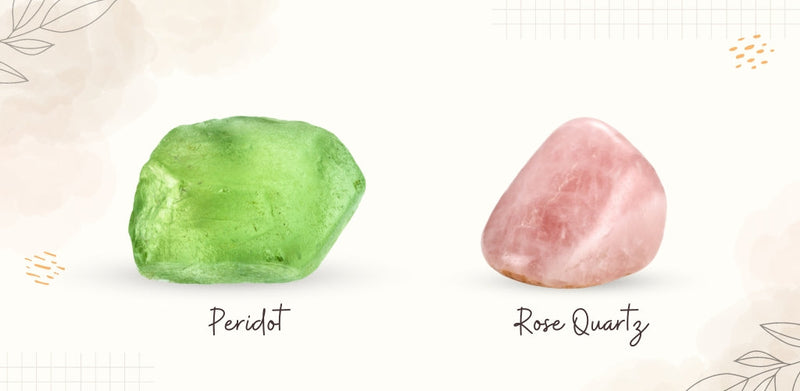
Peridot is unusual in one specific way. In most coloured gems the colour arrives as a trace element sitting inside an otherwise colourless structure. In peridot, the iron responsible for the yellow-green is part of the mineral's defining chemistry. More iron in the lattice pushes the stone towards a deeper olive; less iron leaves it in the bright, almost lime-lit range that August jewellery is known for. Gemmological grading puts peridot at 6.5 to 7 on the Mohs scale, with a specific gravity noticeably higher than quartz, so a peridot bead feels a little denser in the hand than a citrine bead of the same size.
Citrine is the tougher of the two by a small margin at 7, with no cleavage at all, which is why it holds a polish so well and why it has been a jewellery staple for so long. Our fuller peridot guide and citrine guide go further into each stone on its own.
| Property | Peridot | Citrine |
|---|---|---|
| Mineral family | Olivine | Quartz |
| Chemistry | (Mg,Fe)2SiO4 | SiO2 with iron |
| Mohs hardness | 6.5 to 7 | 7 |
| Cleavage | Imperfect, so it can chip on a hard knock | None |
| Colour cause | Iron within the defining chemistry | Iron within the quartz structure |
| Modern birthstone | August | November |
| Main sources | Pakistan, China, Myanmar, the United States, Vietnam | Brazil, Uruguay, Madagascar |
| Traditionally kept for | Renewal at the heart | Confidence at the solar plexus |
Peridot, the August birthstone that also falls from the sky
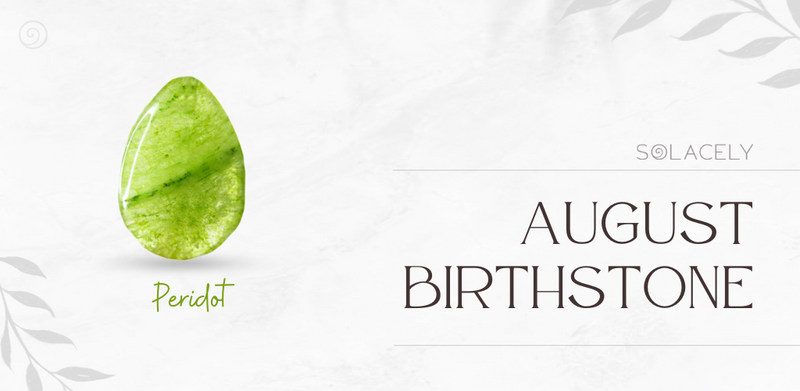
Peridot is the modern August birthstone, and it is one of the very few gems on the market that has been faceted from meteorite material. Gem-quality olivine occurs inside pallasite meteorites, a stony-iron class in which green olivine crystals sit suspended in an iron-nickel metal matrix.
Pallasites are understood to form when asteroids collide early in a solar system's history and molten core metal mixes with olivine from the mantle, then cools into a green and silver mosaic. Cut and polished, those slices are among the most striking objects in any meteorite collection, and the clearest olivine crystals in them have been faceted and set as gem peridot. That material formed before Earth did.
The everyday version of the story is still a good one. Terrestrial peridot forms deep in the mantle and rides to the surface in volcanic rock, which is why the classic collecting localities are volcanic. Most peridot in the shops comes from Pakistan's Sapat Valley in the Himalayas, from Hebei in China, from Mogok in Myanmar, from the San Carlos Apache Reservation in Arizona, and from Vietnam. The oldest named source of all is Zabargad Island in the Red Sea, worked for thousands of years and the likely origin of a good deal of the green stone in antique European jewellery. If birthstone traditions are what brought you here, the wider August birthstone guide covers the month in full.
Choosing your citrine shade
Citrine runs from a pale champagne through honey and amber to a deep madeira brown, and the shade is the only decision that really matters. Gentle heat has been part of the coloured stone trade for centuries, it is used right across the industry, and the colour it settles into a quartz is permanent and stable, so the tone you choose is the tone you keep.
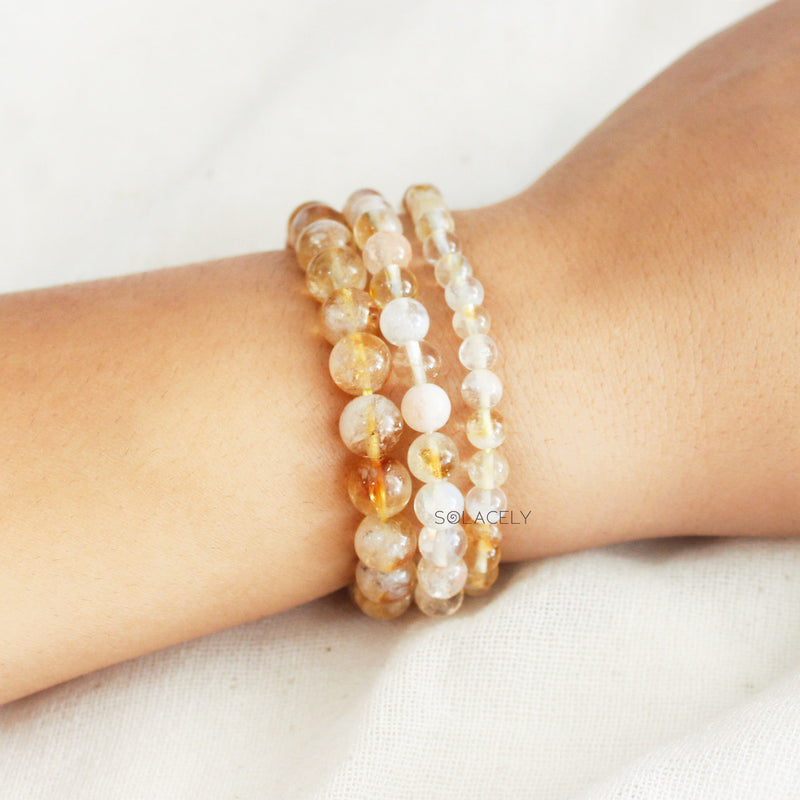
Pale champagne citrine reads as light and everyday, and it sits beautifully beside peridot's yellow-green because neither stone competes for attention. Mid-honey is the most popular choice for a peridot pairing, since it gives the strongest gold-against-green contrast. Deep madeira is the dressier end, warm and almost brandy-coloured, and it suits a pendant better than a full bracelet where it can overwhelm the peridot.
Buy the one you want to look at every morning. That is genuinely the whole test, because the stone you keep reaching for is the one that does its job as a daily cue. Our guide to citrine colour walks through the range side by side.
How to wear and use the pairing
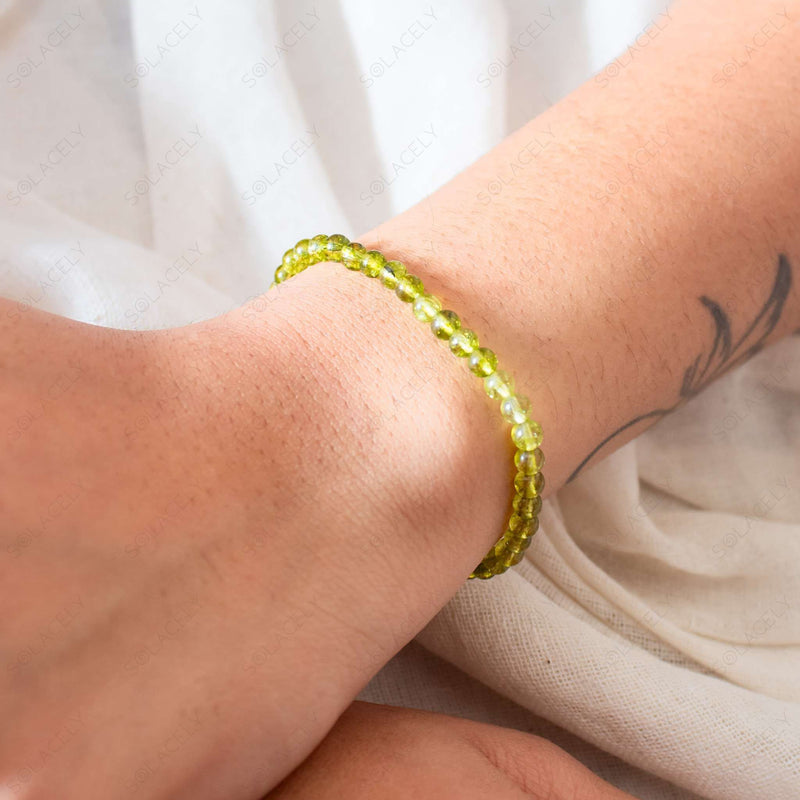
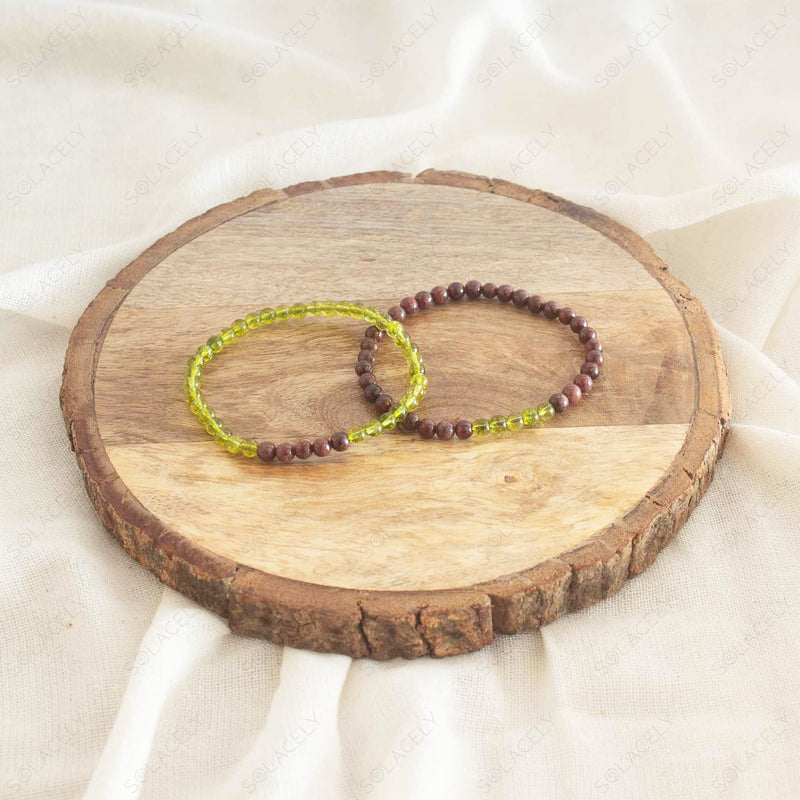
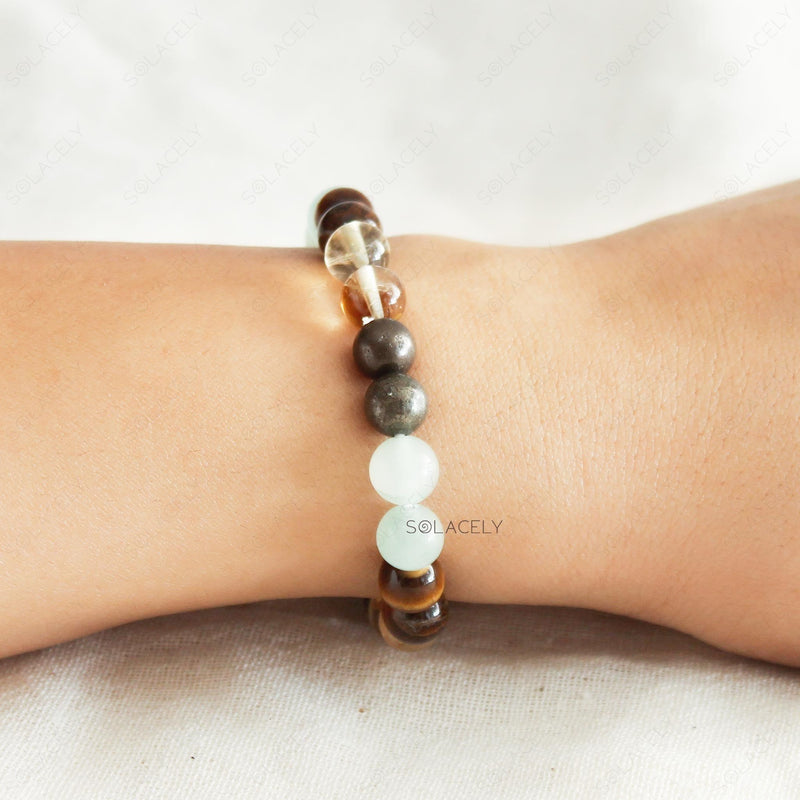
The beaded bracelet is by far the most common format, usually alternating peridot and citrine beads in 6 mm or 8 mm sizing on a single stretch cord. The near-matched hardness means neither stone grinds the other down, so one piece holds up across years of daily wear without one side of the design ageing faster than the other.
Pendants. A peridot cabochon on the same chain as a citrine point is a quieter way to carry both. Ask for bezel rather than prong mounts where you can, since peridot has imperfect cleavage and a rubbed-over edge protects it far better than exposed claws.
A stone in each hand. Hold peridot in the receptive, non-dominant hand for the renewal side, and citrine in the dominant hand for the acting side. Ten to fifteen minutes with one clear intention is the format most people settle into. Our notes on crystals for meditation cover holding positions and breathing patterns in more detail.
As a birthday gift. Because peridot is the modern August birthstone and citrine the modern November one, a single piece can carry both. It is a neat solution for a couple, for siblings born either side of autumn, or for anyone who wants a birthstone piece that is not the obvious one.
How to care for peridot and citrine
Warm soapy water and a soft cloth is the safe routine for both stones, followed by a proper dry before you put the piece away. Peridot is the more delicate of the two and sets the rules for the pair: keep it away from acids, away from sudden temperature changes, and out of ultrasonic and steam cleaners entirely.
Peridot is also brittle for its hardness, so treat a hard knock against a worktop or a door frame as the real risk rather than everyday scratching. Take a bracelet off for washing up, cleaning and the gym, since household cleaners and even lemon juice or vinegar can dull a peridot's polish. A cotton bud gets between the beads on a stretch bracelet without dragging on the cord.
A few habits worth keeping:
- Store the piece in a soft pouch, apart from harder stones such as topaz, sapphire or quartz points that could scratch the peridot.
- Keep citrine out of prolonged direct sunlight, since the gold can soften over time in a sunny window.
- Let the piece come back to room temperature before washing it, rather than going from cold hands to hot water.
- For cleansing, moonlight overnight, a selenite plate, incense smoke or a singing bowl are all gentle on both stones. Skip long salt soaks, which dull the polish.
- Never put stones in drinking water, and keep small beads and chips away from babies and young children, for whom they are a choking and strangulation risk.
Crystals are kept as part of a personal ritual and are not a treatment for any medical condition. If you have a health concern, please speak to your doctor or another qualified professional and carry on with any care that has already been arranged for you. Keep stones out of drinking water, and keep small beads, chips and tumbles away from babies and young children, for whom they are a choking and strangulation risk.
Sources
Written by Chetena Sharma. Reviewed by the Solacely editorial team.
Frequently asked questions
About the author


Written by Chetna Sharma, crystal healing practitioner and co-founder of Solacely. Chetna has worked with healing crystals for over a decade and curates Solacely's protective stone collection.