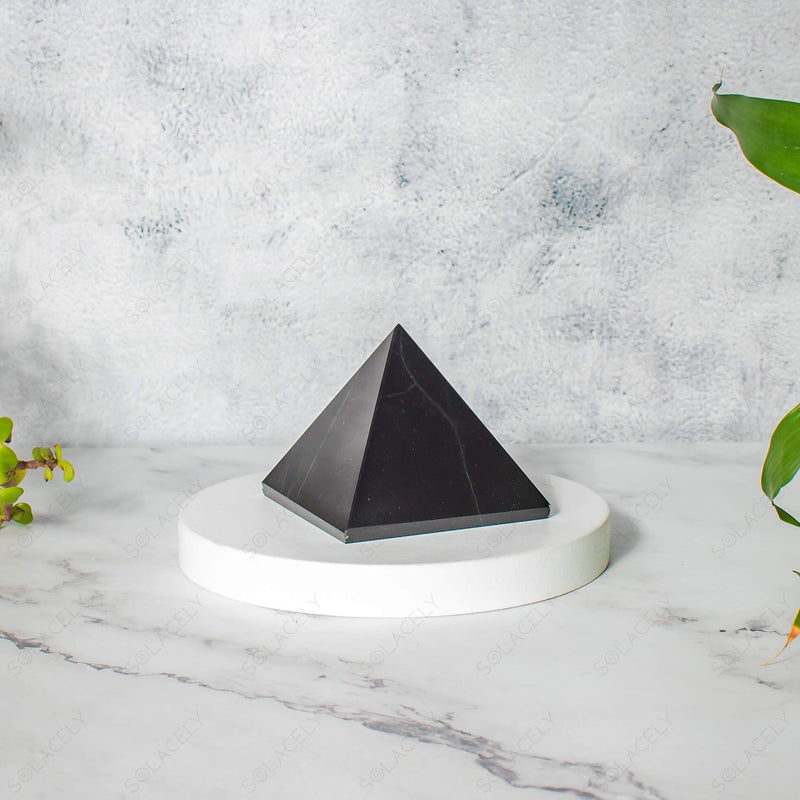
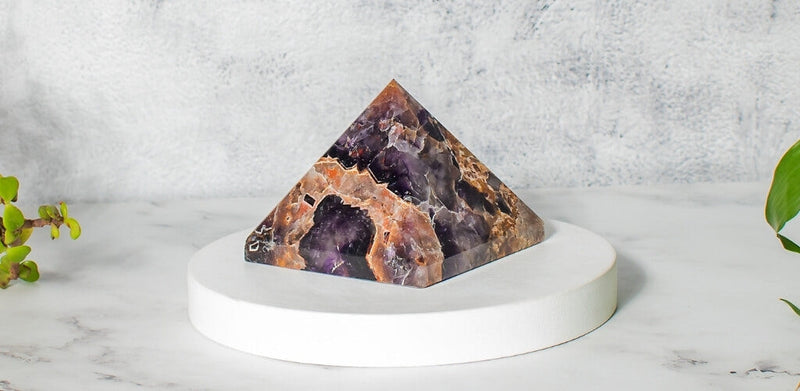
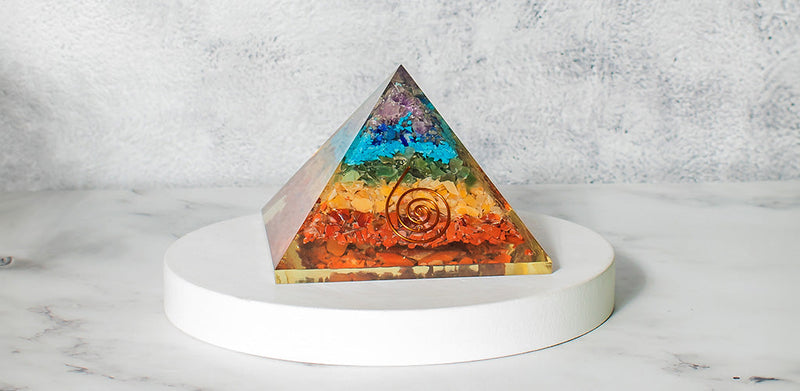
For an office desk, most people pick clear quartz for focus, amethyst for calm, citrine or pyrite for drive, and black tourmaline or black onyx to take the edge off a stressful room. Place the pyramid on the far edge of the desk, apex up, well outside your typing and coffee zone.
Key takeaways
- Match the stone to the job: clear quartz for focus, amethyst for calm, citrine or pyrite for drive, black tourmaline or black onyx for screening out office stress.
- Quartz and its varieties, including amethyst, citrine and tiger's eye, sit at 7 on the Mohs hardness scale, which is why they hold up to daily desk handling.
- The usual advice is a 2 to 3 inch pyramid in a far corner of the desk, apex upward and clear of your typing zone. Vastu and feng shui arrive at much the same placement from different directions.
- Keep it out of the arc your hands sweep while typing and away from open drinks. A chipped apex is the most common way a desk piece comes to grief.
- Dust it weekly, keep pyrite dry, and keep amethyst out of long, direct sun so the colour stays deep.
What is a crystal pyramid, and why the pyramid shape?
A crystal pyramid is a piece of stone cut and polished into a four-sided pyramid on a square base, usually 5 to 8 cm tall for desk use. Both vastu shastra and feng shui read a rising, pointed form as gathering energy and sending it upward, which is why the shape keeps turning up on working desks.
In vastu practice, pyramids appear as remedy objects: small yantra pyramids set in a room or under a bed to support a direction considered weak. Feng shui arrives at the same object from a different angle. Pointed, triangular shapes belong to the fire element in the five element system, which is linked with reputation, visibility and activity. Two traditions, one shape, and a long history behind both.
So why keep one on the desk at all? In our experience it earns its place as a cue object. It is visible, it does not look like an office supply, and it gives the intention you sat down with somewhere to land. If you want the background on the vastu side specifically, our guide to the vastu pyramid covers the traditional rules in more depth.
Which crystals work best for a desk pyramid?
Pick by the problem you actually have at work. Clear quartz is the default for focus, amethyst for a calmer head, citrine and pyrite for drive and confidence, black tourmaline and black onyx for shielding out a stressful office, and tiger's eye for finishing things you have already started.
| Work goal | Stone | Why it is chosen |
|---|---|---|
| Focus and mental clarity | Clear quartz | Treated in practice as an amplifier and a blank slate for intention |
| Calm under pressure | Amethyst | Long association with a settled mind and lower reactivity |
| Drive and confidence | Citrine | Warm colour, linked with optimism and self-belief |
| Ambition and money goals | Pyrite | Metallic gold look, used as a symbol of assertive earning |
| Screening out office stress | Black tourmaline, black onyx | The standard grounding and boundary stones in modern practice |
| Follow-through on long tasks | Tiger's eye | Associated with steady, unglamorous persistence |
Most of that list belongs to one mineral family. Quartz is silicon dioxide and one of the most abundant minerals in the Earth's crust, with a hardness of 7 on the Mohs scale and varieties that include amethyst, citrine, smoky quartz and tiger's eye. That hardness matters on a desk, where a pyramid gets knocked, slid and picked up several times a day.
Citrine deserves a word on colour. Warming quartz to bring out its golden tones is a long established and entirely stable practice across the coloured stone trade, and the results run from pale champagne through honey to deep amber. Choose the shade you actually want to look at every morning. Paler pieces read as bright and clean on a light desk, while the deeper oranges hold their own beside dark wood and black hardware.
Pyrite is the outlier here. It is iron sulfide, the brassy mineral nicknamed fool's gold, with a hardness of roughly 6 to 6.5. It is heavier than it looks and it dislikes moisture, which changes how you care for it. If concentration is your only concern, the wider crystals for focus guide compares more options than a pyramid alone.
Where should you place a pyramid on your office desk?
The common advice is a far corner of the desk, apex pointing up, sitting at the outer edge of your vision rather than in front of your face. Vastu practitioners usually favour the north or east side of a workspace for study and career matters. Feng shui users map the desk with a bagua instead.
Under a desk bagua you stand at the near edge and divide the surface into nine zones. Far left is the wealth area, far centre is reputation, far right is relationships and partnership. A citrine or pyrite pyramid goes far left on that reading, and a clear quartz piece goes far centre if visibility at work is the goal. Vastu takes a compass bearing rather than a desk-relative one, which is why the two systems sometimes point elsewhere. Choose one and stay with it.
Three practical rules matter more than the tradition you follow. Keep the pyramid outside the arc your hands sweep while typing, because a chipped apex is the most common way these pieces die. Keep it away from open drinks. And keep it high enough to be visible over a monitor stand, since a cue object you never see does nothing. For arrangements that mix a pyramid with tumbles or a small tree, our crystals for office desk guide sets out the full layout.
How do you set up the rest of the desk around it?
Give the pyramid a defined spot and build outward from there. A small tray, a coaster or a slice of wood marks the space so nothing else creeps into it, and the piece stops migrating every time you tidy. Cables, mug and notebook then have a reason to stay clear of that corner.
Height does most of the work. A pyramid sitting below the line of a monitor stand disappears within a week, so raise it on a riser, a book or the corner of a shelf until it sits in your peripheral vision while you type. In our experience that single change decides whether the piece stays part of the working day or quietly becomes another ornament you stop noticing.
Watch the environment as well as the layout. Heating vents, radiators and the warm exhaust from a laptop dry the air and pull dust straight onto polished faces. Long afternoon sun through a window is worth avoiding for amethyst and citrine in particular. A shaded corner, or a spot tucked behind a monitor, keeps colour steady for years rather than months.
Hot desking changes the calculation. If the piece travels daily, choose a smaller base, keep it in a padded drawstring pouch, and set it out first thing so arriving at the desk includes putting it down. Open-plan floors favour something discreet: a small clear quartz or smoky quartz pyramid reads as a paperweight to everyone walking past.
What size pyramid works best on a desk?
A 2 to 3 inch base, roughly 5 to 7.5 cm, is the practical range for most desks. It is heavy enough to stay put when a cable snags it, small enough to leave you working room, and large enough for the colour to read from across a room. Anything above 4 inches starts to own the desk.
Weight is the underrated part. A 2 inch quartz pyramid feels substantial in the hand, and that heft is what stops it sliding off a stack of paper or shifting when a cable drags past. Solacely's desk pyramids sit in that range for the same reason. If you share a hot desk, go smaller, since the piece has to travel in a bag every day.
Finish is worth a thought too. Mirror-polished faces show every fingerprint, while a lightly frosted surface hides handling marks. Neither is better energetically. It is purely a question of how much cleaning you want to do.
How do you clean and care for a desk pyramid?
Dust it weekly with a dry microfibre cloth and keep it well away from your mug. Quartz-family pyramids tolerate a quick rinse in lukewarm water followed by a thorough dry. Pyrite should never be soaked, because iron sulfide oxidises when it meets moisture, and salt water is a poor idea for every stone here.
Sunlight is the other quiet hazard. Amethyst is known to lose colour under long, direct exposure, so a sunny windowsill is the wrong home for a purple pyramid. If you want light on the stone, a few minutes of early morning sun is plenty, and moonlight or an overnight rest on a selenite plate is the traditional alternative.
For the energetic side, most practitioners use sound, incense smoke, a selenite slab or simply intention, repeating it when a piece feels dull or after a rough week. There is no fixed schedule, so treat the frequency as preference rather than rule. If the office atmosphere is what you are trying to shift, crystals for positive energy at work covers the wider set-up.
How do you build a daily habit around a desk pyramid?
Attach it to something you already do. The people who get most from a desk pyramid pair it with one small repeatable action: a touch on the apex before deep work, a straightening after a difficult call, a wipe and a reset at the end of the day. The habit is what keeps the intention live.
Pick one moment rather than five. A single anchor, opening your laptop for the first time, say, survives a busy week in a way an elaborate morning routine rarely does. Some people write the intention on a sticky note and tuck it under the base for a month. Others say it once, quietly, and start work.
Then let the piece change as your work does. A quarter spent chasing a target and a quarter spent steadying after a hard stretch call for different stones, and swapping the pyramid when the goal shifts keeps the object meaningful rather than scenery. Plenty of people keep two and rotate them by season or project.
The properties described here reflect traditional and cultural belief around crystals. They are not medical claims and are not a substitute for professional healthcare. If you are managing a health concern, speak to a qualified practitioner.
Sources
Written by Chetena Sharma. Reviewed by the Solacely editorial team.
Frequently asked questions
About the author


Written by Chetna Sharma, crystal healing practitioner and co-founder of Solacely. Chetna has worked with healing crystals for over a decade and curates Solacely's protective stone collection.