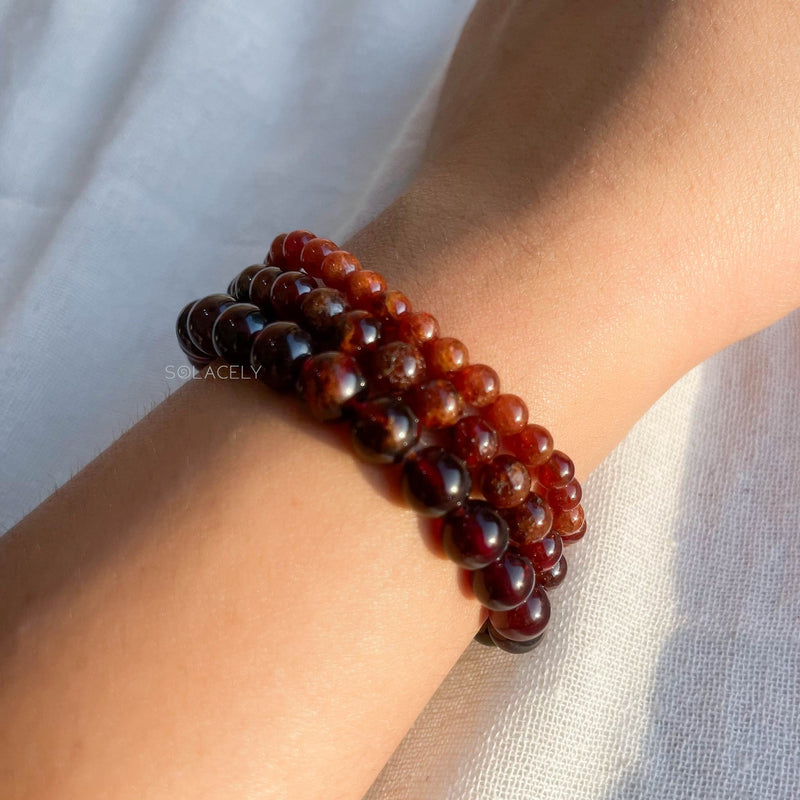
Wear a hessonite bracelet on your right wrist if you are following the Vedic convention. Many practitioners suggest the right for gomed, Rahu's stone, in keeping with the way remedial stones are worn on the working hand. If your astrologer has said otherwise, follow that. If you wear it simply as a grounding bracelet, the left wrist is fine.
Key takeaways
- Right wrist is the common convention for hessonite worn as Rahu's stone.
- The classical prescription is a ring on the middle finger, in silver or ashtadhatu, begun on a Saturday evening. A bracelet is the everyday alternative.
- Left wrist is a comfortable choice when you wear hessonite purely for grounding and confidence.
- If your astrologer has given you different guidance, theirs comes first.
- Switching wrists later changes nothing about the stone. Move it and carry on.
The right wrist, and where the convention comes from
The right wrist is the usual answer for hessonite, and the reasoning is traditional rather than arbitrary. In Vedic practice the right hand is the working hand, the one that acts in the world, and remedial stones are placed there so the remedy travels with the hand that does the day's work.
That is a convention, not a law. It is the placement most practitioners suggest when asked, and it fits the way gomed is understood: a stone worn to steady a period of intense ambition, confusion or sudden change, so that the person meets the world with a firmer footing. Worn on the right, it sits where the meeting happens.
What the ring tradition says, and why a bracelet is different
The classical form for gomed is not a bracelet at all. Tradition sets the stone in silver or ashtadhatu, worn on the middle finger, with the first wearing on a Saturday evening, Rahu sharing Saturn's day. Our guide to crystals for Rahu sets that prescription out in full, along with the caution the tradition attaches to it.
A bracelet carries the same stone against the skin, but it is a different kind of object. It is not set in a prescribed metal, it does not touch a particular finger, and it is as often worn for its colour and its everyday meaning as for its astrological one. That is why the wrist question is more relaxed than the finger question.
If an astrologer has prescribed gomed for you and told you how and when to wear it, that guidance applies to a bracelet as much as to a ring, and it overrides anything written here. If you have not had a reading and are drawn to the stone for its grounding, confident warmth, you are wearing it as a crystal bracelet, and the ordinary crystal conventions apply.
When the left wrist is the right answer
The left wrist is a good choice when you wear hessonite for what it means in everyday practice: confidence, clarity and grounded success. In crystal tradition the left is the receiving side, so anything you want to draw toward you, including steadiness, can sit there comfortably.
The wider rule is set out in our guide to which hand to wear your crystal bracelet on: receiving stones left, projecting stones right. Hessonite can honestly be read either way, which is why both wrists are in use. Garnet as a family is listed there with the projecting stones; hessonite's warm, settling character gives it a claim on the left as well.
Switching, stacking and what to wear it with
You can move a hessonite bracelet from one wrist to the other without undoing anything. The convention keeps your intention legible to you; it is not a test you can fail.
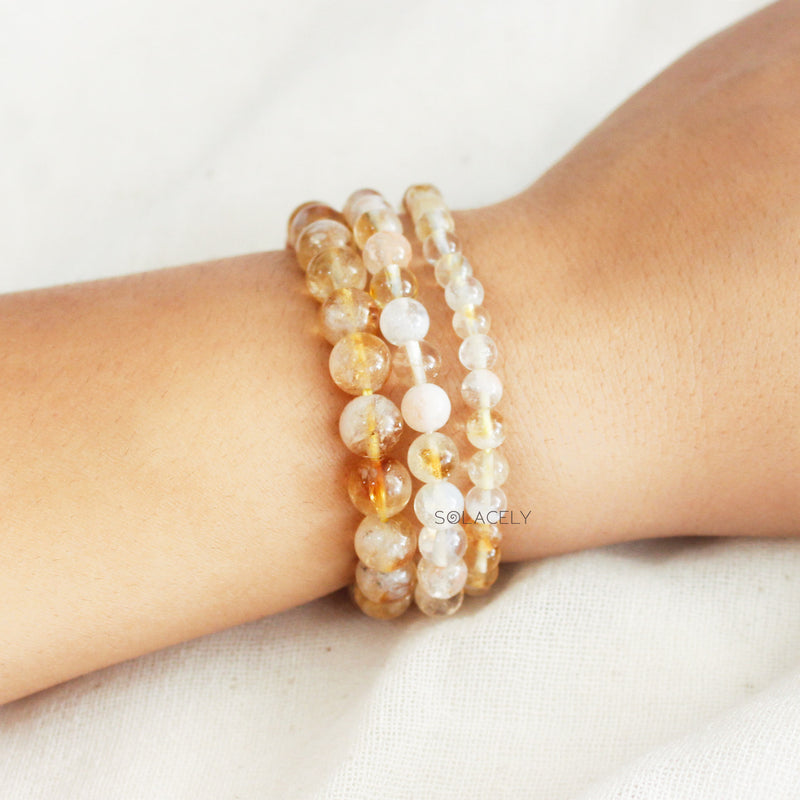
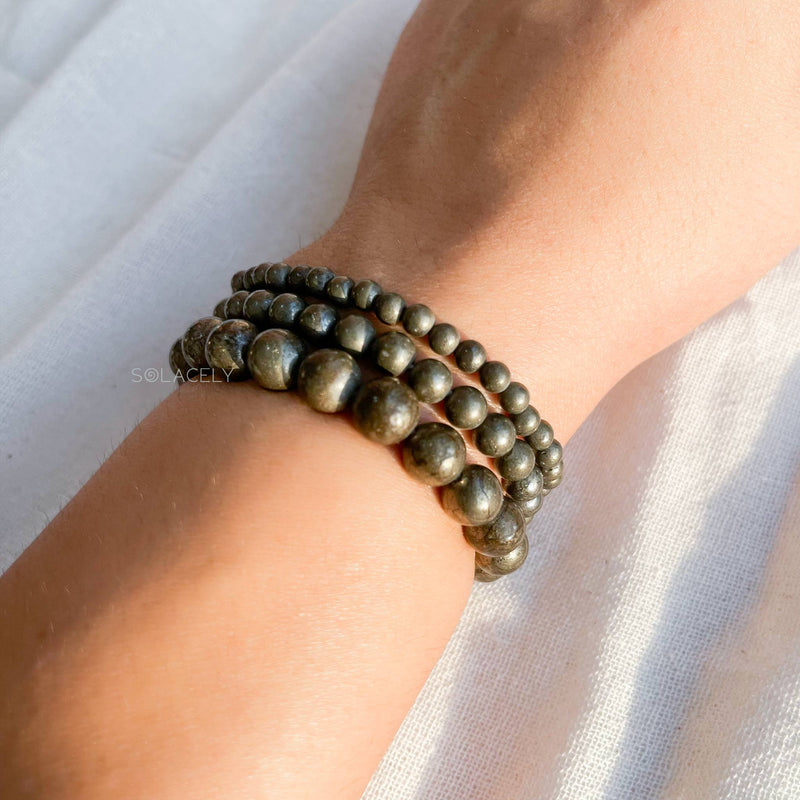
For stacking, hessonite prefers quiet neighbours. Neutral and grounding stones let its honey-brown colour lead, and all of these sit close enough to it in hardness to wear evenly on a shared wrist.
| Partner stone | Mohs | What it adds |
|---|---|---|
| Sulemani hakik | 7 | Traditional protection, and a dark band to frame the honey tones |
| Black tourmaline | 7 to 7.5 | A boundary stone for the same right wrist |
| Smoky quartz | 7 | Grounding and release, in a matching earthy palette |
| Clear quartz | 7 | A neutral partner that takes the wrist of whatever it is paired with |
Our hessonite bracelet comes in 4mm, 6mm and 8mm beads, so a fine strand can sit beside a bolder partner without competing. For the stone's meaning, its Vedic history and its everyday use in one place, see our full hessonite (gomed) meaning and benefits guide.
Caring for it day to day
Hessonite is a garnet, sitting around 7 to 7.5 on the Mohs scale, so the stone handles daily wear well. The elastic cord is the part that needs looking after. Take the bracelet off before showering, swimming and the gym, keep it away from perfume and lotion, and wipe the beads with a soft dry cloth.
Store it away from harder stones such as sapphire when it is off. For cleansing by sound, moonlight or smoke, and charging it with the intention you wear it for, our guide to how to cleanse and charge a hessonite bracelet covers the routine.
Wear it the way that feels steady
Right wrist by convention, left by comfort, and your astrologer's word above both. The stone does not change when it crosses from one hand to the other; what changes is the small reminder you give yourself each time you notice it.
Hessonite was kept, long before bracelets, as a stone for people walking through an unsettled season with more care than usual. Put it on the wrist where you will see it, and let that be the steady thing. From our space to yours.
The placements described here reflect traditional Vedic and cultural crystal practice. They are not medical, legal or financial claims and are not a substitute for professional advice or for a reading from a qualified astrologer. Keep small beads away from young children and pets, as loose beads are a choking risk.
Sources
Written by Chetena Sharma. Reviewed by the Solacely editorial team.
Frequently asked questions
About the author


Written by Chetna Sharma, crystal healing practitioner and co-founder of Solacely. Chetna has worked with healing crystals for over a decade and curates Solacely's protective stone collection.