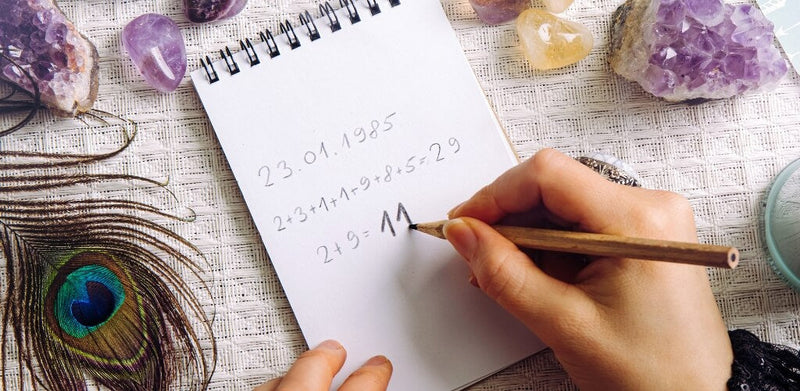
A birth number is the single digit taken from the day you were born, reduced to one digit by adding its parts together. Born on the 23rd? You add 2 + 3 to get 5, so your birth number is 5. In Indian or Vedic numerology it's called the moolank, meaning "root number." By tradition it points to your core temperament and natural strengths. Merriam-Webster defines numerology as the study of the "occult significance of numbers," and the birth number sits right at the heart of that practice. Crucially, it uses only the day of the month, not your whole date of birth, which is what separates it from the life path number people often confuse it with.
Key Takeaways
- Your birth number is the day of your birth reduced to a single digit (born on the 14th = 1+4 = 5).
- It differs from the life path number, which uses your full date of birth, day, month, and year.
- In Vedic numerology it's the "moolank," each digit 1 to 9 linked to a ruling planet and set of traits.
- Merriam-Webster traces "numerology" to number study rooted in centuries of tradition, not proven science.
- Use it for self-reflection, not for medical, financial, or life-changing decisions.
What is a birth number in numerology?
A birth number is the reduced single digit of your date of the month, and in Vedic numerology it's known as the moolank, or root number. Practitioners treat it as a snapshot of your inborn nature. Britannica notes that number symbolism runs through nearly every ancient culture, so the idea of a personal "number" is old and widespread.
Think of the birth number as the most personal of the numerology numbers. It's tied to a single day, the day you arrived, so tradition holds it colours your instincts, your reactions, and the traits people notice first. Some systems also call it the psychic number or driver number.
Is it destiny? No. It's a lens, one many people find useful for reflection. The meanings below come from tradition and belief, not laboratory testing, so hold them lightly.
How do you calculate your birth number?
Calculating your birth number takes one step: reduce the day of the month you were born to a single digit. You only need the day, so ignore the month and year entirely. If you were born on any date from the 1st to the 9th, that digit is already your birth number. For double-digit days, add the two digits together.
Here's the method, step by step:
- Find the day you were born. Use only the day of the month, for example the 28th.
- Add the digits of that day together: 2 + 8 = 10.
- Reduce to a single digit if the total is still two digits: 1 + 0 = 1.
- Read that number (here, 1) as your birth number.
A few worked examples make it clear:
- Born on the 5th: birth number is 5 (already single).
- Born on the 17th: 1 + 7 = 8.
- Born on the 23rd: 2 + 3 = 5.
- Born on the 30th: 3 + 0 = 3.
One question comes up a lot: do master numbers 11, 22, and 33 apply here? In most Vedic birth-number systems, no. The day is reduced all the way to a single digit between 1 and 9. Master numbers usually belong to the life path calculation instead. If mental math isn't your thing, our birth number calculator does the reduction for you in seconds.
Birth number vs life path number vs destiny number
The birth number, life path number, and destiny number describe three different things, and mixing them up is the most common numerology mistake. The birth number uses only your birth day. The life path number uses your entire date of birth. The destiny number, sometimes called the expression number, comes from the letters in your full name, not from dates at all.
Here's the quick contrast:
- Birth number (moolank): just the day. Born on the 14th, your birth number is 5. Compare it in our guide to the life path number.
- Life path number: day, month, and year all reduced together. It's read as your broader journey.
- Destiny number: built from your name using letter-to-number values. See what a destiny number is for the full method.
In our experience helping readers, people are usually looking for the birth number when they say "my number" in a casual sense, because it's the fastest to work out and feels the most personal.
What does each birth number mean?
Each birth number from 1 to 9 is tied, in Vedic tradition, to a ruling planet and a cluster of personality traits. Britannica records that linking numbers to planets and gods dates back to antiquity, so these associations carry a long history. The table below gives the ruling planet and a one-line trait for each, with a link to the full profile.
| Birth Number | Ruling Planet | One-Line Trait |
|---|---|---|
| Birth Number 1 | Sun | Independent, born to lead |
| Birth Number 2 | Moon | Sensitive, intuitive, diplomatic |
| Birth Number 3 | Jupiter | Creative, expressive, optimistic |
| Birth Number 4 | Rahu | Practical, unconventional, hard-working |
| Birth Number 5 | Mercury | Versatile, curious, quick-witted |
| Birth Number 6 | Venus | Loving, harmonious, drawn to beauty |
| Birth Number 7 | Ketu | Spiritual, analytical, introspective |
| Birth Number 8 | Saturn | Disciplined, ambitious, resilient |
| Birth Number 9 | Mars | Energetic, courageous, compassionate |
These one-liners are only a starting point. Each profile digs into career leanings, relationship patterns, lucky elements, and the shadow side of the number. Tap any row above to read its full breakdown.
Many people also pair their birth number with a supportive crystal for daily reflection. If that appeals to you, Solacely's numerology-inspired stone collections are organised by number, so you can match a piece to your moolank without guesswork.
Why does the birth number matter in Vedic numerology?
In Vedic numerology the birth number is treated as one of the two most important numbers in a chart, alongside the life path. Practitioners believe it shapes first impressions, instincts, and compatibility. It's a tradition thousands of years old, and Britannica confirms number symbolism was central to many ancient belief systems, from Pythagorean Greece to Vedic India.
What the birth number offers, more than prediction, is a vocabulary for self-reflection. A number 1 might recognise their drive to lead. A number 6 might see their pull toward harmony and caretaking. Whether you read that as cosmic or simply as a helpful mirror is up to you. Used gently, it's a prompt for thinking about your patterns, not a script for your future.
Sources
- Merriam-Webster, "Numerology" definition. merriam-webster.com
- Encyclopaedia Britannica, "Number symbolism." britannica.com
Frequently asked questions
About the author


Written by Chetna Sharma, crystal healing practitioner and co-founder of Solacely. Chetna has worked with healing crystals for over a decade and curates Solacely's protective stone collection.