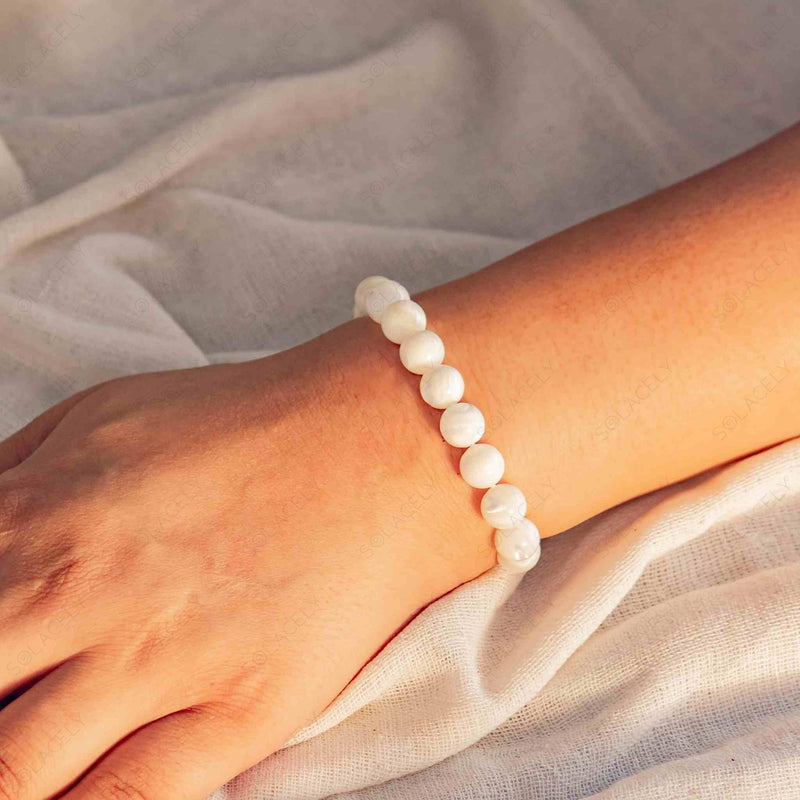
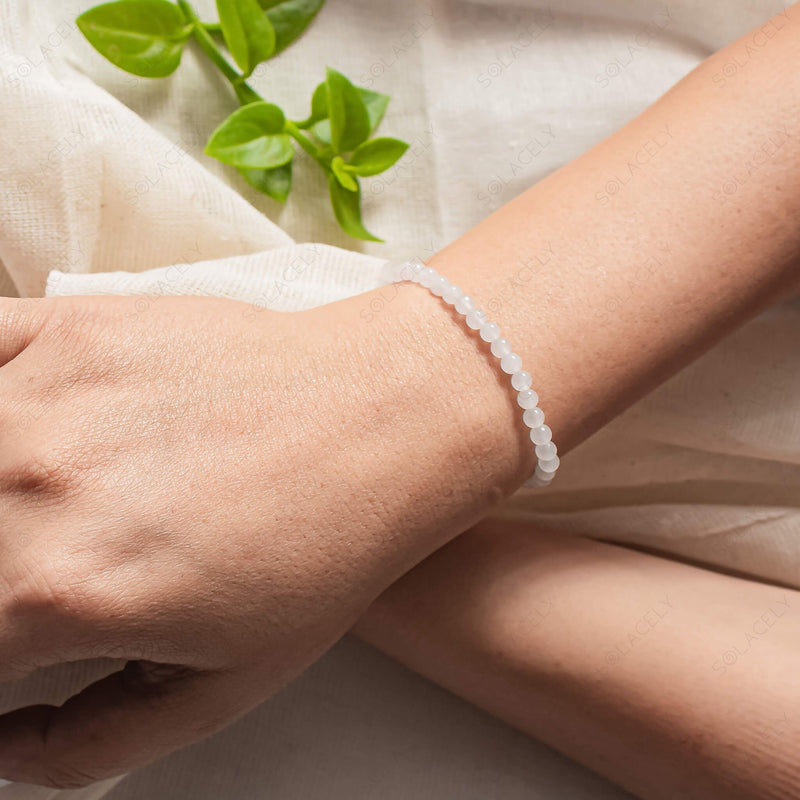
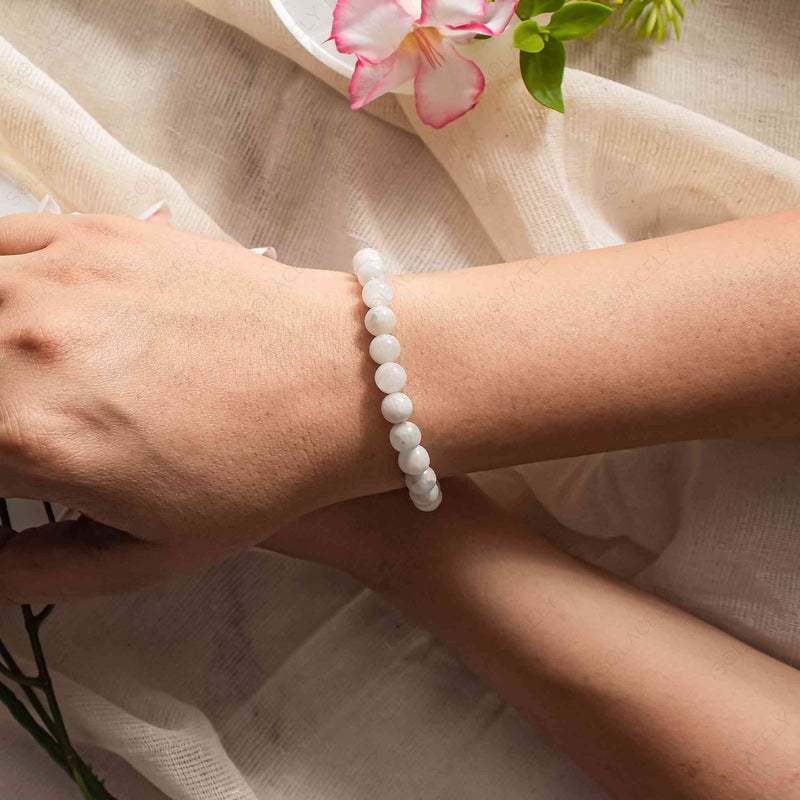
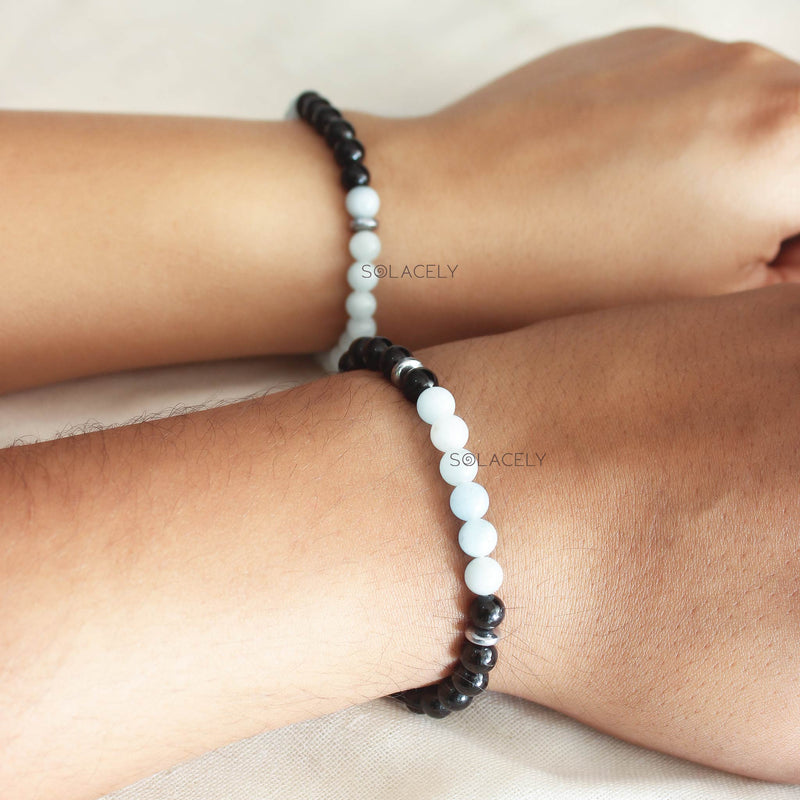
Mother of pearl is nacre, the iridescent lining a mollusc builds on the inside of its own shell. It is an organic gem rather than a mineral: microscopic platelets of aragonite stacked in sheets and bonded by protein. That layered structure is exactly what produces the shifting rainbow sheen.
Key takeaways
- Mother of pearl and pearl are the same substance, nacre. One is laid flat as a shell lining, the other builds up in rounded layers inside the animal.
- Nacre is largely aragonite, a form of calcium carbonate, held together by an organic protein called conchiolin.
- Gemmological references place it at roughly 2.5 to 4.5 on the Mohs scale, which is soft enough to scratch against keys and grit.
- Because it is calcium carbonate, it reacts to acids. Perfume, hairspray, vinegar, lemon juice and sustained sweat all dull the surface.
- Never clean it in an ultrasonic or steam cleaner. A soft damp cloth, dried flat, is the whole method.
- Traditionally kept for calm, maternal protection and emotional soothing, and long tied to the moon and the sea.
What is mother of pearl actually made of?
Mother of pearl is nacre: thousands of flat aragonite platelets, each a fraction of a micrometre thick, stacked like brickwork and mortared by a protein called conchiolin. Aragonite is a form of calcium carbonate. Materials scientists describe nacre as roughly 95 per cent mineral by weight, with the rest organic.
That brick and mortar arrangement is why nacre behaves oddly for something so soft. Pure aragonite is brittle and snaps cleanly. Nacre does not. When a crack starts, it has to travel sideways around every platelet, and the protein layers stretch and absorb the energy on the way. The result is a material far tougher than its ingredients suggest, which is why it survives centuries as furniture inlay.
Molluscs make it constantly. Oysters, abalone, freshwater mussels and some sea snails all secrete nacre from the mantle, the soft tissue that lines the shell, adding sheet after sheet across the interior. Abalone gives the strong blues and greens sold as paua. Pinctada oysters give the creamy silver-white that most people picture, and freshwater mussels give softer pinks and golds.
It is worth saying plainly that mother of pearl is an organic gem, not a crystal in the geological sense. It sits alongside amber, jet and coral rather than alongside quartz. Among the pale stones people gather for a soft, luminous look, it holds its own next to the white crystals people keep for clarity and calm.
Why does mother of pearl shimmer with rainbow colour?
The colour is structural, not pigment. Each aragonite platelet is close in thickness to the wavelengths of visible light, so light reflecting from the top of one layer meets light reflecting from the layer beneath it. Some wavelengths reinforce, others cancel, and the eye reads the difference as shifting colour.
This is why the colour moves when you move. Tilt a mother of pearl pendant and the pinks slide into greens, then into a cool blue. Nothing in the material has changed. You have only altered the angle at which light enters and leaves the stack of layers, which changes which wavelengths survive the interference.
The stepped edges of the platelets add a second effect, scattering light much as a fine grating does. Together the two give nacre its particular depth, a sheen that seems to sit under the surface rather than on it. Gemmologists call the general effect orient when they are talking about pearls.
Shell type sets the palette. Black-lipped oyster shell leans peacock and aubergine, gold-lipped shell leans warm champagne, and abalone runs to electric teal. If you are choosing by colour rather than by species, our guide to what crystal colours traditionally mean is a useful companion.
What is the difference between mother of pearl and a pearl?
The material is identical. Both are nacre, secreted by the same mollusc from the same mantle tissue. The difference is geometry and location: a pearl forms in rounded layers around an irritant inside the soft body, while mother of pearl is laid flat as a lining across the inside of the shell.
That difference in shape drives everything else. A pearl arrives finished and round, so it is drilled and strung. Mother of pearl arrives as a curved sheet, so it is cut, ground flat and set into rings, watch dials, inlay panels and buttons. One is harvested whole. The other is worked like a material.
| Mother of pearl | Pearl | |
|---|---|---|
| Substance | Nacre | Nacre |
| Where it forms | Inner lining of the shell | Inside the mollusc's soft tissue |
| Shape | Curved sheet, then cut | Round or baroque, used whole |
| Mohs hardness | About 2.5 to 4.5 | About 2.5 to 4.5 |
| Typical use | Inlay, buttons, cabochons, dials | Strands, studs, drops |
Care is the same for both, and so are the traditional associations. Anything you read about keeping pearls away from perfume applies word for word to a mother of pearl ring.
How has mother of pearl been used through history?
Mother of pearl is one of the oldest decorative materials in continuous use, appearing in Mesopotamian inlay thousands of years ago and never really going out of favour. Its working life has been practical as much as ornamental: furniture, weapons, musical instruments, religious objects and, for a long stretch, ordinary shirt buttons.
East Asian lacquer traditions built entire schools around it. Japanese raden sets cut nacre into lacquered boxes and instrument bodies. Korean najeonchilgi covers whole cabinets in shell. Chinese and Vietnamese workshops developed their own inlay vocabularies, and the technique travelled west along trade routes into Ottoman furniture and Levantine woodwork, where craftspeople in Bethlehem and Damascus made it a signature.
European cabinetmakers used it against tortoiseshell and brass in the seventeenth century. Then came buttons. Freshwater mussel shell from the Mississippi supported a substantial American button industry from the 1890s until plastics displaced it, and shell buttons survived as the quiet mark of a good shirt. Guitar and mandolin makers still inlay nacre position markers, and watchmakers still slice it thin for dials.
None of this is accidental. Nacre is tough for its softness, it takes a mirror polish, and it is the only common material that changes colour as the viewer moves. That combination has kept it employed for four thousand years.
What is mother of pearl traditionally kept for?
Mother of pearl is traditionally kept for calm, maternal protection and emotional soothing. Its name says most of it: the shell that mothers the pearl. Across coastal cultures it has been linked to the sea and the moon, and worn as a quiet reminder that difficult feelings, like tides, move through and then recede.
Sailors and fishing families carried shell for safe passage. New mothers were given it for steadiness through the early months. In the modern crystal tradition that maternal thread continues, and people reach for it during tender stretches: grief, a house move, a first year with a baby, recovery from a hard season. It is not a stone of push and drive. It is a stone of settling.
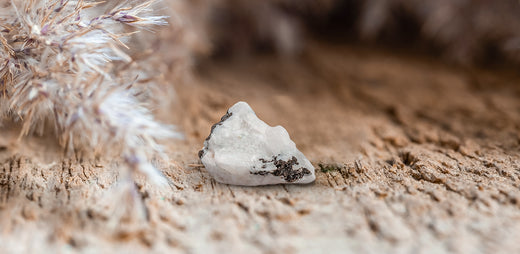
The lunar link is strong enough that mother of pearl sits comfortably with the soft, reflective qualities kept in moonstone, and both appear regularly in the stones people gather for moon rituals. Water signs, particularly Cancer and Pisces, tend to claim it. Pearl is the traditional June birthstone, and mother of pearl is often worn alongside it for the same associations at a gentler price.
People who work with it for feeling rather than for looks usually pair it with the wider family of stones kept for emotional healing, holding a shell cabochon in the palm while they sit with something. The ritual gives the intention somewhere to land, and the cool, smooth surface makes it easy to keep coming back to.
How do you wear and care for mother of pearl?
Wear it, but put it on last. Nacre sits at roughly 2.5 to 4.5 on the Mohs scale and is largely calcium carbonate, so it is both scratchable and acid-sensitive. Let perfume, hairspray, moisturiser and hand sanitiser dry completely before the jewellery goes on, and wipe the piece when it comes off.
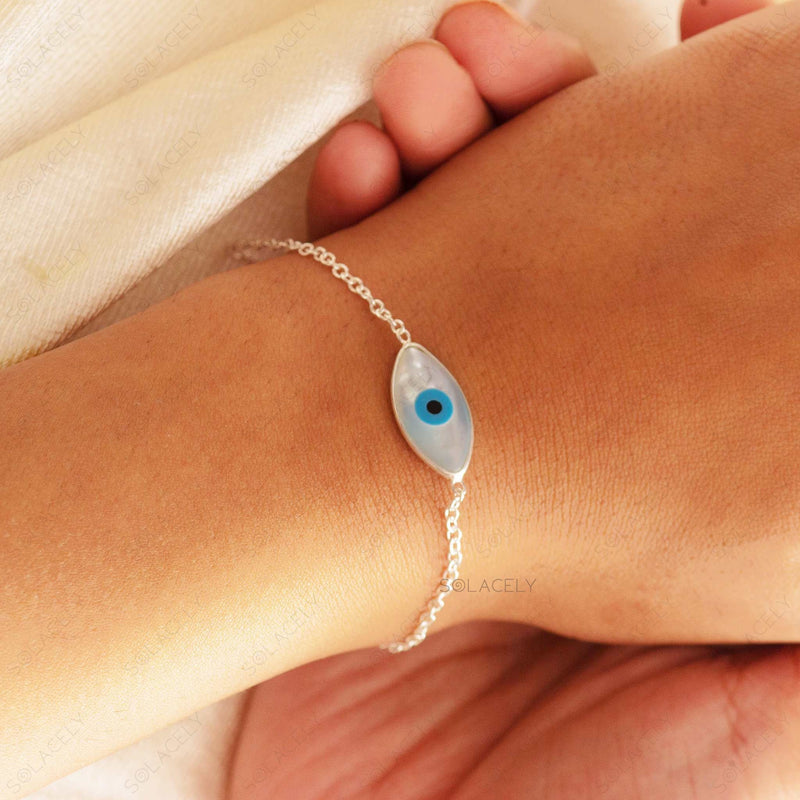
Pendants and earrings have the easiest life, since they meet very little friction. Rings and bracelets take the most abuse, so choose a bezel or channel setting that keeps the nacre below the level of the surrounding metal. If you wear a mother of pearl ring daily, take it off for washing up, gardening, gym work and anything involving cleaning products.
| Do | Avoid |
|---|---|
| Wipe with a soft, barely damp cloth | Ultrasonic and steam cleaners, always |
| Dry flat on a soft cloth before storing | Soaking, hot showers, chlorinated pools |
| Store in a fabric pouch, each piece separate | Sealed plastic bags, which trap moisture |
| Put jewellery on after cosmetics have dried | Vinegar, lemon juice, descalers, jewellery dips |
| Keep it away from harder stones in the box | Leaving sweat or sunscreen on overnight |
The acid point matters more than people expect. Calcium carbonate reacts with even weak acids, and the reaction eats the polish rather than the shape, so the piece goes cloudy long before it looks damaged. Sustained skin sweat will do it over months. A ten second wipe after each wear prevents nearly all of it.
For cleansing in the ritual sense, keep it dry. Sound, moonlight overnight, a few hours on a selenite plate or a pass through incense smoke all suit nacre. Salt water, salt bowls and long water baths do not, and neither does direct summer sun on a windowsill, which can dry the protein layers and dull the sheen over time.
Crystals and organic gems are kept for comfort, focus and personal meaning. Nothing here is medical advice, and mother of pearl is not a treatment for any physical or mental health condition. Please speak to a qualified healthcare professional about any symptom or concern, and never delay, replace or stop medical care because of a crystal practice. Keep small stones and beads away from children and pets, as they are a choking hazard, and never place stones in drinking water.
Sources
Written by Chetena Sharma. Reviewed by the Solacely editorial team.
Frequently asked questions
About the author


Written by Chetna Sharma, crystal healing practitioner and co-founder of Solacely. Chetna has worked with healing crystals for over a decade and curates Solacely's protective stone collection.