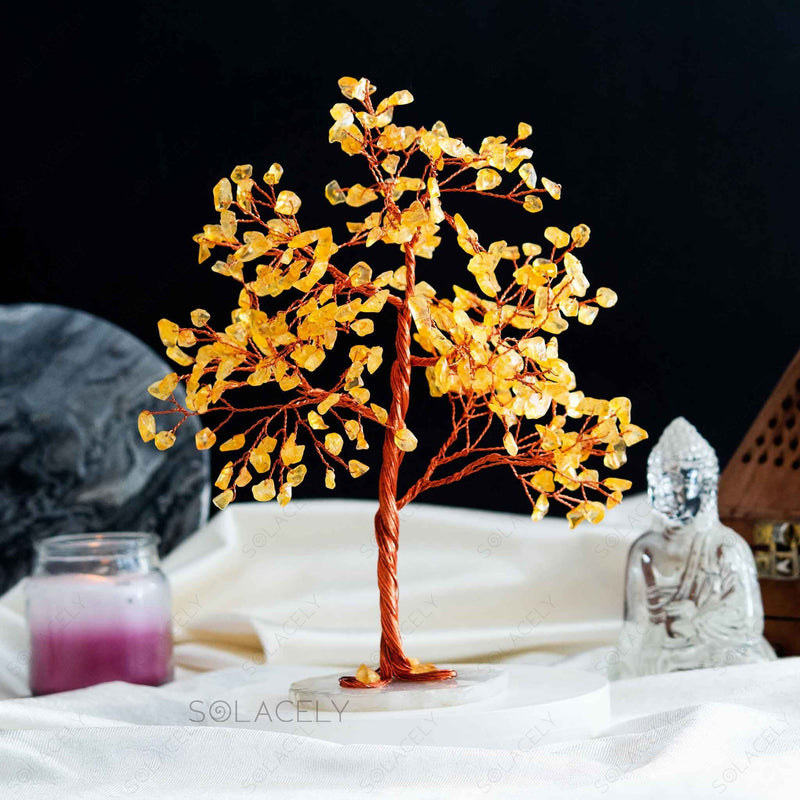
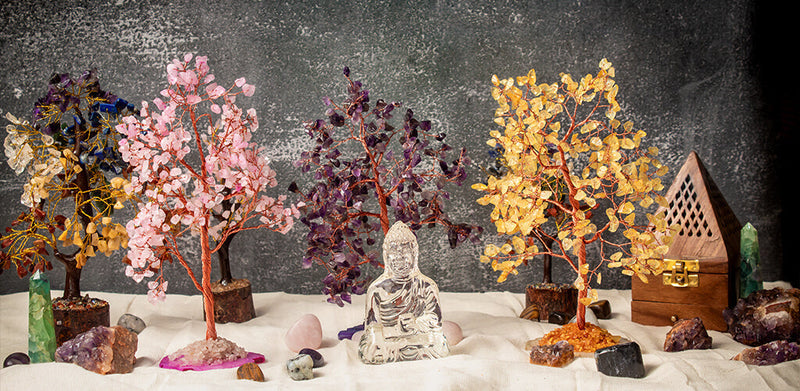
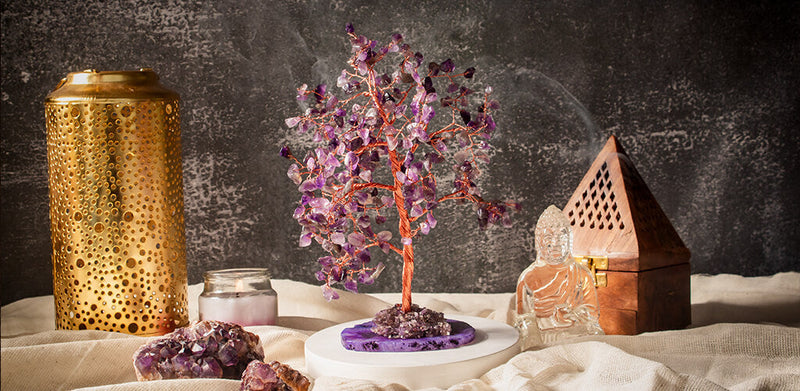
A citrine tree is a handmade decorative sculpture: dozens of small polished citrine chips are wired onto twisted metal branches to look like golden leaves, then anchored in a stone base. It works as home décor and, n tradition, as an abundance-intention piece, which is why many people call it the 'money tree.'
Key Takeaways
- A citrine tree is a wire-branch sculpture with tumbled citrine 'leaves' set on an agate or crystal base, usually 15–25 cm tall.
- Citrine is a golden-to-amber variety of quartz (silicon dioxide), coloured by traces of iron, per the GIA.
- In crystal tradition it stands for abundance, confidence, and fresh starts, which is why it's gifted for new ventures.
- Most citrine on the market is heat-treated amethyst; genuine natural citrine is rarer and usually paler, per the GIA.
- Typical tiers: Entry (small gift), Mid range (premium), Premium (large or executive).
What Is a Citrine Tree?
A citrine tree is a decorative sculpture where small tumbled citrine stones are threaded onto flexible wire branches to mimic foliage, then fixed into a base, often a slice of agate or a raw crystal cluster. Each piece is one of a kind because natural stone varies in colour, size, and clarity.
Think of it as a bonsai made of stone instead of leaves. The 'trunk' is usually twisted copper or aluminium wire, sometimes gold- or silver-toned to match the warm stone. The canopy holds anywhere from 50 to 300 citrine chips depending on size. Because the leaves are real mineral, the colour shifts from pale champagne to rich honey across a single tree.
These pieces belong to a wider family of crystal trees. For the full category, our guide to crystal trees covers every stone type, and our overview of crystal tree sculptures explains the wirework behind them. Citrine is the go-to when you want warmth and an abundance theme rather than the calm of purple amethyst.
What Is Citrine, Actually?
Citrine is the yellow-to-golden variety of quartz, a mineral made of silicon dioxide. According to the Gemological Institute of America (GIA), its warm colour comes from traces of iron within the crystal. It ranks 7 on the Mohs hardness scale, hard enough for everyday handling and dusting.
Natural citrine is relatively rare. The GIA notes that most citrine sold today is heat-treated amethyst or smoky quartz, which turns golden when warmed. That doesn't make a treated stone 'fake,' it's still real quartz, but genuine untreated citrine is usually a softer, paler yellow. The name comes from the French citron, meaning lemon.
| Property | Detail |
|---|---|
| Mineral family | Quartz (silicon dioxide, SiO₂) |
| Colour cause | Traces of iron (GIA) |
| Hardness | 7 on the Mohs scale |
| Colour range | Pale lemon to deep amber-brown |
| Main sources | Brazil, Bolivia, Madagascar, Spain |
Britannica describes citrine as a semiprecious yellow quartz long used in jewellery and ornament. Because it's genuine quartz, a well-made citrine tree keeps its glow for years, though intense, constant sunlight can dull richly heat-treated stones over time.
How a Citrine Tree Is Made
A crystal tree is built by hand in stages: the maker twists wire into a trunk and branches, wraps individual citrine chips as leaves, then sets the trunk into a drilled stone base with resin. A single mid-size tree can take an artisan one to three hours of careful work.
Here's the usual sequence:
- Wire framing. Several strands of thin wire are twisted together, then split into branches, the way you'd shape a bonsai skeleton.
- Leafing. Each tumbled citrine chip, drilled or wire-wrapped, is attached and bent into position so the canopy looks full from every angle.
- Basing. The trunk roots into an agate slice, crystal cluster, or resin base for weight and stability.
- Shaping and finishing. The maker fans out the branches, balances the weight, and cleans stone dust off the golden leaves.
Handwork is why no two trees match, and why a heavier, denser canopy costs more. Our crystal tree décor guide shows how these finishing choices read on a real shelf at home.
Citrine Tree Meaning (as Tradition)
In crystal tradition, citrine is the stone of abundance, confidence, and fresh energy. Its sunny colour has long linked it to prosperity and optimism, which is why a citrine tree is often called the 'money tree' and given at the start of a business, job, or new home. The tree shape adds a layer of steady growth.
Because a tree suggests roots, branching, and expansion, pairing that form with an abundance-associated stone reads as 'growing good fortune.' In many homes people keep a citrine tree near the entrance, the cash box, or a work desk as a warm visual cue for enterprise and self-belief. It's décor first, symbol second.
Citrine is also tied to the solar plexus chakra (manipura) in yogic tradition, the centre associated with personal power and drive. If you like the tree form but want a calmer intention instead, compare it with the amethyst tree and its companion guide on amethyst tree benefits. These meanings are cultural belief, not fact, and are best held lightly, as intention rather than any promise of wealth.
Where to Place a Citrine Tree
Placement follows the intention. Because citrine is associated with abundance and confidence, most people set the tree where money or work happens: near the entrance, on a work desk, by the billing counter, or on a living-room console where guests notice it. Keep it out of long, harsh sunlight to protect a heat-treated stone's colour.
A few spots that work well n homes and workplaces:
- Entryway console: greets guests and, by tradition, 'invites' abundance into the home.
- Work or study desk: a small tree makes a warm focal point and a confidence cue.
- Near the cash box or billing counter: a common choice for shops and home offices.
- Living-room shelf: the golden canopy pairs well with brass, wood, and warm lighting.
In vastu and feng-shui-minded homes, the south-east is often linked with wealth, so many owners place the tree there. There's no single rule. Choose the spot where you'll see it daily and where it genuinely lifts the room.
How to Care for and Clean It
Care is simple: dust the leaves gently, avoid soaking the base, and keep it away from long, harsh sunlight. In crystal tradition, people also 'cleanse' the piece periodically, meaning they reset its energy through smoke, sound, or moonlight rather than washing it.
Physical care first:
- Dust with a soft, dry brush or makeup brush; the canopy traps fine dust.
- Don't submerge the base. Agate and resin bases can loosen if soaked.
- Wipe leaves with a barely damp cloth, then dry immediately.
- Rotate away from windows if you notice the gold dulling over months.
Traditional cleansing methods people use include passing the tree through sage or palo santo smoke, sounding a singing bowl nearby, or resting it on a selenite plate overnight. Some also 'charge' it on a windowsill under the full moon, kept behind glass to avoid dew. These are customs, not maintenance requirements.
How to Choose Quality and Spot a Fake
Judge a citrine tree on three things: stone quality, canopy density, and base weight. Real quartz feels cool, shows uneven natural colour, and varies chip to chip. Dyed glass looks suspiciously uniform, feels warmer in the hand, and often glows an unnaturally vivid, even orange with tiny air bubbles trapped inside.
Quick checks before you buy:
| Signal | Real citrine (quartz) | Likely fake / glass |
|---|---|---|
| Temperature | Stays cool to the touch | Warms up fast in hand |
| Colour | Uneven, natural gradients | Perfectly even, over-bright |
| Bubbles | None inside chips | Tiny air bubbles (glass) |
| Chip-to-chip | Each slightly different | Identical clones |
| Base | Solid, weighty stone | Light, hollow plastic |
Also weigh the tree in your hand. A quality piece has a dense canopy and a heavy, stable base so it won't topple. Remember that most citrine is heat-treated amethyst, so a deep amber tone is normal and not a red flag on its own. If a 'natural' tree costs suspiciously little and glows neon-orange, the leaves are probably dyed glass.
Citrine Tree Price Bands
Citrine tree prices are driven by size, canopy density, and base quality. Small desk trees sit at the budget end; large statement pieces with raw-crystal bases command a premium. Genuine natural stone costs more than dyed-glass lookalikes, and untreated citrine is dearer than heat-treated.
| Band | Tier | What you get |
|---|---|---|
| Budget / small gift | Entry | 15–18 cm, lighter canopy, agate slice base |
| Premium | Mid range | 18–22 cm, fuller canopy, solid stone base |
| Luxury / executive | Premium | 22 cm+, dense canopy, raw crystal cluster base |
Spend up only when you want a large centrepiece for a desk or entryway.
Citrine Tree as a Gift
A citrine tree is a natural gift because it's warm, meaningful, and needs no wrapping fuss. Its abundance symbolism makes it a favourite for new beginnings: a new business, a new job, a housewarming, or Diwali. Pair it with a short handwritten note explaining the 'money tree' tradition, and it reads as a genuinely personal wish.
Some occasion ideas:
- New business or job: the classic 'abundance and confidence' gift for a fresh start.
- Diwali: a premium yet affordable festive gift in the mid range.
- Griha pravesh (housewarming): a golden accent that traditionally welcomes prosperity.
- Corporate / executive: a desk-size tree with a stone base makes a tasteful client gift.
For a smaller token or a matching set, a crystal car charm pairs nicely with a tree. If the recipient would prefer calm over ambition, the amethyst tree offers a restful alternative for bedrooms and study corners.
Sources
- Gemological Institute of America (GIA), Citrine quality and description: gia.edu/citrine
- Encyclopaedia Britannica, Citrine: britannica.com/science/citrine
- Mindat.org, Quartz (var. Citrine) mineral data: mindat.org/min-198.html
Frequently asked questions
About the author


Written by Chetna Sharma, crystal healing practitioner and co-founder of Solacely. Chetna has worked with healing crystals for over a decade and curates Solacely's protective stone collection.