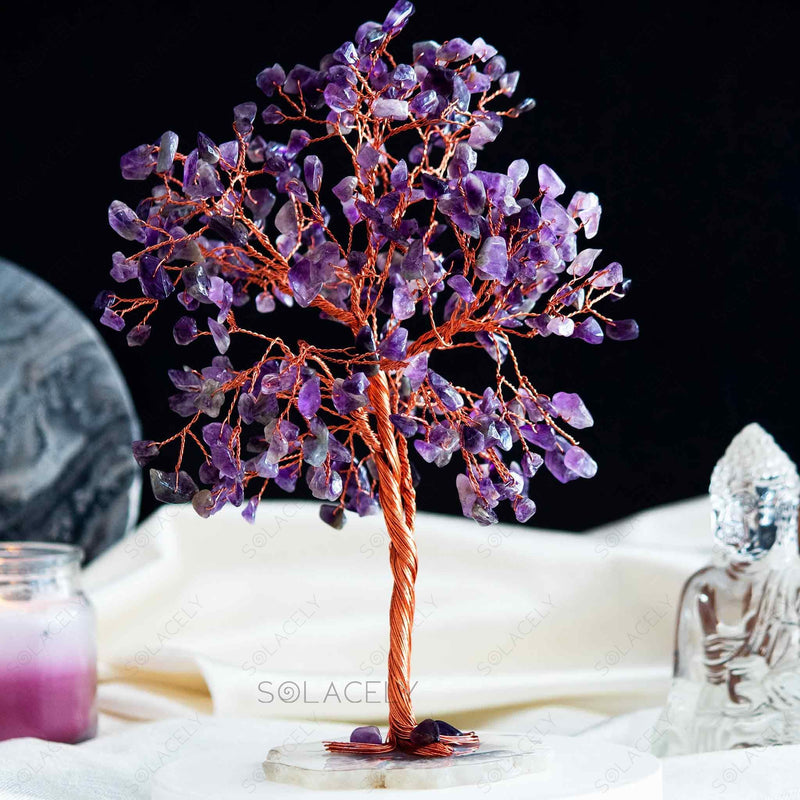
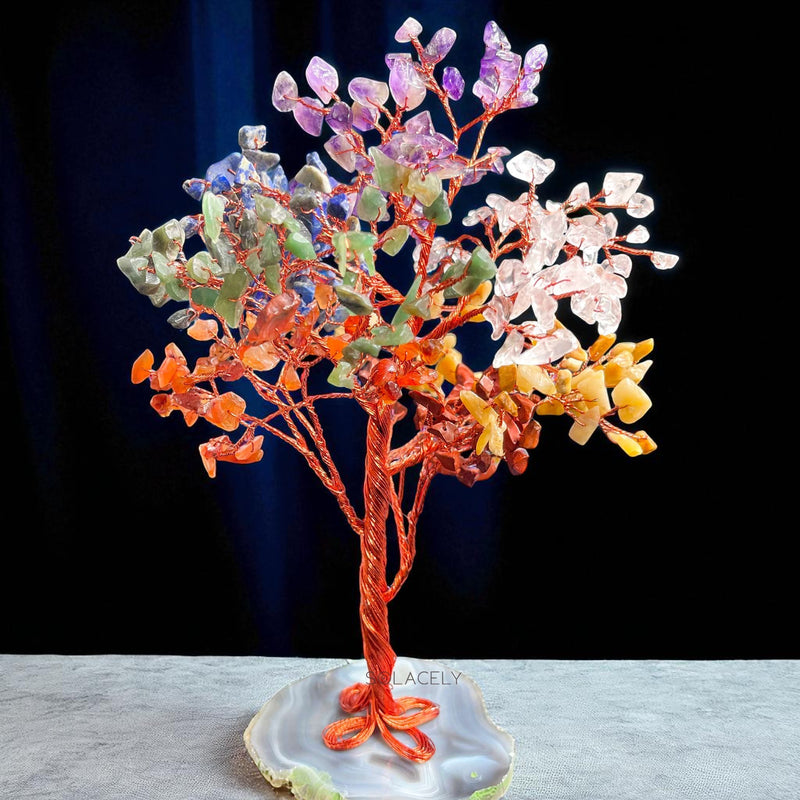
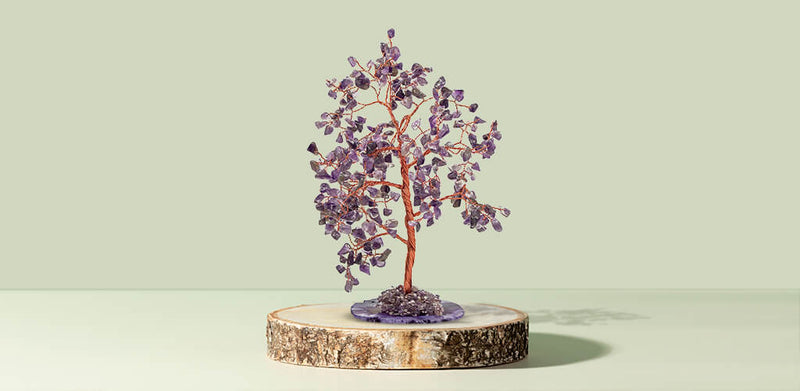
An amethyst tree is a handmade decorative sculpture: dozens of small polished amethyst chips are wired onto twisted metal branches to look like leaves, then anchored in a stone or crystal base. It works as home décor and, n tradition, as a calm-intention piece for a shelf, desk, or pooja corner.
Key Takeaways
- An amethyst tree is a wire-branch sculpture with tumbled amethyst 'leaves' set on an agate or amethyst base, usually 15–25 cm tall.
- Amethyst is a purple variety of quartz (silicon dioxide), coloured by iron and natural irradiation, per the GIA.
- In crystal tradition it stands for calm, rest, and clear thinking, which is why it suits bedrooms and study desks.
- Real amethyst is cool to the touch, unevenly coloured, and often shows fine natural zoning; dyed glass looks too perfect.
- Typical tiers: Entry (small gift), Mid range (premium), Premium (large or executive).
What Is an Amethyst Tree?
An amethyst tree is a decorative sculpture where small tumbled amethyst stones are threaded onto flexible wire branches to mimic foliage, then fixed into a base, often a slice of agate or a cluster of raw amethyst. Each piece is one of a kind because natural stone varies in colour, size, and clarity.
Think of it as a bonsai made of stone instead of leaves. The 'trunk' is usually twisted copper or aluminium wire, sometimes gold- or silver-toned. The canopy holds anywhere from 50 to 300 amethyst chips depending on size. Because the leaves are real mineral, the colour shifts from pale lilac to deep grape across a single tree.
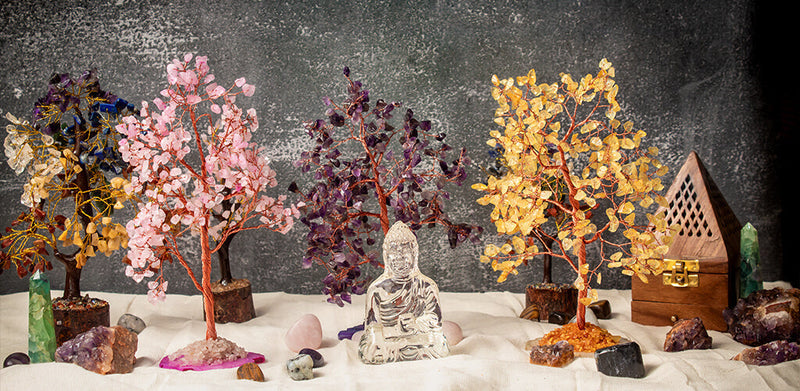
These pieces sit in a family of crystal trees. If you want the wider category, our guide to crystal trees covers every stone type, and our overview of crystal tree sculptures explains the craftsmanship behind the wirework. The amethyst version is simply the most popular because purple reads as calm and premium at once.
What Is Amethyst, Actually?
Amethyst is the purple variety of quartz, a mineral made of silicon dioxide. According to the Gemological Institute of America (GIA), its violet colour comes from traces of iron combined with natural gamma irradiation inside the earth. It ranks 7 on the Mohs hardness scale, hard enough for everyday handling.
The stone has been prized for millennia. Britannica notes the name comes from the Greek amethystos, meaning 'not drunken,' because ancient Greeks and Romans believed it guarded against intoxication. Major deposits today sit in Brazil, Uruguay, Zambia, and India, where amethyst is mined in states including Tamil Nadu and Karnataka.
| Property | Detail |
|---|---|
| Mineral family | Quartz (silicon dioxide, SiO₂) |
| Colour cause | Iron impurities + natural irradiation (GIA) |
| Hardness | 7 on the Mohs scale |
| Colour range | Pale lilac to deep royal purple |
| Main sources | Brazil, Uruguay, Zambia, India |
Because it's genuine quartz, a well-made amethyst tree keeps its colour for years if you keep it out of harsh, constant sunlight, which can fade purple over time.
How an Amethyst Tree Is Made
A crystal tree is built by hand in stages: the maker cuts and twists wire into a trunk and branches, glues or wire-wraps individual amethyst chips as leaves, then sets the trunk into a drilled stone base with resin. A single mid-size tree can take an artisan one to three hours.
Here's the usual sequence:
- Wire framing. Several strands of thin wire are twisted together, then split into branches, the way you'd shape a bonsai skeleton.
- Leafing. Each tumbled amethyst chip, drilled or wire-wrapped, is attached and bent into position so the canopy looks full from every angle.
- Basing. The trunk roots into an agate slice, amethyst cluster, or resin base for weight and stability.
- Shaping and finishing. The maker fans out the branches, checks balance, and cleans stone dust off the leaves.
Handwork is why no two trees match, and why a heavier, denser canopy costs more. Our crystal tree décor guide shows how these finishing choices change the look on a real shelf.
Amethyst Tree Meaning (as Tradition)
In crystal tradition, amethyst is the stone of calm, rest, and mental clarity. Across many cultures it's linked to soothing an overactive mind, supporting sleep, and encouraging honest reflection. An amethyst tree concentrates that symbolism into one sculptural object for a room.
The tree shape adds its own layer of meaning. A tree suggests growth, roots, and steadiness, so pairing it with a calm-associated stone reads as 'grounded peace.' n homes people often keep one in a meditation nook or near the study, treating it as a quiet visual cue to slow down.
Amethyst is also tied to the crown and third-eye chakras in yogic tradition, which is why it turns up in spaces meant for reflection. For the deeper symbolism and the customs around it, see our companion piece on amethyst tree benefits. These meanings are cultural belief, not medical fact, and are best held lightly, as intention rather than cure.
Where to Place an Amethyst Tree
Placement follows the intention. Because amethyst is associated with calm and rest, most people set the tree where they wind down or concentrate: the bedroom, a meditation corner, a study desk, or a quiet living-room shelf. Keep it away from constant direct sun to protect the purple colour.
A few practical spots that work well n homes:
- Bedside or dresser: supports a restful, unhurried mood before sleep.
- Study or work desk: a small tree makes a calm focal point during long hours.
- Pooja or meditation corner: pairs naturally with a lamp, incense, or a singing bowl.
- Entryway console: greets guests with a premium, jewel-toned accent.
In vastu-minded homes, the north-east (the ishaan corner) is popular for reflective objects. There's no single rule here. Choose the spot where you'll actually see it and enjoy it daily.
How to Care for and Clean It
Care is simple: dust the leaves gently, avoid soaking the base, and keep it out of long, harsh sunlight. In crystal tradition, people also 'cleanse' the piece periodically, meaning they reset its energy through smudging, sound, or moonlight rather than washing it.
Physical care first:
- Dust with a soft, dry brush or makeup brush; the canopy traps fine dust.
- Don't submerge the base. Agate and resin bases can loosen if soaked.
- Wipe leaves with a barely damp cloth, then dry immediately.
- Rotate away from windows if you notice fading over months.
Traditional cleansing methods people use include passing the tree through sage or palo santo smoke, sounding a singing bowl nearby, or resting it on a selenite plate overnight. Full-moon 'charging' on a windowsill is common too, kept behind glass to avoid dew. These are customs, not maintenance requirements.
How to Choose Quality and Spot a Fake
Judge an amethyst tree on three things: stone authenticity, canopy density, and base quality. Real amethyst feels cool, shows uneven natural colour with faint zoning, and has tiny variations chip to chip. Dyed glass looks suspiciously uniform, feels warmer, and often shows a colour that's too vivid and even.
Quick checks before you buy:
| Signal | Real amethyst | Likely fake / glass |
|---|---|---|
| Temperature | Stays cool to the touch | Warms up fast in hand |
| Colour | Uneven, zoned, natural | Perfectly even, over-bright |
| Bubbles | None inside chips | Tiny air bubbles (glass) |
| Chip-to-chip | Each slightly different | Identical clones |
| Base | Solid, weighty stone | Light, hollow plastic |
Also weigh the tree in your hand. A quality piece has a dense canopy and a heavy, stable base so it won't topple. Count roughly how full the branches look, sparse trees photograph poorly and feel cheap in person. If a 'natural' tree costs suspiciously little, the leaves are probably dyed glass.
Amethyst Tree Price Bands
Amethyst tree prices are driven by size, canopy density, and base quality. Small desk trees sit at the budget end; large statement pieces with raw-amethyst bases command a premium. Genuine natural stone always costs more than dyed-glass lookalikes.
| Band | Tier | What you get |
|---|---|---|
| Budget / small gift | Entry | 15–18 cm, lighter canopy, agate slice base |
| Premium | Mid range | 18–22 cm, fuller canopy, solid stone base |
| Luxury / executive | Premium | 22 cm+, dense canopy, raw amethyst cluster base |
Spend up only when you want a large centrepiece.
Amethyst Tree as a Gift
An amethyst tree is a natural gift because it's beautiful, meaningful, and needs no wrapping fuss. It suits housewarmings (griha pravesh), Diwali, weddings, and work milestones, and its calm symbolism reads as a warm, personal wish rather than a generic present. Pair it with a short handwritten note on the meaning.
Some occasion ideas:
- Griha pravesh: a calm-intention piece for a brand-new home.
- Diwali: a premium yet affordable festive gift in the mid range.
- Corporate / executive: a desk-size tree with a stone base makes a tasteful client gift.
- Weddings: a lasting keepsake instead of consumables.
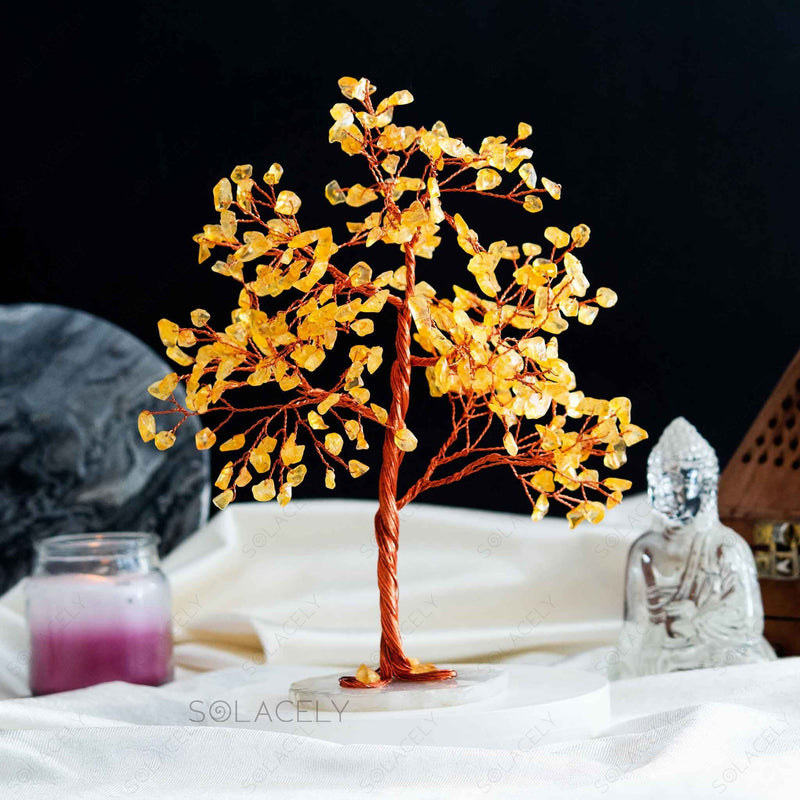
For smaller tokens or a matching set, a crystal car charm pairs nicely with a tree. If you want the abundance angle instead of calm, gift a citrine tree, traditionally the 'money tree,' for someone starting a business or new job.
Amethyst Tree vs Amethyst Cluster: Which Should You Buy?
People often shortlist a tree and a raw cluster together, then stall. The two do different jobs. A tree is a made object: wire, chips, and a base, arranged deliberately, so it reads as decor first and mineral second. A cluster is the stone as it grew, so it reads as a natural specimen and carries more of that raw, geological character.
Choose a tree when you want something that fits a styled shelf, survives a courier, and suits a recipient who does not collect crystals. The wire canopy is forgiving, the base gives it presence at a small size, and nothing about it demands explanation. It also photographs well, which matters more than people admit for a gift.
Choose a cluster when the person already likes minerals, when you want the piece to feel found rather than assembled, or when you have a spot with real light for the crystal faces to catch. Clusters vary far more piece to piece, so buy from photos of the actual item rather than a stock image. If the gift is for a desk rather than a home, the tree usually wins on practicality alone.
Sources
- Gemological Institute of America (GIA), Amethyst quality and colour: gia.edu/amethyst
- Encyclopaedia Britannica, Amethyst: britannica.com/science/amethyst
- Mindat.org, Quartz (var. Amethyst) mineral data: mindat.org/min-198.html
Frequently asked questions
About the author


Written by Chetna Sharma, crystal healing practitioner and co-founder of Solacely. Chetna has worked with healing crystals for over a decade and curates Solacely's protective stone collection.