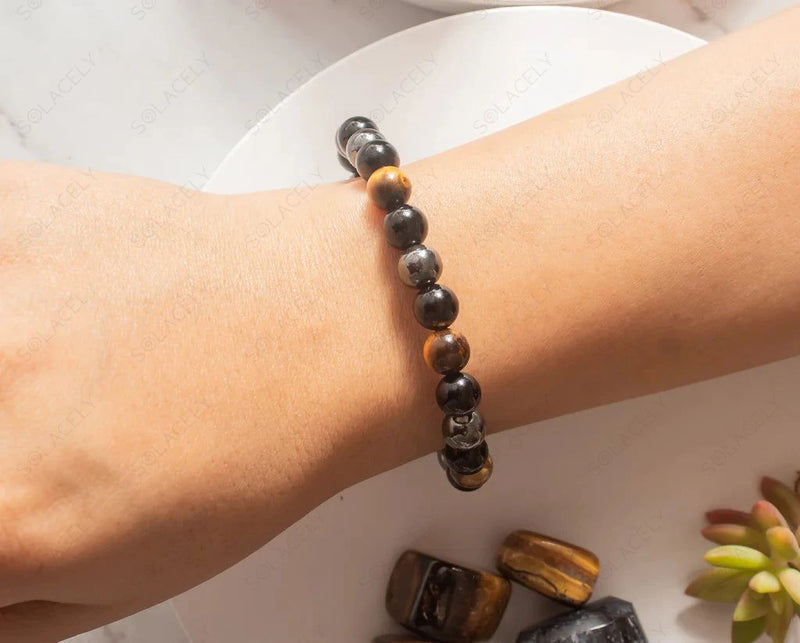
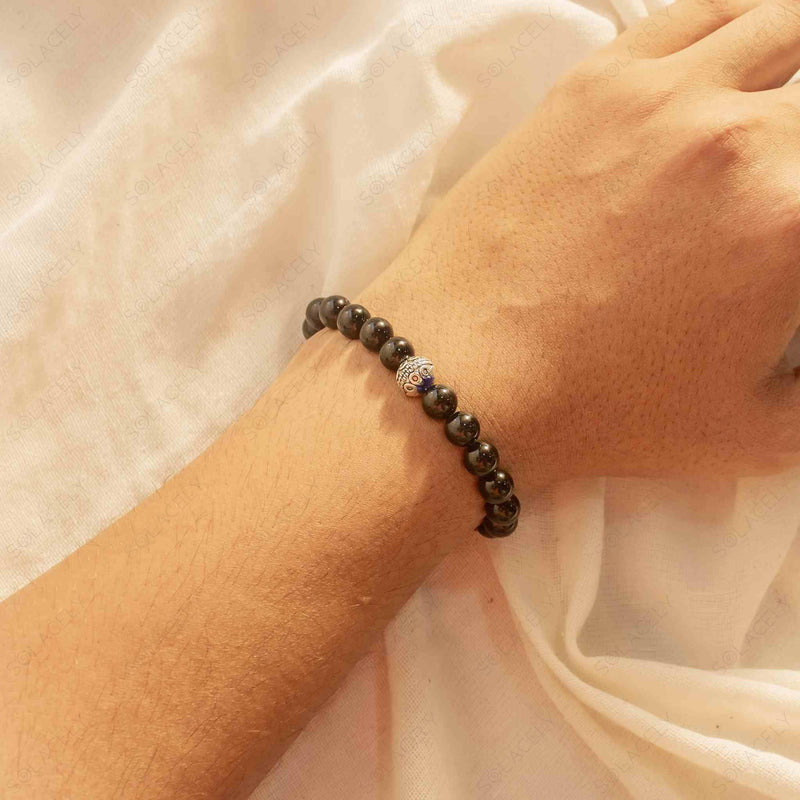
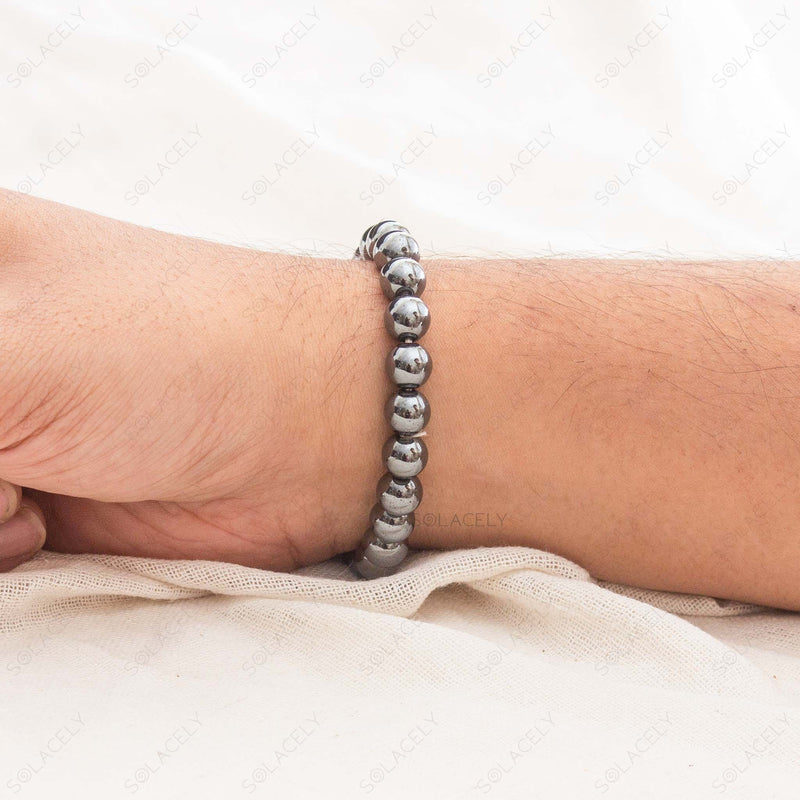
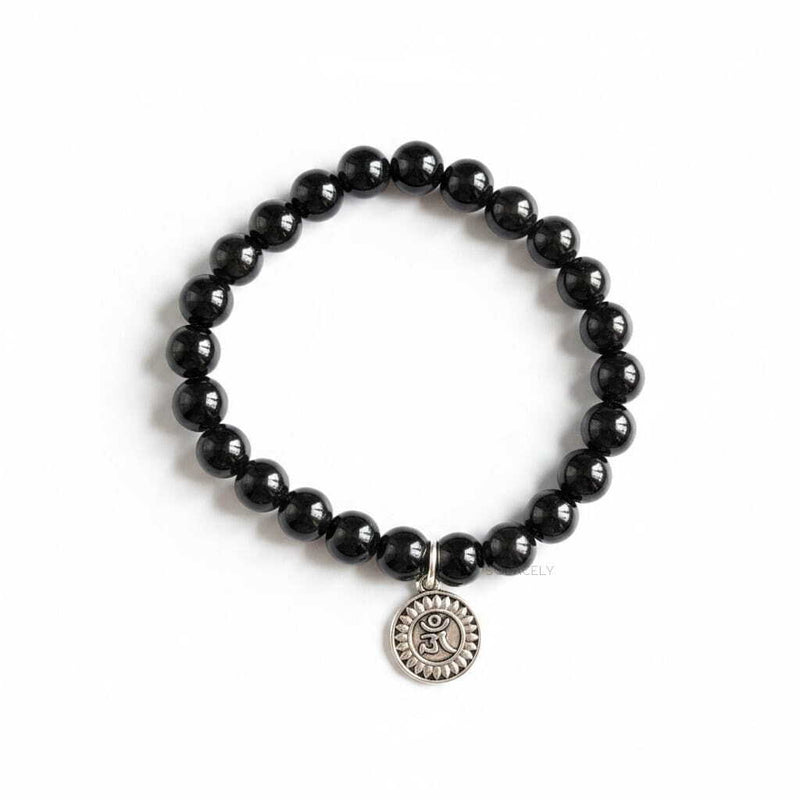
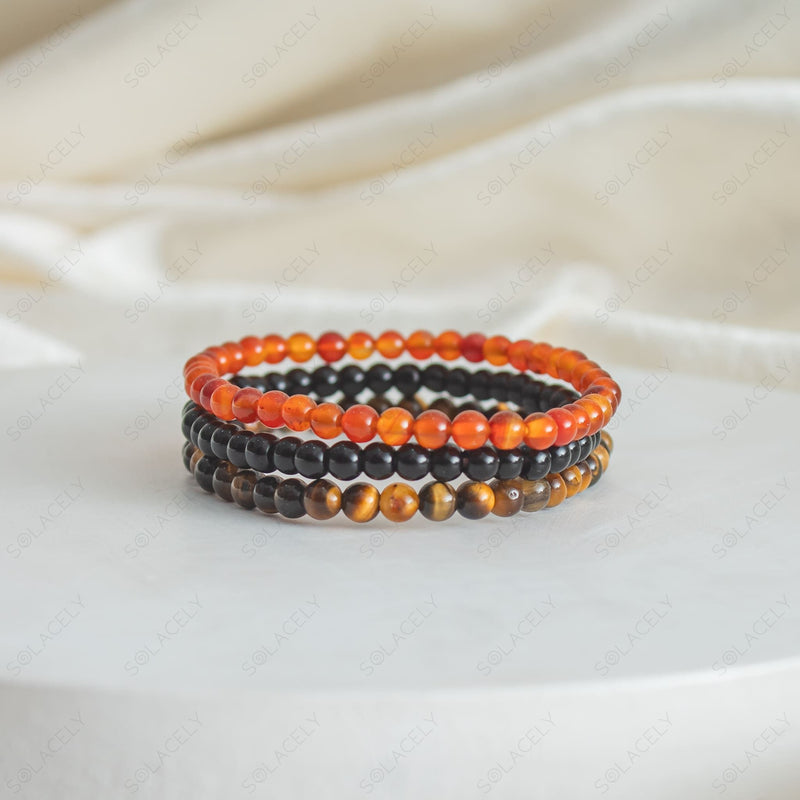
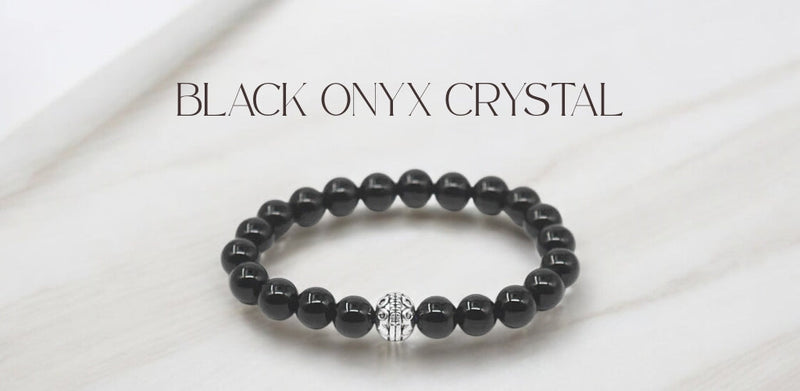
Smoky quartz and black onyx are paired because they do different jobs. Onyx is traditionally kept to hold a boundary and keep other people's moods out. Smoky quartz is kept to draw off and clear what you are already carrying. One holds the line, the other empties the load, and together they cover both halves of feeling overloaded.
Key takeaways
- Both are quartz family stones sitting near 7 on the Mohs scale, so they wear together without marking each other.
- Smoky quartz gets its warm brown-grey from natural processes deep in the earth.
- Black onyx is a banded chalcedony with a deep, even, glossy black that holds beautifully.
- Traditional use: onyx for the boundary, smoky quartz for clearing what gets through.
- Keep smoky quartz out of long direct sun to hold its colour.
What smoky quartz is
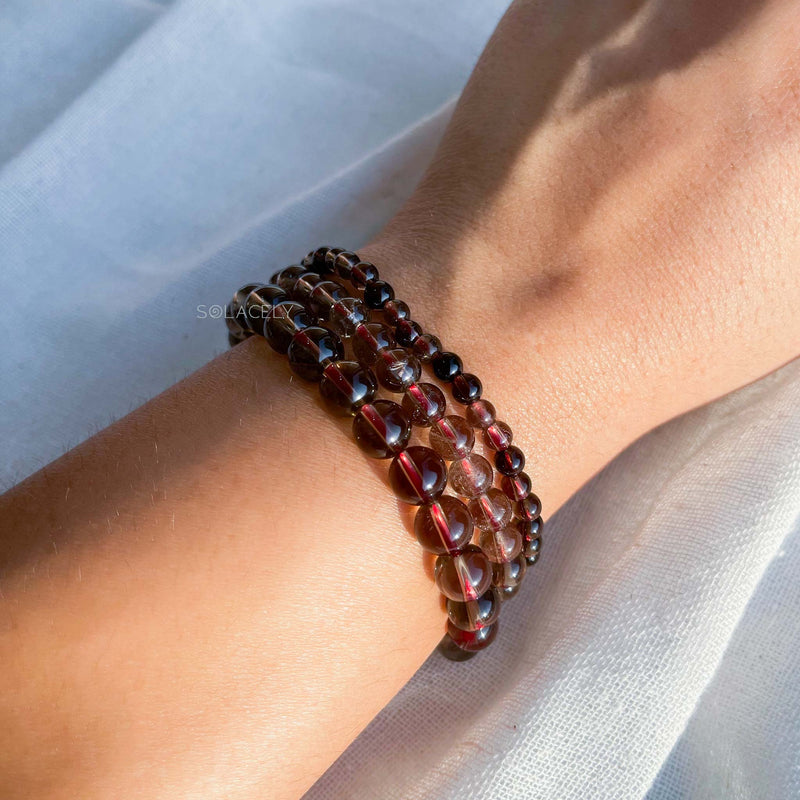
Smoky quartz is quartz that has taken on a warm brown to near black tone, formed slowly underground over a very long time. It is not a coating and it is not a different mineral. It is quartz with a history, and the depth of colour runs from a pale wisp of smoke through to a rich near-black that still holds light when you turn it.
Practically, it is one of the easiest stones to live with. Durable, unfussy about handling, and it looks like something rather than nothing when worn with everyday clothes. Gemmological grading favours an even, well saturated tone with good clarity, and choosing between a lighter and a darker piece is a matter of what you want to look at.
Our fuller profile sits in the smoky quartz meaning and properties guide.
What black onyx is
Black onyx belongs to the chalcedony branch of the quartz family: microcrystalline silica rather than the large single crystals you see in a quartz point. That fine structure is exactly what gives onyx its extraordinary polish, a glassy depth that few other stones match.
Bringing chalcedony to that deep, even black is a craft the trade has practised since antiquity, and the result is permanent and completely stable. It is the reason black onyx has such a consistent, glossy uniformity, and why it has been the stone of choice for signet rings, cameos and mourning jewellery for centuries. Choose the piece whose polish and depth you like best, and it will hold that way for a lifetime.
Our black onyx guide covers the stone's history and traditional uses in full.
Why the two are paired
The traditional division of labour is clean. Onyx is the door: it is kept for when you want less of other people getting in, whether that is a difficult workplace, an exhausting family member, or a room full of strangers. Smoky quartz is the drain: it is kept for the residue you are already carrying, the leftover tension of a bad week.
Using only one leaves a gap. A boundary without a way to discharge what you have already absorbed means you stay full. Clearing without a boundary means you empty out and refill immediately. That logic is why the pair shows up so often in pieces made for people in demanding jobs, and why it is a popular alternative to the more familiar smoky quartz and black tourmaline combination.
There is a practical bonus. Both stones sit around 7 on the Mohs scale, so a stack of the two wears evenly rather than one marking the other.
How to wear or place the pair
Most people wear it. A two-strand stack is the simplest approach, and the usual convention is onyx on the right wrist as the outward-facing boundary, smoky quartz on the left as the receiving and clearing side. Reverse it if that feels better.
- Daily wear. One strand of each, same or opposite wrists.
- Desk. A smoky quartz point where you can see it, onyx nearer the door of the room.
- Travel. A small tumbled piece of each in a bag. Both are hard enough to survive being knocked about.
- Home entry. Onyx near the entrance is the traditional placement for household boundary work, covered further in crystals for protection.
If your interest is specifically in feeling planted rather than shielded, look at root chakra crystals, where both of these stones also appear.
Smoky quartz and black onyx compared
| Smoky quartz | Black onyx | |
|---|---|---|
| Type | Macrocrystalline quartz | Chalcedony (microcrystalline quartz) |
| Appearance | Transparent to translucent brown-grey | Opaque, deep even black with high polish |
| Hardness | 7 Mohs | Around 6.5 to 7 Mohs |
| Traditional use | Clearing, discharging, grounding | Boundary, endurance, composure |
| Best format | Points, tumbles, beads | Beads, cabochons, signet settings |
| Light | Keep out of sustained sun | Stable; avoid harsh solvents |
Caring for the pair
Both take warm water and a soft cloth. Dry them fully, especially strung beads, because damp elastic and damp knots are what actually shorten the life of a bracelet.
Keep onyx away from acetone, alcohol gels and strong cleaners, which are unkind to any polished surface. Keep smoky quartz off a sunny windowsill so its warm tone stays deep.
For energetic cleansing, weekly is the common rhythm for protective stones worn daily. Sound, incense smoke, moonlight, or a rest on selenite all work well for this pair.
Who this pairing suits
People who come home flattened. Anyone in customer-facing work, healthcare, teaching, or any role where other people's moods are part of the job. It also suits people who have tried a single protective stone and found they wanted something to pair it with.
It suits less well someone wanting lift and optimism. These are both quiet, weighted stones by character. For warmth and drive, citrine or carnelian are the traditional answers, and the dark pair can hold the boundary while a warmer stone does the rest.
The uses described here reflect traditional and cultural crystal practice. They are not medical claims and are not a substitute for professional care. If stress or burnout is affecting your health, please speak to a qualified practitioner.
Sources
Written by Chetena Sharma. Reviewed by the Solacely editorial team.
Frequently asked questions
About the author


Written by Chetna Sharma, crystal healing practitioner and co-founder of Solacely. Chetna has worked with healing crystals for over a decade and curates Solacely's protective stone collection.