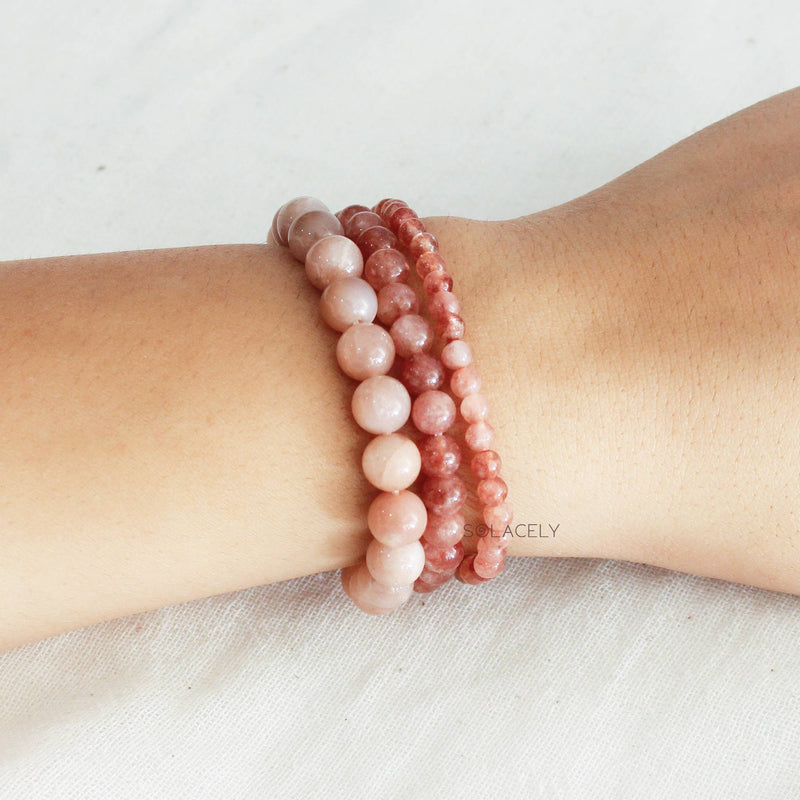
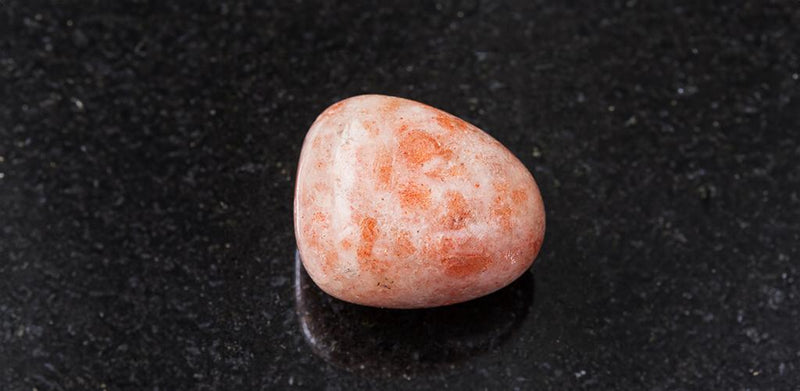
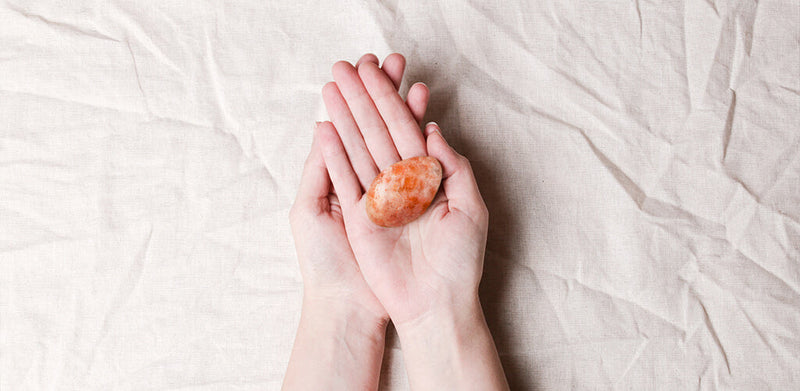
Sunstone is the manifestation stone people reach for when an intention needs warmth and momentum behind it rather than quiet reflection. A feldspar flecked with tiny platy inclusions that flash copper and orange in the light, it is traditionally kept for visibility, confidence and the first push on a goal you have already named.
Key takeaways
- Sunstone belongs to the feldspar group and sits at roughly 6 to 6.5 on the Mohs scale, durable enough for daily wear but softer than quartz.
- Its glitter is called aventurescence, produced by thin platelets of hematite or copper suspended inside the stone.
- Oregon sunstone, coloured by copper, was adopted as the state gemstone of Oregon in 1987.
- In crystal tradition sunstone is long associated with the sun, warmth and being seen, which is why it suits outward facing intentions.
- A practice usually means one intention, written down, with the stone kept somewhere it will be looked at each morning.
- Citrine, pyrite and clear quartz are the classic partners, each chosen for a different part of the same intention.
Why is sunstone used for manifestation?
Sunstone is chosen for manifestation because everything traditionally attached to it is solar: warmth, visibility, momentum. People reach for it when a goal needs energy behind it, such as a launch, an application or a conversation they keep postponing. The flash in the stone is what keeps it in plain sight.
Not every intention wants the same kind of stone. Some ask for stillness and a long, slow look inward. Sunstone belongs to the other category, the intention that needs heat under it and a reason to move this week rather than next quarter. That is the difference most people notice first when they set it beside cooler stones like moonstone or amethyst.
Because of that, sunstone is traditionally kept for goals with other people in them. Interviews. Pitches. A first performance. New work, or asking plainly for what you are worth. It is worn as a reminder that the thing you want has a date attached to it. For the wider background on the stone itself, our guide to sunstone meaning, properties and benefits covers its history and symbolism in more depth.
What gives sunstone its flash?
Sunstone is a plagioclase feldspar whose interior holds thin, reflective platelets of hematite or copper. Light striking those inclusions scatters back as a metallic shimmer, an optical effect gemmologists call aventurescence. Gemmological reference works place feldspar at about 6 to 6.5 on the Mohs hardness scale.
The colour range runs from pale champagne through peach and honey to deep red, and in the copper bearing Oregon material into green and blue green. The denser the platelets, the more a stone reads as glittering rather than translucent. Some pieces show a single broad flash that appears only at one angle.
Feldspar also has good cleavage in two directions, which matters for care more than for looks. A sharp knock in the wrong plane can split a stone that would happily shrug off a scratch. In practice that is an argument for pendants, tumbles and bowl pieces over a ring you wear while gardening.
How do you choose one intention to work with?
Choose one. A sunstone practice runs on a single named intention rather than five hopeful ones, and the wording matters as much as the stone. Make it specific, present tense and short enough to say out loud in one breath. Then leave it alone long enough for it to mean something.
Vague intentions are hard to hold on to. More abundance gives you nothing to look at on a wet Tuesday morning. I am booking three new clients before the end of March gives you a sentence you can actually repeat, and a point at which you will know where you stand.
Write it once, properly, on a small card or the first page of a notebook. Keep the card with the stone. Some people fold it and sit the sunstone on top, others tape it inside a cupboard door they open every day. Handwriting it is part of the practice for most people.
One rule almost everyone arrives at on their own: do not swap the intention every fortnight. Give it a full lunar cycle at least. If you also work with layouts, our piece on crystal grids for abundance shows how one intention can anchor a whole grid.
What does a daily sunstone practice look like?
Most sunstone practice happens in the morning and takes under five minutes. Hold the stone, say the intention once, then put the stone somewhere it will be seen again during the day. Repetition is the practice, and the ritual is kept small on purpose so it survives a busy week.
- Pick the stone up before you look at your phone. Warmth first, screen second.
- Hold it in your right hand, the giving and doing hand in most traditions, and tilt it until the flash catches the light.
- Say your intention once, out loud if you can, in the present tense.
- Read the written card. Do not rewrite it.
- Set the stone where your eye will land on it later: desk, windowsill, bedside table, car cup holder.
Evening is optional and quieter. Some people close the day by picking the stone up and naming one thing they did that moved the intention forward, however small. Others prefer to leave the morning to stand on its own, which is perfectly complete.
Keeping the stone visible is the part people skip, and then they wonder why the practice quietly faded in week three. A sunstone in a drawer is a lovely stone in a drawer.
Should you start on a new moon or a full moon?
Either works, and the choice tends to follow the kind of intention. New moon starts suit something you are beginning: a business, a search, a habit. Full moon starts suit something you want to bring to completion or release. Plenty of people simply mark both dates and let the cycle carry the practice.
A new moon opening is the more common one for manifestation work. Write the intention that evening, sit the sunstone on the card, and leave the pair somewhere undisturbed overnight.
At the full moon, take the stone out again, read back what you wrote, and note what has actually shifted. Some intentions get renewed at this point. Some get retired, and retiring one is not a failure.
If lunar timing appeals to you, keep it simple. Two marked dates a month is a rhythm you can hold for a year without effort.
Which crystals pair with sunstone for manifestation?
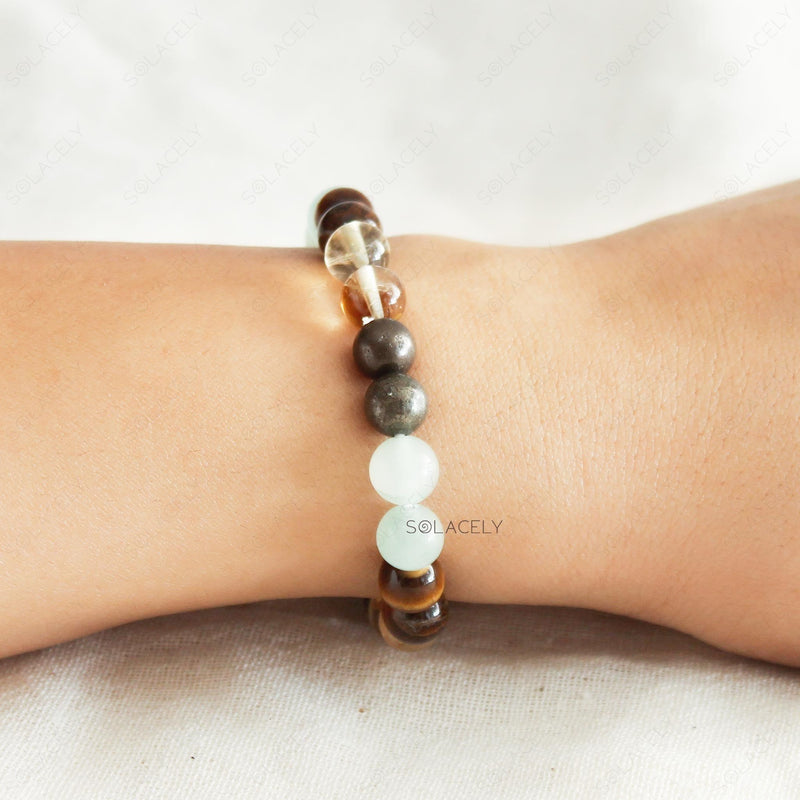
Citrine, pyrite and clear quartz are the three classic partners. Citrine is traditionally kept for abundance and good cheer, pyrite for confidence and follow through, and clear quartz for focus. Each is chosen for a different part of the same intention rather than as a replacement for the sunstone itself.
| Stone | Mohs hardness | Traditionally kept for | How it is used alongside sunstone |
|---|---|---|---|
| Sunstone | 6 to 6.5 | Warmth, visibility, momentum | The anchor stone, held each morning |
| Citrine | 7 | Abundance, optimism | Sits on the same card or windowsill |
| Pyrite | 6 to 6.5 | Confidence, drive | Kept at the desk where the work happens |
| Clear quartz | 7 | Clarity, focus | Placed as the centre point of a grid |
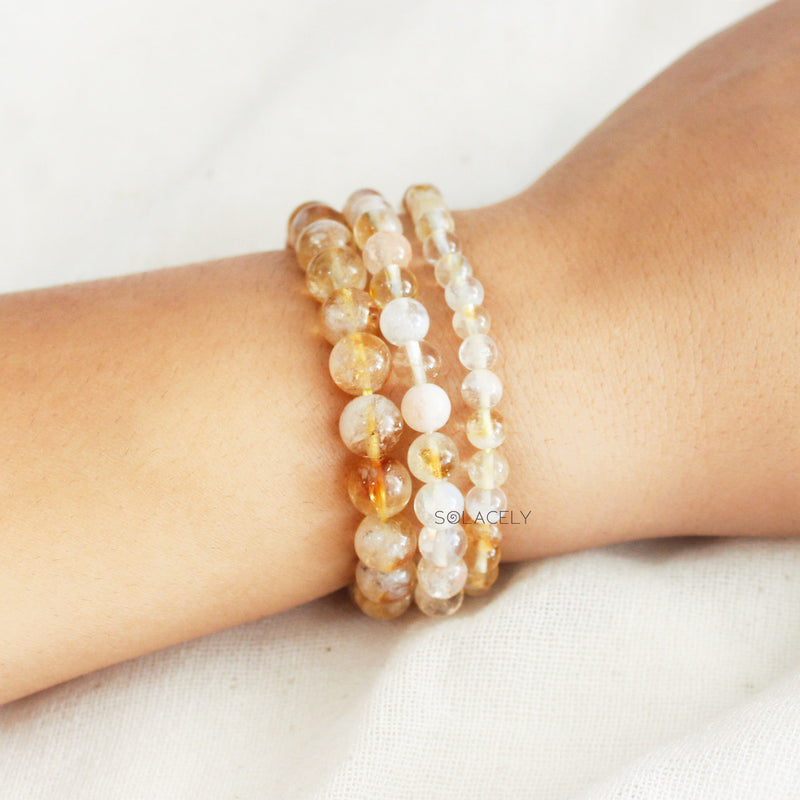
Citrine sits closest to sunstone in mood, golden and outward facing, which is why the two are so often kept together for money and opportunity intentions. Our guide to citrine meaning, benefits and properties goes through the colour range and how the stone is worn.
Pyrite is the heavier partner, all metallic cube and weight in the hand, long associated with getting on with things. Keep it dry. Pyrite is a sulphide mineral and does not take kindly to damp or salt water, as our pyrite meaning and properties guide explains.
Clear quartz is the neutral one, added when an intention has gone fuzzy at the edges and needs sharpening again. It is the usual centre stone in a grid, with sunstone and citrine arranged around it. Our clear quartz guide covers the shapes people choose for that role.
How do you care for sunstone?
Warm water, mild soap and a soft cloth. Sunstone sits at about 6 to 6.5 on the Mohs scale and has cleavage in two directions, so keep it away from hard knocks, ultrasonic cleaners and steam. Store it apart from quartz and harder stones so the surface does not pick up scratches.
Dry it fully before it goes back on its card. If your sunstone shares a dish with pyrite, keep that dish dry too, since pyrite is the one in the pair that objects to moisture.
Cleansing routines vary and none of them is compulsory. Many people pass the stone through incense smoke, rest it on a selenite plate overnight, or leave it on a bright sill for a short spell in the morning. Long, repeated sun is worth avoiding for anything stored beside it, particularly amethyst and citrine, whose colour can fade.
Keep tumbles and small beads away from young children and pets, and never leave stones in water you plan to drink.
Crystals are kept for tradition, comfort and personal meaning. They are not a medical treatment, and nothing here is intended to diagnose, treat, prevent or cure any condition, nor to serve as financial advice. If you have a health concern, speak to a qualified healthcare professional, and never delay or stop treatment you have been given. Keep small stones away from young children and pets, and do not place stones in drinking water.
Sources
Written by Chetena Sharma. Reviewed by the Solacely editorial team.
Frequently asked questions
About the author


Written by Chetna Sharma, crystal healing practitioner and co-founder of Solacely. Chetna has worked with healing crystals for over a decade and curates Solacely's protective stone collection.