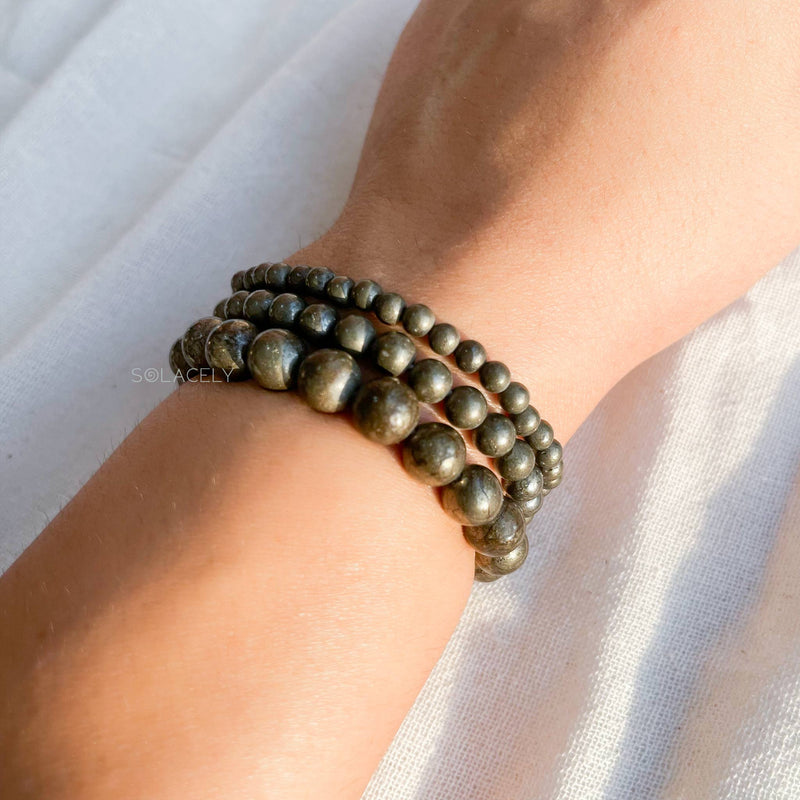
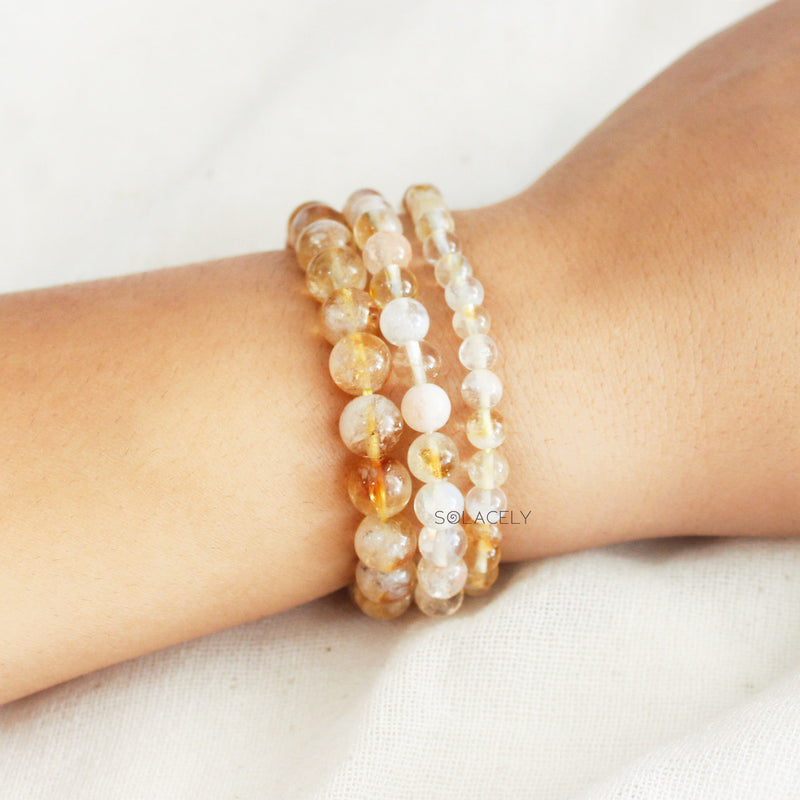
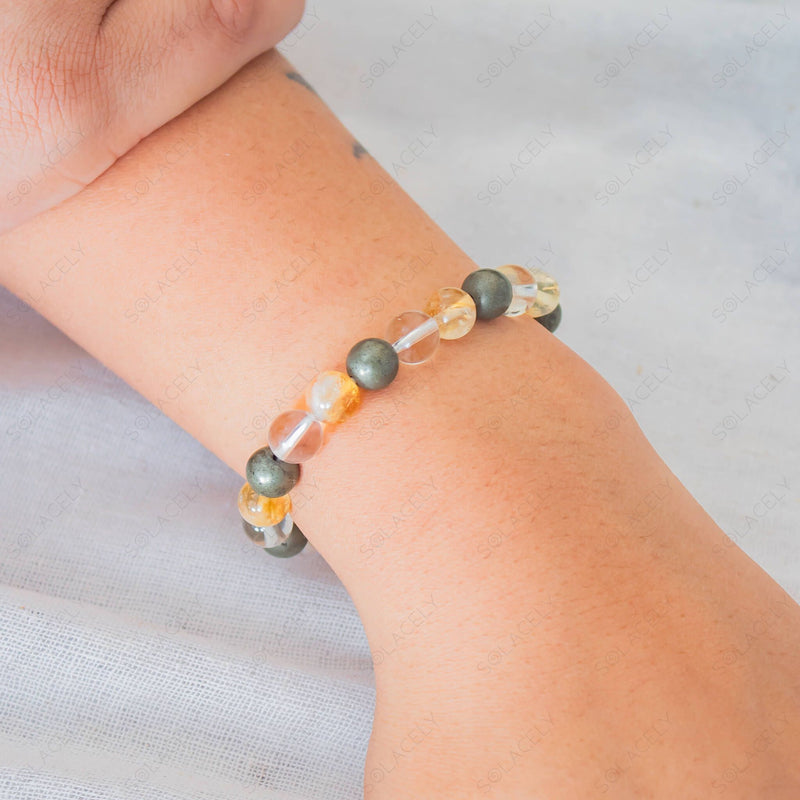
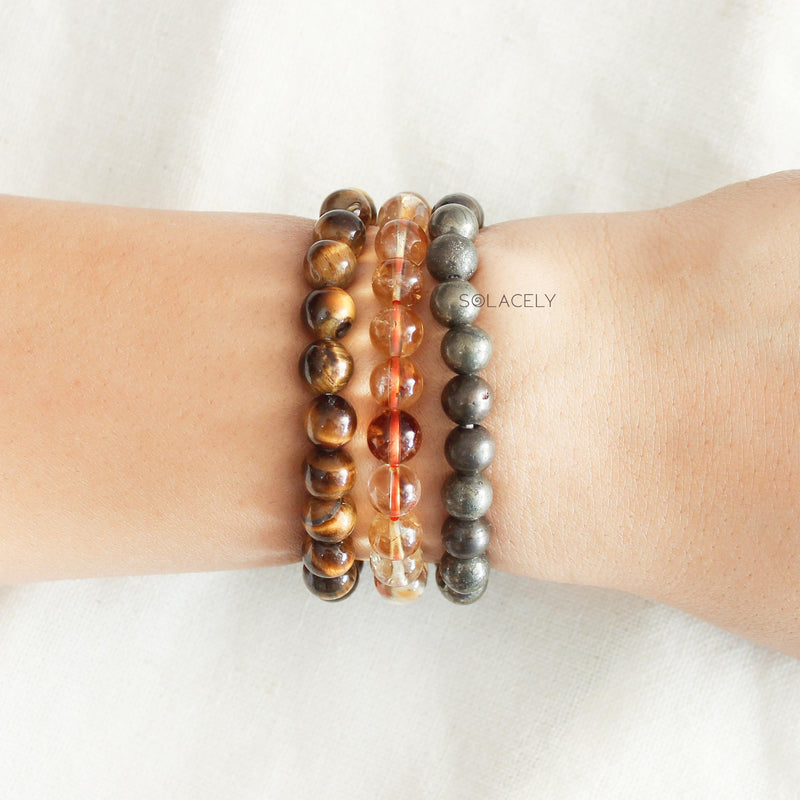
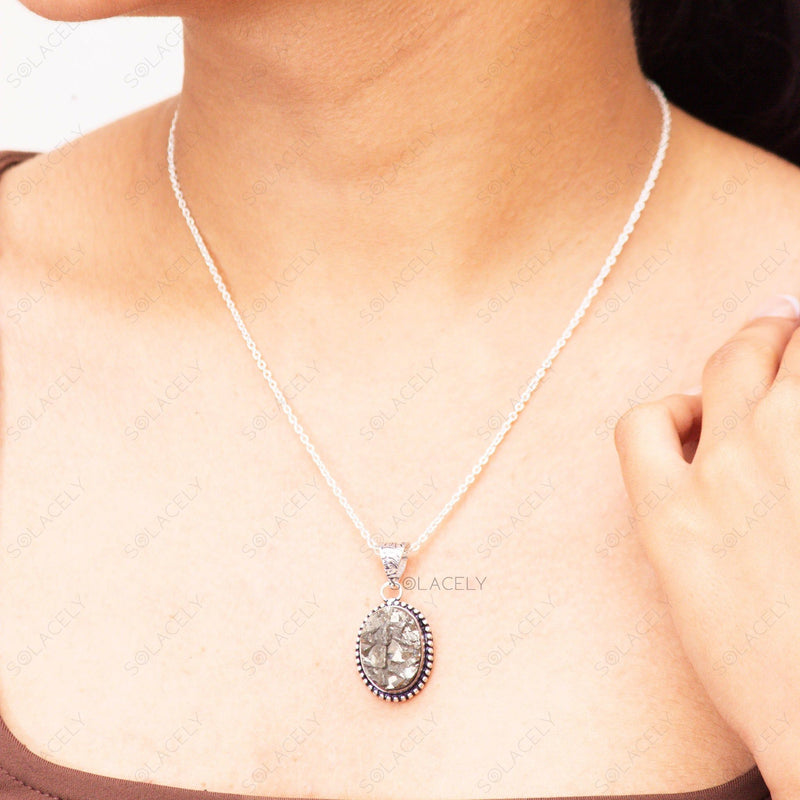
Pyrite and citrine are worn together because they belong to the same chakra and do different jobs within it. Both sit with the Solar Plexus, the centre tradition links to confidence and will. Citrine brings warmth and optimism, the merchant's stone. Pyrite brings nerve and follow through. One opens the door, the other walks through it.
Key takeaways
- Both are Solar Plexus stones, which is why the pairing is so common.
- Citrine is warmth, optimism and good fortune in trade.
- Pyrite is nerve, focus and the mindset side of money.
- They are not the same mineral. Citrine is quartz, pyrite is iron sulphide, and pyrite is much heavier.
- Same wrist or opposite wrists both work. Mixed bead sizes usually look better than matched.
- On care, follow pyrite's rules for both. Neither should be soaked, and neither likes long sun.
One chakra, two temperaments
The Solar Plexus sits just above the navel. In chakra tradition it is the seat of confidence, will and personal authority: the part of you that decides what you are worth and whether you are going to say so. Our guide to Solar Plexus crystals covers the centre in full.
Both of these stones are associated with it, and both are gold. That is where the similarity stops. Put them side by side and they behave like two people who agree on the goal and completely disagree about the method.
What citrine brings
Warmth and optimism, and a very long history in trade. Citrine has been the merchant's stone for generations, kept in tills and cash boxes and associated with prosperity and good fortune in business. It is the stone of the open hand rather than the clenched one.
Worn on the wrist it carries that same intention through the day: receptivity, good humour, the belief that something is coming. Our complete citrine guide covers its shades, care and history.
What pyrite brings
Nerve and focus. Where citrine is about what might arrive, pyrite is about what you are going to do on Tuesday morning.
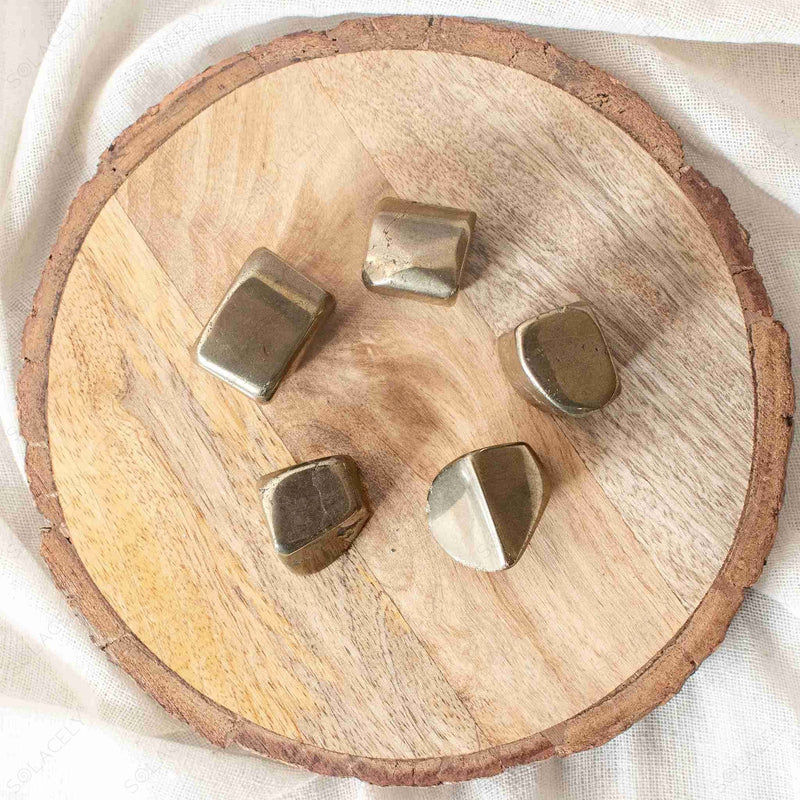
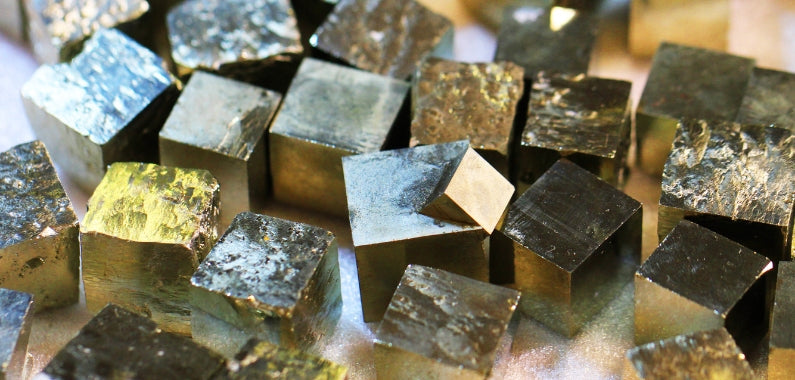
It is traditionally kept for the mindset side of money rather than the luck side: enterprise, the moment of starting rather than continuing, backing yourself in a room where you have to say a number out loud. It is dense and heavy and cool to the hand, which is a large part of why people find it steadying. Our guide to pyrite meaning and properties covers the stone itself.
Why they work together
This is the argument of the whole page, and it is fairly simple.
Optimism without follow through is daydreaming. You keep the good feeling and nothing moves. Follow through without optimism is grim: you do the work but you have stopped believing it leads anywhere, which is how people burn out quietly.
Citrine holds the first half and pyrite holds the second. Worn together they cover both the hoping and the doing, which is more balanced than either stone manages alone. That is why the pairing turns up in almost every abundance stack, and why it tends to be the second bracelet people buy rather than the fifth.
Wearing them together
Same wrist is the usual arrangement and the one most people prefer, because the two stones read as one intention rather than two.
Opposite wrists suits anyone who wants to split the roles by hand: citrine on the left to receive, pyrite on the right to project. Our guide to which hand to wear a pyrite bracelet on works through that properly.
On appearance, mixing bead sizes usually looks better than matching them. A 6mm citrine strand beside a 4mm pyrite one reads as considered where two identical strands can look accidental.
On care, follow pyrite's rules for both and you will not go wrong. Pyrite is the more demanding of the two: it cannot be soaked, cannot be salt cleansed and must come off before water. Citrine tolerates more, though its colour is light sensitive and it should stay out of sustained sun. Our guide to cleansing pyrite without water covers a routine that is safe for the pair.
Are they the same stone?
No, and they are easy to tell apart once you have held both.
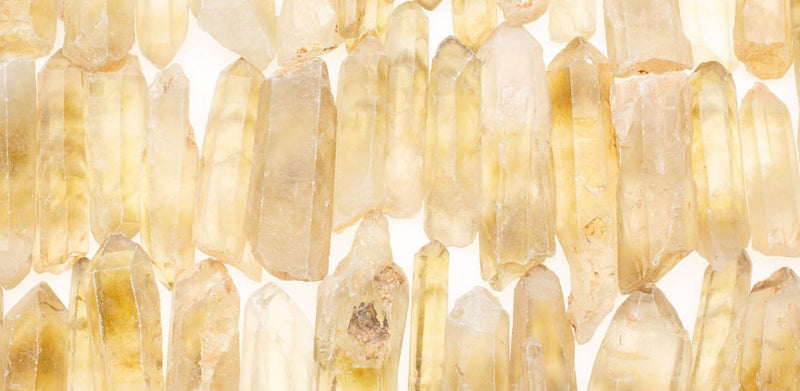
Citrine is quartz, a transparent to translucent crystal in shades from pale champagne to deep amber, and it sits at 7 on the Mohs scale. Pyrite is iron sulphide, opaque and metallic, brassy rather than golden, and noticeably heavier. Pick up one of each and the weight difference alone settles it.
On citrine's colour, it is worth knowing that warming quartz to draw out its golden tones is a long established and entirely stable practice used right across the coloured stone trade, and the colour it produces does not fade back. Shades vary from a soft champagne to a deep madeira. Choose the one you actually want to look at every day.
A morning practice for the pair
Two stones, two sentences, under two minutes.
Hold the citrine first and name what you hope for. The large version, the one you would be slightly embarrassed to say out loud: the business that works, the offer, the year that goes well.
Then hold the pyrite and name what you will do about it today. Only today, and only one thing. Send the quote. Ask for the meeting. Open the spreadsheet you have been walking past.
Then put them both on. The pairing works because the second sentence is much harder than the first, and it helps to say them in that order.
Which to start with
If you are choosing one, choose by which half you are missing. If you are working hard and losing heart, start with citrine. If you have plenty of ideas and nothing has been sent, start with pyrite.
Most people end up with both eventually, and there is no advantage to buying them together. Our guide to pyrite crystal combinations covers the other partners worth knowing, and the pyrite bracelet comes in the same bead sizes as the citrine one, so a matched pair is straightforward whenever you get to it.
Two halves of the same wish
Two golden stones, side by side on a wrist, easily mistaken for each other and doing entirely different work.
One for the hoping and one for the doing. Most wishes need both, and most of us are better at one than the other.
The uses described here reflect traditional and cultural crystal practice. They are not medical claims and are not a substitute for professional healthcare, financial or legal advice.
Sources
Frequently asked questions
About the author


Written by Chetna Sharma, crystal healing practitioner and co-founder of Solacely. Chetna has worked with healing crystals for over a decade and curates Solacely's protective stone collection.