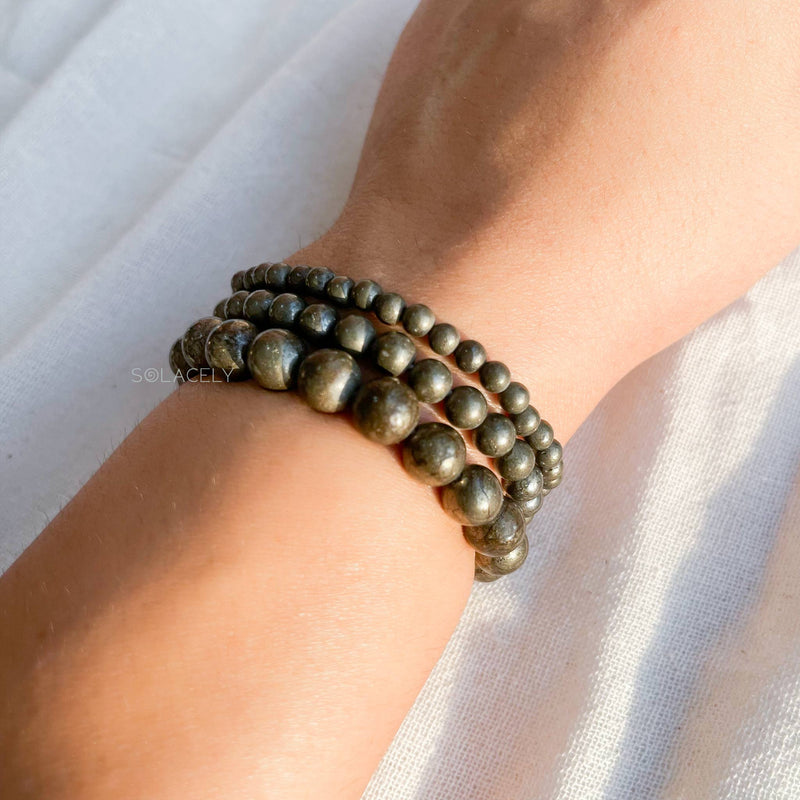
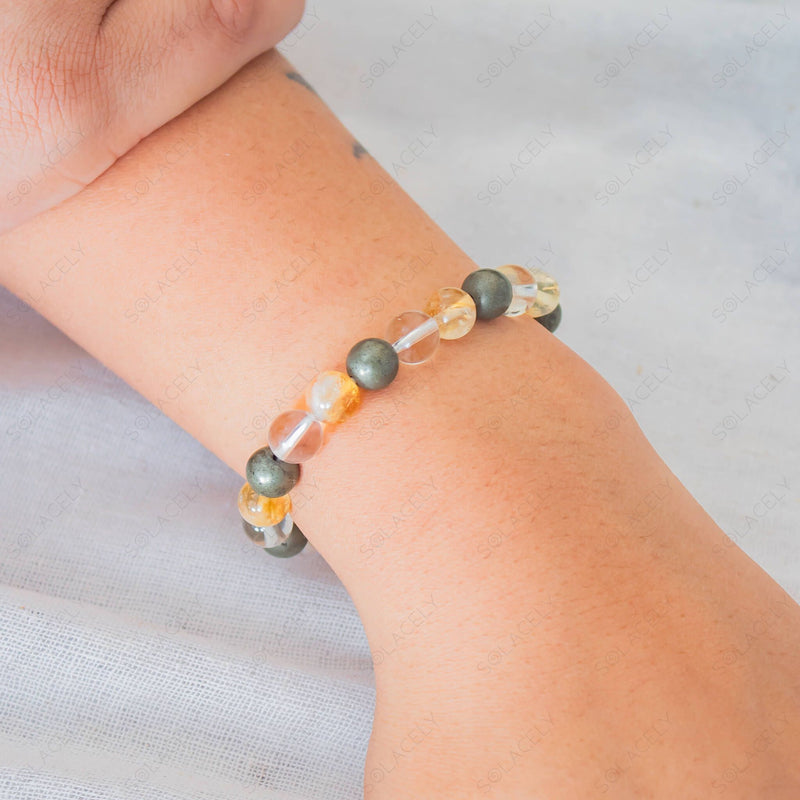
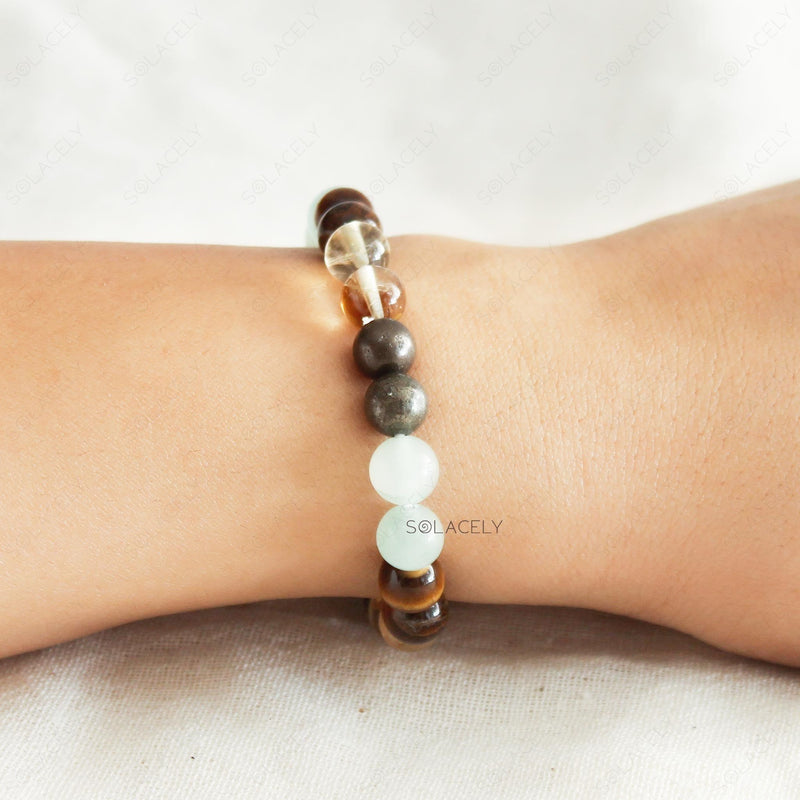
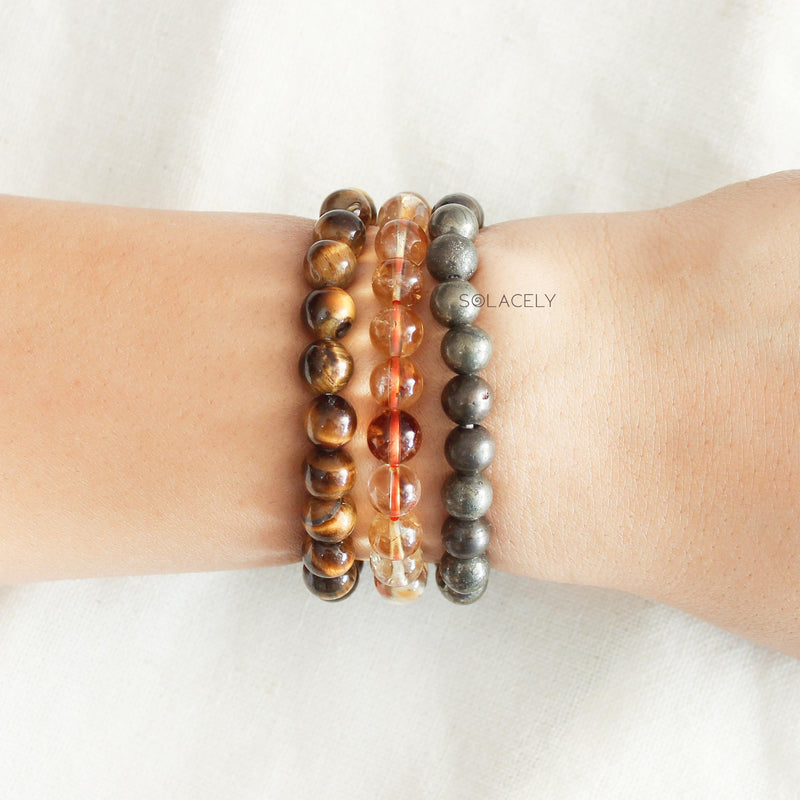
Most people wear a pyrite bracelet on the left wrist, and that is a sound default. In crystal tradition the non dominant hand is the receiving side, so the left suits an intention about drawing steadiness and opportunity toward you. The right is the deliberate alternative, chosen for the days you need to carry confidence outward into a room. Both placements are traditional, and neither one is a mistake.
Key takeaways
- Left wrist (the non dominant one) to draw steadiness and opportunity in.
- Right wrist to carry confidence outward into a pitch, a review or an exam.
- The rule follows dominant and non dominant, not left and right literally, so left handed readers swap the guidance.
- The traditions genuinely differ. Vedic practice leans right for wealth and career stones, Western crystal practice leans left to receive.
- You can move it between wrists during the day. Nothing is undone by switching.
- Pyrite must stay dry. Take it off before water and never salt cleanse it.
The receiving hand and the giving hand
Underneath almost every version of this question sits one simple idea. The non dominant hand, which for most people is the left, is understood to draw energy inward. The dominant hand, usually the right, sends it outward. The left is where you receive, the right is where you act.
That is the whole principle, and it holds across stones rather than being special to any one of them. Our pillar guide to which hand to wear your crystal bracelet works through it in more detail, including the stones where the answer is less open than it is here.
What makes pyrite interesting is that it sits honestly on both sides of that line. It is kept for abundance, which is a receiving intention. It is also kept for drive and for backing yourself, which is about as outward as an intention gets.
Why the traditions disagree about pyrite
If you have read three guides and got three answers, you are not misreading them. The traditions really do differ, and most guides do not say so.
Vedic practice tends toward the right hand for wealth and career stones. The reasoning is consistent: money in that framing is something you go out and earn through action, negotiation and effort, and the right hand is the working hand. Pyrite fits that reading neatly, because it has always been worked with for the mindset side of money rather than for luck. Mindset is something you carry outward into a conversation.
Western crystal practice more often places abundance stones on the left, so that what you are asking for can arrive. Under that reading pyrite belongs with citrine and green aventurine on the receiving wrist, and the same logic sits behind which hand to wear a citrine bracelet.
Both are coherent. They start from different questions, which is why they arrive at different wrists. One asks where the money comes from, the other asks what the stone is being kept for. There is no version of this where you have worn it wrong.
Choosing by intention, not by rule
The more useful question is not which hand is correct, but what you bought the bracelet for. Answer that and the wrist follows.
| What you are wearing it for | Wrist |
|---|---|
| To feel steadier, and to let opportunity find you | Left, the receiving side |
| To carry confidence into a room and speak for yourself | Right, the projecting side |
| Not sure yet | Start on your non dominant wrist, where it will bother you least |
That last row is the practical one. A bracelet on your writing hand catches on desks, sleeves and laptop edges all day. On the other wrist you stop noticing it within a week, which is usually the point.
Does being left handed change things?
Yes, and it is a straightforward swap. The principle follows dominant and non dominant rather than left and right as directions. If you are left handed, your right wrist is your receiving side and your left is the one that projects. Reverse every piece of guidance above and you are following the same tradition, correctly.
Can you switch hands during the day?
You can. Nothing breaks, nothing resets, and nothing you set earlier is undone. People worry about this more than they need to.
Plenty of people wear it on the left through an ordinary week and move it to the right on the morning of something that matters. That is not indecision, it is using the bracelet the way it is meant to be used. If the switching itself starts to feel like a rule you are failing, leave it on the non dominant wrist and forget about it.
For the moments that matter
Pyrite earns its place on days that need you to speak up. A pyrite bracelet is easy to wear into these three in particular.
The salary conversation. This is the clearest case for the right wrist. The work is not attracting anything, it is saying a number out loud and then not filling the silence afterwards. Wear it where you can see it while you wait.
The first client pitch. Right wrist again, and worth putting on while you are still preparing rather than in the car park. By the time you walk in it should already feel like part of the outfit rather than something you are leaning on.
The morning of an exam. Left wrist suits this one better. The work is steadiness rather than projection, and on the non dominant hand it will not catch on the desk or the paper while you write.
A small ritual for the first wear
Worth doing once, and it takes under a minute. Hold the bracelet in your palm and feel the weight of it, because pyrite is denser than it looks and that is half of what makes it satisfying to wear. Take one slow breath. Then name, out loud or otherwise, the one thing you are wearing it for.
If you would like words for it: I am steady, I am prepared, and I can say what I am worth.
In Vedic practice, Thursday is often chosen as the day to begin wearing a stone kept for prosperity. If that tradition means something to you, wait for Thursday. If it does not, the day you happen to open the parcel is a perfectly good day.
One care note that does matter more than the wrist. Pyrite is an iron mineral, and iron reacts with moisture. Take the bracelet off before you shower, swim or wash up, keep it out of humid rooms, and never cleanse it in water or salt. A soft dry cloth is all it needs.
The hand matters less than the noticing
After the first week, most people stop thinking about the wrist entirely. What stays is the small catch of gold at the edge of your vision partway through a difficult morning, and the half second where you remember what you put it on for.
That is the actual work of a bracelet like this one. It does not make the case for you. It sits at the wrist and reminds you that you already decided to.
The uses described here reflect traditional and cultural crystal practice. They are not medical claims and are not a substitute for professional healthcare, financial or legal advice.
Sources
Frequently asked questions
About the author


Written by Chetna Sharma, crystal healing practitioner and co-founder of Solacely. Chetna has worked with healing crystals for over a decade and curates Solacely's protective stone collection.