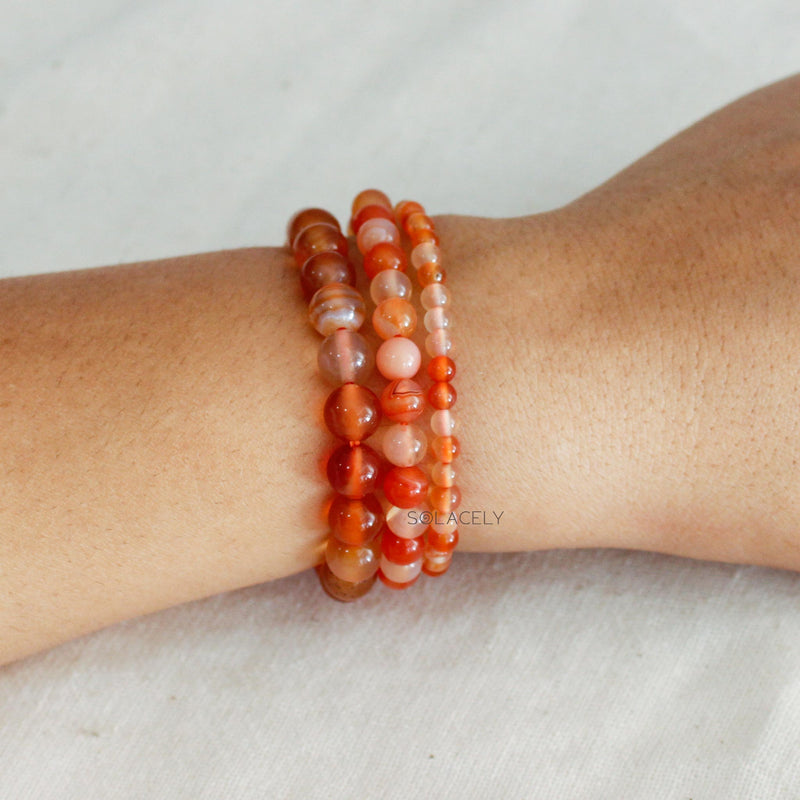
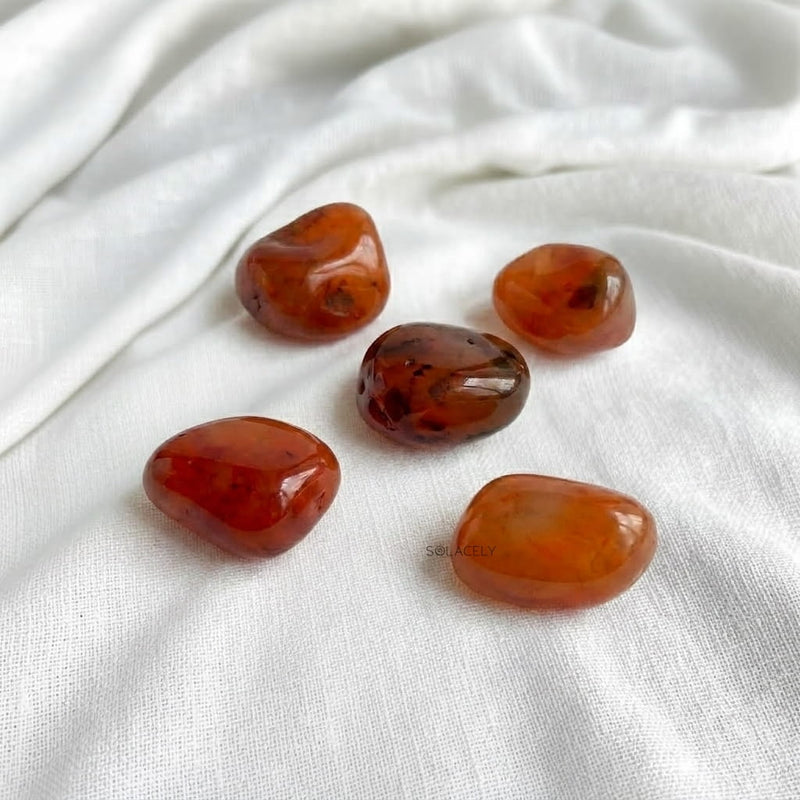
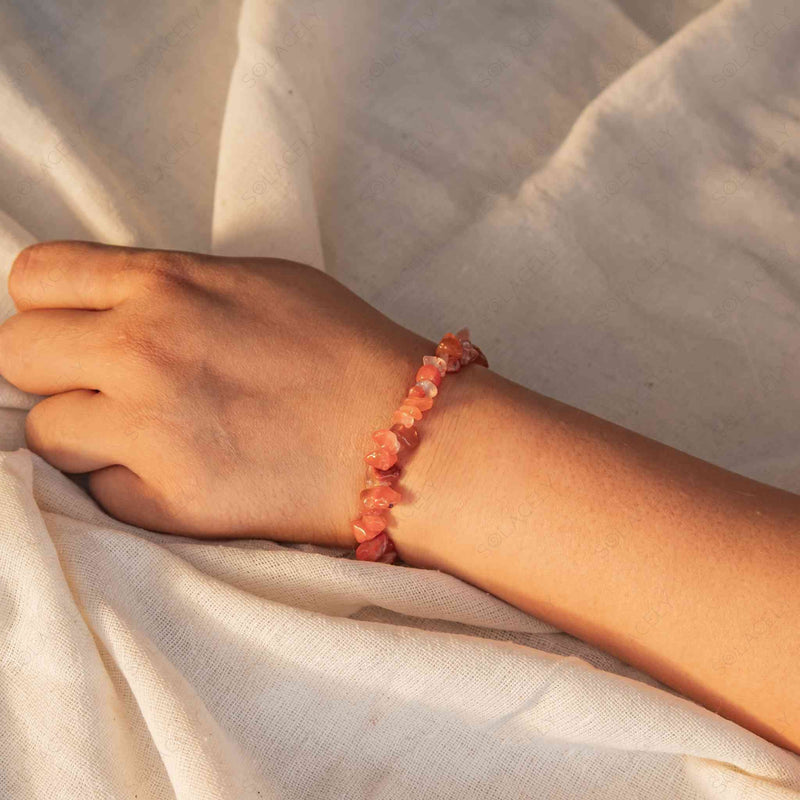
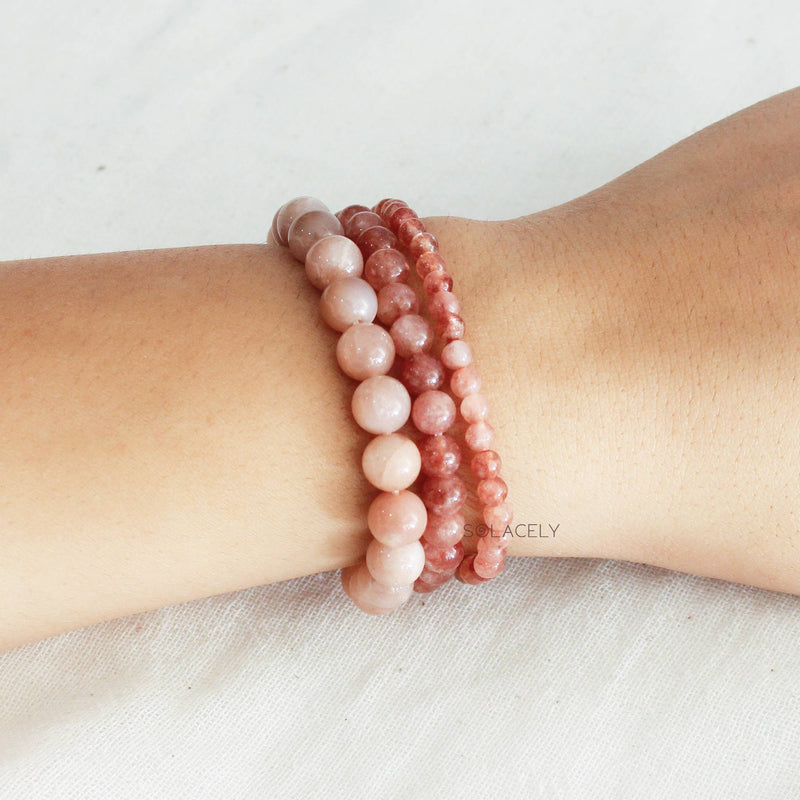
Orange crystals run from soft peach to deep burnt amber, and the group is led by carnelian, sunstone, orange calcite, amber, orange aventurine and tangerine quartz. Orange is the sacral chakra colour, so these stones are traditionally kept for creativity, drive and warmth. Most of them are hard enough to wear every day.
Key takeaways
- The six orange stones you will meet most often are carnelian, sunstone, orange calcite, amber, orange aventurine and tangerine quartz.
- Iron is behind nearly all of it: iron oxide gives carnelian its warmth, and tiny hematite platelets give sunstone and orange aventurine their glitter.
- Amber is the outlier, being fossilised tree resin rather than a mineral, which is why it feels light and warm in the hand.
- Orange is the sacral chakra colour, long associated with creativity, drive, appetite for life and physical warmth.
- Carnelian, orange aventurine and tangerine quartz sit near 7 on the Mohs scale and cope with daily wear. Orange calcite and amber are much softer and belong on a shelf or in a pouch.
- Carnelian is warmed to bring out a deeper, more even orange, a practice thousands of years old that produces a permanent colour, so buy the shade you like the look of.
What makes a crystal orange?
Orange in crystals almost always comes down to iron. Iron oxide spread through chalcedony gives carnelian its warmth. Fine hematite platelets give sunstone and orange aventurine their glitter. Trace iron colours orange calcite. Amber is the exception, being fossilised tree resin rather than a mineral at all.
Because the colour comes from several different chemistries, orange stones look very different from one another even at the same saturation. Carnelian is translucent and glows when held up to a window. Orange calcite is milky and sherbet bright. Sunstone throws flashes of metallic glint as you turn it. Amber has a resinous, honeyed depth that no mineral quite matches.
Orange also shades into its neighbours on the colour wheel, which is worth knowing when you shop. Deep carnelian and cornelian agate sit right on the border with the reds, and our guide to red crystals picks up the family from there. At the other end, a pale tangerine quartz or a golden amber leans towards the yellows. Lighting shifts all of it, so check a piece under the lamps you actually live with before deciding on a shade.
Six orange crystals at a glance
These six cover almost everything you will meet on an orange shelf. The hardness column is the practical one. Anything at 6 or above copes with a bracelet worn daily, while the softer stones are happier in a bowl, a pouch or a display piece. Traditional associations are given as they have been handed down.
| Stone | Colour range | Mohs hardness | Traditionally kept for |
|---|---|---|---|
| Carnelian | Peach through burnt orange to red brown | 6.5 to 7 | Courage, motivation, getting started |
| Sunstone | Golden orange to reddish brown with metallic flash | 6 to 6.5 | Optimism, leadership, warmth |
| Orange calcite | Sherbet to bright tangerine, usually milky | 3 | Fresh ideas, lifting a flat mood |
| Amber | Pale honey to deep orange brown | 2 to 2.5 | Comfort, steadiness, protection |
| Orange aventurine | Warm orange with a fine shimmer | 7 | Perseverance, seeing things through |
| Tangerine quartz | Pale apricot to strong tangerine over clear quartz | 7 | Curiosity, playfulness, creative flow |
Carnelian, the orange crystal most people start with
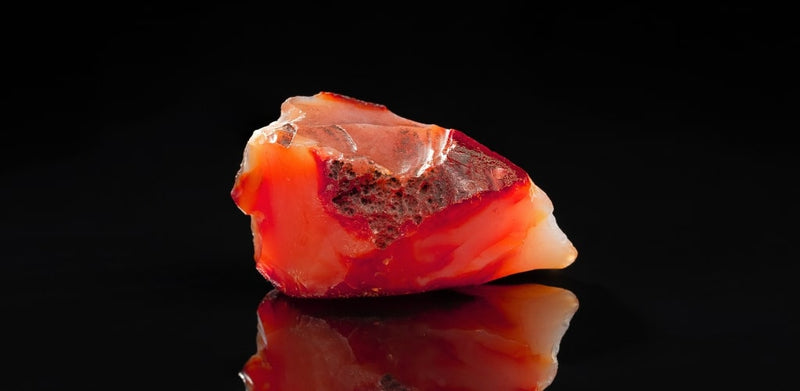
Carnelian is the orange variety of chalcedony, a microcrystalline form of quartz, and it is where most people begin. It is widely available as beads, tumbles and pendants, it sits between 6.5 and 7 on the Mohs scale so it holds up to daily wear, and its colour range is broad enough that almost everyone finds a tone they like.
Warming carnelian to bring out a deeper, more even orange is one of the oldest practices in the gem trade, running back thousands of years to the bead workshops of the ancient world. Gentle heat encourages the iron already inside the stone to oxidise further, and the colour that results is permanent. It does not wash out, rub off or fade back over time, and it goes all the way through the stone rather than sitting on the surface.
That makes choosing carnelian pleasantly simple: pick the shade you actually want to look at. Some people want a pale peach that almost reads as pink in daylight. Others want the deep burnt orange that turns nearly red under a lamp. Hold a strand up to the light, because carnelian shows its best character backlit. Our full carnelian meaning and properties guide goes further into formats, pairings and how people wear it.
Traditionally carnelian is the stone of getting going. People reach for it before a difficult conversation, at the start of a project that has been sitting untouched, or on the mornings when the day needs a push. It is the most common anchor stone in an orange collection for that reason.
Sunstone and amber, the golden end of orange
Sunstone and amber are the two warmest stones in the group, and both carry a glow rather than a flat colour. Sunstone is a feldspar filled with tiny reflective platelets that flash as it moves. Amber is fossilised conifer resin, tens of millions of years old, sometimes with plant fragments or bubbles caught inside it.
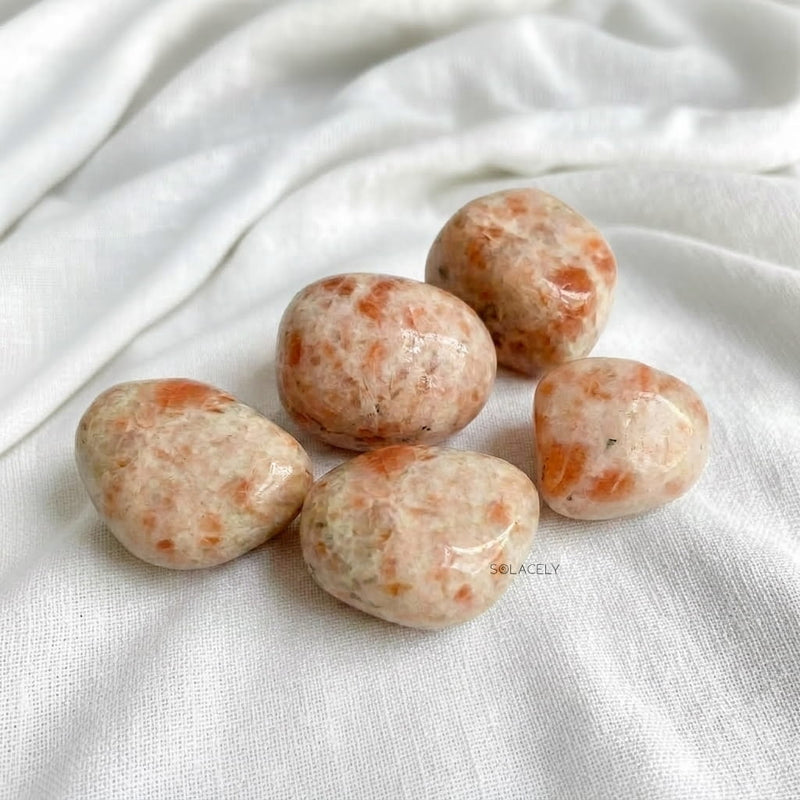
Sunstone's flash is called aventurescence, and it comes from microscopic inclusions of copper, hematite or goethite lying parallel inside the feldspar. Turn a sunstone bead under a lamp and the whole surface lights up at once, then goes quiet again. Cutters orient the rough so that the flash sits face up. It runs from 6 to 6.5 on the Mohs scale, which is fine for a bracelet worn with a little care. Our sunstone guide covers the varieties in more detail.
Amber needs a gentler hand. At 2 to 2.5 on the Mohs scale it is the softest thing on the shelf, and being an organic resin it does not like heat, solvents, perfume, hairspray or ultrasonic cleaners. Put amber jewellery on last and take it off first. Kept sensibly it lasts for generations, which is exactly why it has been passed down as a comfort and protection piece across so many cultures.
Orange calcite, orange aventurine and tangerine quartz
These three fill out the rest of the orange range. Orange calcite is the soft, milky, sherbet coloured one, a calcium carbonate that often arrives as a rough chunk or a polished palm stone. Orange aventurine is a shimmering quartzite. Tangerine quartz is clear quartz carrying a fine coating of iron oxide over its faces.
Orange calcite is only 3 on the Mohs scale and reacts to acids, so it stays away from vinegar, lemon, bathroom cleaners and long soaks. A dry cloth is all it wants. What it offers in return is the brightest, most cheerful orange in the group, which is why it so often ends up on a desk or a windowsill where it can catch the morning light. People traditionally reach for it when a project has gone stale and needs a fresh angle.
Orange aventurine and tangerine quartz are both quartz at heart, both sit at 7, and both wear well. Aventurine carries a fine glittery shimmer from included mica or hematite and is long associated with perseverance, the quality of finishing what you started rather than starting something new. Tangerine quartz keeps the clear crystal's shape and terminations under a warm apricot skin, and is kept for curiosity and play. If you want a point on a desk rather than a bead on a wrist, tangerine quartz is usually the one people choose.
Orange crystals and the sacral chakra
Orange is the colour assigned to the sacral chakra, the energy centre traditionally placed just below the navel and connected with creativity, appetite, pleasure and emotional flow. That single association is why orange stones are gathered together in the first place, and why the same handful keeps appearing in creative rituals.
In practice, people work with them in three ways: worn, held or placed. A carnelian bracelet keeps the colour in your line of sight through the working day. A tumble in a pocket gives you something to reach for before you start. A calcite chunk or a sunstone sphere on a desk sets the tone of a workspace without asking anything of you. Our guide to sacral chakra crystals sets out the usual layouts.
For a simple creative routine, pick one stone rather than five. Put it beside whatever you are making, take a few slow breaths before you begin, and set a plain intention such as starting badly rather than not starting at all. Writers, painters and makers often keep an orange stone as a working object in exactly this way, and our list of crystals for creativity and art covers how people arrange them around a studio or a desk.
How to care for orange crystals
Orange stones split cleanly into two care groups. Carnelian, orange aventurine and tangerine quartz are quartz family stones at 6.5 to 7, and they tolerate a quick rinse in cool water and a thorough dry. Orange calcite and amber are soft, and both want nothing more than a dry or barely damp cloth.
Keep the whole group out of long spells of direct sunlight. Amber in particular can dry and craze if it is left somewhere hot or sunny, and no stone benefits from baking on a windowsill for months. Skip ultrasonic cleaners entirely, and keep household cleaners, solvents and perfume away from calcite and amber, which react to both.
Store bracelets flat in individual pouches so the softer pieces are not rubbing against harder beads such as quartz or hematite. If you like to cleanse your stones, moonlight, sound and a plate of dry salt set beside the piece are all gentle options that avoid soaking. Never put stones in drinking water, and keep small beads, chips and tumbles well away from babies and young children, as they are a choking and strangulation risk.
Crystals are kept for comfort, focus and ritual. They are not a medical treatment and nothing here is medical, psychological or safety advice. If you have a health concern, please speak to a qualified professional and carry on with any care that has already been arranged for you. Keep small stones, beads and chips away from babies, young children and pets, as they present a choking and strangulation risk.
Sources
- Geology.com, Carnelian: The Orange to Red Variety of Chalcedony
- Geology.com, Sunstone: A Feldspar with Aventurescence
Written by Chetena Sharma. Reviewed by the Solacely editorial team.
Frequently asked questions
About the author


Written by Chetna Sharma, crystal healing practitioner and co-founder of Solacely. Chetna has worked with healing crystals for over a decade and curates Solacely's protective stone collection.