The best known purple crystals are amethyst, lepidolite, charoite, purple fluorite and sugilite. In crystal tradition purple is the colour of the crown and third eye centres, so these stones are kept for calm, intuition, rest and spiritual practice rather than for drive.
Key takeaways
- Amethyst, lepidolite, charoite, purple fluorite and sugilite are the purple stones most kept in practice.
- Purple is traditionally linked to the crown and third eye chakras, which is why these stones cluster around calm and intuition.
- Amethyst is the most practical of the group at 7 on the Mohs scale, comfortable for everyday wear.
- Lepidolite and charoite are much softer, so they show their best as tumbled or display pieces.
- Keep purple stones out of long direct sunlight, which softens their colour over time.
Why purple carries this meaning
Purple has been the colour of ceremony and contemplation for a very long time, and part of that is simple scarcity. Purple dye was historically difficult and expensive to produce, which made it the colour of ritual and of rank, and purple stones inherited some of that association.
In chakra practice the connection is more direct. The third eye centre at the brow and the crown centre at the top of the head are both given to the violet end of the spectrum, and both are associated with insight, perspective and stillness rather than action. Purple stones are placed with them almost without exception.
That is why the practical uses cluster so tightly. Whatever the mineral, purple stones in this tradition tend to be kept for evenings, meditation, sleep and the quieter kind of thinking. For the chakra framing, crystals for the crown chakra sets it out properly.
Amethyst, the one most people start with
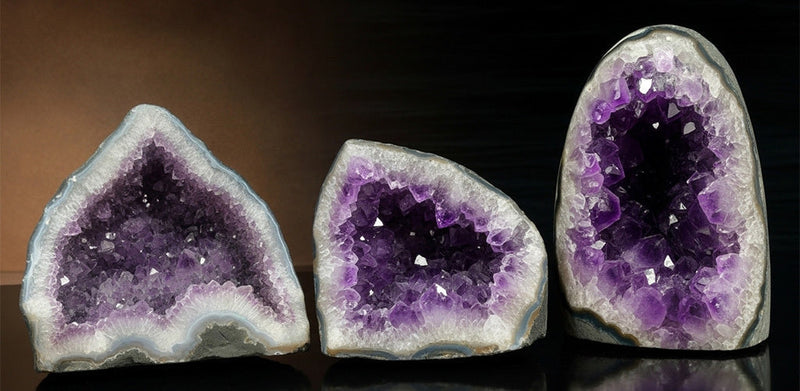
Amethyst is the purple quartz, and it is the stone that anchors this whole group. It runs from a pale lilac through to a deep, saturated violet, and the finest material carries flashes of red within the purple that give it real depth.
Traditionally it is kept for calm, clarity and rest, and it is the classic bedside stone across almost every modern practice. People place it where the evening ends: a nightstand, a reading corner, the shelf where the phone gets put down. That habit is the most common use of any purple stone.
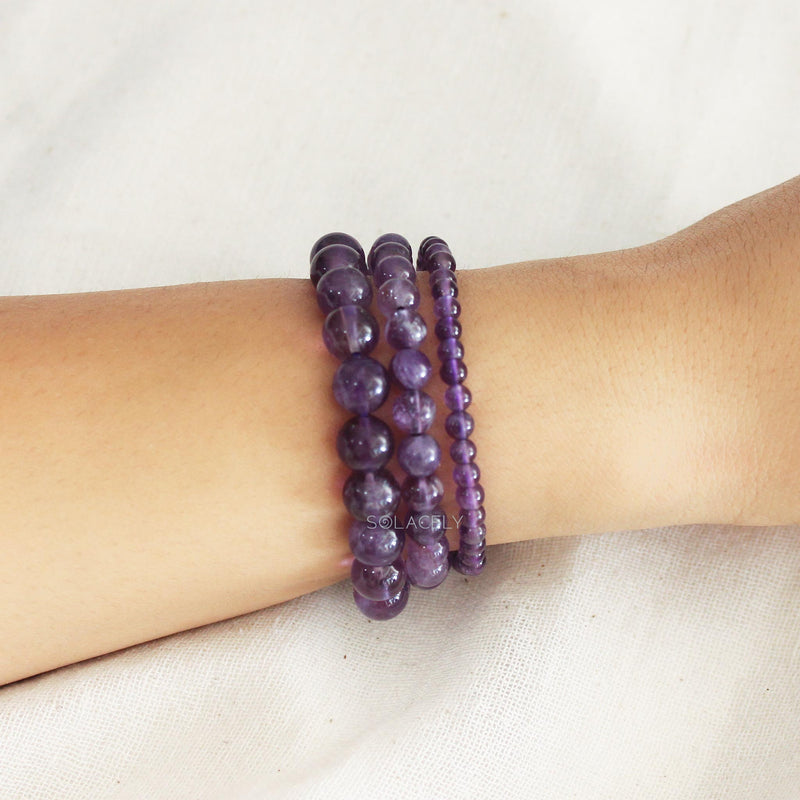
It is also the most practical of the group. At 7 on the Mohs scale it takes daily wear comfortably, which is why amethyst bracelets and pendants outnumber every other purple piece. Our amethyst meaning and properties guide covers colour, care and tradition in detail.
Lepidolite, charoite, fluorite and sugilite
Lepidolite is the soft lilac mica, often flecked with a subtle sparkle, and it is kept for settling an overactive mind. It is much softer than amethyst, so it does best as a tumbled palm stone rather than as jewellery worn every day.
Charoite is the most dramatic of the group, a swirling violet stone with white and black feathering through it, found in only one region of Siberia. That single source is part of its appeal, and every piece carries a completely distinct pattern.
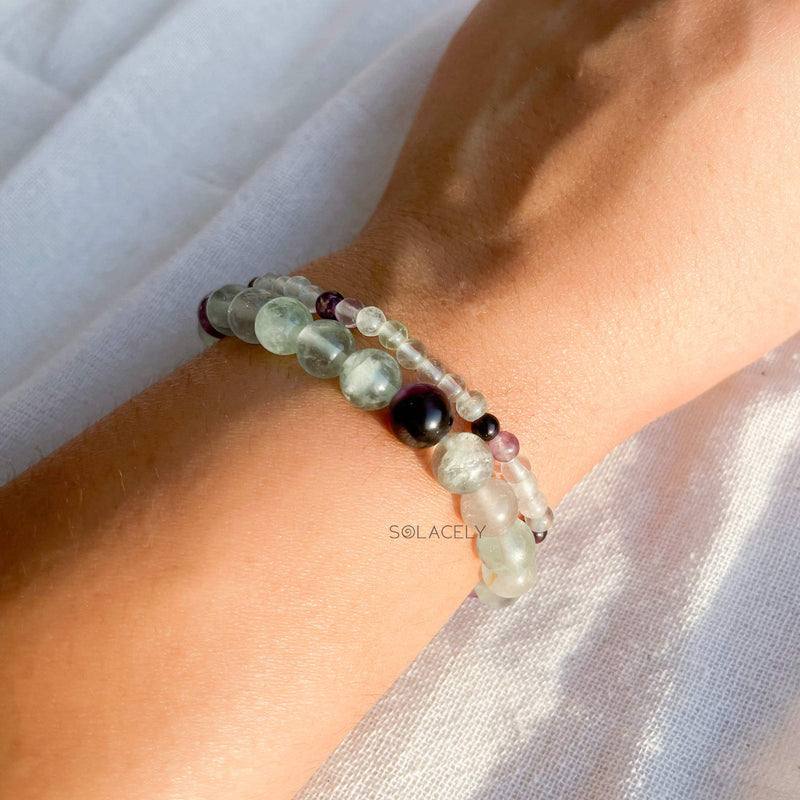
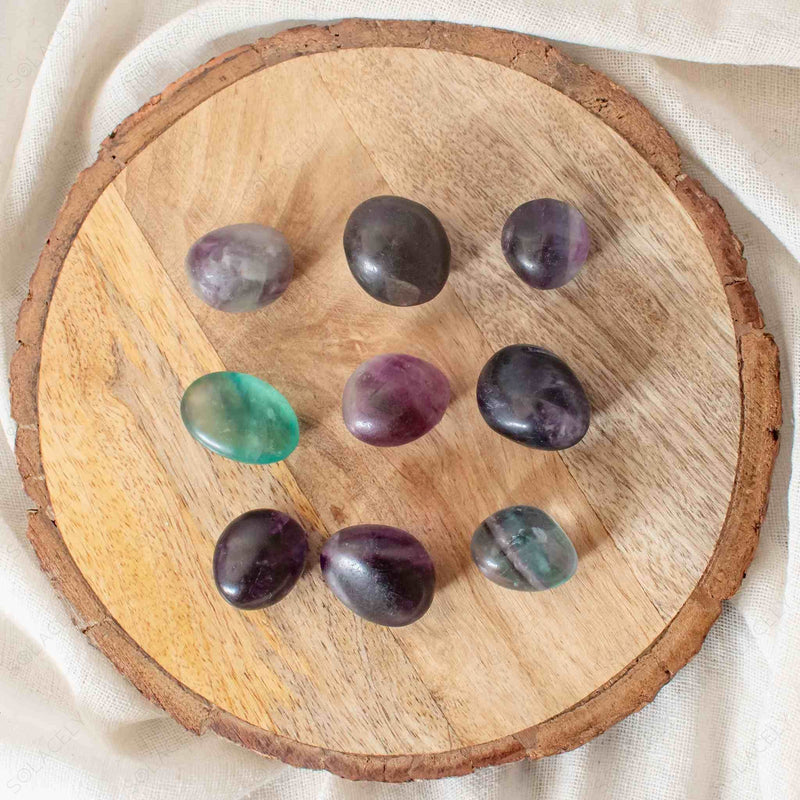
Purple fluorite is the study stone, traditionally kept for mental order and sequencing. It sits at 4 on the Mohs scale, which makes it a desk piece rather than a carry stone. Sugilite rounds out the group as a deep, opaque purple long kept for comfort and emotional steadiness.
Choosing among the purple stones
| Stone | Traditionally kept for | Hardness | Best format |
|---|---|---|---|
| Amethyst | Calm, clarity, rest | 7 | Anything, including daily jewellery |
| Lepidolite | Settling a busy mind | 2.5 to 3 | Tumbled palm stone |
| Charoite | Perspective, transformation | 5 to 6 | Pendant or display piece |
| Purple fluorite | Mental order, study | 4 | Desk piece on a dish |
| Sugilite | Comfort, emotional steadiness | 6 to 6.5 | Pendant or cabochon |
If you want one purple stone that does everything, amethyst is the answer. If you want a small set, amethyst for the bedside, fluorite for the desk and lepidolite for the pocket covers the three places most people actually need one.
How purple crystals are traditionally used
The practices attached to this group are quiet ones, which follows from what the colour is associated with.
- At the bedside. Amethyst on the nightstand as the marker that the day has ended.
- In meditation. Held in the palm or placed at the brow, which is the traditional third eye position.
- On a desk. Purple fluorite beside a notebook when a task has too many moving parts.
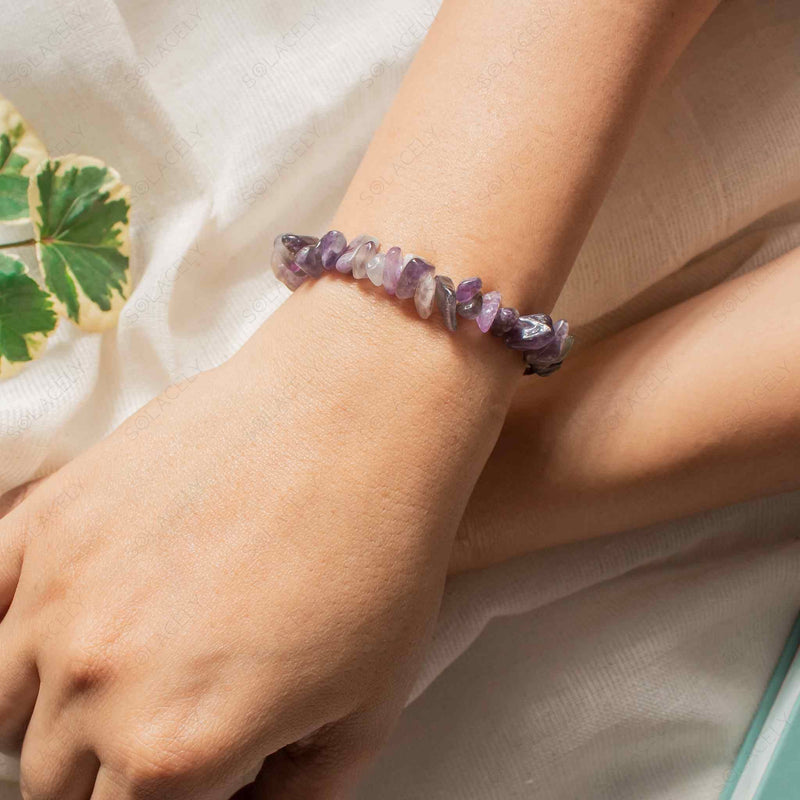
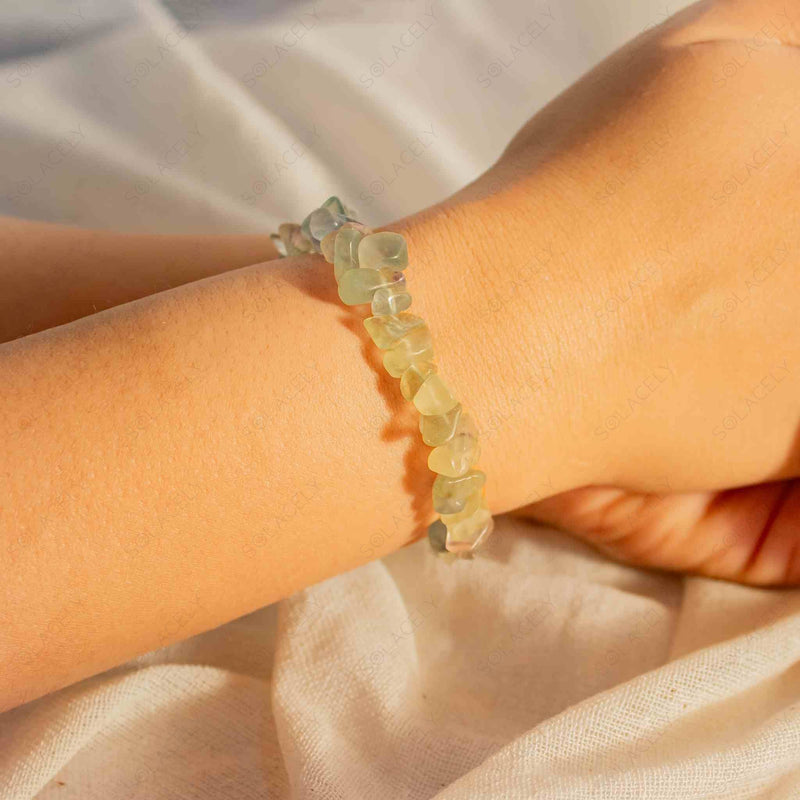
- Worn. An amethyst bracelet for anyone who wants the reminder with them through the day.
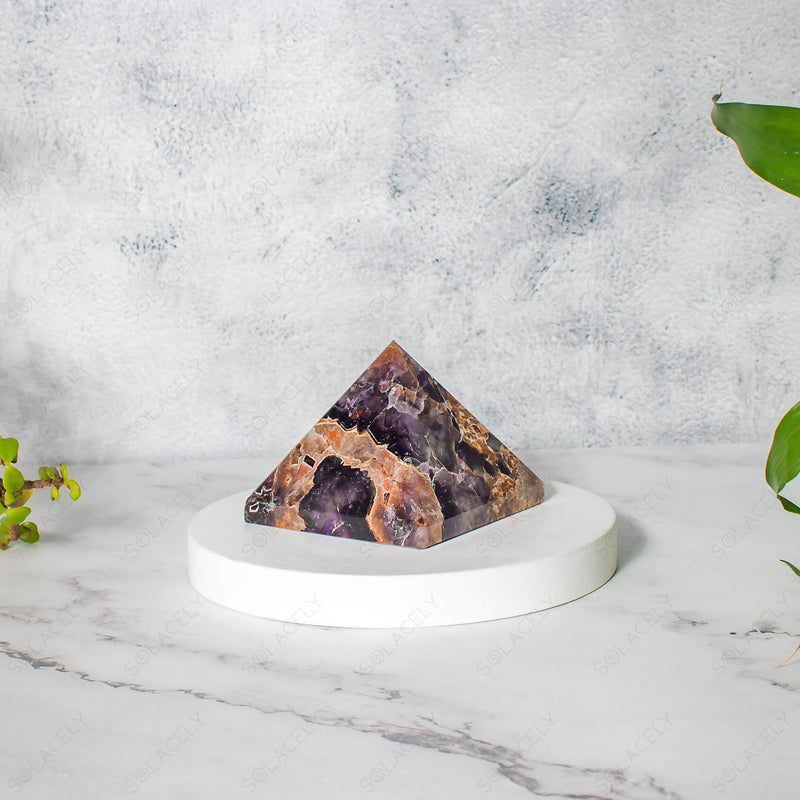
- In a room. A cluster or geode in a corner used for reading, resting or practice.
For the meditation side specifically, crystals for meditation covers how people actually set up a practice, and crystals for the third eye narrows to that centre.
Caring for purple stones
The one care habit that matters across this whole group is light. Purple colouring is the most light-sensitive in the crystal world, and long hours on a bright windowsill will soften the shade of amethyst, fluorite and lepidolite alike over months.
That is a simple thing to work around. Keep purple pieces on a bedside table, a shelf away from the window, or in a drawer between wearings. It is also why moonlight rather than sunlight is the traditional cleansing choice for this group, which happens to be the gentler option physically too.
Beyond light, amethyst takes warm water, mild soap and a soft cloth without any trouble. The softer stones prefer a dry cloth and their own pouch, since anything in the quartz family will mark them in a shared box. Fluorite in particular should be dusted rather than washed.
Building a purple set
Start with amethyst and add only if there is a specific job to do. A single well chosen piece in a place you pass daily does more than a shelf of stones that have become scenery.
Two or three is the natural ceiling. Beyond that the colour stops signalling anything particular, and the whole value of a colour group like this is that it marks one kind of intention clearly. Keep the set small and let each piece hold its own corner of the house.
Choosing an amethyst piece
Colour is what you are choosing between, and the range is wide enough that personal preference genuinely decides it. Pale lilac reads light and everyday; deep violet reads richer and shows better in a pendant. Neither is more correct, and the paler material is often the easier thing to wear daily.
Look at how the colour sits in the stone. In natural amethyst the purple usually deepens toward one area and softens elsewhere rather than sitting flat across the whole piece, and that gradient is part of its character. On a bead strand the beads will differ slightly from one another for the same reason.
Format follows use. Clusters and geodes suit a room and hold their colour well out of direct light. Tumbled stones suit a pocket or a bedside dish. Bracelets suit anyone who wants the reminder with them, and amethyst is hard enough to take that comfortably.
Purple stones through history
Amethyst has been prized for a very long time and carried real status for most of it. It appears in Egyptian jewellery, in Greek and Roman rings, and in ecclesiastical settings across medieval Europe, where its violet placed it firmly among the ceremonial colours.
For centuries it sat among the most valuable stones in the world, largely because good deposits were scarce. That changed when substantial finds in Brazil and Uruguay brought amethyst within reach of ordinary buyers, which is why the stone that once signified rank is now the friendliest entry point into a crystal collection.
Charoite tells the opposite story. It was only described in the 1970s and comes from a single area in Siberia, which makes it one of the newest additions to the purple group and one of the few stones whose entire supply traces to one place.
The properties described here reflect traditional and cultural belief around crystals. They are offered for reflection and wellbeing and are not medical advice, a diagnosis, or a treatment for any condition. If you are managing sleep difficulty, anxiety or any health concern, please speak with a qualified healthcare professional. Keep small stones away from young children, and never place crystals in drinking water.
Sources
- Gemological Institute of America, Amethyst Description
- International Gem Society, Quartz gemstone information
Written by Chetena Sharma. Reviewed by the Solacely editorial team.
Frequently asked questions
About the author


Written by Chetna Sharma, crystal healing practitioner and co-founder of Solacely. Chetna has worked with healing crystals for over a decade and curates Solacely's protective stone collection.