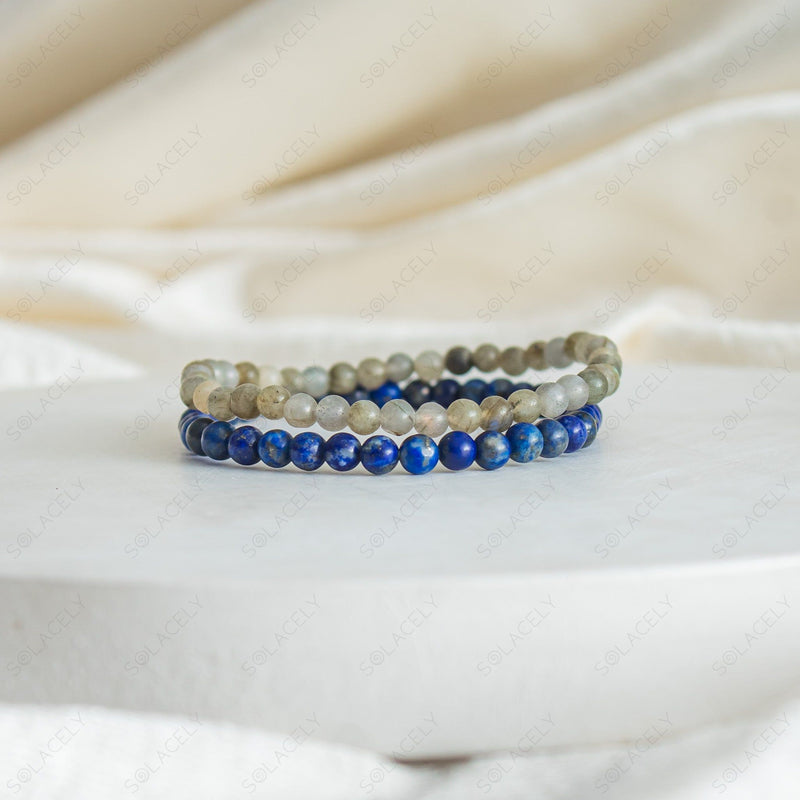
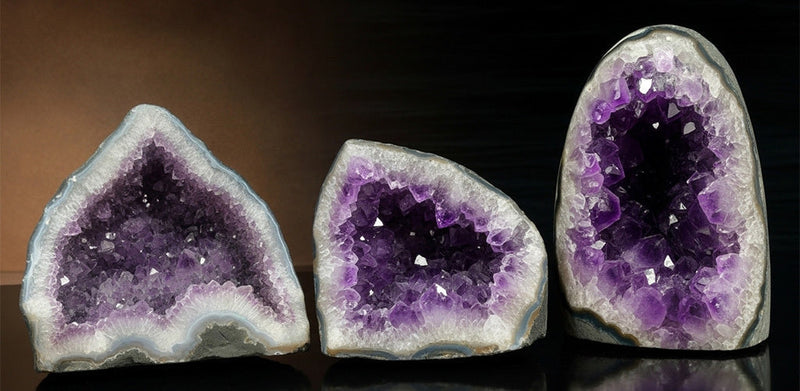
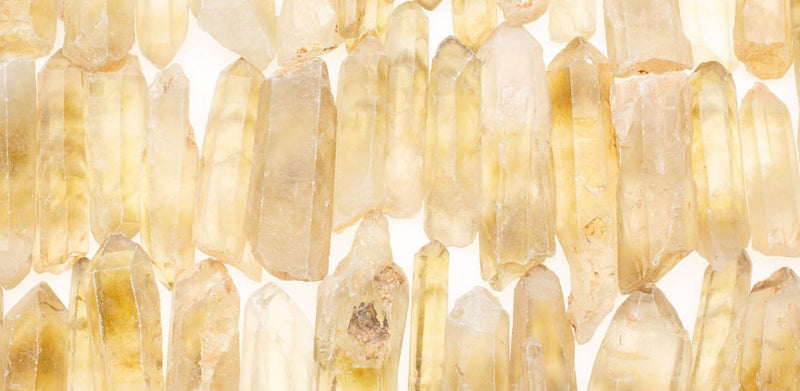
Amethyst, sodalite and citrine are kept together because stress is rarely one thing. Amethyst handles the settling, sodalite the thinking that will not organise itself, and citrine the flatness that follows a long hard stretch. Each takes a different part of the same week.
Key takeaways
- Three stones, three different jobs. This is not three versions of calm.
- Amethyst is kept for settling, sodalite for ordering thought, citrine for warmth.
- Amethyst and citrine are quartz at 7 on the Mohs scale; sodalite is softer at 5.5 to 6.
- Start with whichever describes your week rather than buying all three at once.
- Keep amethyst and citrine out of long strong sun, and store sodalite separately.
Why three stones rather than one
Most stress sets are built from three calming stones, which sounds thorough and in practice means the set only addresses one third of the problem. This combination is put together differently, and that is the whole reason it holds up.
A genuinely difficult stretch usually has three distinct parts. There is the not switching off at the end of the day. There is the head full of unsorted thoughts that will not resolve into a plan. And there is the flatness that arrives after weeks of it, where nothing feels worth starting.
Amethyst, sodalite and citrine map onto those three in order. Knowing which part is actually loudest for you is more useful than owning the full set, and it is the better basis for deciding what to buy first.
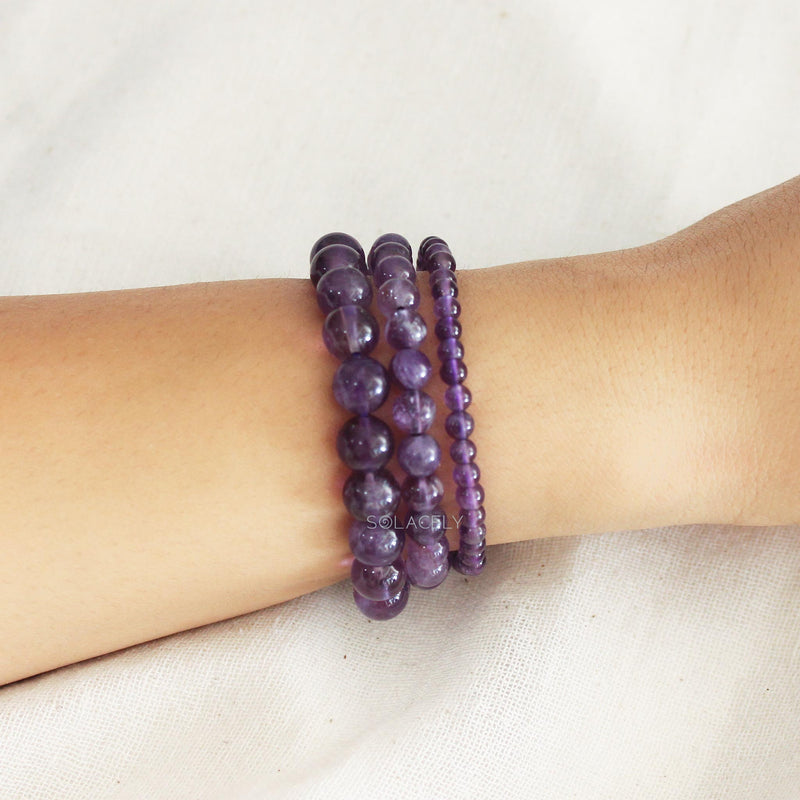
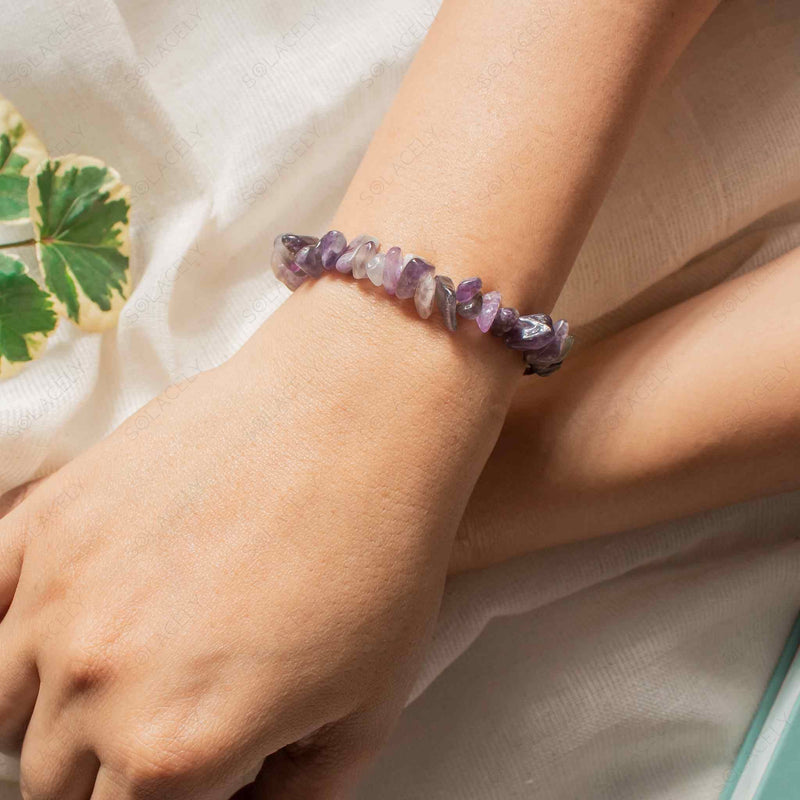
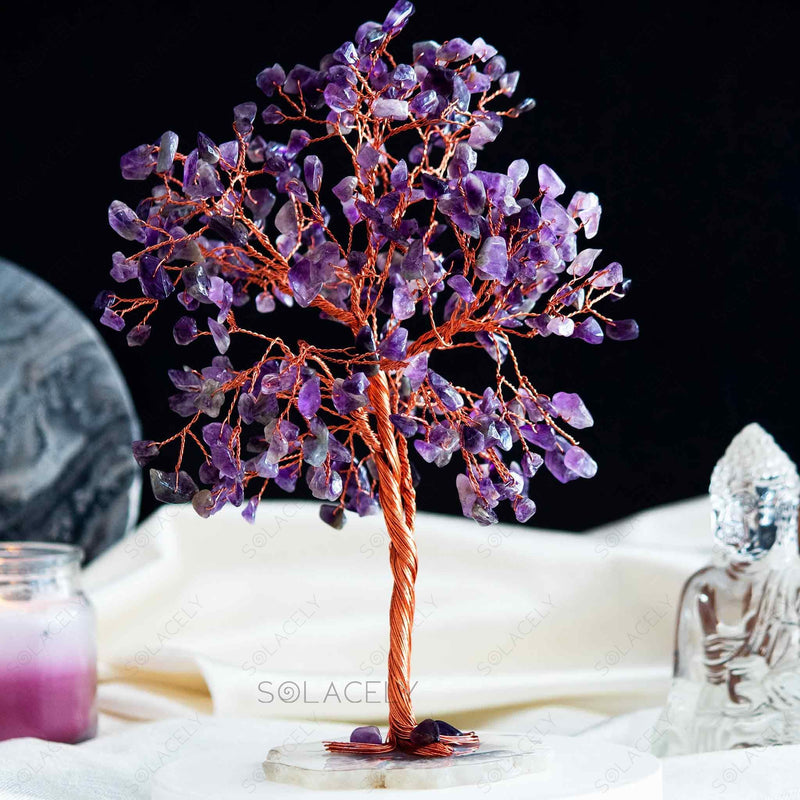
Amethyst for settling
Amethyst is the purple variety of quartz, coloured by iron held within the crystal structure. At 7 on the Mohs scale with no cleavage it is one of the most forgiving stones in any collection, and it takes daily wear in any format.
Its role here is the end of the day. It is the stone that marks the point where work stops, screens go down and the room quietens, and it works best kept somewhere that transition actually happens rather than worn indiscriminately.
The one care note is light. Long hours of strong direct sun soften the purple over months. The amethyst guide covers the varieties and what drives price.
Sodalite for ordering thought
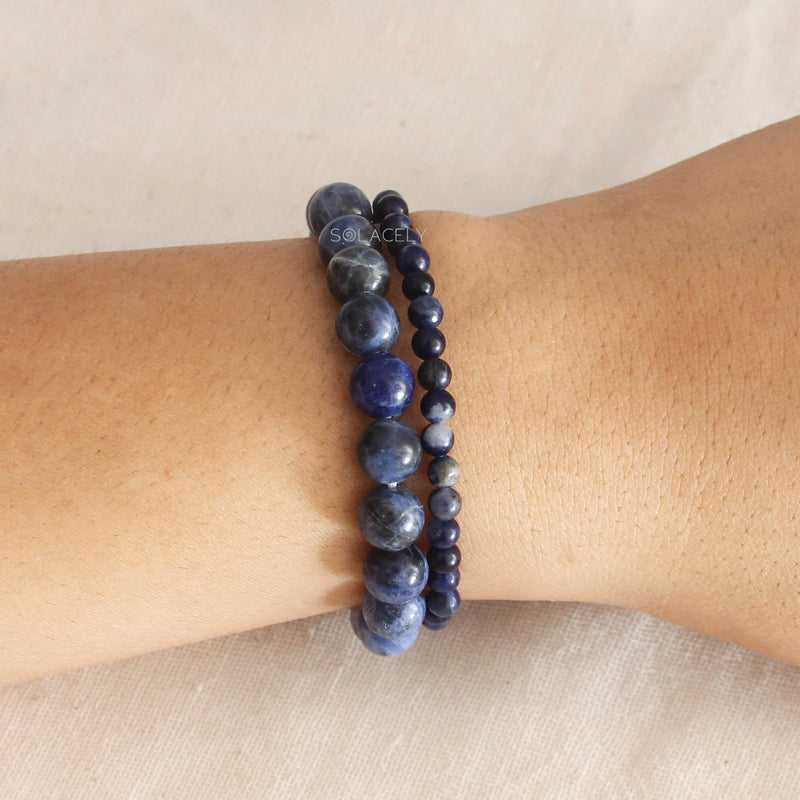
Sodalite is the least known of the three and the most specific in what it does. A deep blue stone flecked and veined with white, it is traditionally tied to the throat and third eye and kept for thinking clearly and speaking plainly.
The state it suits is jumbled rather than loud. If you have four things to decide and they keep rearranging themselves without resolving, that is the sodalite complaint. It is a different problem from anxiety and it responds to a different stone.
It is softer than the other two, at roughly 5.5 to 6 on the Mohs scale, and slightly porous. Keep it away from perfume and cosmetics, and choose a pendant or bracelet over a ring.
Citrine for the warmth afterwards
Citrine is the golden variety of quartz, and in this set it does the job the other two cannot. It is kept for warmth, confidence and coming back into things, which is exactly what tends to go missing after a long demanding stretch.
That makes it the recovery stone of the three rather than the coping one. People reach for it when the crisis has passed and what is left is a flatness that will not lift on its own, and it is genuinely the wrong stone to reach for mid-storm.
Practically it is the easiest to live with alongside amethyst, being the same hardness and needing the same care. The citrine guide covers it in full.
Matching the stone to the week
| What the difficulty actually is | Stone | How it is kept |
|---|---|---|
| Cannot switch off in the evening | Amethyst | Bedside, held for a few slow breaths |
| Head full, nothing resolving | Sodalite | Beside a notebook, where you write things down |
| Flat, nothing worth starting | Citrine | Worn, or kept where you work |
| Constantly interrupted | Black tourmaline | Between you and the door |
| Ungrounded, rushing | Hematite | Pocket stone, carried |
The last two rows are additions rather than part of the set, included because people often arrive at a stress combination when what they actually need is a boundary or some weight.
How the set is used together
The version that survives is the one where each stone keeps a separate place rather than all three sitting in a bowl.
- Amethyst at the bedside. Where the day ends, not where it happens.
- Sodalite at the desk. Beside whatever you write plans in.
- Citrine worn. The one that travels, since its job is out in the world.
- Move them as the stretch changes. Citrine forward once the worst has passed.
That last habit is the most valuable one. Changing which stone is closest to hand as a difficult period shifts is a real acknowledgement that something has moved, and people tend to notice it.
Care for the three
Amethyst and citrine are straightforward. Warm water, mild soap, a soft brush and a full dry, and both are hard enough to share storage with most of a collection. Both want keeping out of prolonged strong sun, which softens either colour over months.
Sodalite needs a little more thought. Wipe it rather than soaking it, keep it away from perfume, cosmetics and household cleaners, and store it apart from the two quartz stones, which will scratch it.
For energetic cleansing, moonlight or sound suit all three, and none of them need salt. If the stress is specifically about sleep rather than the wider stretch, crystals for insomnia covers the bedside set and when to stop treating it as a crystal question.
Choosing the three
With amethyst, the range runs from pale lilac to deep royal purple and price tracks depth and evenness of colour rather than size. Banding is common and entirely natural, so pick the shade you would genuinely enjoy having beside a bed.
With sodalite, look at the balance of blue to white. Some pieces are almost solid deep blue with a hairline of white; others are heavily marbled. Neither is better, and the marbled material is usually cheaper, so buy on how it looks to you.
With citrine, the range runs from pale lemon through clear gold to deep honey, and all of it is properly citrine. Since this stone is the one you will wear rather than shelve, choose the tone that suits what you actually put on in the morning.
What the set can honestly offer
Three separate reminders, each attached to a different part of a hard stretch. That is more useful than it sounds, because the most common failure with a stress practice is having one object that vaguely means calm and therefore means nothing in particular.
What it will not do is reduce the workload causing the stress. If the real problem is too many commitments or a situation that would flatten anyone, that is where the change belongs, and the stones are a small honest thing alongside it.
The properties described here reflect traditional and cultural belief around crystals. They are offered for reflection and wellbeing and are not medical advice, a diagnosis, or a treatment for any condition. If stress, low mood or anxiety is persistent or affecting your daily functioning, please speak with a GP or a qualified practitioner. Keep small stones away from young children, and never place crystals in drinking water.
Sources
- Gemological Institute of America, Amethyst Description
- Gemological Institute of America, Citrine Description
Written by Chetena Sharma. Reviewed by the Solacely editorial team.
Frequently asked questions
About the author


Written by Chetna Sharma, crystal healing practitioner and co-founder of Solacely. Chetna has worked with healing crystals for over a decade and curates Solacely's protective stone collection.