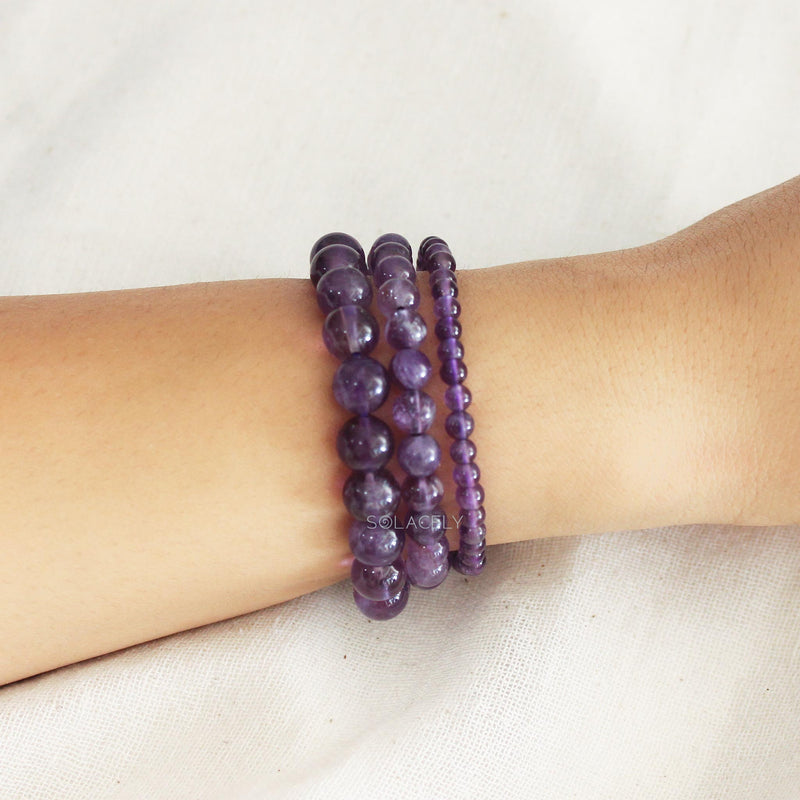
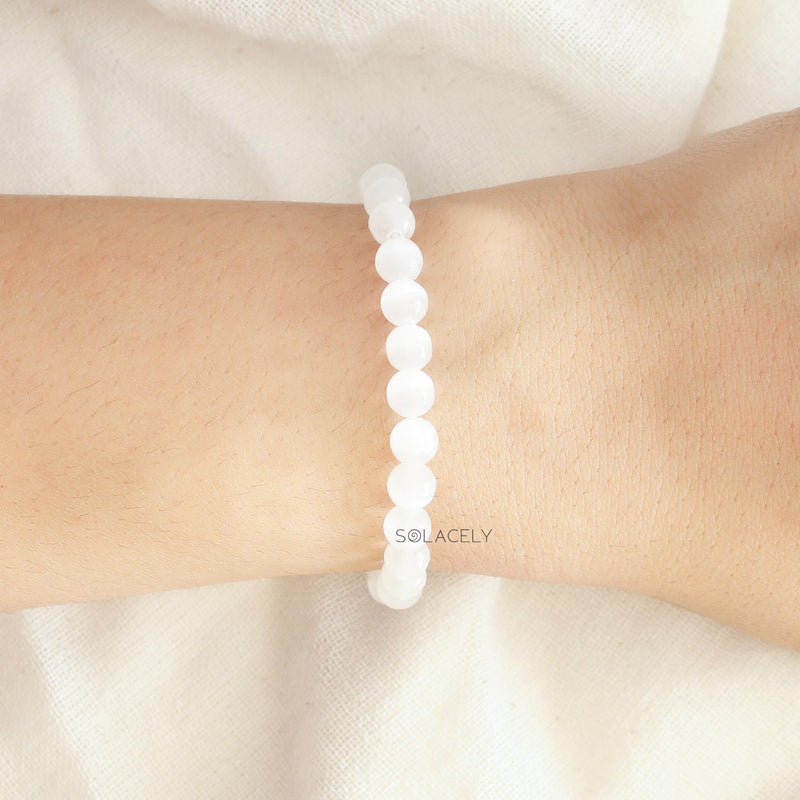
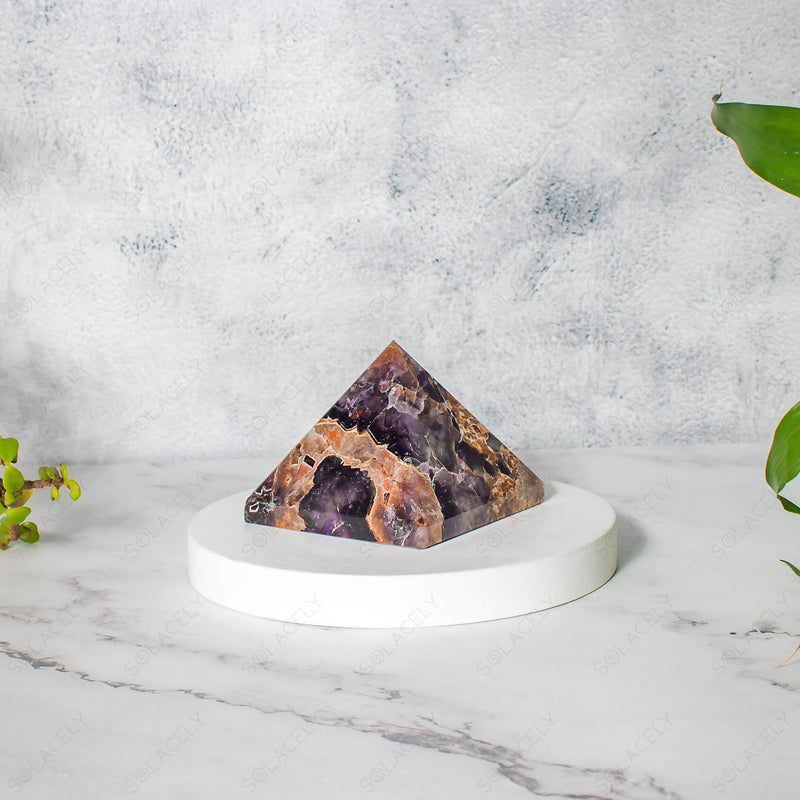
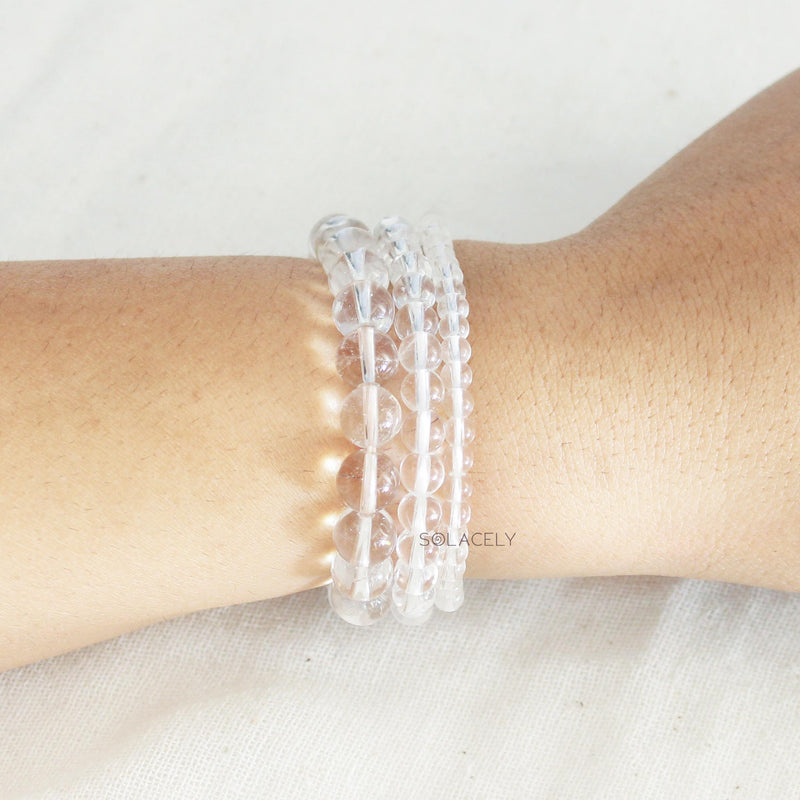
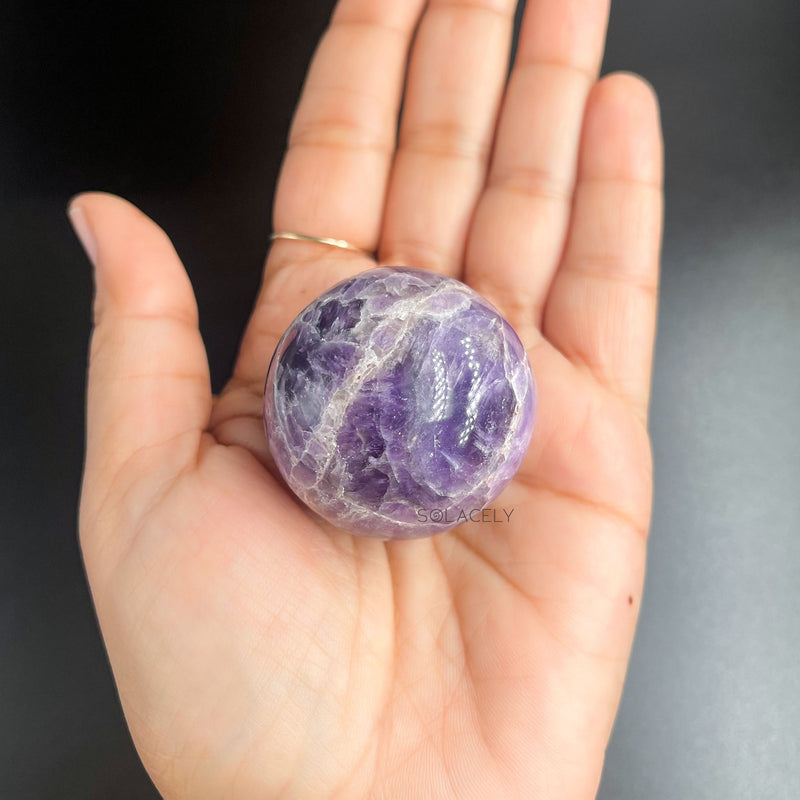
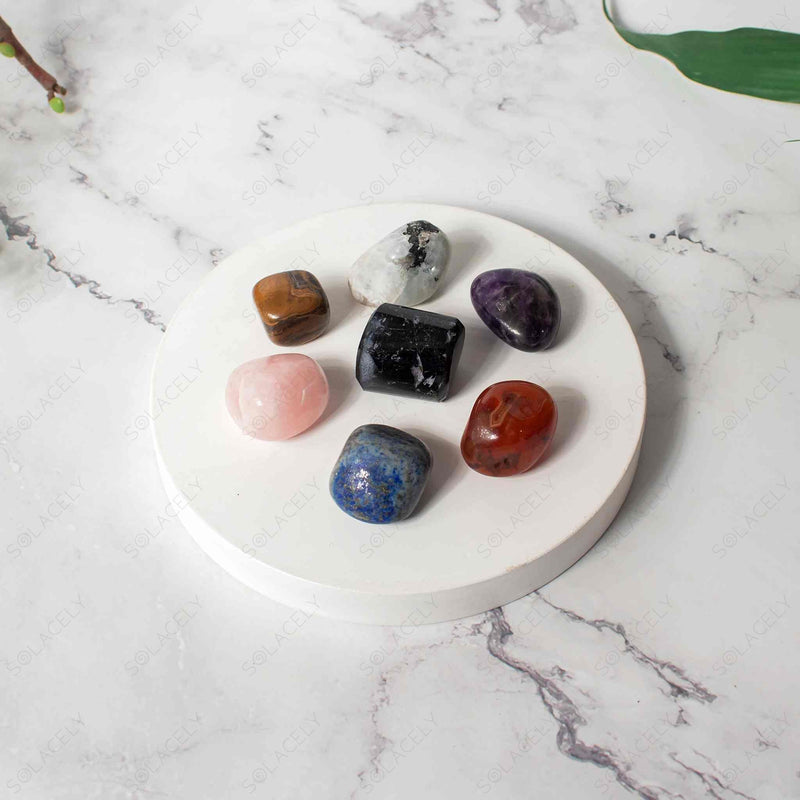
Amethyst and selenite are the traditional choices for a busy mind, black tourmaline and hematite for feeling unmoored, clear quartz as a general companion, and lepidolite when emotion keeps surfacing. The useful way to choose is not by which stone is most popular but by what is actually making sitting difficult.
Key takeaways
- Match the stone to the difficulty: racing mind, restlessness, emotion, or drifting off entirely.
- Grounding stones go low at the feet or base of the spine. Opening stones go high at the forehead or crown.
- Hold a tumbled palm stone rather than a point, which digs in.
- Ten to twenty minutes daily beats an occasional long sitting.
- One or two stones works better than a full seven stone layout.
Start with what is going wrong
Most guides list stones. It is more useful to list problems, because the same person needs different stones in different weeks.
| What happens when you sit | Traditional choice |
|---|---|
| Mind sprints; endless mental to-do list | Amethyst, howlite |
| Physically restless; cannot stay still | Black tourmaline, hematite |
| Feel unmoored or floaty afterwards | Smoky quartz, red jasper |
| Emotion keeps surfacing | Lepidolite, rose quartz |
| Drift off or fall asleep | Clear quartz, carnelian |
| Practice feels flat and dutiful | Sunstone, citrine |
| Want to go deeper, no obstacle | Selenite, clear quartz |
The distinction that matters most is between opening and grounding. Amethyst, selenite and clear quartz are traditionally used for expansive sitting, going up and out. Black tourmaline, hematite and smoky quartz are used for the opposite, coming down and back into the body. Choosing an opening stone when the real problem is agitation tends to make the session harder rather than easier.
How to hold and place them
Holding is the simplest approach and suits seated practice. Rest an open palm on each knee with a tumbled stone in one or both. Keep the grip loose. A palm stone or tumble is far better than a point or a cluster, both of which press into the hand and become the thing you are thinking about.
Placement suits lying down, since almost nothing stays put on a seated body. The conventional positions follow the chakra the stone belongs to:
- Base of the spine or between the feet for grounding stones.
- Just above the navel for citrine or carnelian.
- Centre of the chest for rose quartz and green aventurine.
- Forehead for amethyst.
- On the mat just above the head for selenite.
Two stones is plenty. A full seven stone layout takes longer to arrange than most people sit for, and the arranging becomes a substitute for the practice. Our beginner's chakra stone guide covers the full mapping if you want to build up to one.
A session that works
- Same place, same time. The practice attaches itself to a spot faster than you expect.
- Choose one stone for the difficulty you actually have today.
- Set a timer for ten to twenty minutes so you are not clock watching.
- Settle the breath. Four counts in, six out, five rounds, then let it find its own rhythm.
- Use the stone as the return. When you notice you have drifted, put attention on its weight and temperature, then go back to the breath.
- Do not chase anything. What you are training is the returning, not the arriving.
- Sit still for a moment afterwards before standing.
Beginners often expect a session to feel like something. It rarely does, and that is not a sign it is failing. Our black tourmaline for meditation guide covers grounding practice specifically, and sunstone meditation covers a morning version.
Building toward deeper practice
Once sitting is comfortable, the stones people move toward are selenite and clear quartz, both traditionally associated with the crown and with expansion rather than settling. Practitioners tend to add them only after the base of the practice is steady, on the same logic that runs through chakra work generally: build from the ground up.
Our crystals for enlightenment guide covers what the tradition says about the upper reaches of practice, and crown chakra crystals covers the stones assigned there.
Caring for a meditation stone
A stone handled daily picks up skin oils and needs more attention than one sitting on a shelf. Warm water and a soft cloth suits most of the group, with two exceptions worth knowing.
Selenite must never be rinsed. It is a soft form of gypsum and it dissolves in water. Dust it dry, and nothing else.
Amethyst fades in strong sun. Charge it in moonlight or indirect light rather than on a windowsill.
Beyond that, clear quartz is durable and takes water and light without complaint, black tourmaline is fine polished but brittle raw, and hematite should be dried thoroughly so it does not develop rust spots. Weekly cleansing with sound, smoke or moonlight suits a stone in daily use.
What to expect over time
Not fireworks. What people who keep a practice describe, over months, is a slightly longer gap between something happening and their reaction to it. Unglamorous, and exactly what the traditions point at.
The crystal's contribution is modest and real: it gives the practice an object and a place, which makes it easier to keep. A practice you actually sit for beats a perfect method you abandon in a fortnight.
Crystals and meditation are offered here for reflection and wellbeing as part of a long standing tradition. They are not a treatment for any medical condition and are not a substitute for professional care. Meditation is generally safe but can be difficult for people with certain mental health conditions, so speak to a qualified professional if you have concerns before starting a practice.
Sources
- Gemological Institute of America, Amethyst Description
- NCCIH, Meditation and Mindfulness: Effectiveness and Safety
Written by Chetena Sharma. Reviewed by the Solacely editorial team.
Frequently asked questions
About the author


Written by Chetna Sharma, crystal healing practitioner and co-founder of Solacely. Chetna has worked with healing crystals for over a decade and curates Solacely's protective stone collection.