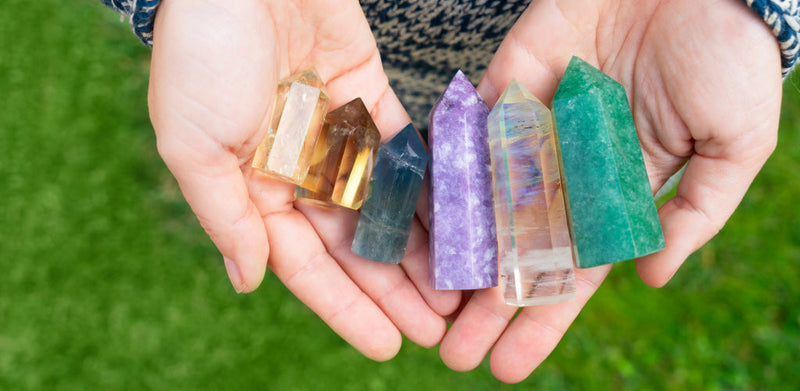
The five crystals used most often for new opportunities are citrine, green aventurine, pyrite, moonstone and labradorite. Traditional practice assigns each a stage of change: courage to apply, luck to be seen, confidence to ask, a clean start, and steadiness while the transition is still messy. Tiger's eye and clear quartz follow close behind.
Key takeaways
- Citrine is used for momentum and decisiveness, green aventurine for opportunity and luck, pyrite for nerve, moonstone for new beginnings and labradorite for holding steady mid-change.
- Pyrite is iron sulfide, the mineral known as fool's gold, and it forms the striking natural cubes that made it a symbol of found fortune.
- Green aventurine and moonstone both rate around 6 to 6.5 on the Mohs scale, softer than quartz, so they need a little more care in daily wear.
- A crystal keeps the intention in view while you do the work. It sits as a visible reminder of a goal you have already named, which is where the reported benefit comes from.
- All metaphysical properties described here are traditional belief, not medical or scientific fact.
Which five crystals suit new opportunities best?
Citrine, green aventurine, pyrite, moonstone and labradorite are the working set. They are chosen together because they cover different stages of a change rather than repeating the same idea. Most people pick two: one for the outward push, usually citrine or pyrite, and one for the inward steadiness, usually moonstone or labradorite.
| Stone | Traditionally used for | Stage of change it suits |
|---|---|---|
| Citrine | Momentum, decisiveness, enterprise | Deciding to move |
| Green aventurine | Luck, opportunity, timing | Applying and waiting |
| Pyrite | Nerve, self-belief, ambition | Interviews and asks |
| Moonstone | New beginnings, intuition | Starting over |
| Labradorite | Transition, resilience | The uncomfortable middle |
If your change is specifically a career move, the sequencing matters more than the stone. Our guide to crystals for career clarity covers the decision stage, which is the part people usually skip.
Why is pyrite associated with opportunity?
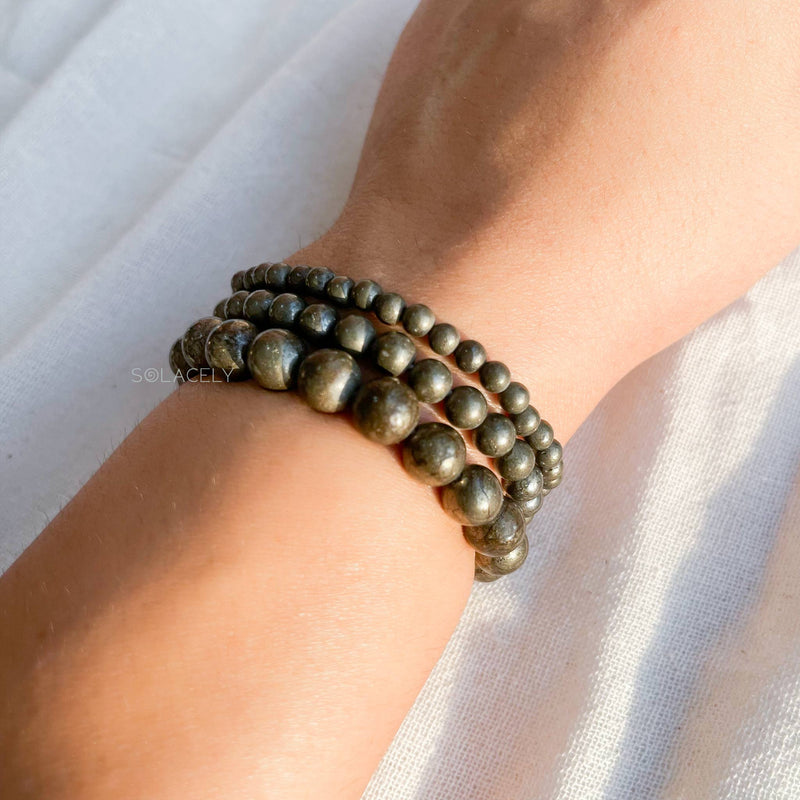
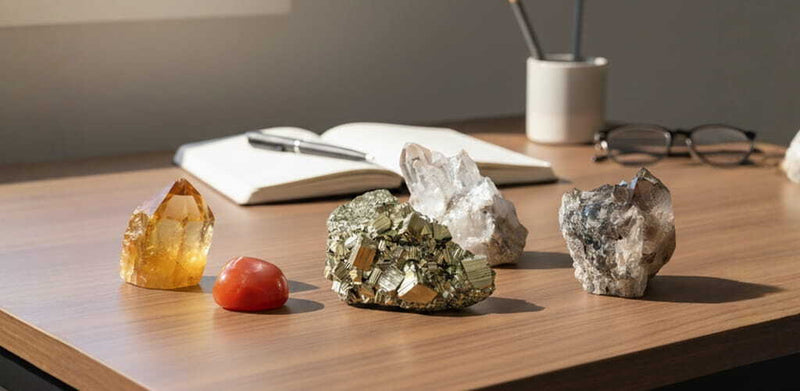
Pyrite is iron sulfide, and Geology.com notes that its metallic lustre and brassy yellow colour earned it the nickname fool's gold, since prospectors repeatedly mistook it for the real thing. It commonly grows as remarkably sharp natural cubes, which is unusual enough that people have collected it for centuries.
The opportunity association came out of that mistaken-identity history. Pyrite is the stone of the thing that looks like gold, and crystal tradition reframed that as confidence, ambition and the willingness to back yourself in front of other people. It is the stone people carry into salary conversations.
Two practical notes. Pyrite tarnishes in humid conditions, so keep it dry and out of the bathroom. Some specimens degrade over years, a process collectors call pyrite disease, and a sealed display box makes that worse rather than better.
What does green aventurine do that citrine does not?
Green aventurine is the patience stone of the pair. It is a quartz variety whose shimmer, called aventurescence, comes from tiny platy inclusions of fuchsite mica. Tradition treats it as the luckiest stone, used for chance, timing and openings you cannot force. Citrine, which the Gemological Institute of America describes as the yellow to orange variety of quartz, is used instead for drive and for closing.
That difference is genuinely useful when choosing. If your problem is that you have not applied for anything yet, citrine is the more useful pick. If you have applied for eleven things and are waiting, aventurine is the stone that matches the actual situation.
Aventurine sits around 6.5 on the Mohs scale and its green colour is stable, though very long sun exposure can dull it slightly. Our green aventurine guide goes further into the mineralogy and the traditional uses.
Moonstone and labradorite: the two feldspars for change
Both belong to the feldspar family, and both are used for transition rather than for gain. Moonstone is the feldspar that shows a floating blue-white sheen, an optical effect gemmologists call adularescence. Labradorite shows a different one, labradorescence, which flashes blue, green and gold as the stone tilts in the light.
Moonstone is the new-beginnings stone. It is used at the start of something: a first day, a move, a decision to try again. Labradorite is used later, once the excitement has worn off and the change is simply hard work. That is a real distinction, and it explains why the two are so often bought together.
Both are softer than quartz and both cleave, meaning they can split along internal planes if dropped. Wear them, but not while gardening or gym training. For a wider look at the starting-over intention, see our guide to crystals for new beginnings.
Do crystals actually attract opportunities?
In crystal tradition that is exactly the job green aventurine and citrine are given, which is why both appear on almost every opportunity list you will read. What practitioners describe is a carried stone keeping a stated goal in your awareness, so the openings already around you get noticed rather than missed.
Think about how the practice works day to day. You set an intention, you put a stone in your pocket, and every time your hand finds it you are reminded of the thing you said you wanted. That prompts the small actions that generate opportunities: the message sent, the application finished, the awkward request made.
That is also why people who write their intention down get more out of a single stone than people who simply own more of them. One named opportunity, one stone, revisited often enough to stay real. Our piece on crystals for good luck in a job search pairs each stone with a concrete action.
How do you use opportunity crystals day to day?
Pick one stone, name one specific opportunity and keep the stone somewhere you touch it. Vague intentions produce vague results, so a wish for something better is far less useful than a wish for a particular role, a particular conversation or a particular deadline you intend to meet.
Carry it to the moment that matters
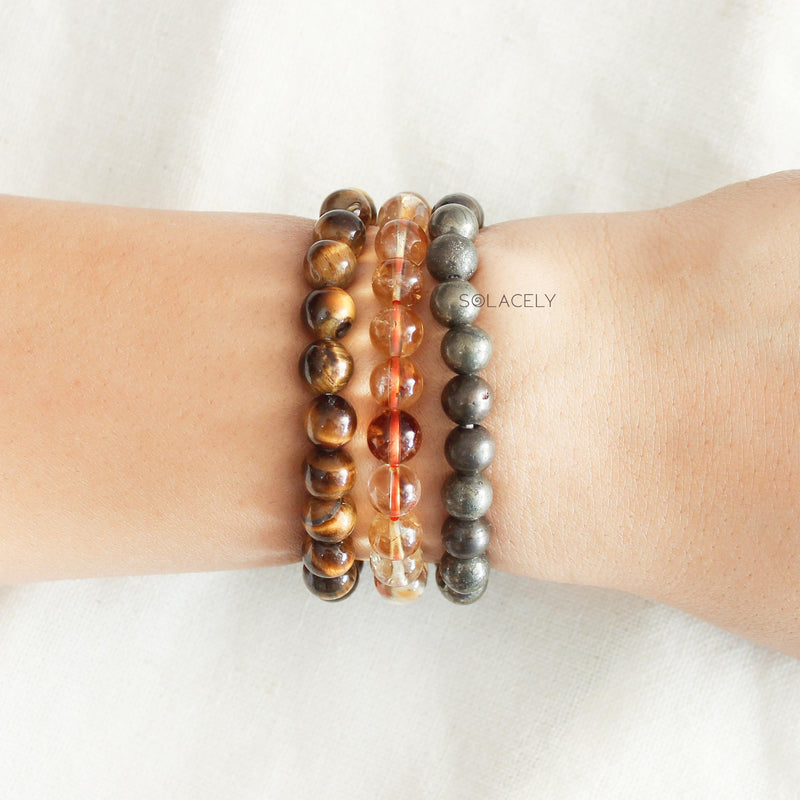
Pyrite in a pocket before an interview, tiger's eye on the wrist for a negotiation, moonstone in a bag on a first day. The point is to attach the stone to a specific event rather than to a general mood.
Keep one at the workspace
A citrine piece or an aventurine tumble in your sightline works as a daily prompt while you apply, pitch or plan. Our guide to crystals for business success covers placement for anyone building something of their own.
Review it monthly
This is the step nobody writes about. Once a month, pick the stone up and ask yourself what has moved since you set the intention. Name the next concrete action, set the stone back down, and carry on.
How do you care for these stones?
Match the method to the mineral, because these five behave differently. Citrine and green aventurine are quartz-family stones sitting at roughly 7 and 6.5 on the Mohs hardness scale, so both tolerate a brief rinse. Moonstone and labradorite are softer feldspars. Pyrite should stay dry altogether, since moisture accelerates tarnishing.
| Stone | Water | Sunlight |
|---|---|---|
| Citrine | Quick rinse, dry fully | Avoid long exposure, colour can fade |
| Green aventurine | Quick rinse is fine | Short exposure only |
| Pyrite | Keep dry, wipe with a cloth | Fine, but store somewhere dry |
| Moonstone | Brief rinse, dry gently | Moonlight suits it better |
| Labradorite | Brief rinse, dry gently | Short exposure only |
Moonlight, sound and a rest on selenite work for all five and carry no risk to any of them. Store the softer pieces separately so harder stones do not scratch the polish.
The properties described here reflect traditional and cultural belief around crystals. They are not medical, financial or career advice, and no stone influences hiring decisions, business outcomes or health. If you are managing a health concern or a significant financial decision, speak to a qualified professional.
Sources
Written by Chetena Sharma. Reviewed by the Solacely editorial team.
Frequently asked questions
About the author


Written by Chetna Sharma, crystal healing practitioner and co-founder of Solacely. Chetna has worked with healing crystals for over a decade and curates Solacely's protective stone collection.