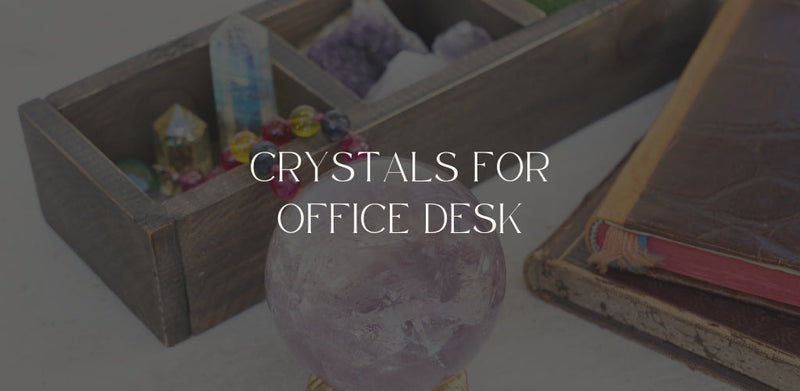
The crystals most often used for productivity are tiger's eye for willpower, fluorite for mental order, pyrite for drive, clear quartz for clarity, and citrine for motivation. They work as desk cues and routine anchors rather than performance enhancers, which is a smaller claim but an honest and genuinely useful one.
Key takeaways
- Tiger's eye, fluorite, pyrite, clear quartz and citrine are the five stones most commonly kept on a working desk.
- The mechanism is behavioural, not mineral. A stone on the desk is a visual cue tied to starting a task.
- Fluorite is soft at 4 on the Mohs scale, so it scratches easily and belongs on a dish rather than loose in a bag.
- Pair the practice with something evidenced. The NIH reports mindfulness training can improve attention-related outcomes.
- Metaphysical uses described here are traditional belief, not medical or psychological fact.
Do crystals actually help productivity?
In the way the practice describes, yes. A desk crystal acts as an environmental cue: a small, deliberate object that marks the start of focused work. Habit research has long shown that consistent cues make routines easier to start, and a stone is a particularly pleasant one. That is what the tradition is built on, and it is worth building on.
The confusion arises because people feel a difference and then attribute it to the mineral. The difference is usually real; the attribution is the shaky part. If you place a stone down every time you begin deep work, you are building an anchor. Over a few weeks that anchor starts pulling its weight.
Where the effect has actual study behind it is in attention training rather than stones. The National Center for Complementary and Integrative Health summarises evidence that mindfulness and meditation practices can support attention and stress management. Use the crystal to start the practice, not instead of it.
Tiger's eye for willpower and follow-through
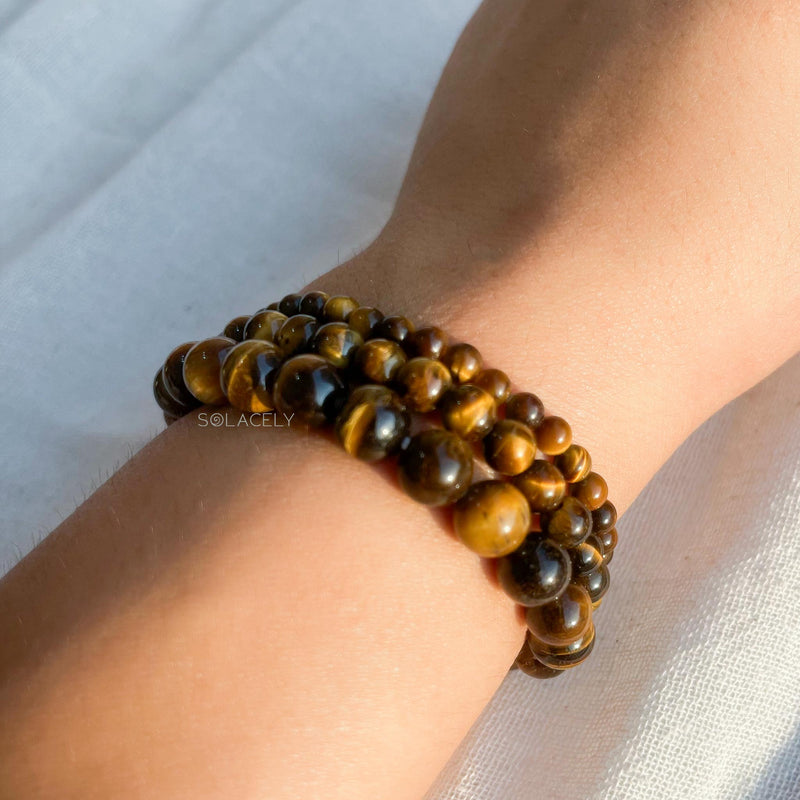
Tiger's eye is the classic productivity stone, traditionally carried for nerve, decisiveness, and sticking with something past the interesting part. Its golden banding comes from a fibrous structure inside the quartz that reflects light in a shifting band, an effect called chatoyancy.
Practically, it suits people whose problem is starting rather than concentrating. A tiger's eye bracelet is common precisely because it travels with you into meetings and commutes, which is where the intention usually gets abandoned. Keep it on the wrist you use least if you type all day, since beads and keyboards do not get along.
It is a quartz variety, so it sits around 7 on the Mohs scale and takes daily wear without complaint. Our full breakdown lives in the tiger's eye meaning and properties guide.
Fluorite and clear quartz for mental order
Fluorite is the stone people reach for when the problem is scatter rather than motivation. It is used traditionally for sorting, structuring, and thinking in sequence, which makes it a natural fit for planning work, writing, and anything with a lot of moving parts.
It is also the most fragile stone on this list. Fluorite is calcium fluoride and sits at 4 on the Mohs scale, soft enough to be scratched by a steel key. The Mohs hardness scale is the quickest sanity check for any new stone. Keep fluorite on a dish, not rattling around in a bag with keys.
Clear quartz plays a different role. It is the neutral stone, used as a general amplifier and a blank slate, and it happens to be the most abundant framework mineral in the crust. Geology.com describes quartz as one of the most common minerals on Earth, which is part of why it is the cheapest way into a crystal practice. On a desk it usually functions as the anchor stone that the others rotate around.
Pyrite and citrine for drive
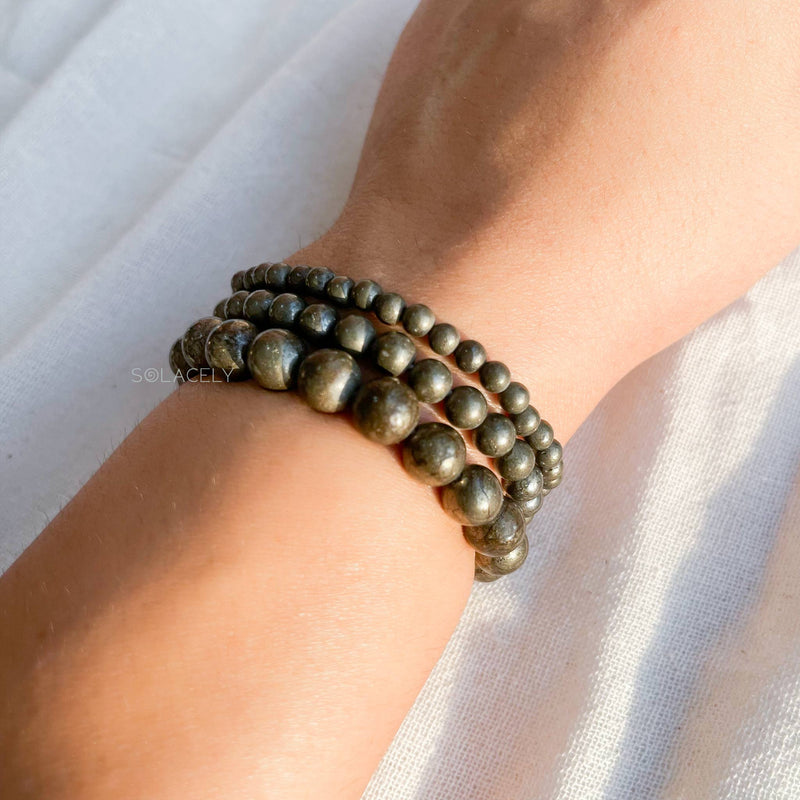
Pyrite is iron sulfide, brassy and heavy, and it is used traditionally for momentum and confidence in work. The weight is part of the appeal. It is a satisfying object to pick up, and a surprising number of people report that handling it is what actually breaks the stall.
One real caution: Geology.com notes that pyrite can oxidise when exposed to moist air, which is why specimens sometimes develop a dull or crumbly surface over time. Keep it dry, never soak it, and do not leave it in a humid bathroom or near a window that sweats.
Citrine is the warmer counterpart, associated with optimism and self-starting rather than grinding effort. According to the Gemological Institute of America, citrine is the yellow to orange variety of quartz, and warming amethyst to bring out that golden tone is one of the oldest and most stable practices in the trade. Both are properly citrine, so choose the shade you would most like on your desk. For desk-specific layouts, see crystals for the office desk.
Building a desk set that you will actually use
Three stones is the practical ceiling. Beyond that the desk becomes decoration and the cue stops meaning anything.
| Problem | Stone | Where to put it |
|---|---|---|
| Cannot start | Pyrite or tiger's eye | Held for ten seconds before opening the task |
| Too many open threads | Fluorite | Beside the notebook or task list |
| Foggy, low energy | Citrine | In the light, where you will see it |
| General focus | Clear quartz | Centre of the desk as the anchor |
| Constant interruption | Black tourmaline | Between you and the door or the shared space |
Pair the set with a rule rather than a hope. Something as small as "the stone goes in my hand, then the phone goes face down" converts a decorative object into a working one. If deep concentration rather than motivation is the goal, crystals for concentration and crystals for energy and focus cover narrower selections.
Care and cleansing for desk stones
Desk stones get handled constantly, so they pick up skin oil and dust faster than jewellery. A wipe with a soft damp cloth once a week keeps them looking sharp. Dry them fully afterwards, particularly pyrite.
Skip salt water on everything here. It pits softer stones and accelerates pyrite's oxidation. For energetic cleansing, moonlight, sound, or a rest on a selenite plate are the low-risk options. Keep amethyst and citrine out of prolonged direct sun, since both can fade.
There is a case for cleaning the stones on a schedule rather than by instinct. Tying it to something you already do weekly, such as clearing the desk on a Friday, means the ritual survives busy periods instead of quietly lapsing. A stone that has gathered a fortnight of dust stops reading as deliberate, and once it stops reading as deliberate it stops working as a cue.
What to skip
Two things undermine this more than anything else. The first is buying a large set at once. A tray of fifteen stones gives you a decoration, not a practice, and the sheer number removes any sense that picking one up means something. Start with one stone, add a second only when the first has an established job.
The second is expecting the stone to carry a workload problem. If the real issue is too many projects, unclear priorities, or genuine burnout, no arrangement of minerals will touch it. Crystals are a reasonable support for a functioning system and a poor substitute for a broken one. Fix the system first, then let the desk set do its small, honest job on top.
The properties described here reflect traditional and cultural belief around crystals. They are not medical or psychological claims and are not a substitute for professional advice. If you are struggling with persistent concentration difficulties, low mood, or burnout, speak to a qualified practitioner rather than relying on a crystal practice.
Sources
- National Center for Complementary and Integrative Health, Meditation and Mindfulness
- Gemological Institute of America, Citrine Description
Written by Chetena Sharma. Reviewed by the Solacely editorial team.
Frequently asked questions
About the author


Written by Chetna Sharma, crystal healing practitioner and co-founder of Solacely. Chetna has worked with healing crystals for over a decade and curates Solacely's protective stone collection.