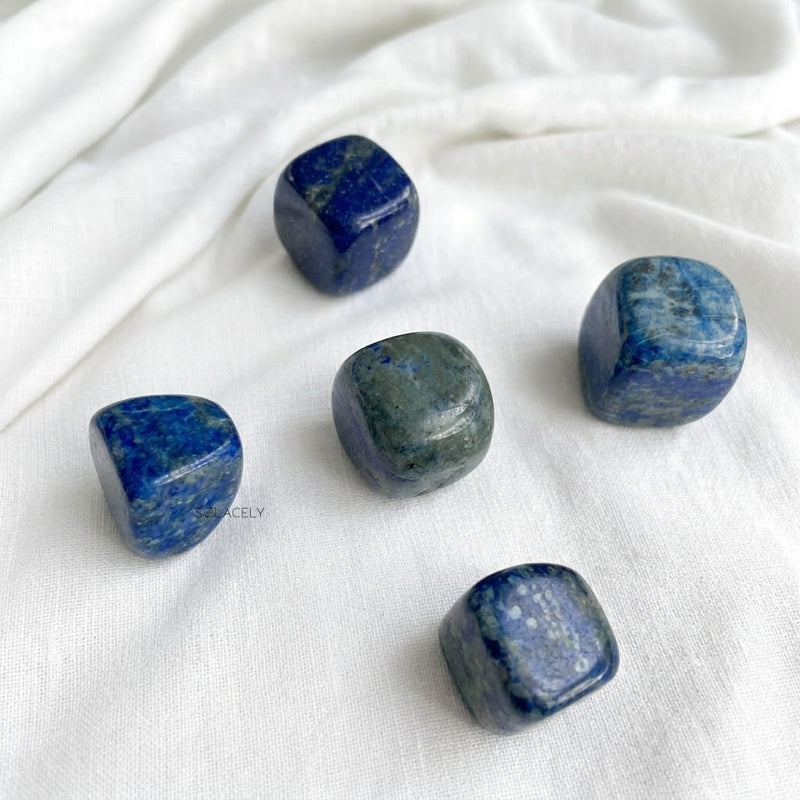
Indigo crystals are the deep blue to blue violet stones that sit between blue and purple on the colour spectrum: lapis lazuli, sodalite, azurite, iolite, blue kyanite, dumortierite, indigo gabbro and tanzanite. In crystal practice they are associated with the third eye chakra, intuition and a quieter, more inward kind of focus.
Key takeaways
- Indigo sits between blue and violet, so the group runs from the pyrite flecked blue of lapis lazuli to the blue violet of tanzanite.
- Hardness varies a lot: azurite is roughly 3.5 to 4 on the Mohs scale, sodalite 5.5 to 6, tanzanite 6 to 7 and iolite 7 to 7.5.
- Lapis lazuli is a rock rather than a single mineral, built mainly from lazurite with calcite and pyrite mixed through it.
- Tanzanite is a blue violet variety of zoisite from the Merelani Hills of Tanzania, and it joined the December birthstone list in 2002.
- Lapis lazuli is porous and usually waxed, so keep it away from soaps, solvents and long soaks.
What makes a crystal indigo rather than blue or purple?
Indigo is the narrow band between blue and violet, so an indigo crystal reads deep blue with a violet lean rather than sky blue or plum. Sodalite and lapis lazuli sit at the blue end, tanzanite and iolite drift towards violet, and indigo gabbro carries both in one stone.
The colour comes from a different place in each stone. Lapis lazuli owes its blue to lazurite, a mineral in the same family as sodalite. Azurite is a copper carbonate, and copper is what gives it that saturated azure. Indigo gabbro takes its violet grey from a mix of pale feldspar and dark iron rich minerals.
Iolite and tanzanite add another layer: both are pleochroic, so the colour shifts with the viewing angle. Turn a piece of iolite and you may see violet blue from one direction and a paler, smokier grey from another. Cutters orient the rough to put the best colour face up.
If you want to see where indigo ends and the neighbouring families begin, our guide to blue crystals and their meanings covers the band just below it in more depth.
Which stones count as indigo crystals?
Eight stones make up the working list: lapis lazuli, sodalite, azurite, iolite, blue kyanite, dumortierite, indigo gabbro and tanzanite. They range from soft copper minerals to hard silicates, and from opaque rock to transparent gem material, so the group is far less uniform than the shared colour suggests.
Lapis lazuli
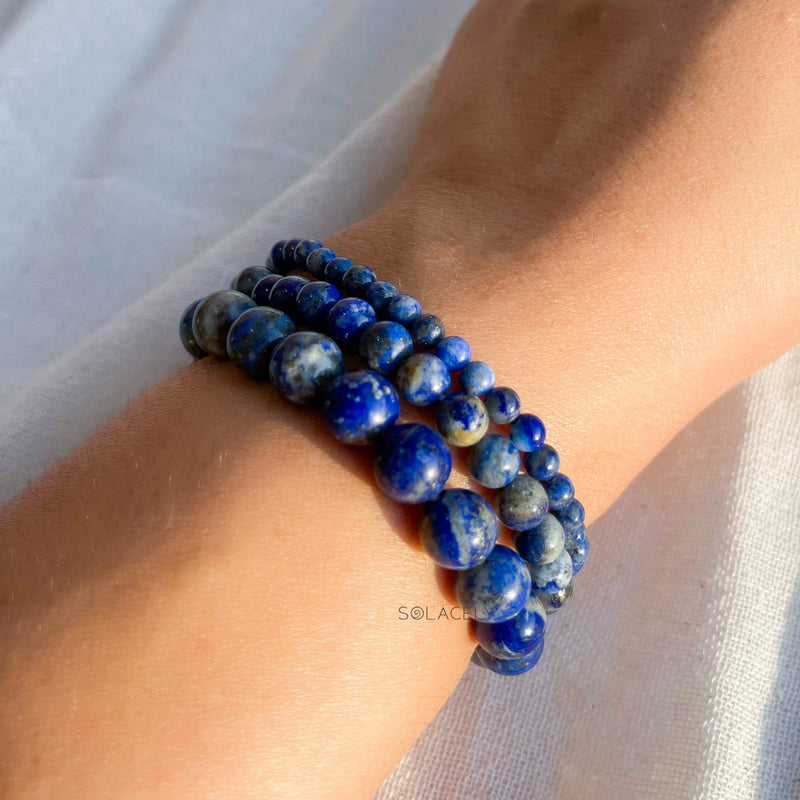
Lapis lazuli is a rock, not a single mineral. Its blue comes from lazurite, and most pieces also carry white calcite veining and brassy specks of pyrite. The finest material has come from the Sar-e-Sang valley in Badakhshan, north east Afghanistan, for thousands of years. Ground and purified, it gave Renaissance painters the pigment ultramarine. Our full guide to lapis lazuli meaning and properties goes further into that history.
Sodalite
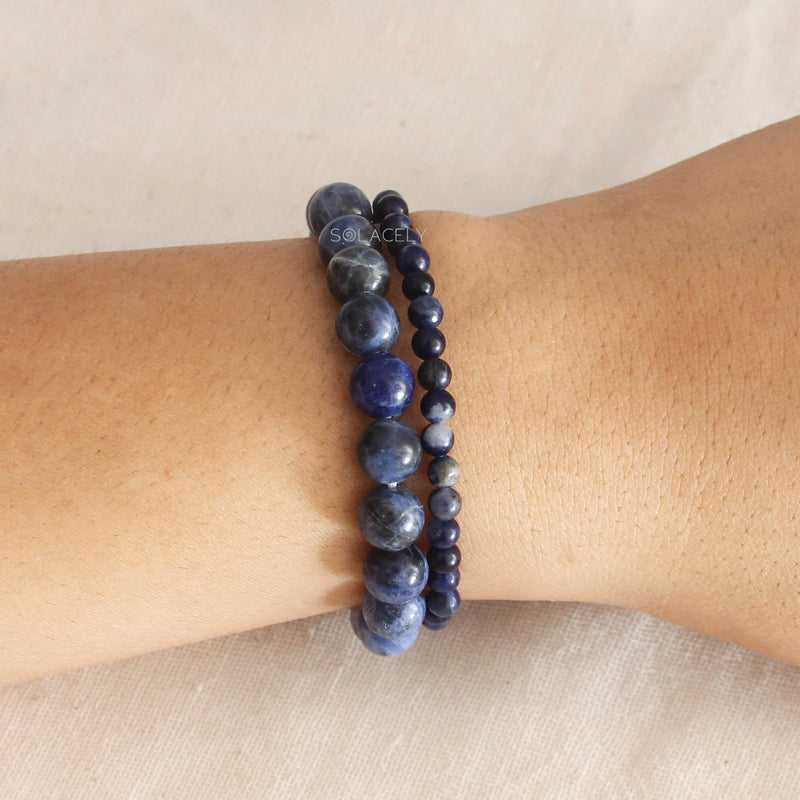
Sodalite is a sodium rich silicate, royal blue with white veining, named in 1811 for the sodium in its chemistry. It is slightly harder than lapis at 5.5 to 6 on the Mohs scale, which makes it the workhorse indigo stone for tumbles and beads. Well known deposits sit at Bancroft in Ontario and in Greenland. There is more in our sodalite meaning and benefits guide.
Azurite
Azurite is a copper carbonate hydroxide and the most intense blue in this group. It is also the softest, around 3.5 to 4 on the Mohs scale, and it slowly alters to green malachite in damp conditions. Plenty of specimens show the two minerals side by side. Azurite is happiest as a display piece rather than a ring stone.
Iolite
Iolite is the gem quality form of cordierite, a magnesium aluminium silicate, and at 7 to 7.5 it is hard enough for everyday jewellery. Its violet blue can look close to a soft sapphire. Gem lore has long linked iolite to Viking navigators, who are said to have read the position of the sun through cloud using thin slices of it.
Blue kyanite
Blue kyanite grows in long bladed crystals and has an unusual habit: its hardness depends on direction. Gemmological reference works give roughly 4.5 to 5 along the length of a blade and 6 to 7 across it. It also has perfect cleavage, so blades split cleanly if knocked. In crystal tradition kyanite is the piece people keep for alignment, and it is often said to need no cleansing.
Dumortierite
Dumortierite is an aluminium borosilicate, first described in 1881 and named after the French palaeontologist Eugene Dumortier. Massive material is a dense denim blue that takes a fine polish. It also occurs as inclusions inside quartz, sold as blue quartz or dumortierite quartz. It is one of the harder indigo stones, which makes it practical for beads worn daily.
Indigo gabbro
Indigo gabbro, also sold as mystic merlinite, is a mottled dark rock from Madagascar rather than a single crystal. Gabbro is a coarse grained intrusive igneous rock, formed as magma cools slowly underground, and this variety swirls black, violet grey and creamy feldspar together. It polishes to a high shine and sits near 6 on the Mohs scale.
Tanzanite
Tanzanite is the blue violet variety of the mineral zoisite, and it comes from one small area, the Merelani Hills in northern Tanzania. It was found there in 1967 and named by Tiffany and Company. Gentle warming to bring the blue violet forward is a long established and entirely stable part of preparing the stone. Tanzanite joined the December birthstone list in 2002.
What is indigo linked to in crystal practice?
Indigo is the colour of the third eye chakra, the point at the brow that crystal practice links to intuition, perspective and inner quiet. People reach for indigo stones when they want to think clearly rather than quickly: before study, during meditation, or at the end of a noisy day.
Each stone carries its own traditional emphasis. Lapis lazuli is long associated with honest speech and self knowledge, which is why it often sits with throat work as well as brow work. Sodalite is kept for calm reasoning. Azurite is the classic choice for insight and dreamwork. Iolite is worn as a reminder to hold your own direction, an echo of that old navigator story.
Blue kyanite and dumortierite tend to be the study desk stones, traditionally kept for patience with detail. Indigo gabbro is the grounding counterweight, the piece people hold when the thinking needs an anchor. If brow work is your main interest, our guide to crystals for the third eye goes deeper.
How hard are indigo crystals, and how should you care for them?
Hardness across this group runs from about 3.5 to 8.5 on the Mohs scale, a wide spread, so one routine will not serve them all. The general rule is simple: dry cleaning with a soft cloth, no soaking, no ultrasonic machines and no household cleaners on any of them.
| Stone | Mohs hardness | Character | Care note |
|---|---|---|---|
| Azurite | 3.5 to 4 | Deep azure copper carbonate | Display piece, keep dry |
| Blue kyanite | 4.5 to 7, by direction | Bladed, perfect cleavage | Store flat, blades split if knocked |
| Lapis lazuli | 5 to 5.5 | Lazurite with calcite and pyrite | Porous and waxed, no soaps or solvents |
| Sodalite | 5.5 to 6 | Royal blue with white veining | Dry cloth, avoid long soaks |
| Indigo gabbro | About 6 | Mottled Madagascan rock | Hard wearing, a barely damp cloth is enough |
| Tanzanite | 6 to 7 | Blue violet zoisite | Cleavage, so protective settings only |
| Iolite | 7 to 7.5 | Pleochroic violet blue cordierite | Durable, still avoid hard knocks |
| Dumortierite | 7 to 8.5 | Dense denim blue, often in quartz | The toughest here for daily beads |
Lapis lazuli earns an extra sentence. Because it is a rock with calcite running through it, it is porous, and polished lapis is normally waxed or resin stabilised to hold that polish. Soaps, solvents, perfume and jewellery dips strip the wax and leave the surface dull and chalky. Wipe it with a dry cloth, take rings off before washing up, and it keeps its depth for decades.
Kyanite and tanzanite share a different weakness: cleavage. Both split along flat planes if they take a sharp knock in the wrong place. That is a reason to choose settings that shelter the stone and to store pieces separately rather than loose in a bowl.
How do you use indigo crystals day to day?
Most people use them in one of three ways: worn as a bracelet or pendant, held during a few quiet minutes of meditation, or simply placed where the eye lands, on a desk or a bedside table. The point is repetition, so the intention stays in view.
For meditation, the traditional placement is the brow. Lie down, rest a small tumbled sodalite or lapis lazuli just above the bridge of the nose, and breathe for five or ten minutes. Flat, palm sized pieces work better than points here. Blue kyanite blades are usually held in the hand instead, since they are too angular to rest comfortably.
For work and study, a dumortierite or sodalite bracelet is the easy option, because both are hard enough to shrug off desk life. Keep tanzanite and azurite off the desk. Wondering which wrist? Crystal tradition places receiving stones on the left and projecting stones on the right, and our guide to which hand to wear a crystal bracelet on walks through it.
Which indigo crystal should a beginner start with?
Sodalite. It is the most forgiving entry point: hard enough at 5.5 to 6 for a bracelet, widely available as tumbles and beads, and unmistakably indigo. Lapis lazuli is the next step up if you want the historic stone, and iolite if you want something faceted and bright.
Buy one piece and use it for a month before adding another. A single sodalite tumble you actually pick up beats a drawer of stones you never touch. On price, sodalite, dumortierite and indigo gabbro sit at the affordable end, lapis lazuli in the middle, and tanzanite is properly priced as a gemstone because it comes from a single small deposit.
Crystals are kept as a supportive, traditional practice and are not a treatment for any medical or mental health condition. Nothing here replaces advice, diagnosis or care from a qualified professional, and no crystal should delay or substitute treatment. Keep small stones away from young children and pets because of the choking risk, and never place stones in drinking water.
Sources
Written by Chetena Sharma. Reviewed by the Solacely editorial team.
Frequently asked questions
About the author


Written by Chetna Sharma, crystal healing practitioner and co-founder of Solacely. Chetna has worked with healing crystals for over a decade and curates Solacely's protective stone collection.