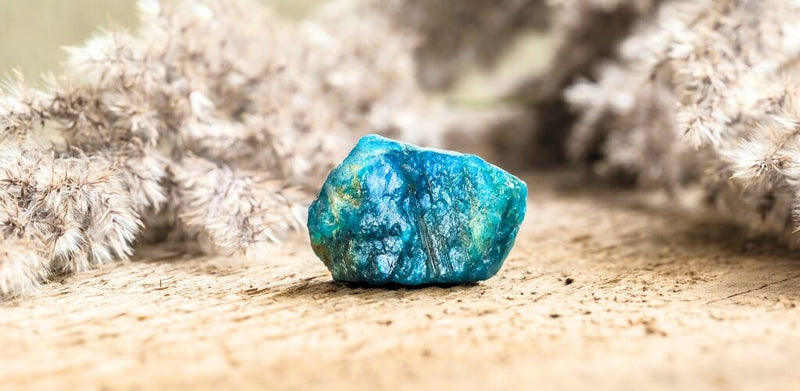
Sodalite is a rich royal blue mineral, usually threaded with white calcite veins, traditionally kept for clear thinking and honest speech. It is a throat chakra stone, often worn as a bracelet or kept on a desk. This guide covers its meaning, its geology, how people use it and how to care for it.
Key takeaways
- Sodalite is a deep blue feldspathoid, not a quartz, and the white marbling running through it is calcite.
- It is traditionally kept for clear thinking, level judgement and saying what you actually mean.
- Sodalite is a throat chakra stone, with a long secondary association with the third eye.
- It sits around 5.5 to 6 on the Mohs scale, softer than quartz, so it prefers a soft pouch to a bowl of loose tumbles.
- Desk, pocket, bracelet or pendant are the four placements people settle on most often.
- Keep it out of long soaks and prolonged direct sun, and keep small beads away from young children.
What sodalite means and why people keep it
Sodalite is long associated with clear thinking, honest speech and steady judgement. People reach for it when they have something difficult to say, a decision to weigh up, or a piece of work that needs a calm head. It carries the nickname the Poet's Stone, which points at the same idea from the writing side.
The thread running through all of that is the gap between what you think and what comes out of your mouth. Sodalite is traditionally kept as a reminder to close that gap: to work out what you actually believe first, then say it plainly. That is why it turns up so often on desks, in interview pockets and on the wrists of people who speak for a living.
It is also worn as a settling stone. Many people find that holding something cool and solid gives a racing mind somewhere to land before a meeting or a difficult conversation. The stone does not do the thinking, but it marks the moment you decide to slow down and do it properly.
In astrology, sodalite has a long association with Sagittarius, whose reputation for bluntness and truth-seeking lines up neatly with the stone's traditional character. It is often given as a zodiac stone for late November and December birthdays for exactly that reason.
What sodalite looks like, and where it comes from
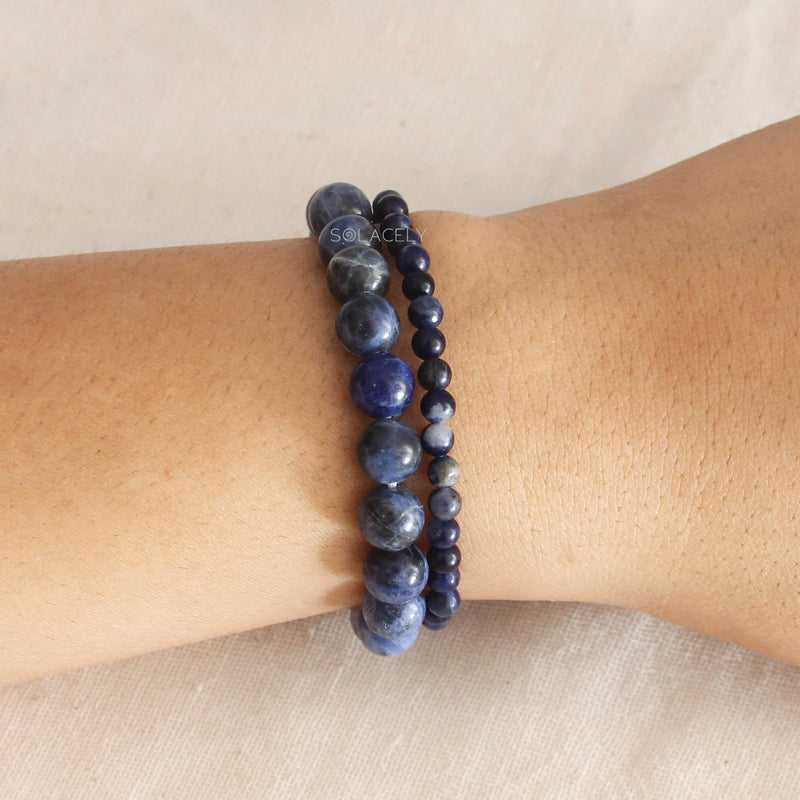
Sodalite is a sodium aluminium silicate that belongs to the feldspathoid group, and it forms in the cubic crystal system. Most of what you will see is massive rather than crystalline: solid royal blue material shot through with white calcite veining, with a waxy to glassy lustre when polished.
The blue ranges from a soft denim through to a deep, almost inky navy, and the amount of white varies enormously from piece to piece. Some stones are near solid blue, others look like a night sky with cloud drifting across them. Neither is better. Choose the pattern you actually want to look at every day, because that is the piece you will keep picking up.
It was first described in 1811 from material collected in Greenland, but the deposit that made its name was found in Ontario, Canada, in 1891. Princess Patricia of Connaught chose the Canadian stone for the interiors of Marlborough House in England, and the trade name Princess Blue stuck to that material for decades afterwards. Sodalite has been a decorative and architectural stone ever since, used for table tops, bookends and inlay as readily as for jewellery.
Today it is quarried in Brazil, Namibia, India, Russia, Afghanistan and Canada. One quirk worth knowing about: some sodalite fluoresces a warm orange under ultraviolet light, and a variety called hackmanite is tenebrescent, meaning it deepens in shade after sun exposure and drifts back again in the dark. It is a genuinely unusual optical behaviour for a stone this widely available.
Sodalite among the blue stones
Blue crystals are a crowded field, and sodalite has a distinct character within it. Where aquamarine is pale and clear and blue lace agate is soft and banded, sodalite is dense, saturated and opaque. It is the workhorse blue: the one people keep for thinking and speaking rather than for drifting.
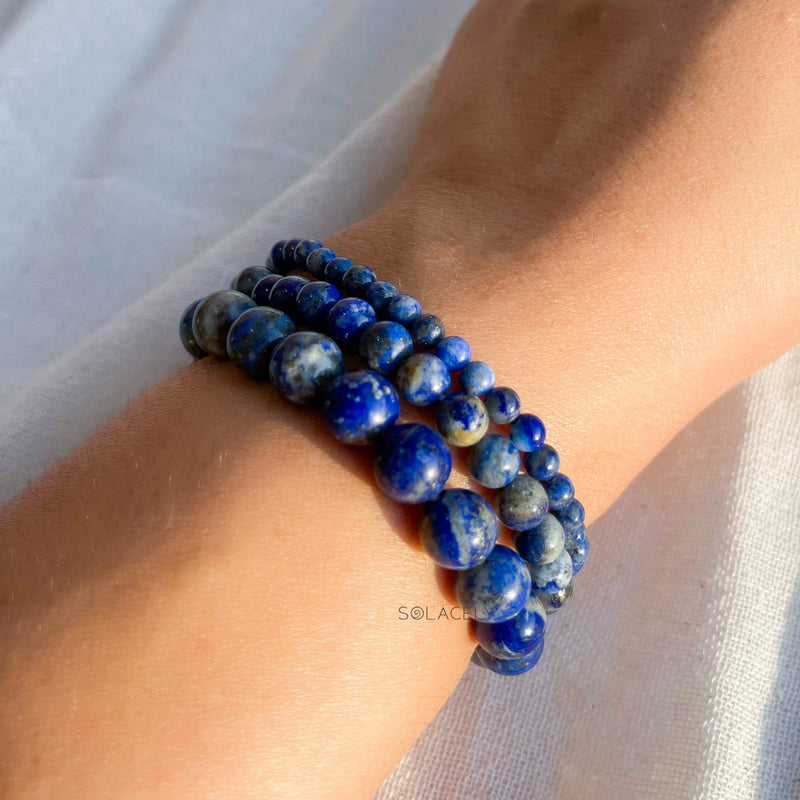
Sodalite and lapis lazuli are the two royal blues people most often weigh against each other, and they are worth thinking of as two different characters rather than two versions of the same thing. Lapis is a rock of several minerals with golden pyrite flecks and a scholarly, ceremonial reputation. Sodalite is a single mineral with white calcite marbling and a plainer, more everyday feel. Many people end up owning both and reaching for them in different moods, which is the sensible outcome. Our guide to lapis lazuli meaning and properties covers that stone in its own right.
| Stone | Look | Traditionally kept for | Mohs |
|---|---|---|---|
| Sodalite | Opaque royal blue with white calcite veining | Clear thinking, honest speech | 5.5 to 6 |
| Lapis lazuli | Deep blue rock flecked with golden pyrite | Study, reflection, self-knowledge | 5 to 6 |
| Blue apatite | Bright teal to sea blue, often translucent | Motivation and getting started | 5 |
| Blue lace agate | Pale blue with fine white banding | Gentle, unhurried speech | 6.5 to 7 |
| Aquamarine | Clear pale sea blue | Calm and quiet courage | 7.5 to 8 |
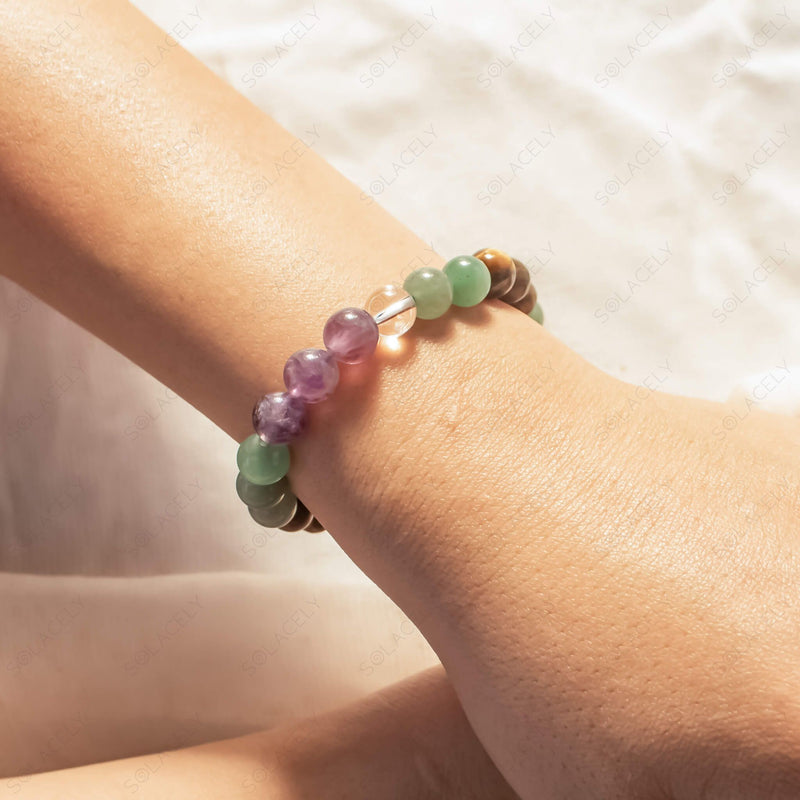
If the brighter, more energetic end of the blue range appeals more than sodalite's depth, the blue apatite guide is the natural next read. Sodalite also pairs well with purple stones, and amethyst and sodalite together is one of the more popular combinations for a bedside or desk set.
Sodalite and the throat chakra
Sodalite is first and foremost a throat chakra stone. The throat chakra, Vishuddha, governs communication and self-expression, and sodalite's blue puts it squarely in that family. It is traditionally worn at the throat as a pendant, or held during meditation, when someone wants to speak more clearly and more truthfully.
Its secondary association is with the third eye chakra, which sits between the eyebrows and is linked with insight and inner knowing. That pairing is part of what makes sodalite feel so useful: the third eye side is about working out what you think, and the throat side is about getting it said. The stone is traditionally kept for both halves of that job at once.
In practice, people place a tumble at the base of the throat while lying down, hold one in each hand during a short sitting, or simply wear a pendant through a day when they know a conversation is coming. If chakras are new to you, our beginner's guide to chakra stones lays out the seven centres and their stones, and there is a fuller list of options in our roundup of crystals for the throat chakra.
How to use sodalite day to day
Sodalite suits people who want a stone that works while they are working. The four placements that stick are the desk, the pocket, the wrist and the throat, and most people settle on one or two rather than trying all four. What matters is that the stone is somewhere you will see it at the moment you need the reminder.
- On the desk. A polished palm stone or a small tower beside the keyboard is the classic setup for study and focused work. It sits in your eyeline and gives your hands something to do while you think.
- As a bracelet. Beaded sodalite is the easiest way to keep the stone with you all day. Many people wear it on the receiving hand for a settling influence and switch sides depending on the intention they have set.
- As a pendant. Worn at the throat, it sits over the chakra it is most closely tied to, which is why pendants are the traditional choice for anyone who speaks, teaches or presents.
- In a pocket. A single tumble in a jacket pocket is the quietest option. You reach for it without anyone noticing, which makes it popular for interviews and appraisals.
- In meditation. Held in one hand or placed at the throat, sodalite is used as an anchor for a short sitting focused on what you want to say and how you want to say it.
- In shared spaces. A larger piece on a shelf in a meeting room or a family kitchen is traditionally kept as a marker for open, straightforward conversation.
A simple ritual, if you want one: hold the stone for a minute before the thing you are dreading, say the one sentence you most need to get across, then put it in your pocket and go. The point is the rehearsal, and the stone is the cue that starts it.
Caring for sodalite
Sodalite is more delicate than the quartz family, sitting around 5.5 to 6 on the Mohs scale, and the white calcite running through it is softer still at around 3. That combination means it scratches more readily than an amethyst or a clear quartz, so a soft pouch and a little separation from harder beads go a long way.
To clean it, wipe it with a soft damp cloth and dry it straight away. A brief rinse under cool running water is fine, but avoid long soaks, because the calcite veining does not enjoy prolonged water and salt water is best skipped altogether. Keep it away from ultrasonic cleaners and household chemicals, and keep it out of prolonged direct sunlight so the blue stays as deep as the day you bought it.
For energetic cleansing, the gentle methods all suit sodalite well. Moonlight on a windowsill overnight is the easiest and carries no risk to the stone. Sound from a singing bowl, a pass through incense or sage smoke, and a night resting on a selenite plate or an amethyst cluster are the other three most people use. Set your intention afterwards by holding the stone for a moment and naming what you want it kept for.
A few practical points worth keeping in mind:
- Never put stones in drinking water or a water bottle.
- Take a sodalite bracelet off before swimming, showering or washing up.
- Store it separately from quartz, topaz and other harder stones rather than loose in a shared bowl.
- Small tumbles, chips and beaded bracelets are a choking and strangulation risk, so keep them out of reach of babies and young children.
Crystals are kept as part of a personal ritual and are not a treatment for any medical condition. If you have a health concern, please speak to your doctor or another qualified professional, and carry on with any care that has already been arranged for you. Keep stones out of drinking water, and keep small tumbles, chips and beaded jewellery away from babies and young children, for whom they are a choking and strangulation risk.
Sources
Written by Chetena Sharma. Reviewed by the Solacely editorial team.
Frequently asked questions
About the author


Written by Chetna Sharma, crystal healing practitioner and co-founder of Solacely. Chetna has worked with healing crystals for over a decade and curates Solacely's protective stone collection.