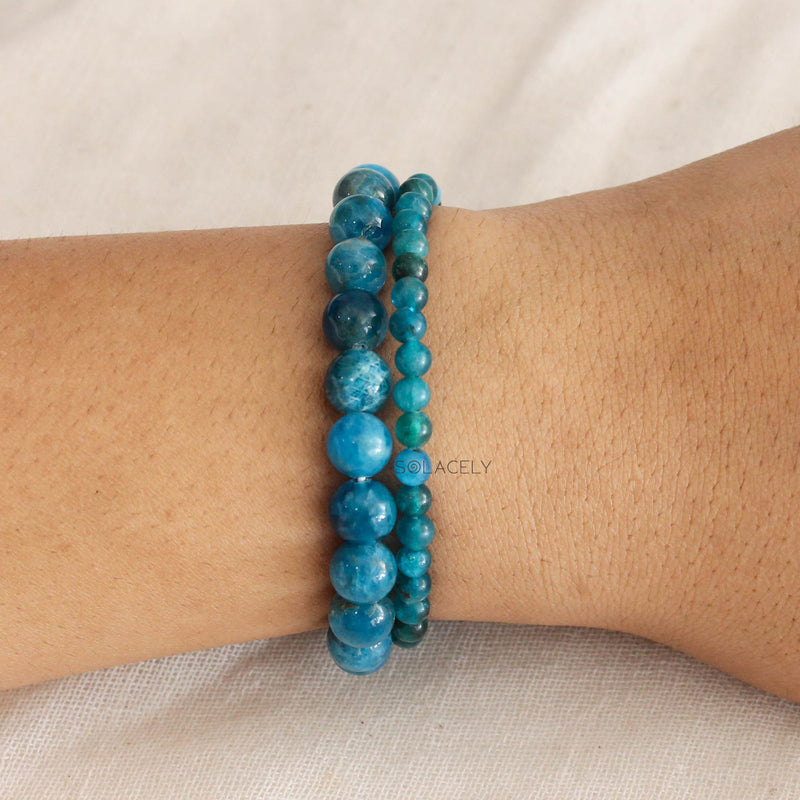
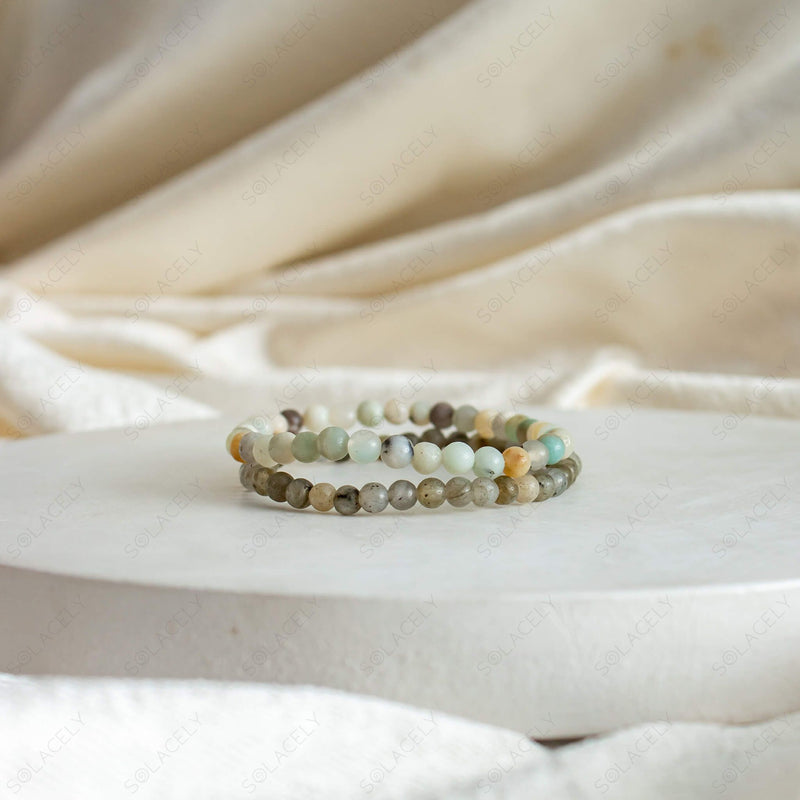
Blue apatite and labradorite are paired for periods of change. Apatite is traditionally the clarity stone, kept for working out what you actually want and then saying it. Labradorite is the transition stone, kept for the in-between times. Together they are held for moving through a shift with a clear head rather than drifting through it.
Key takeaways
- Blue apatite for clarity and motivation; labradorite for transition and change.
- Both sit in the upper half of the chakra system: throat, third eye and crown.
- Labradorite's flash is labradorescence, light bouncing between internal layers.
- Both are softer than quartz, so store them apart from the rest of a collection.
- Wipe rather than soak, and keep both out of ultrasonic cleaners.
Why these two are put together
Most stone pairings balance opposites. This one is a sequence instead. Labradorite is for the part where things are unsettled and you do not yet know the shape of what is coming. Apatite is for the part where you have to decide and then say so.
That makes it a natural set for a specific kind of period: leaving a job without a next one lined up, the months after a move, the end of a long relationship, or any stretch where the old structure has gone and the new one has not arrived. People reach for labradorite first and add apatite when it is time to act.
Both belong to the upper half of the chakra system, which is worth knowing. This is a pairing for the head rather than the body, and it works better alongside a grounding stone than on its own. Our root chakra guide covers what to add underneath it.
What labradorite is
Labradorite is a feldspar, and from most angles it looks like unremarkable grey stone. Turn it and it blazes: blue, gold, green, sometimes violet. Gemmologists call that labradorescence, and it comes from light bouncing between microscopic layers inside the crystal rather than from any pigment.
That optical fact is the whole reason for its traditional meaning. A stone that hides its colour until the angle is right became the stone of hidden things and of what emerges during change. Cutters have to orient a piece carefully to bring the flash out, which is why two labradorites of the same size can look completely different.
It sits around 6 to 6.5 on the Mohs scale and parts fairly readily along its internal planes, so it wants a little care.
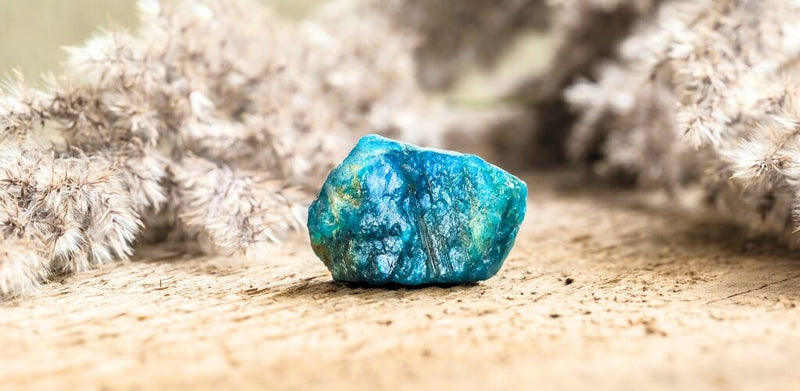
What blue apatite is
Apatite is a phosphate mineral, and the blue variety is the one kept in crystal practice. Its name comes from the Greek for deceit, given because apatite occurs in so many colours that it was repeatedly mistaken for other gems before modern identification.
Its most interesting geological note is closer to home than most minerals: apatite is the same family that makes up tooth enamel and bone. That is a genuine and rather pleasing fact about a stone people keep for clear thinking.
Traditionally it is kept for clarity and motivation, and specifically for the moment a decision has been circling too long. It sits at the throat and the third eye, covering both halves of the same act: working out what you think, then being willing to say it. Our blue apatite guide covers it in full.
How to work with the pair
| Arrangement | Suits |
|---|---|
| Labradorite worn, apatite on the desk | The everyday version; change carried, clarity for work |
| Both as pendants at the collarbone | Puts each near its traditional height |
| Apatite held before a conversation | When you know what to say and keep not saying it |
| Labradorite on a bedside table | Through a long unsettled stretch |
| Both placed in a session | Apatite at the throat, labradorite on the forehead |
For a session, lie down with apatite at the base of the throat and labradorite on the forehead, and give it ten to fifteen minutes with a longer exhale than inhale. Add a grounding stone at the feet if you tend to feel floaty after upper chakra work. Our crystals for meditation guide covers session structure.
Who this pairing suits
People mid change. Anyone who has left something and not yet arrived at the next thing, and anyone who knows a decision is due and keeps deferring it. It also suits people who find grounding stones too heavy and want something that moves.
It suits less well someone in acute distress rather than transition. Where the need is calm, amethyst and the other settling stones are the more direct answer, covered in crystals for focus and our anxiety guides. And it is not a confidence pairing as such: for nerve, our crystals for confidence selection is the better fit.
Where speaking is the specific difficulty, the wider blue set in crystals for the throat chakra is worth reading alongside this.
Caring for both
These are two of the softer stones in a typical collection, and they need handling accordingly.
Wipe both with a barely damp soft cloth and dry them fully. Avoid soaking, avoid ultrasonic cleaners and steam, and keep them away from harsh cleaning products.
Store them separately. Apatite at around 5 is softer than almost everything else people own, and a quartz bracelet in the same pouch will mark it within weeks. Labradorite parts readily along its internal planes, so it does not enjoy being dropped.
For energetic cleansing, sound, smoke, moonlight or a rest on selenite all suit them, and all avoid the water question. Monthly is comfortable for pieces that are worn occasionally rather than daily.
Crystals are offered here for reflection and wellbeing as part of a long standing tradition. They are not a treatment for any medical condition and are not a substitute for professional healthcare or advice.
Sources
Written by Chetena Sharma. Reviewed by the Solacely editorial team.
Frequently asked questions
About the author


Written by Chetna Sharma, crystal healing practitioner and co-founder of Solacely. Chetna has worked with healing crystals for over a decade and curates Solacely's protective stone collection.