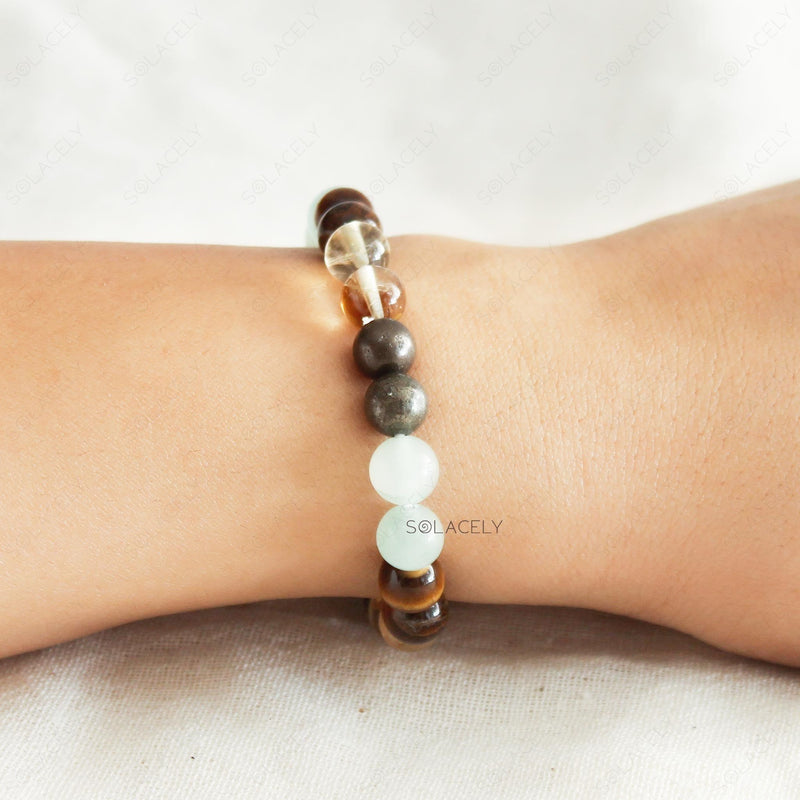
A money attracting bracelet is a beaded bracelet strung from the stones traditionally kept for abundance and confident earning, most often citrine, pyrite, green aventurine, tiger's eye and clear quartz. Most are 8mm rounds on elastic, worn on the left wrist and treated as a daily reminder of what you are working toward.
Key takeaways
- The classic five are citrine, pyrite, green aventurine, tiger's eye and clear quartz, and four of the five are quartz family stones at 7 on the Mohs scale.
- Citrine is the yellow to orange variety of quartz, SiO2, coloured by traces of iron, and it carries the old trade nickname of the merchant's stone.
- Pyrite is iron sulphide, FeS2, at 6 to 6.5 on the Mohs scale, with a specific gravity near five that gives the strand real weight. If pyrite is the stone calling to you, our genuine pyrite bracelet comes in 4mm, 6mm and 8mm, cleansed by singing bowl before it reaches you.
- Green aventurine owes its soft internal glitter to tiny platelets of fuchsite mica, an effect called aventurescence.
- The left wrist is the traditional side for anything you are drawing in, including a carved Pixiu, which is worn with its head facing outward.
- Care is the one rule with no flexibility: pyrite contains iron, so the bracelet stays dry, is never salt cleansed and is never soaked.
What is a money attracting bracelet?
A money attracting bracelet is a strand of beads chosen around a single theme: abundance, ambition and confident earning. The usual line up is citrine, pyrite, green aventurine, tiger's eye and clear quartz. Four of those five belong to the quartz family and sit at 7 on the Mohs scale, so they wear well.
The format is deliberately plain. Most are 8mm round beads on elastic cord, sized to slip over the hand, sometimes with one carved feature bead or a metal spacer. Some strands use a single stone. Others mix three or five.
What makes it a money bracelet is the selection rather than the construction. Every stone on the strand has a long association with some part of earning: optimism, nerve, opportunity, follow through. Worn together they act as one daily cue, which is the reason for putting them on your wrist rather than a shelf.
People reach for one at the start of something: a new role, a first invoice, a business that has stopped feeling small. Our guide to crystals for prosperity covers the wider family of stones chosen for that kind of season.
Which crystals go into a money attracting bracelet?
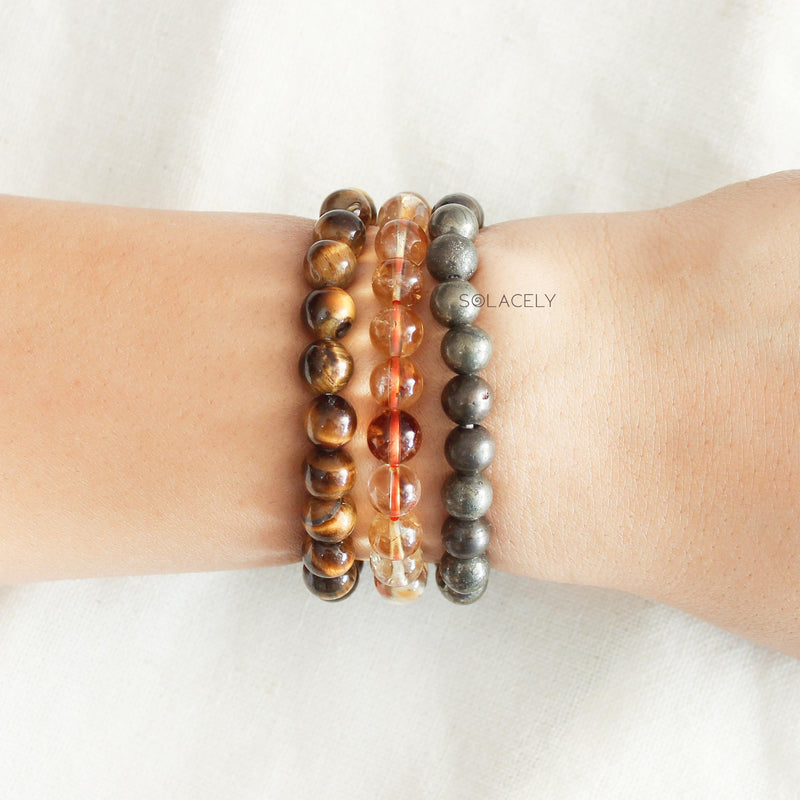
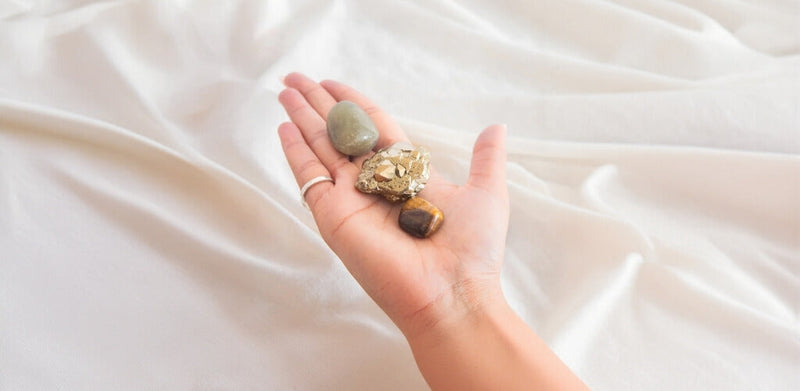
Citrine, pyrite, green aventurine, tiger's eye and clear quartz make up the standard five. Citrine brings the optimism, pyrite the drive, green aventurine the openness to opportunity, tiger's eye the nerve and clear quartz the clarity. Each has a long, separate history behind its place on the strand.
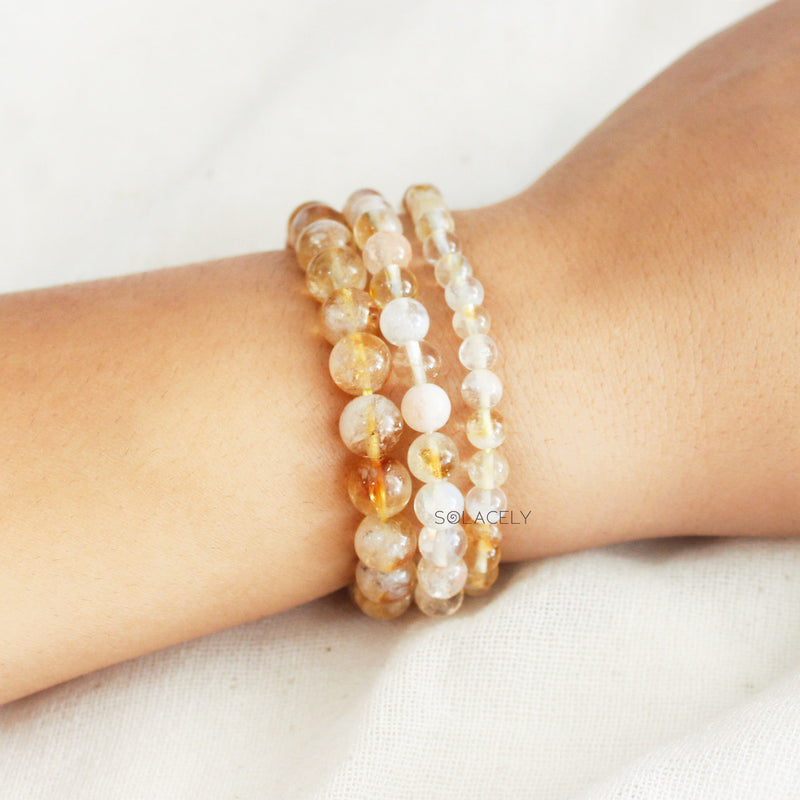
Citrine is the yellow to orange variety of quartz, silicon dioxide coloured by traces of iron, and it sits at 7 on the Mohs scale. Long called the merchant's stone, it is traditionally kept for optimism, self worth and the confidence to name your rate. Our guide to citrine's meaning, benefits and properties has the full history.
Pyrite is the metal in the mix. It is iron sulphide, FeS2, brass yellow and brightly metallic, 6 to 6.5 on the Mohs scale, with a specific gravity near five that makes even a small bead feel heavy. It is traditionally kept for ambition and follow through, and it sits with the solar plexus, the centre linked with personal power.
Green aventurine is quartz shot through with tiny platelets of fuchsite, a chromium rich mica that gives it a soft internal glitter called aventurescence. It is also 7 on the Mohs scale. Long known as a stone of opportunity, it is kept for luck and for saying yes to a chance that arrives at an awkward moment, as our guide to green aventurine meaning, benefits and properties explains.
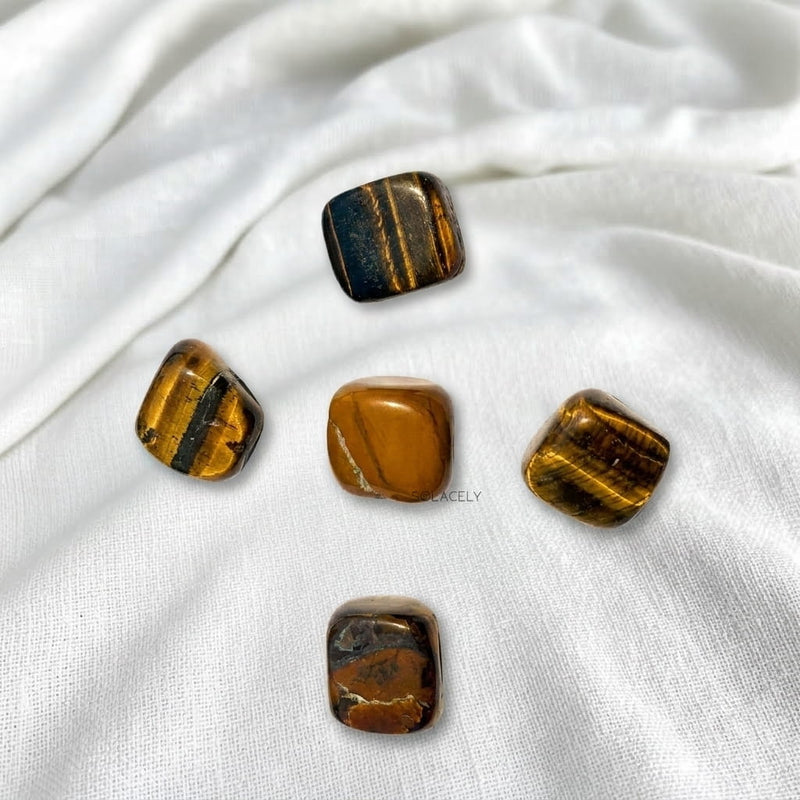
Tiger's eye is quartz with a fibrous structure that throws a moving band of light across the surface, an effect called chatoyancy. It is also 7 on the Mohs scale, golden brown to honey coloured. Traditionally kept for nerve and clear headed decisions, it turns up on almost every strand aimed at work.
Clear quartz does the quiet job. Pure silicon dioxide, 7 on the Mohs scale, colourless and transparent. In crystal tradition it is the amplifier, the bead that holds the intention of the whole strand and keeps it in view between the coloured stones.
| Stone | What it is | Mohs | Traditionally kept for |
|---|---|---|---|
| Citrine | Yellow to orange quartz, SiO2 | 7 | Optimism, self worth, confident earning |
| Pyrite | Iron sulphide, FeS2 | 6 to 6.5 | Ambition, drive, follow through |
| Green aventurine | Quartz with fuchsite platelets | 7 | Opportunity, luck, new chances |
| Tiger's eye | Fibrous chatoyant quartz | 7 | Nerve, focus, steady decisions |
| Clear quartz | Pure quartz, SiO2 | 7 | Clarity, holding the intention |
Once you know which crystals align with your intention for wealth and abundance, you can choose the stones that feel most relevant to you. A customised crystal bracelet can bring together the crystals you connect with most, creating a more personal combination for your intention.
How does the Pixiu bracelet fit in?
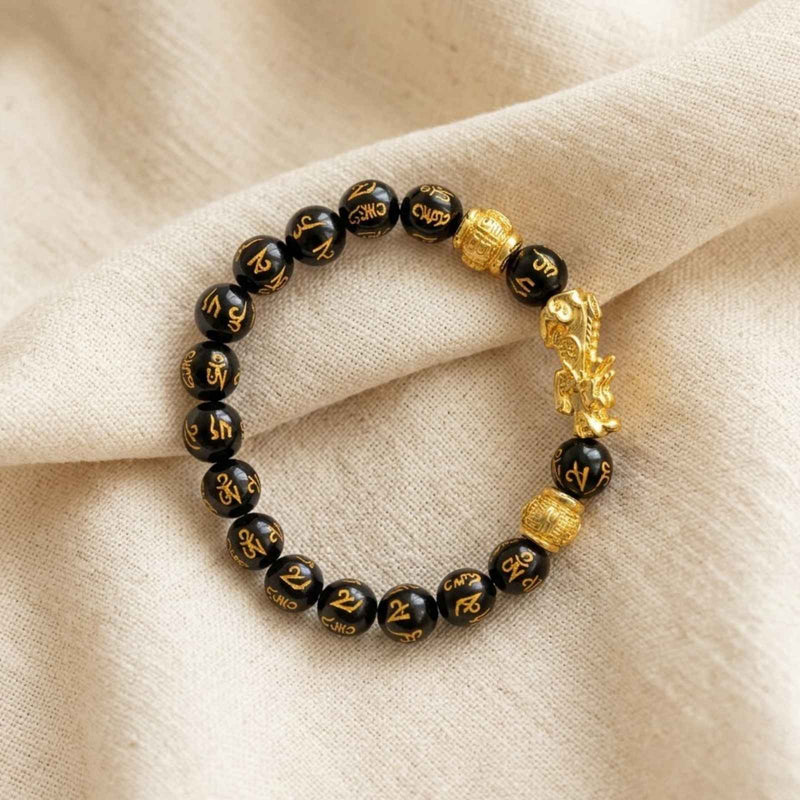
The Pixiu bracelet is the feng shui version of the money bracelet. It pairs a strand of beads, most often black obsidian, with a single carved Pixiu, a winged guardian creature in Chinese tradition said to draw wealth in and hold on to it. It is worn on the left wrist with the head facing outward.
The carving is the point of difference. Pixiu appears in Chinese decorative tradition as a fierce, winged, lion like guardian, and the old stories describe it as taking wealth in and never letting it back out. That is why it is set facing away from the body, with the head pointing toward your fingertips and the world beyond, so it can gather.
Obsidian is the usual base, though jade, agate and tiger's eye strands are common too. The etiquette is more specific than most bracelets: wearers keep it on the left, avoid letting other people handle it, and take it off before bathing. Our step by step on how to activate your feng shui Pixiu bracelet walks through the sequence.
Which wrist should you wear it on?
The left. In the tradition most bracelet guidance follows, the left side is the receiving side and the right is the giving side, so anything worn to draw something in goes on the left wrist. That includes citrine, pyrite and green aventurine strands, and it includes the carved Pixiu.
The right wrist has its own logic. Stones worn to send energy outward or to hold a boundary, black tourmaline and obsidian among them, are traditionally worn on the right. Plenty of people wear a money strand on the left and a protective strand on the right, which keeps both conventions intact.
There is a practical argument for the left as well, at least for right handed wearers. The non dominant wrist meets fewer desk edges, door frames and keyboards, so the beads take less punishment and the elastic lasts longer. Our guide to which hand to wear your crystal bracelet on covers the exceptions stone by stone.
How do you activate and cleanse a money bracelet?
Activating means naming what the bracelet is for. Cleansing means resetting it. With pyrite on the strand, both have to be done dry. Sound, incense or herb smoke, a short spell of indirect moonlight and a dry selenite plate all suit it. Salt bowls and water soaks do not.
- Cleanse the new bracelet before you wear it, with sound or with smoke.
- Hold it in both hands and say, out loud or silently, what you are working toward. Keep it concrete: the project, the role, the number of clients.
- Fasten it on the left wrist and wear it for a full week, so putting it on becomes part of the morning.
- Repeat the cleansing weekly, or after any stretch that has felt heavy.
Some people add a charging step on a windowsill. Indirect moonlight is safe for the whole strand. Direct midday sun is not, since prolonged sunlight can pale citrine over time and a warm sill is unkind to elastic cord. An hour of early light is plenty.
How do you care for a money bracelet day to day?
Keep it dry, and take it off before water. Pyrite is an iron sulphide, so moisture and air together can leave surface rust, dulling or orange staining on the beads. That single rule covers most of what can go wrong: no soaking, no salt cleansing, no showers, no swimming.
Perfume, lotion, hairspray and hand sanitiser go on first and the bracelet goes on last. Elastic cord absorbs whatever it meets, and residue dulls polished beads over time. Cleaning is a dry job: a soft cloth over the beads, and a soft brush for the gaps between them.
Store it flat in a pouch or a lined box, away from a sunny windowsill and away from a radiator, and keep it apart from softer stones so nothing gets scratched. In a humid climate a sachet of silica gel in the box helps, and the pyrite benefits most of all.
Elastic is a consumable. A bracelet worn daily usually wants restringing after a year or so, and the sign is cord showing between the beads when you stretch it. Take the bracelet off for the gym, for gardening and for heavy lifting. Keep loose beads away from young children and pets, as they are a choking hazard.
This article is shared for general interest and reflects long standing crystal tradition. It is not financial advice. A crystal bracelet is a personal practice rather than a substitute for earning, saving, budgeting or guidance from a qualified financial professional, and nothing here is a promise of income or returns. Crystals are also not a treatment for any physical or mental health condition, and they should never replace or delay care from a qualified practitioner. Keep small beads, stones and tumbles away from young children and pets, as they are a choking hazard. Never place pyrite or any mineral in drinking water, and do not use stones to make elixirs. If you have a health or financial concern, please speak to a qualified professional.
Sources
- GIA, Citrine: description and gemmological properties
- Geology.com, Pyrite: mineral properties, uses and occurrence
Written by Chetena Sharma. Reviewed by the Solacely editorial team.
Frequently asked questions
About the author


Written by Chetna Sharma, crystal healing practitioner and co-founder of Solacely. Chetna has worked with healing crystals for over a decade and curates Solacely's protective stone collection.