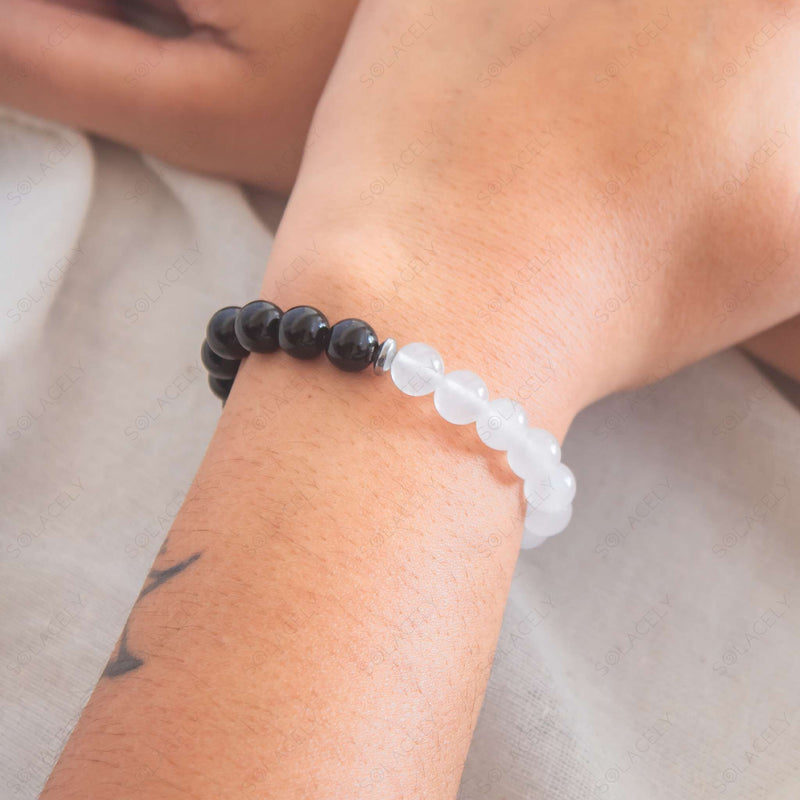
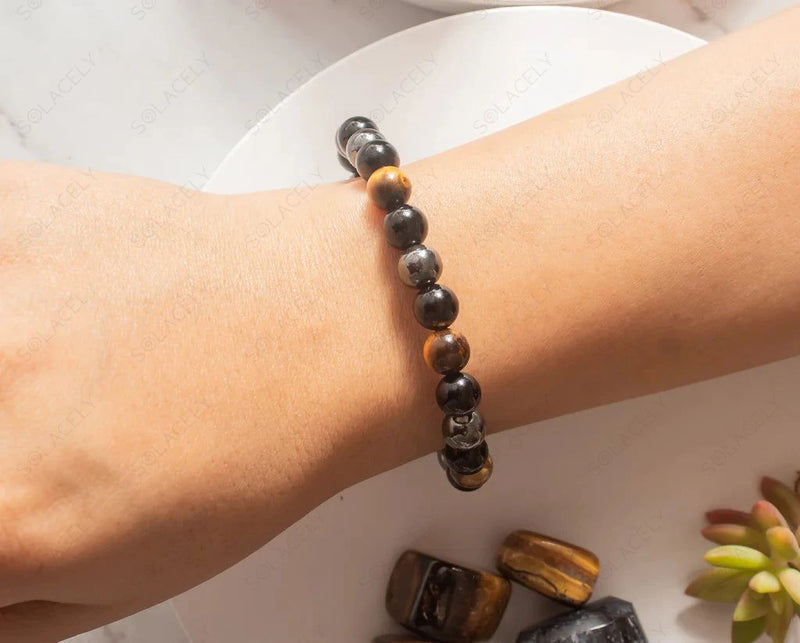
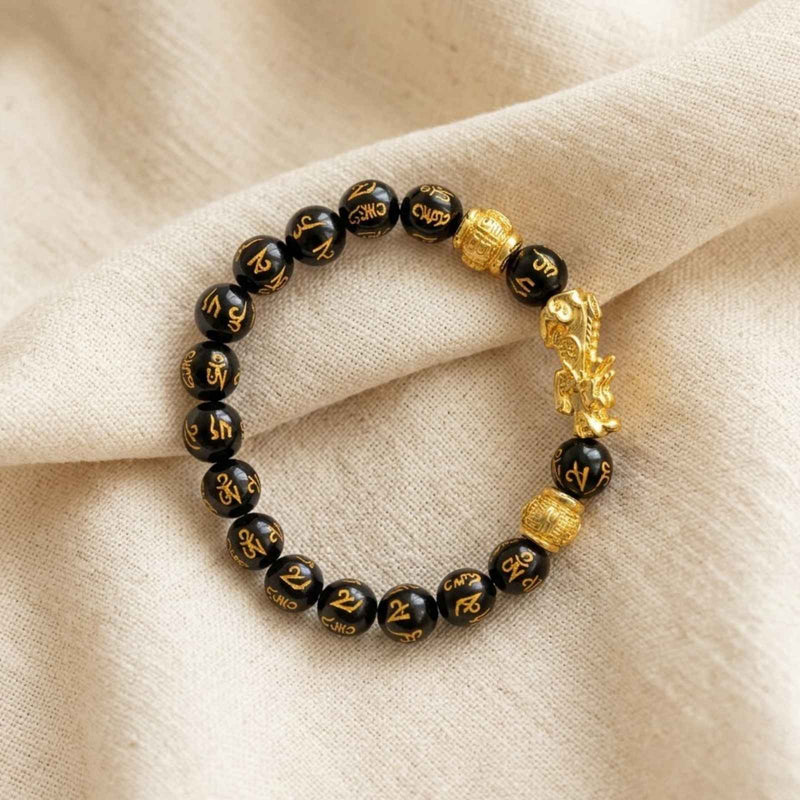
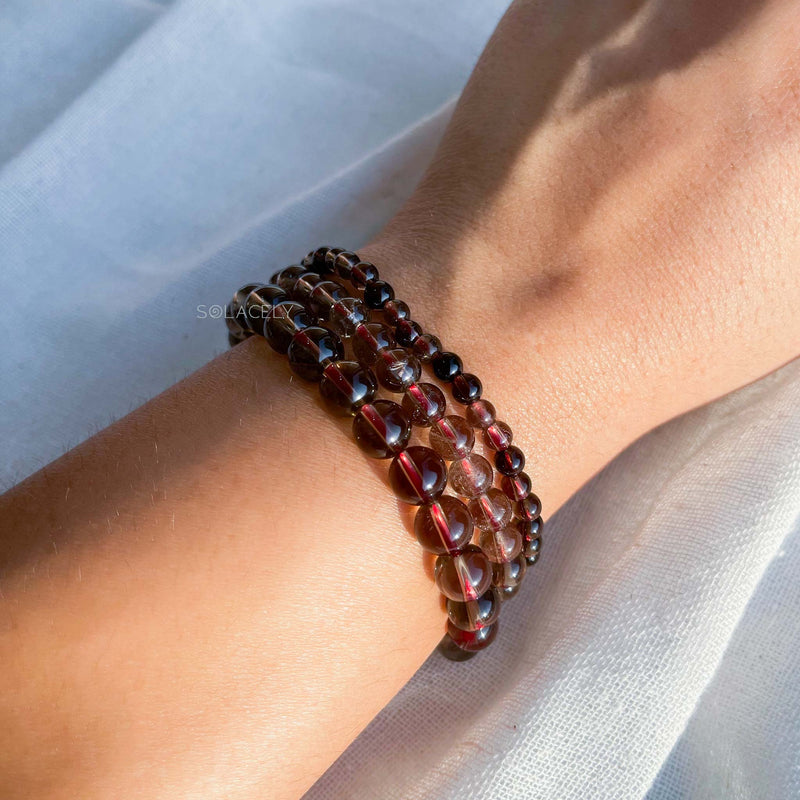
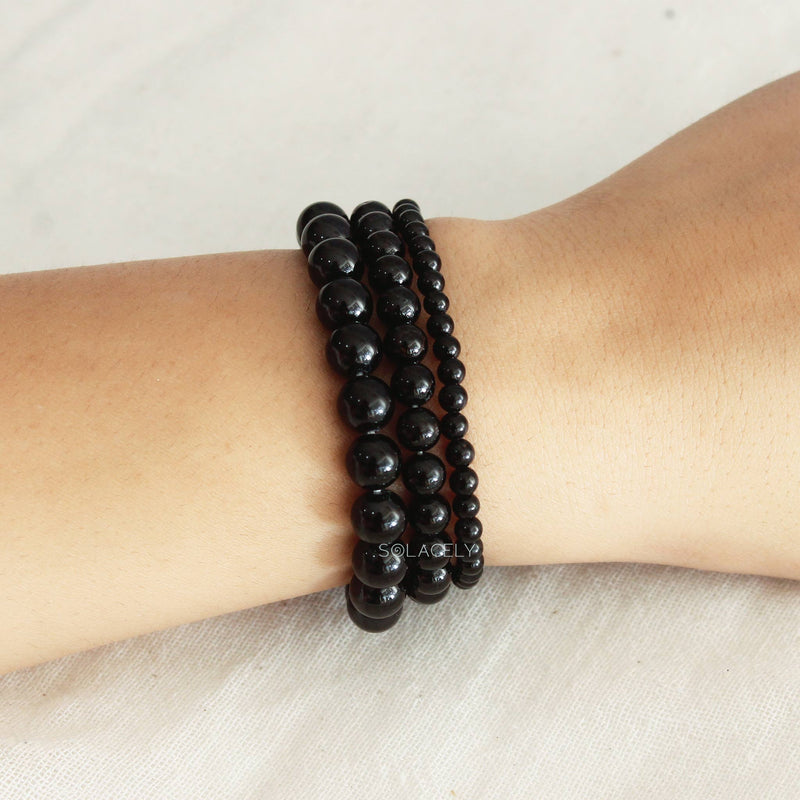
Wear a black obsidian bracelet on your right wrist. Obsidian is a projecting stone, kept for deflecting what you do not want and for seeing a situation without flinching, and the right is the outward facing side. The left is the considered exception, chosen when the work is inward.
Key takeaways
- Right wrist for the usual intention: deflecting, and facing what needs facing.
- Left wrist when you are using it as a mirror rather than a shield.
- Many people wear it for particular days rather than continuously.
- It is volcanic glass at Mohs 5 to 5.5. It chips into sharp edges if dropped.
- Black tourmaline covers the same intention more quietly, if obsidian feels too direct.
Why the right wrist
Crystal practice reads the left as the receiving side and the right as the projecting side. Anything meant to be drawn in goes left. Anything meant to be sent out, deflected or held at a distance goes right.
Black obsidian sits firmly on the right. Its tradition is about what does not reach you: the difficult household, the colleague whose mood fills a room, the situation you have to walk into knowing how it will go. That is outward work, so the right wrist matches the intention.
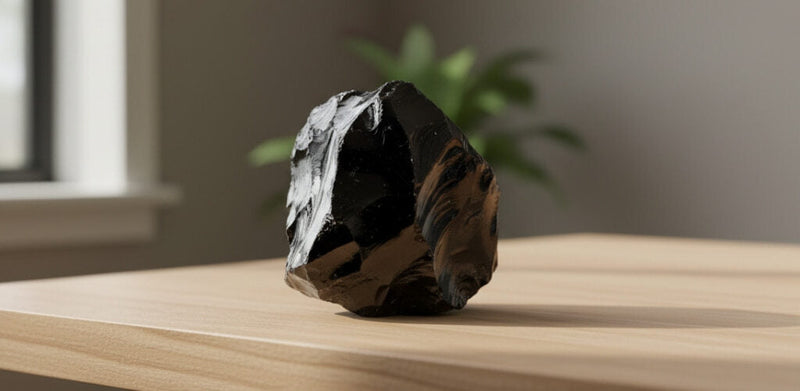
Obsidian is also volcanic glass, formed when lava cools too fast for crystals to grow, which is why it takes such a sharp edge and such a deep polish. Cultures across the world worked it into blades and mirrors long before it was worn as jewellery, and both of those uses are still legible in what it is kept for now.
When to wear it on the left
There is a genuine second placement here, and it follows from the mirror rather than the blade.
Obsidian is the traditional stone for looking at yourself honestly, at the parts of a situation you have been managing not to notice. That is inward work, and people doing it deliberately often move the bracelet to the left so the clarity arrives rather than deflects.
The test is simple. If you bought the stone because of somebody else, wear it on the right. If you bought it because of something you know you have been avoiding, the left makes more sense.
Once you know which wrist feels right for wearing Black Obsidian, you can also choose a bracelet style that reflects your personal preferences and intentions. A custom crystal bracelet gives you the flexibility to bring together the stones and design details that feel right for you.
Wearing it some days and not others
Obsidian has a reputation for being direct, and that is worth taking at face value rather than as a warning.
Plenty of people who wear rose quartz or amethyst continuously keep obsidian for specific days: the difficult meeting, the family visit, the conversation that has been postponed twice. Used that way it stays meaningful, because putting it on is itself a decision rather than a habit.
If you want the same protective intention in something you can wear every day without thinking about it, black tourmaline is the gentler choice and is also harder, so it survives daily wear better. We compare the two directly in black obsidian vs black tourmaline.
What to wear with it on the same wrist
| Partner stone | Mohs | What it adds |
|---|---|---|
| Clear quartz | 7 | Keeps the practice open as well as closed |
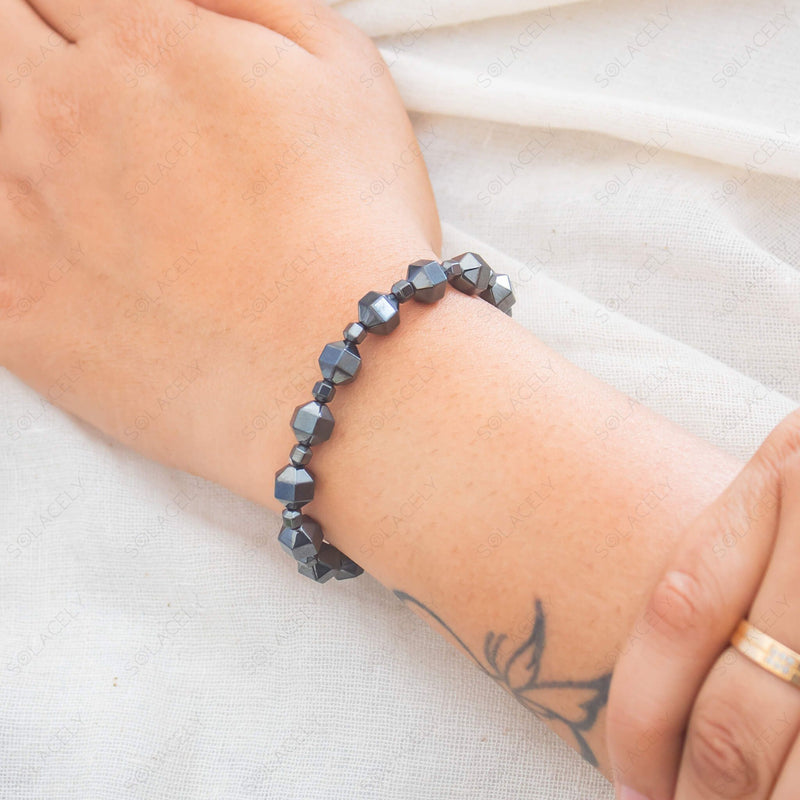
| Hematite | 5 to 6.5 | Grounding, and a close hardness match |
| Black tourmaline | 7 to 7.5 | A steadier boundary alongside the sharper one |
| Smoky quartz | 7 | Settling what has already built up |
Hematite is the best physical match at 5 to 6.5 against obsidian's 5 to 5.5, so the two wear down at a similar rate. Quartz partners at 7 are harder and will gradually scuff the obsidian beads where they meet, which is worth knowing rather than avoiding entirely.
Looking after it
Obsidian is non porous and water is perfectly safe, so warm soapy water and a soft cloth cover everyday cleaning, and water, sound, smoke and moonlight are all fine for cleansing.
The care that matters is physical. This is glass. It has conchoidal fracture, which means it breaks in curved flakes with genuinely sharp edges, so a bracelet dropped on a tiled bathroom floor can chip and leave something sharp behind. Keep it away from ultrasonic cleaners and sudden temperature changes for the same reason.
As with any beaded bracelet, take it off for the shower and the gym so the elastic lasts.
Where to go next
For the rule applied across every stone, see our pillar guide to which hand to wear your crystal bracelet. For what the stone is and what it is kept for, see black obsidian meaning, properties and benefits.
The uses described here reflect traditional and cultural crystal practice. They are not medical claims and are not a substitute for professional healthcare or advice.
Sources
Written by Chetena Sharma. Reviewed by the Solacely editorial team.
Frequently asked questions
About the author


Written by Chetna Sharma, crystal healing practitioner and co-founder of Solacely. Chetna has worked with healing crystals for over a decade and curates Solacely's protective stone collection.