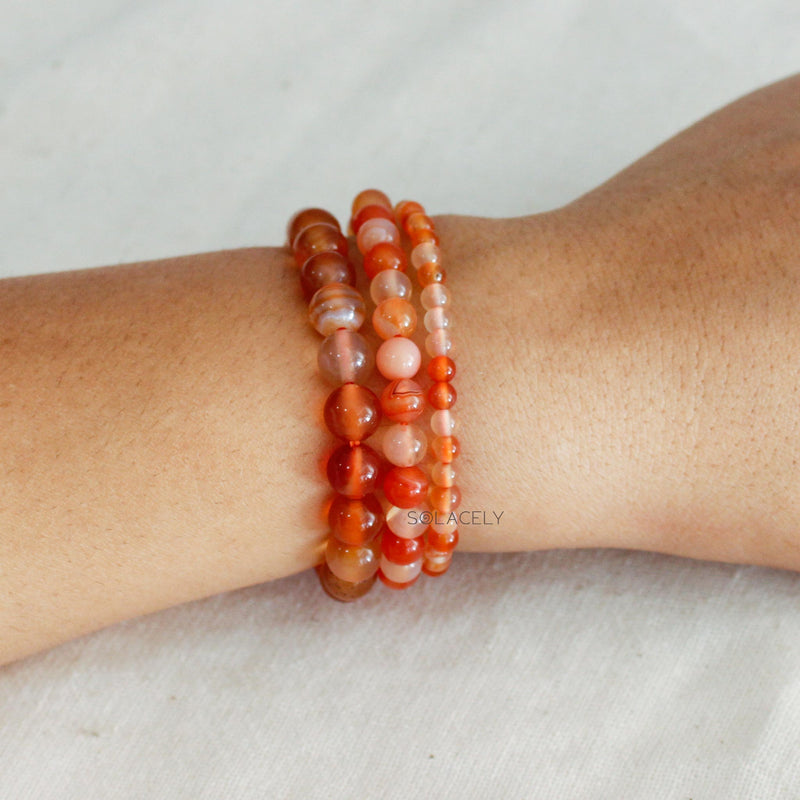
Carnelian is the orange to red variety of chalcedony, a microcrystalline quartz coloured by iron oxide, sitting at 6.5 to 7 on the Mohs scale. In crystal tradition it is the motivation stone, kept at the sacral chakra for creative work and for getting started again after a stalled patch.
Key takeaways
- Carnelian is chalcedony, a quartz family stone, coloured by iron oxide.
- Mohs 6.5 to 7 with no cleavage, which makes it genuinely hard wearing.
- Chakra: the sacral, associated with creativity, appetite and drive.
- Traditionally kept for motivation and momentum rather than calm.
- One of the oldest ornamental stones, cut for seal rings because hot wax will not stick to it.
- India and Brazil are the main sources today.
What carnelian is
Carnelian belongs to the chalcedony family, which is quartz built from crystals too small to see individually. That microcrystalline structure is why chalcedony stones are translucent and waxy rather than glassy, and why they take such a smooth polish.
The colour comes from iron oxide distributed through the stone, running from pale apricot through bright orange to a deep brick red. Where the colour bands rather than sits evenly, the stone shades into sard or agate, and the boundaries between those names are more a matter of trade convention than sharp mineralogy.
| Mineral | Chalcedony, a microcrystalline quartz |
|---|---|
| Colour | Pale apricot to deep brick red |
| Colour cause | Iron oxide |
| Mohs hardness | 6.5 to 7 |
| Cleavage | None |
| Chakra | Sacral |
| Main sources | India, Brazil, Uruguay, Madagascar |
A very old stone
Carnelian has one of the longest continuous records of any ornamental stone. It was cut for seal rings and signet stones across the ancient world, and the reason is beautifully practical: hot wax does not stick to carnelian, so a signet pressed into a seal lifts away cleanly every time.
It appears in Egyptian jewellery and amulets, in Mesopotamian cylinder seals, and in Roman intaglios. That is several thousand years of continuous use, which gives carnelian a pedigree very few crystals can claim.
Carnelian meaning and the sacral chakra
Carnelian sits at the sacral chakra, low in the abdomen, which tradition links to creativity, appetite, pleasure and drive. That placement explains the whole shape of what carnelian is kept for.
It is the stone of starting. People reach for it when a project has stalled, when the work is creative and the well feels dry, or when the problem is momentum rather than direction. It is warm and activating, and it has no tradition as a calming or contemplative stone.
A second, older strand associates carnelian with courage, from its long use as a warrior's stone in the ancient world. That reading survives in modern practice as confidence for doing rather than confidence for speaking.
How to use carnelian
- On a desk or workbench. The classic placement for creative work, in your sightline while you work.
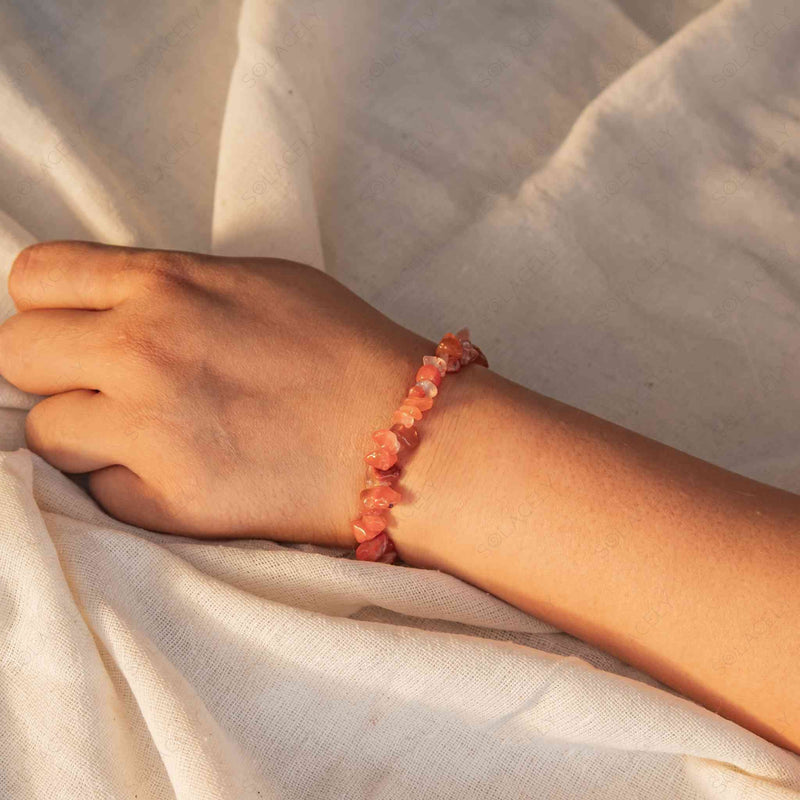
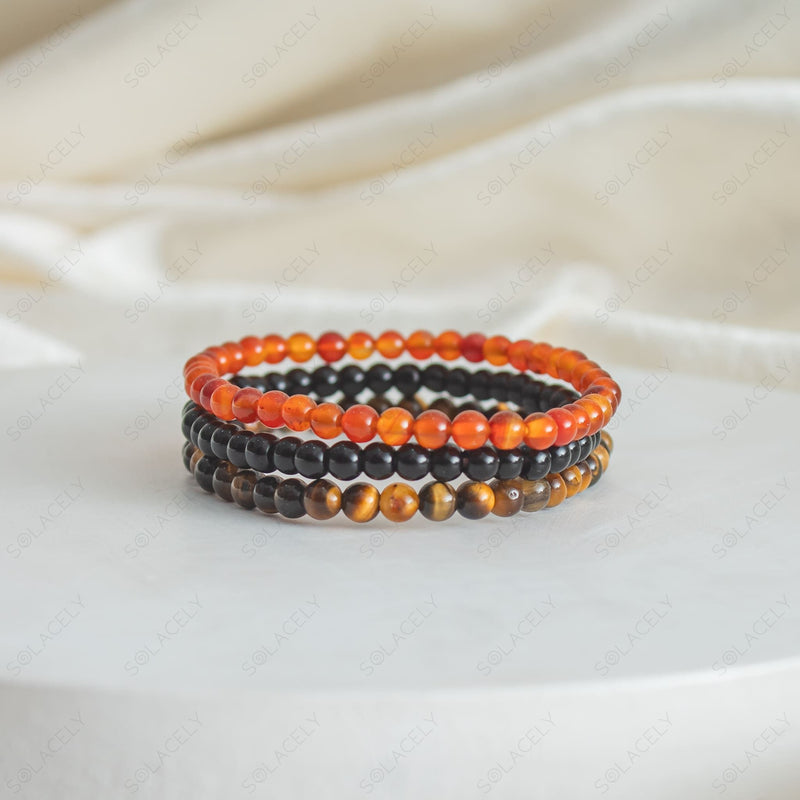
- Worn as a bracelet. Hard wearing enough for every day, and warm against most skin tones.
- At the sacral chakra. Placed low on the abdomen during a short lying down practice.
- Carried when restarting. Kept in a pocket through the first fortnight of something new.
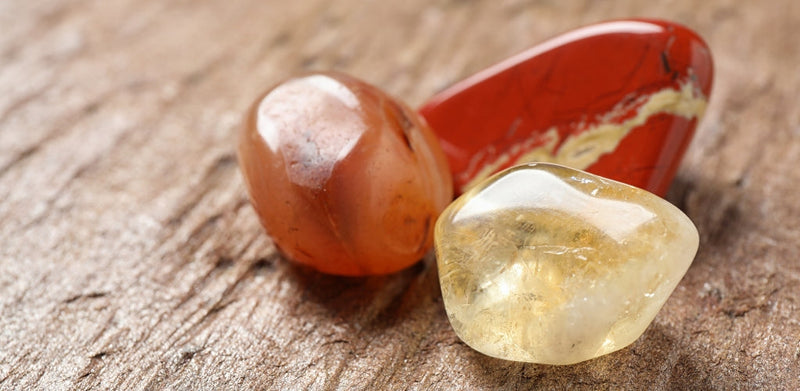
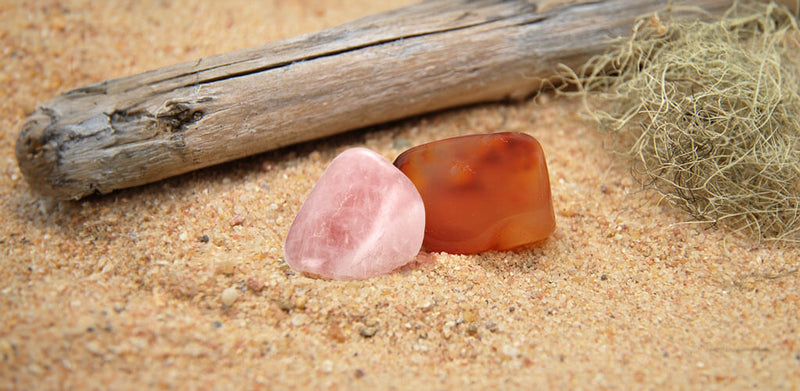
Pairings follow the same logic. Citrine reinforces the warmth and adds the self worth theme, covered in citrine and carnelian. Rose quartz softens it when the creative block is emotional rather than practical, which we cover in rose quartz and carnelian.
Choosing and caring for carnelian
Look for even colour and a good translucence: hold the stone up and a decent carnelian glows rather than sitting flat. Banding is not a fault, but a piece where the colour pools at one end will always read as two stones.
Care is easy. Warm soapy water and a soft cloth, and at 6.5 to 7 with no cleavage it takes daily wear without complaint. The one caution is prolonged strong sunlight, which can soften the orange over long periods, so keep it off a bright sill.
Who carnelian suits
It suits someone with the idea already and the trouble in the starting. Freelancers between projects. Anyone returning to creative work after a long gap. People who describe themselves as flat rather than anxious.
It suits less well someone who is overstimulated and wants quiet, since carnelian points the other way entirely. For that, see crystals for calming. For the wider sacral set, see crystals for the sacral chakra, and for creative work specifically, crystals for creativity and art.
The uses described here reflect traditional and cultural crystal practice. They are not medical claims and are not a substitute for professional healthcare or advice.
Sources
Written by Chetena Sharma. Reviewed by the Solacely editorial team.
Frequently asked questions
About the author


Written by Chetna Sharma, crystal healing practitioner and co-founder of Solacely. Chetna has worked with healing crystals for over a decade and curates Solacely's protective stone collection.