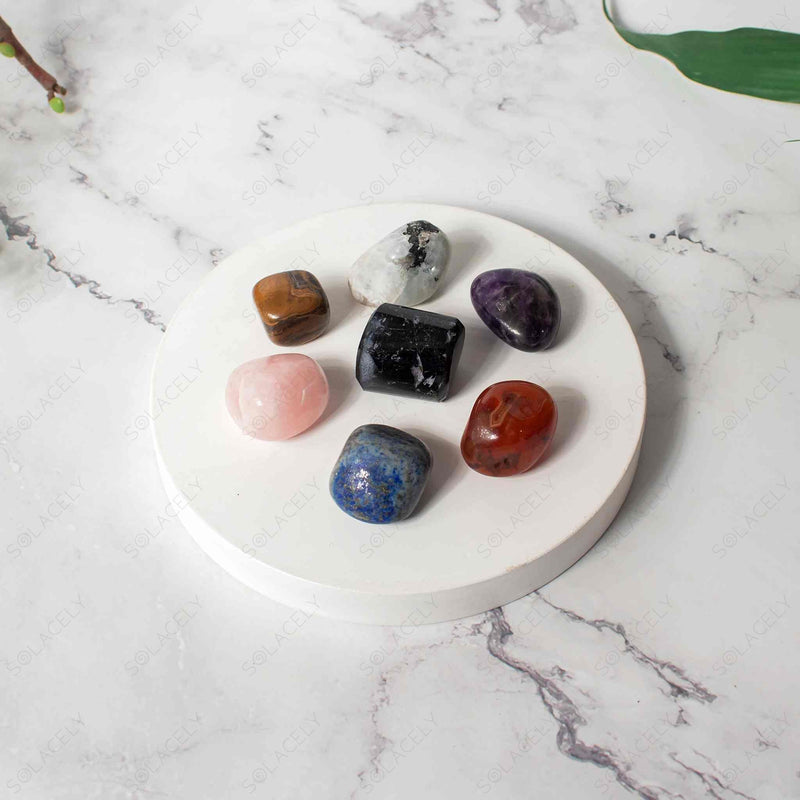
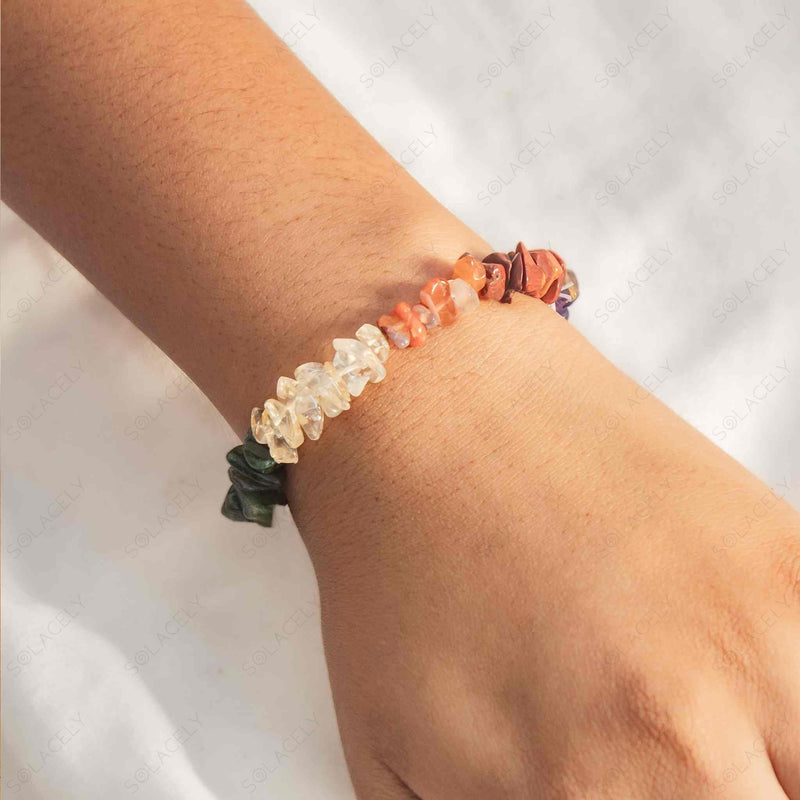
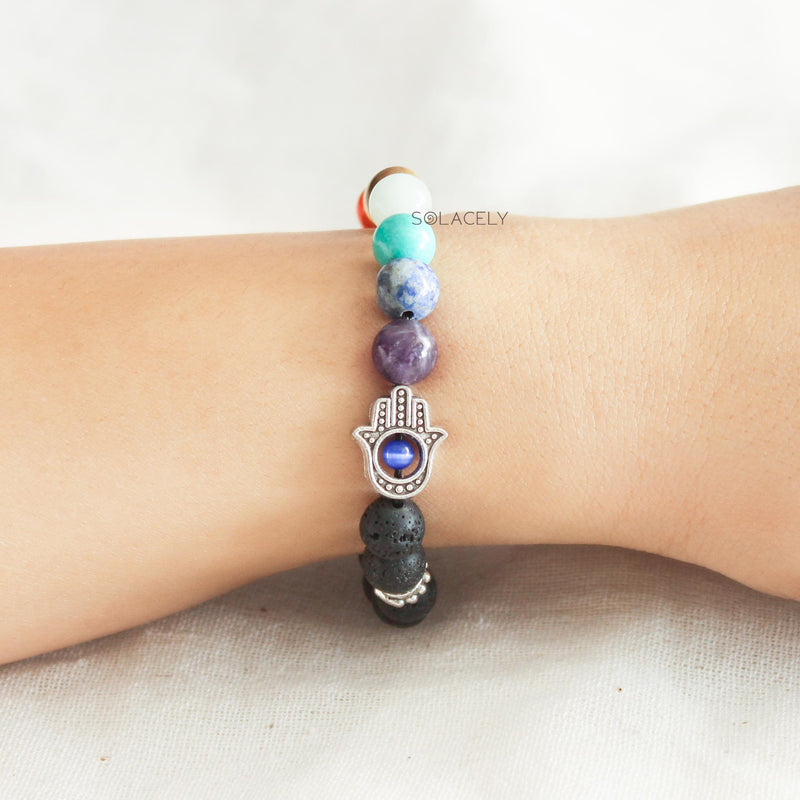
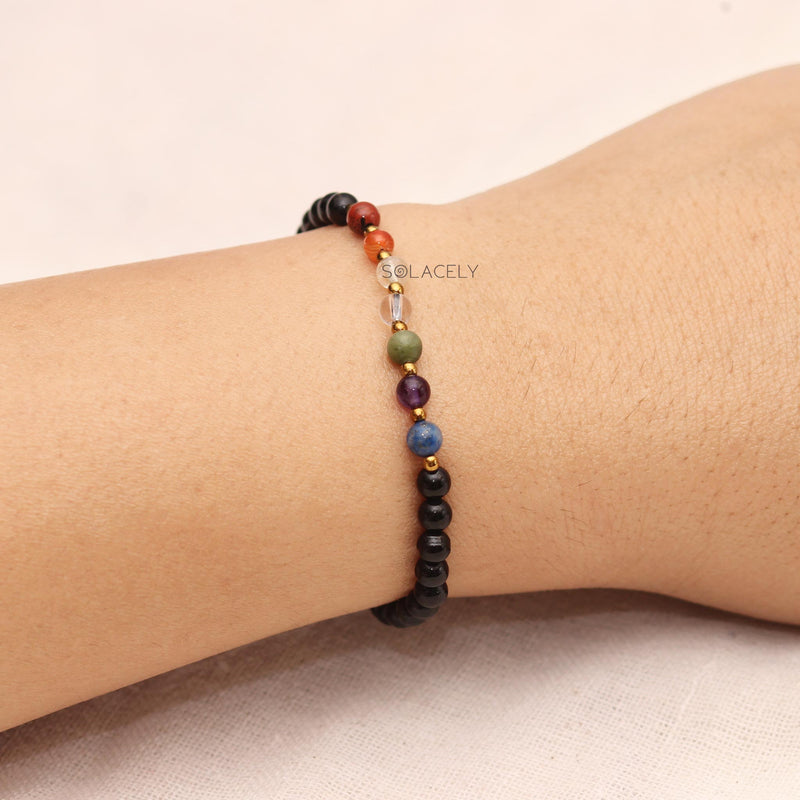
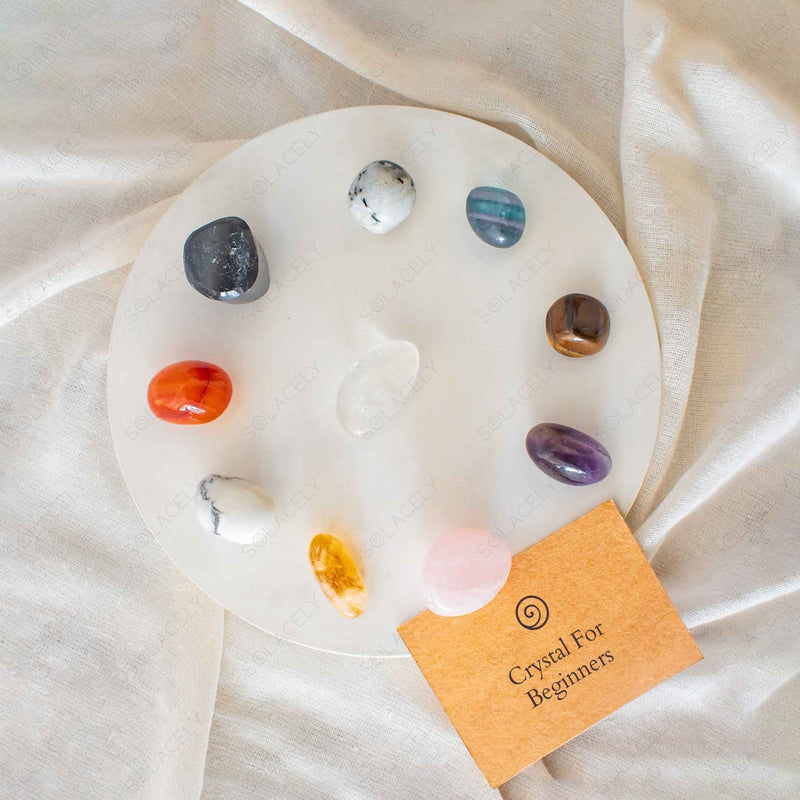
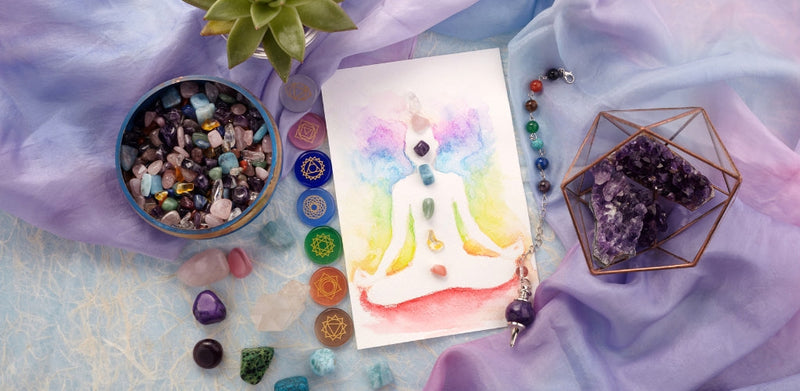
Chakra stones follow a colour sequence: red jasper at the root, carnelian at the sacral, citrine at the solar plexus, green aventurine or rose quartz at the heart, blue lace agate at the throat, amethyst at the third eye, and clear quartz at the crown. Learn the colour order and the whole system becomes easy to use.
Key takeaways
- Seven centres, base to crown, each with a colour and a matching stone.
- The correspondence is colour based, so substitutions work: any blue stone can serve the throat.
- Start with one centre, not all seven. The root is the conventional first.
- Lie down for placement. Almost nothing stays put on a seated body.
- Ten to fifteen minutes, daily, beats an occasional full layout.
The seven centres and their stones
| Chakra | Sanskrit | Colour | Stones | Traditionally kept for |
|---|---|---|---|---|
| Root | Muladhara | Red | Red jasper, black tourmaline, hematite | Safety, feeling planted |
| Sacral | Svadhishthana | Orange | Carnelian, sunstone | Creativity, pleasure, drive |
| Solar plexus | Manipura | Yellow | Citrine, tiger's eye, pyrite | Personal power, will |
| Heart | Anahata | Green or pink | Green aventurine, rose quartz, rhodonite | Warmth, compassion, connection |
| Throat | Vishuddha | Blue | Blue lace agate, sodalite, lapis lazuli | Honest expression |
| Third eye | Ajna | Indigo | Amethyst, labradorite, blue apatite | Insight, perspective |
| Crown | Sahasrara | Violet or white | Clear quartz, selenite, amethyst | Openness, connection beyond self |
Notice how much overlap there is at the edges. Amethyst appears at both the third eye and the crown, rose quartz and green aventurine share the heart, and several blues share the throat. That flexibility is a feature rather than a muddle.
Why colour drives everything
The single most useful thing a beginner can know is that these correspondences follow colour. Yellow stone, yellow chakra. Once that clicks, you no longer need to memorise a list, and you can work out where any new stone belongs by looking at it.
It also means substitutions are entirely legitimate. If you own sodalite but not blue lace agate, sodalite serves the throat. If you have rose quartz but not green aventurine, it serves the heart. Nothing breaks. Use what you have, and buy the specific stone later if you want it.
That is worth saying plainly because a lot of beginners delay starting until they own the exact seven from a list. The practice does not require it.
Start with one centre
A full seven stone layout is a lovely thing and a bad place to begin. It takes longer to arrange than most beginners sit for, and the arranging quietly becomes a substitute for the practice.
Teachers conventionally start at the root and work upward, on the reasoning that the base is the foundation the rest rests on. There is a practical argument too: grounding stones are heavy, quiet and undemanding, and nobody has ever found a hematite palm stone overwhelming.
- Pick the centre that matches what you are actually working on.
- Lie down and place its stone at the right height.
- Breathe into that area, four counts in and six out.
- Ten to fifteen minutes, timer set.
- Stay with that centre for a week before moving on.
Our root chakra guide covers the first step in detail, and the sacral chakra guide covers the second.
The full layout, when you are ready
Once single centre work is comfortable, a full layout is a satisfying thing to do occasionally. Lie flat and place the stones base to crown:
- Red jasper at the pubic bone
- Carnelian below the navel
- Citrine above the navel, below the ribs
- The heart stone at the centre of the chest
- The throat stone at the collarbone
- Amethyst on the forehead
- Clear quartz or selenite on the mat above your head
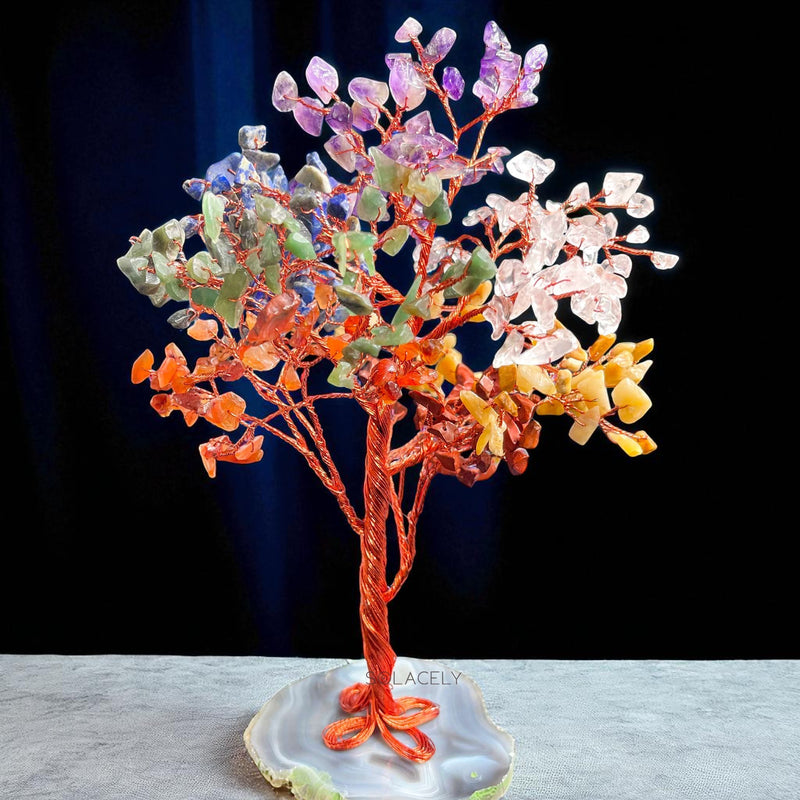
Give it twenty to thirty minutes, and get up slowly. Many people find a full layout is something they do monthly rather than daily, with single centre work in between. A seven chakra crystal tree is the decorative equivalent for people who want the full set present without a layout.
What people get wrong at the start
Three things, consistently.
Placing everything at the head. Beginners default to the forehead and chest, which suits amethyst and rose quartz and works directly against grounding stones whose whole character is about the base. Root stones go low.
Buying seven before using one. A single stone used daily teaches more than a set used twice.
Treating the mapping as rigid. Practitioners have swapped stones between centres for as long as the modern system has existed. Colour is the guide, not a rulebook.
Our guide to the chakra system covers what each centre is traditionally understood to do, and the throat chakra guide and crown chakra guide cover the upper end.
Care across the set
A seven stone collection spans a wide range of hardness and durability, so a few rules cover most of it.
Selenite must never be rinsed. It is a soft gypsum and dissolves in water. Dust it dry.
Amethyst and citrine pale in strong sun. Charge them in moonlight or indirect light.
Hematite should be dried thoroughly or it can develop rust spots.
Lapis and sodalite are porous and prefer wiping to washing.
Quartz family stones, which is most of the set, take warm water and a soft cloth happily. Store softer stones separately so the harder ones do not mark them. Sound, smoke or moonlight suit the whole collection for cleansing, monthly for pieces at home and weekly for anything carried daily.
Chakra work and crystals are offered here for reflection and wellbeing as part of a long standing spiritual tradition. They are not a medical model, not a treatment for any condition, and not a substitute for professional healthcare. Keep small stones away from young children and pets, since they present a choking risk.
Sources
Written by Chetena Sharma. Reviewed by the Solacely editorial team.
Frequently asked questions
About the author


Written by Chetna Sharma, crystal healing practitioner and co-founder of Solacely. Chetna has worked with healing crystals for over a decade and curates Solacely's protective stone collection.